2017 GENESIS G80 head restraint
[x] Cancel search: head restraintPage 21 of 496

Safety system of your vehicle
2
Important safety precautions...............................2-2
Always wear your seat belt............................................2-2
Restrain all children ..........................................................2-2
Air bag hazards..................................................................2-2
Driver distraction ...............................................................2-2
Control your speed ...........................................................2-3
Keep your vehicle in safe condition .............................2-3
Seats ........................................................................\
2-4
Safety precautions............................................................2-5
Front seats ........................................................................\
..2-6
Rear seats ........................................................................\
.2-11
Headrest ........................................................................\
....2-14
Seat warmers and coolers ............................................2-18
Seat belts ..............................................................2-22
Seat belt safety precautions ........................................2-22
Seat belt warning light ..................................................2-23
Seat belt restraint system ............................................2-25
Pre-Active Seat belt (PSB) ...........................................2-30
Additional seat belt safety precautions ....................2-31
Care of seat belts ...........................................................2-34
Child restraint system (CRS) ..............................2-35
Selecting a child restraint system (CRS) ...................2-36
Installing a child restraint system (CRS) ...................2-38
Air bag -
advanced supplemental restraint system .........2-46
Where are the air bags? ...............................................2-48
How does the air bags system operate? ..................2-51
What to expect after an air bag inflates..................2-56
Occupant classification system (OCS) .......................2-57
Why didn't my air bag go off in a collision? (Air bags
are not designed to inflate in every collision.) .......2-61
SRS care ........................................................................\
....2-66
Additional safety precautions ......................................2-67
Air bag warning labels ...................................................2-68
Page 58 of 496

2-38
Safety system of your vehicle
Forward-facing child restraints
A forward-facing child seat provides
restraint for the child’s body with a
harness. Keep children in a forward-
facing child seat with a harness until
they reach the top height or weight
limit allowed by your child restraint’s
manufacturer.
Once your child outgrows the forward-
facing child restraint, your child is
ready for a booster seat.
Booster seats
A booster seat is a restraint designed
to improve the fit of the vehicle’s seat
belt system. A booster seat positions
the seat belt so that it fits properly
over the lap of your child. Keep your
child in a booster seat until they are
big enough to sit in the seat without a
booster and still have the seat belt fit
properly.
For a seat belt to fit properly, the lap
belt must lie snugly across the upper
thighs, not the stomach. The shoulder
belt should lie snug across the shoul-
der and chest and not across the neck
or face. Children under age 13 must
always ride in the rear seats and must
always be properly restrained to mini-
mize the risk of injury.
Installing a Child Restraint
System (CRS)
Before installing your child
restraint system always:
Read and follow the instruc-
tions provided by the manu-
facturer of the child restraint.
Read and follow the instruc-
tions regarding child restraint
systems in this manual.
Failure to follow all warnings
and instructions could increase
the risk of the SERIOUS INJURY
or DEATH if an accident occurs.
WARNING
If the vehicle headrest prevents
proper installation of a child
seat (as described in the child
seat system manual), the head-
rest of the respective seating
position shall be readjusted or
entirely removed.
WARNING
ODH033062
Page 62 of 496

2-42
Safety system of your vehicle
Securing a child restraint seatwith “Tether Anchor” system
First secure the child restraint with
the LATCH lower anchors or the seat
belt. If the child restraint manufactur-
er recommends that the top tether
strap be attached, attach and tighten
the top tether strap to the top tether
strap anchor.
Child restraint hook holders are
located on the package tray. To install the tether anchor:
1. Route the child restraint tether
strap over the child restraint seat-
back. Route the tether strap under
the headrest and between the
headrest posts, or route the tether
strap over the top of the vehicle
seatback. Make sure the strap is
not twisted.
2. Connect the tether strap hook to the tether anchor, then tighten the
tether strap according to the child
seat manufacturer’s instructions to
firmly secure the child restraint to
the seat.
Take the following precautions
when installing the tether strap:
Read and follow all installation
instructions provided with
your child restraint system.
NEVER attach more than one
child restraint to a single teth-
er anchor. This could cause
the anchor or attachment to
come loose or break.
Do not attach the tether strap
to anything other than the cor-
rect tether anchor. It may not
work properly if attached to
something else.
Do not use the tether anchors
for adult seat belts or harness-
es, or for attaching other items
or equipment to the vehicle.
WARNING
ODH033066
ODH033065
Page 71 of 496
2-51
Safety system of your vehicle
2
The curtain air bags are designed to
deploy only during certain side
impact collisions, depending on the
crash severity, angle, speed and
impact.
The curtain air bags do not only
deploy on the side of the impact but
also on the opposite side.
For vehicles equipped with a rollover
sensor the side and curtain air bags
on both sides of the vehicle may
deploy if a rollover or possible
rollover is detected.
The curtain air bags are not designed
to deploy in all side impact or rollover
situations.How does the air bags system
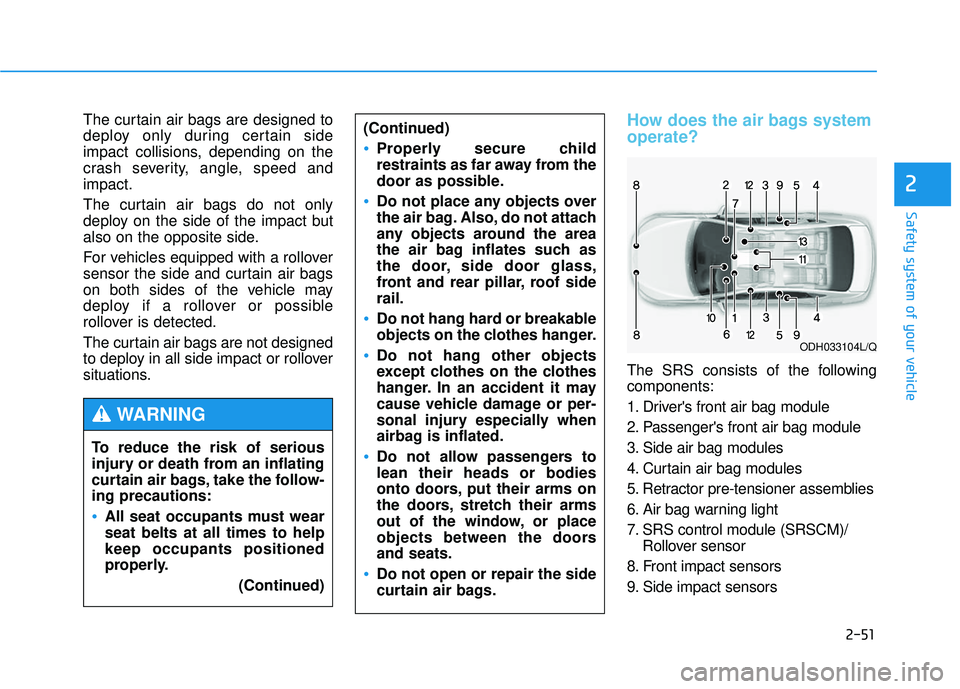
operate?
The SRS consists of the following
components:
1. Driver's front air bag module
2. Passenger's front air bag module
3. Side air bag modules
4. Curtain air bag modules
5. Retractor pre-tensioner assemblies
6. Air bag warning light
7. SRS control module (SRSCM)/Rollover sensor
8. Front impact sensors
9. Side impact sensors
To reduce the risk of serious
injury or death from an inflating
curtain air bags, take the follow-
ing precautions:
All seat occupants must wear
seat belts at all times to help
keep occupants positioned
properly.
(Continued)
(Continued)
Properly secure child
restraints as far away from the
door as possible.
Do not place any objects over
the air bag. Also, do not attach
any objects around the area
the air bag inflates such as
the door, side door glass,
front and rear pillar, roof side
rail.
Do not hang hard or breakable
objects on the clothes hanger.
Do not hang other objects
except clothes on the clothes
hanger. In an accident it may
cause vehicle damage or per-
sonal injury especially when
airbag is inflated.
Do not allow passengers to
lean their heads or bodies
onto doors, put their arms on
the doors, stretch their arms
out of the window, or place
objects between the doors
and seats.
Do not open or repair the side
curtain air bags.
WARNING
ODH033104L/Q
Page 493 of 496

I-7
Maintenance under severe usage conditions ..............7-22
Explanation of scheduled maintenance items ............7-24
Tire maintenance ........................................................7-51
Maintenance schedule Normal maintenance schedule .....................................7-9
Maintenance under severe usage conditions ..............7-22
Maintenance services ........................................................7-5
Manual heating and air conditioning ............................3-136
Mirrors ........................................................................\
....3-22 Inside rearview mirror ................................................3-22
Electric chromic mirror (ECM) with HomeLink
®
system......................................................................3-\
22
Side view mirrors .......................................................3-36
Moonroof, see sunroof ....................................................3-44
Multi fuse ........................................................................\
7-65
Multimedia system............................................................4-2 AUX, USB and iPod
®port ..........................................4-2
Antenna ........................................................................\
4-3
Steering wheel audio control........................................4-4
Audio / Video / Navigation system (AVN) ..................4-5
Bluetooth
®Wireless Technology hands-free................4-5
Neck restraints, see headrest ...........................................2-14 Odometer........................................................................\
.3-66
Oil (Engine) ....................................................................7-27\
Overheats ........................................................................\
..6-7
Owner maintenance ..........................................................7-6
Panorama sunroof ...........................................................3-44
Parking assist system ....................................................3-128
Parking brake.........................................................5-24, 5-26
Parking brake inspect......................................................7-34
Passenger's front air bag .................................................2-48
Power brakes ...................................................................5-23
Power outlet ..................................................................3-156
Power window lock button .............................................3-43
Push starting......................................................................6-\
6
Rear seat ........................................................................\
..2-11
Recommended cold tire inflation pressures ...................7-46
Recommended lubricants and capacities ..........................8-6
Recommended SAE viscosity number .........................8-7
Refrigerant label ...............................................................8-9
Reporting safety defects..................................................8-11
I
Index
O
P
R
N