2017 FORD FOCUS ELECTRIC tires
[x] Cancel search: tiresPage 215 of 367
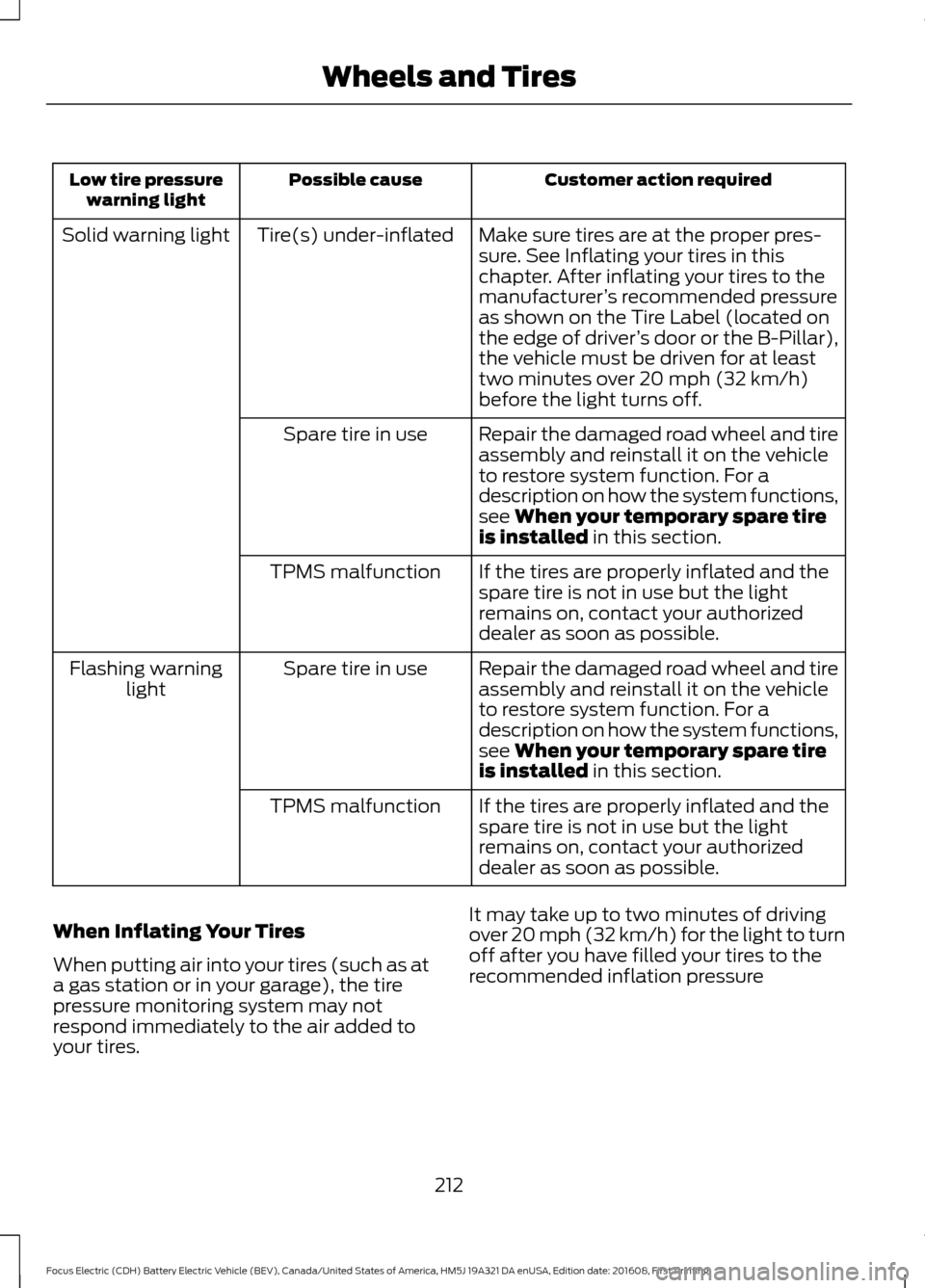
Customer action required
Possible cause
Low tire pressure
warning light
Make sure tires are at the proper pres-
sure. See Inflating your tires in this
chapter. After inflating your tires to the
manufacturer’s recommended pressure
as shown on the Tire Label (located on
the edge of driver ’s door or the B-Pillar),
the vehicle must be driven for at least
two minutes over 20 mph (32 km/h)
before the light turns off.
Tire(s) under-inflated
Solid warning light
Repair the damaged road wheel and tire
assembly and reinstall it on the vehicle
to restore system function. For a
description on how the system functions,
see
When your temporary spare tire
is installed in this section.
Spare tire in use
If the tires are properly inflated and the
spare tire is not in use but the light
remains on, contact your authorized
dealer as soon as possible.
TPMS malfunction
Repair the damaged road wheel and tire
assembly and reinstall it on the vehicle
to restore system function. For a
description on how the system functions,
see
When your temporary spare tire
is installed in this section.
Spare tire in use
Flashing warning
light
If the tires are properly inflated and the
spare tire is not in use but the light
remains on, contact your authorized
dealer as soon as possible.
TPMS malfunction
When Inflating Your Tires
When putting air into your tires (such as at
a gas station or in your garage), the tire
pressure monitoring system may not
respond immediately to the air added to
your tires. It may take up to two minutes of driving
over 20 mph (32 km/h) for the light to turn
off after you have filled your tires to the
recommended inflation pressure
212
Focus Electric (CDH) Battery Electric Vehicle (BEV), Canada/United States of America, HM5J 19A321 DA enUSA, Edition date: 201608, First Printing Wheels and Tires
Page 216 of 367

How Temperature Affects Your Tire
Pressure
The tire pressure monitoring system
monitors tire pressure in each pneumatic
tire. While driving in a normal manner, a
typical passenger tire inflation pressure
may increase about 2
–4 psi (14– 28 kPa)
from a cold start situation. If the vehicle is
stationary overnight with the outside
temperature significantly lower than the
daytime temperature, the tire pressure may
decrease about 3 psi (21 kPa) for a drop of
30°F (17°C) in ambient temperature. This
lower pressure value may be detected by
the tire pressure monitoring system as
being significantly lower than the
recommended inflation pressure and
activate the system warning light for low
tire pressure. If the low tire pressure warning light is on, visually check each tire
to verify that no tire is flat. If one or more
tires are flat, repair as necessary. Check
the air pressure in the road tires. If any tire
is under-inflated, carefully drive the vehicle
to the nearest location where air can be
added to the tires. Inflate all the tires to
the recommended inflation pressure.
CHANGING A ROAD WHEEL
Important Information for Lifting
or Jacking WARNING
If you do not follow the guidelines it
will result in extensive damage to the
high voltage battery.
Lifting points
A
High voltage battery and support brace
B
213
Focus Electric (CDH) Battery Electric Vehicle (BEV), Canada/United States of America, HM5J 19A321 DA enUSA, Edition date: 201608, First Printing Wheels and TiresB
AA
E167345
Page 217 of 367
If you need to use a jack or hoist to service
your vehicle, make sure the lift pads do not
contact the high voltage battery or support
brace.
The high voltage battery and support brace
are very close to the rear lifting points.
These points are identifiable by a triangle
icon. Position the lift pads of the jack or
hoist at the specified lifting points. Lifting
your vehicle with the lift pads of the jack
or hoist on the high voltage battery or the
brace will damage the battery.
LUG NUTS
WARNING
When a wheel is installed, always
remove any corrosion, dirt or foreign
materials present on the mounting
surfaces of the wheel or the surface of the
wheel hub, brake drum or brake disc that
contacts the wheel. Make sure that any
fasteners that attach the rotor to the hub
are secured so they do not interfere with
the mounting surfaces of the wheel.
Installing wheels without correct
metal-to-metal contact at the wheel
mounting surfaces can cause the wheel
nuts to loosen and the wheel to come off
while the vehicle is in motion, resulting in
loss of control. Retighten the lug nuts to the specified
torque within 100 mi (160 km) after any
wheel disturbance (such as tire rotation,
changing a flat tire, wheel removal). Wheel lug nut
torque*
Bolt size
100 lb.ft (135 Nm)
M12 x 1.5
*Torque specifications are for nut and bolt
threads free of dirt and rust. Use only Ford
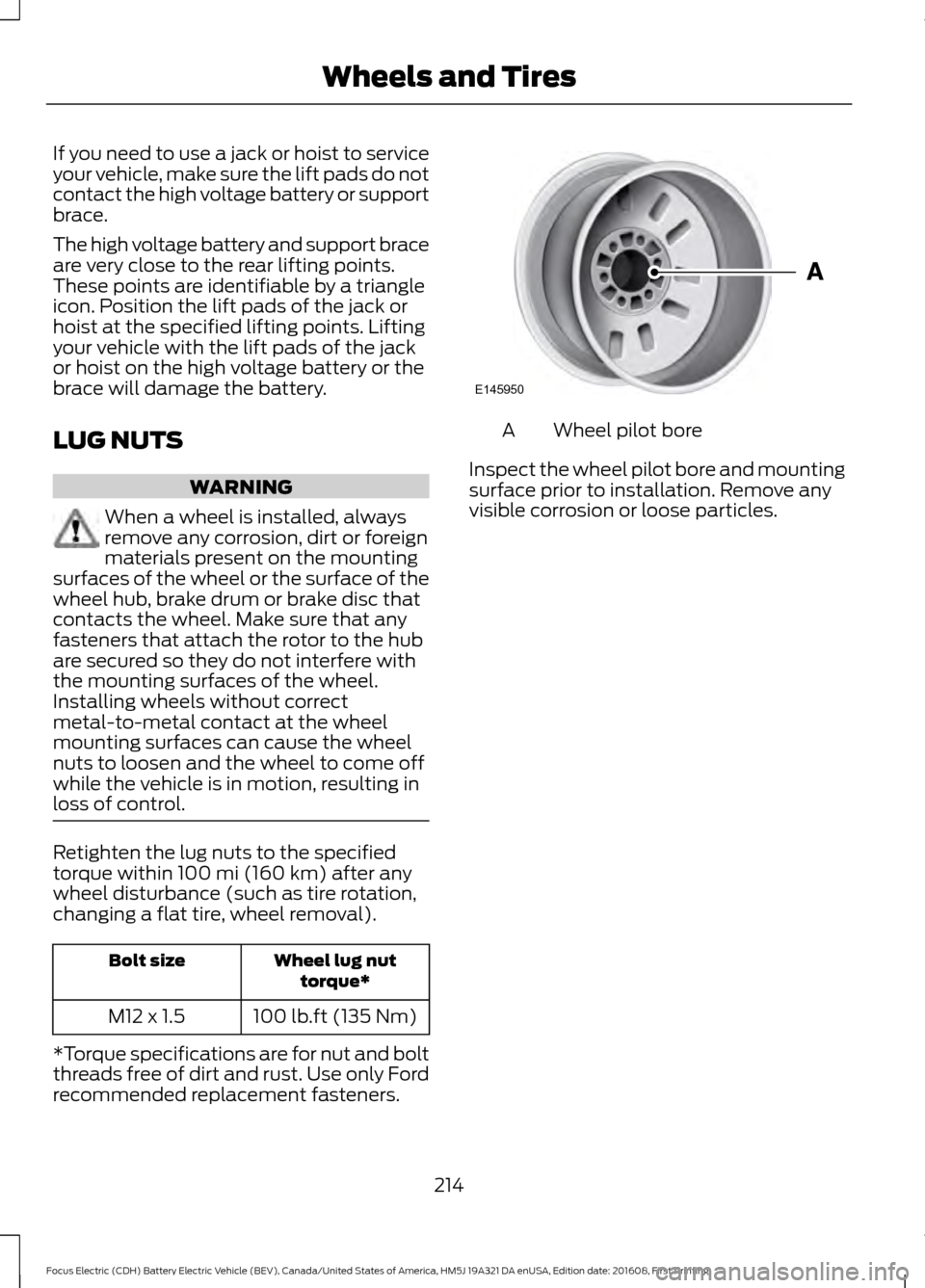
recommended replacement fasteners. Wheel pilot bore
A
Inspect the wheel pilot bore and mounting
surface prior to installation. Remove any
visible corrosion or loose particles.
214
Focus Electric (CDH) Battery Electric Vehicle (BEV), Canada/United States of America, HM5J 19A321 DA enUSA, Edition date: 201608, First Printing Wheels and TiresE145950
Page 320 of 367

Ford Motor Company has recommended
maintenance intervals for various parts
and component systems based upon
engineering testing. Ford Motor Company
relies upon this testing to determine the
most appropriate mileage for replacement
of oils and fluids to protect your vehicle at
the lowest overall cost to you and
recommends against maintenance
schedules that deviate from the scheduled
maintenance information.
We strongly recommend the use of only
genuine Ford, Motorcraft or
Ford-authorized re-manufactured
replacement parts engineered for your
vehicle.
Additives and Chemicals
This owner's manual and the Ford
Workshop Manual list the recommended
additives and chemicals for your vehicle.
We do not recommend using chemicals or
additives not approved by us as part of
your vehicle
’s normal maintenance. Please
consult your warranty information. Oils, Fluids and Flushing
In many cases, fluid discoloration is a
normal operating characteristic and, by
itself, does not necessarily indicate a
concern or that the fluid needs to be
changed. However, a qualified expert, such
as the factory-trained technicians at your
dealership, should inspect discolored fluids
that also show signs of overheating or
foreign material contamination
immediately.
Make sure to change your vehicle
’s oils and
fluids at the specified intervals or in
conjunction with a repair. Flushing is a
viable way to change fluid for many vehicle
sub-systems during scheduled
maintenance. It is critical that systems are
flushed only with new fluid that is the same
as that required to fill and operate the
system or using a Ford-approved flushing
chemical.
Owner Checks and Services
Make sure you perform the following basic
maintenance checks and inspections every
month or at six-month intervals. Check every month
Function of all interior and exterior lights.
Tires (including spare) for wear and proper pressure. Windshield washer fluid level. Check every six months
Battery connections. Clean if necessary.
Body and door drain holes for obstructions. Clean if necessary. Cooling system fluid level and coolant strength.
Door weatherstrips for wear. Lubricate if necessary.
Hinges, latches and outside locks for proper operation. Lubricate if necessary.
317
Focus Electric (CDH) Battery Electric Vehicle (BEV), Canada/United States of America, HM5J 19A321 DA enUSA, Edition date: 201608, First Printing Scheduled Maintenance
Page 321 of 367
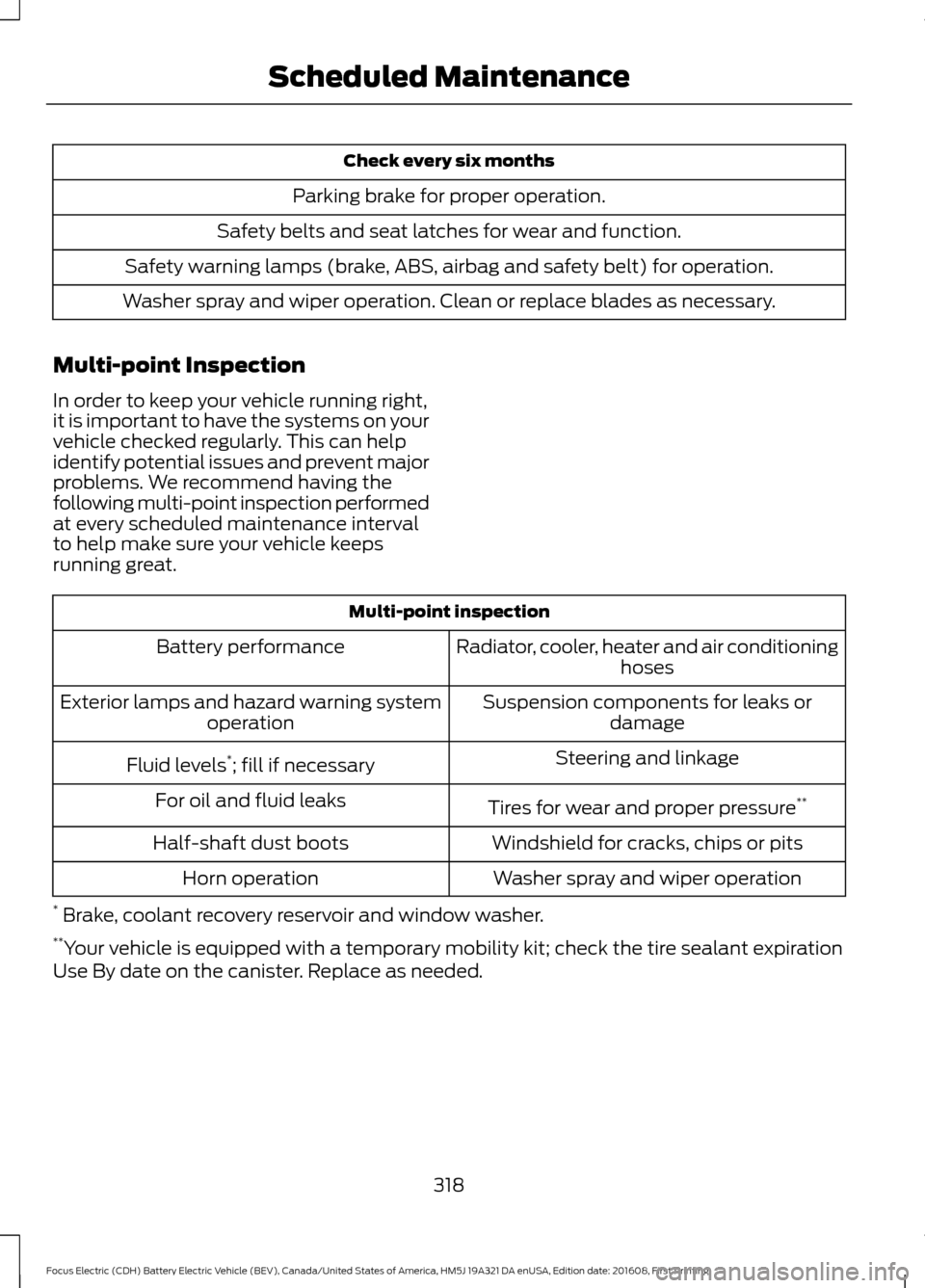
Check every six months
Parking brake for proper operation.
Safety belts and seat latches for wear and function.
Safety warning lamps (brake, ABS, airbag and safety belt) for operation.
Washer spray and wiper operation. Clean or replace blades as necessary.
Multi-point Inspection
In order to keep your vehicle running right,
it is important to have the systems on your
vehicle checked regularly. This can help
identify potential issues and prevent major
problems. We recommend having the
following multi-point inspection performed
at every scheduled maintenance interval
to help make sure your vehicle keeps
running great. Multi-point inspection
Radiator, cooler, heater and air conditioning hoses
Battery performance
Suspension components for leaks ordamage
Exterior lamps and hazard warning system
operation
Steering and linkage
Fluid levels *
; fill if necessary
Tires for wear and proper pressure **
For oil and fluid leaks
Windshield for cracks, chips or pits
Half-shaft dust boots
Washer spray and wiper operation
Horn operation
* Brake, coolant recovery reservoir and window washer.
** Your vehicle is equipped with a temporary mobility kit; check the tire sealant expiration
Use By date on the canister. Replace as needed.
318
Focus Electric (CDH) Battery Electric Vehicle (BEV), Canada/United States of America, HM5J 19A321 DA enUSA, Edition date: 201608, First Printing Scheduled Maintenance
Page 322 of 367
Be sure to ask your dealership service
advisor or technician about the multi-point
vehicle inspection. It is a comprehensive
way to perform a thorough inspection of
your vehicle. Your checklist gives you
immediate feedback on the overall
condition of your vehicle.
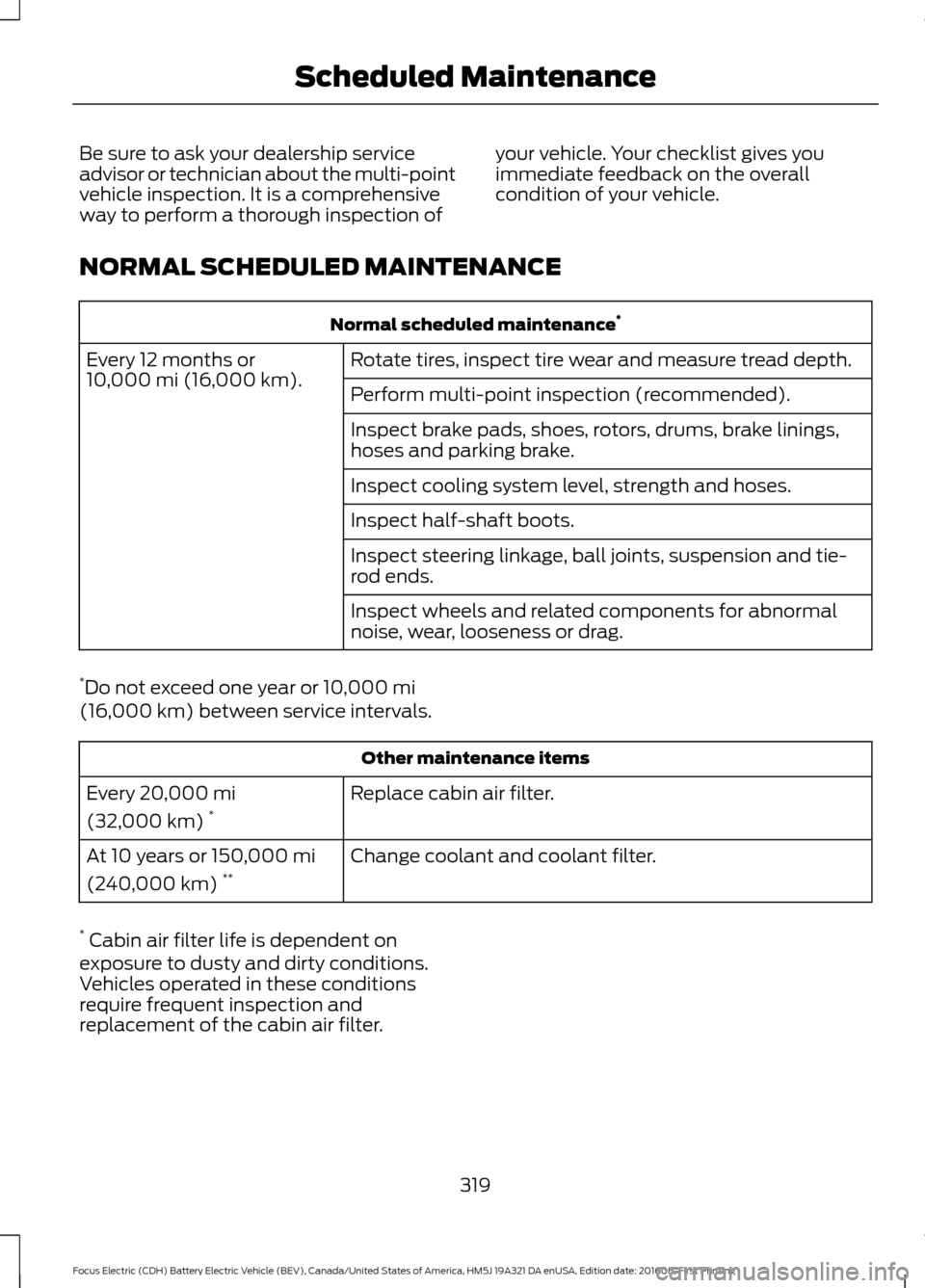
NORMAL SCHEDULED MAINTENANCE Normal scheduled maintenance
*
Rotate tires, inspect tire wear and measure tread depth.
Every 12 months or
10,000 mi (16,000 km).
Perform multi-point inspection (recommended).
Inspect brake pads, shoes, rotors, drums, brake linings,
hoses and parking brake.
Inspect cooling system level, strength and hoses.
Inspect half-shaft boots.
Inspect steering linkage, ball joints, suspension and tie-
rod ends.
Inspect wheels and related components for abnormal
noise, wear, looseness or drag.
* Do not exceed one year or
10,000 mi
(16,000 km) between service intervals. Other maintenance items
Replace cabin air filter.
Every
20,000 mi
(32,000 km) *
Change coolant and coolant filter.
At 10 years or
150,000 mi
(240,000 km) **
* Cabin air filter life is dependent on
exposure to dusty and dirty conditions.
Vehicles operated in these conditions
require frequent inspection and
replacement of the cabin air filter.
319
Focus Electric (CDH) Battery Electric Vehicle (BEV), Canada/United States of America, HM5J 19A321 DA enUSA, Edition date: 201608, First Printing Scheduled Maintenance
Page 366 of 367
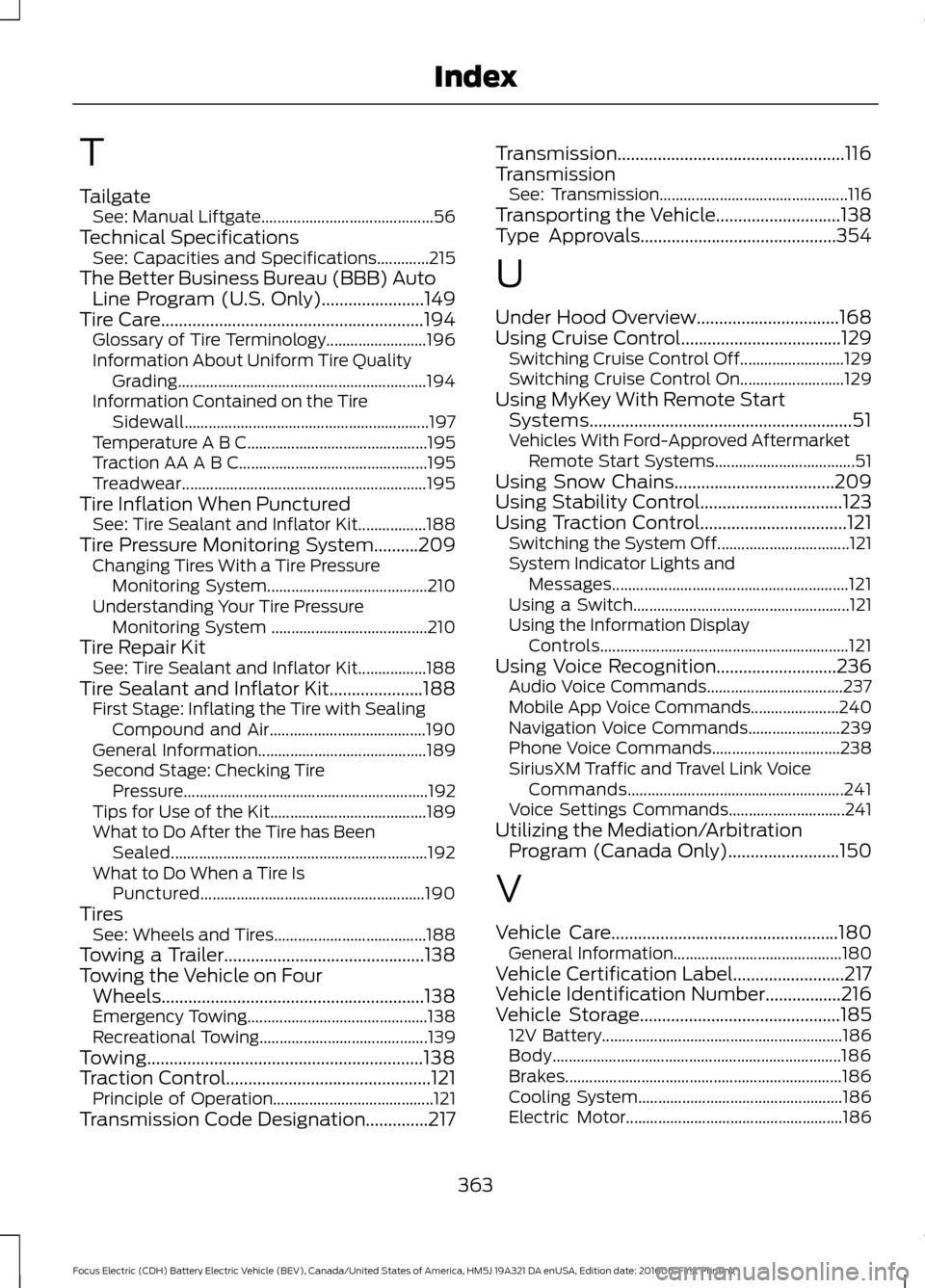
T
Tailgate
See: Manual Liftgate........................................... 56
Technical Specifications See: Capacities and Specifications.............215
The Better Business Bureau (BBB) Auto Line Program (U.S. Only).......................149
Tire Care...........................................................194
Glossary of Tire Terminology......................... 196
Information About Uniform Tire Quality Grading.............................................................. 194
Information Contained on the Tire Sidewall............................................................. 197
Temperature A B C............................................. 195
Traction AA A B C............................................... 195
Treadwear............................................................. 195
Tire Inflation When Punctured See: Tire Sealant and Inflator Kit.................188
Tire Pressure Monitoring System..........209 Changing Tires With a Tire Pressure
Monitoring System........................................ 210
Understanding Your Tire Pressure Monitoring System ....................................... 210
Tire Repair Kit See: Tire Sealant and Inflator Kit.................188
Tire Sealant and Inflator Kit.....................188 First Stage: Inflating the Tire with Sealing
Compound and Air....................................... 190
General Information.......................................... 189
Second Stage: Checking Tire Pressure............................................................. 192
Tips for Use of the Kit....................................... 189
What to Do After the Tire has Been Sealed................................................................ 192
What to Do When a Tire Is Punctured........................................................ 190
Tires See: Wheels and Tires...................................... 188
Towing a Trailer.............................................138
Towing the Vehicle on Four Wheels
...........................................................138
Emergency Towing............................................. 138
Recreational Towing.......................................... 139
Towing..............................................................138
Traction Control
..............................................121
Principle of Operation........................................ 121
Transmission Code Designation..............217 Transmission...................................................116
Transmission
See: Transmission............................................... 116
Transporting the Vehicle............................138
Type Approvals............................................354
U
Under Hood Overview
................................168
Using Cruise Control....................................129 Switching Cruise Control Off.......................... 129
Switching Cruise Control On.......................... 129
Using MyKey With Remote Start Systems
...........................................................51
Vehicles With Ford-Approved Aftermarket
Remote Start Systems................................... 51
Using Snow Chains
....................................209
Using Stability Control................................123
Using Traction Control.................................121 Switching the System Off................................. 121
System Indicator Lights and Messages........................................................... 121
Using a Switch...................................................... 121
Using the Information Display Controls.............................................................. 121
Using Voice Recognition...........................236 Audio Voice Commands.................................. 237
Mobile App Voice Commands...................... 240
Navigation Voice Commands....................... 239
Phone Voice Commands................................ 238
SiriusXM Traffic and Travel Link Voice Commands...................................................... 241
Voice Settings Commands............................. 241
Utilizing the Mediation/Arbitration Program (Canada Only)
.........................150
V
Vehicle Care...................................................180 General Information.......................................... 180
Vehicle Certification Label.........................217
Vehicle Identification Number.................216
Vehicle Storage
.............................................185
12V Battery............................................................ 186
Body........................................................................\
186
Brakes..................................................................... 186
Cooling System................................................... 186
Electric Motor...................................................... 186
363
Focus Electric (CDH) Battery Electric Vehicle (BEV), Canada/United States of America, HM5J 19A321 DA enUSA, Edition date: 201608, First Printing Index
Page 367 of 367
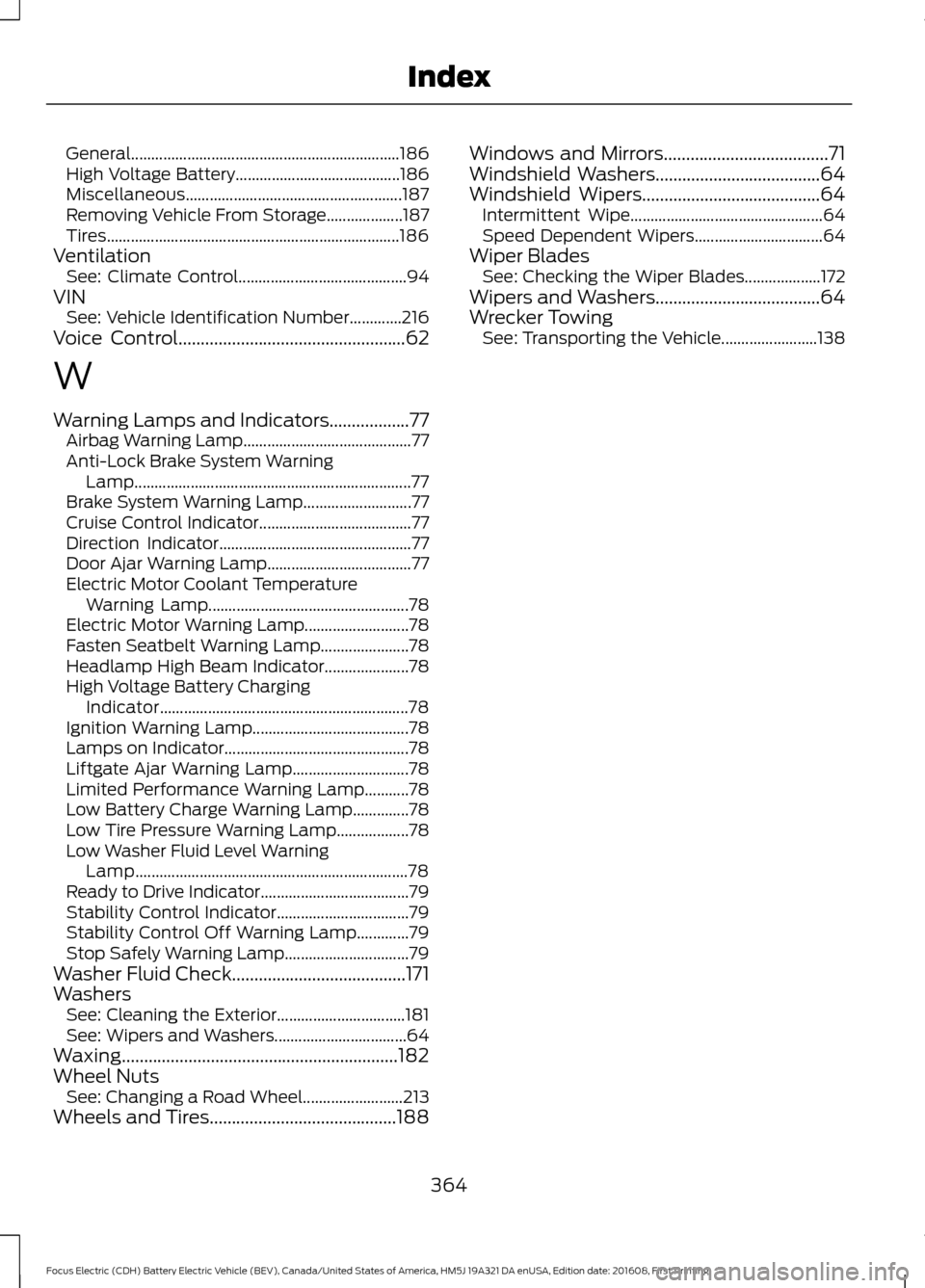
General...................................................................
186
High Voltage Battery......................................... 186
Miscellaneous...................................................... 187
Removing Vehicle From Storage................... 187
Tires........................................................................\
. 186
Ventilation See: Climate Control.......................................... 94
VIN See: Vehicle Identification Number.............216
Voice Control...................................................62
W
Warning Lamps and Indicators..................77 Airbag Warning Lamp.......................................... 77
Anti-Lock Brake System Warning Lamp..................................................................... 77
Brake System Warning Lamp........................... 77
Cruise Control Indicator...................................... 77
Direction Indicator................................................ 77
Door Ajar Warning Lamp.................................... 77
Electric Motor Coolant Temperature Warning Lamp.................................................. 78
Electric Motor Warning Lamp.......................... 78
Fasten Seatbelt Warning Lamp...................... 78
Headlamp High Beam Indicator..................... 78
High Voltage Battery Charging Indicator.............................................................. 78
Ignition Warning Lamp....................................... 78
Lamps on Indicator.............................................. 78
Liftgate Ajar Warning Lamp............................. 78
Limited Performance Warning Lamp...........78
Low Battery Charge Warning Lamp..............78
Low Tire Pressure Warning Lamp.................. 78
Low Washer Fluid Level Warning Lamp.................................................................... 78
Ready to Drive Indicator..................................... 79
Stability Control Indicator................................. 79
Stability Control Off Warning Lamp.............79
Stop Safely Warning Lamp............................... 79
Washer Fluid Check.......................................171
Washers See: Cleaning the Exterior................................ 181
See: Wipers and Washers................................. 64
Waxing..............................................................182
Wheel Nuts See: Changing a Road Wheel......................... 213
Wheels and Tires..........................................188 Windows and Mirrors.....................................71
Windshield Washers.....................................64
Windshield Wipers........................................64
Intermittent Wipe................................................ 64
Speed Dependent Wipers................................ 64
Wiper Blades See: Checking the Wiper Blades................... 172
Wipers and Washers.....................................64
Wrecker Towing See: Transporting the Vehicle........................ 138
364
Focus Electric (CDH) Battery Electric Vehicle (BEV), Canada/United States of America, HM5J 19A321 DA enUSA, Edition date: 201608, First Printing Index