2017 FORD F450 SUPER DUTY reset
[x] Cancel search: resetPage 161 of 642
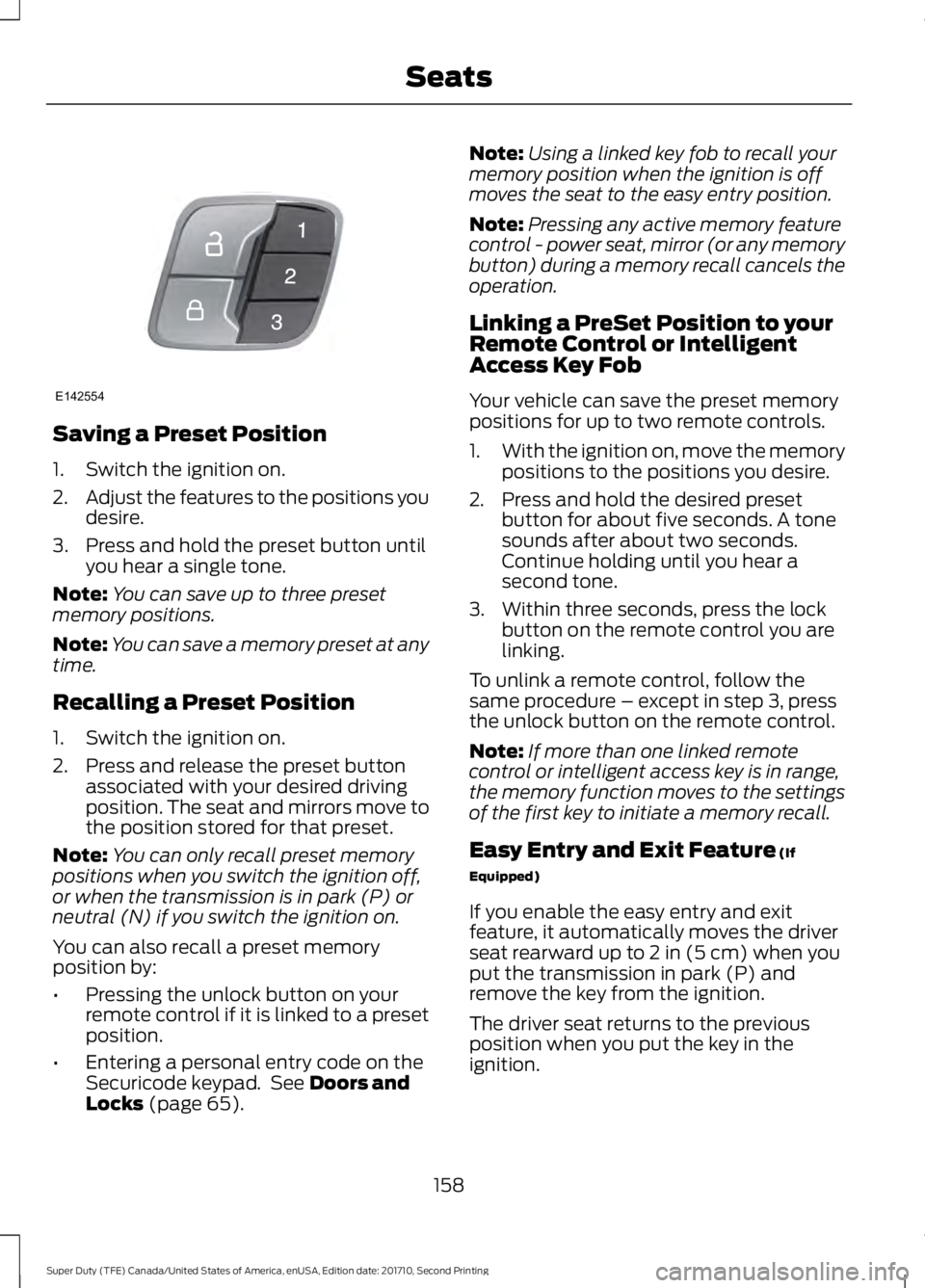
Saving a Preset Position
1. Switch the ignition on.
2.Adjust the features to the positions youdesire.
3. Press and hold the preset button untilyou hear a single tone.
Note:You can save up to three presetmemory positions.
Note:You can save a memory preset at anytime.
Recalling a Preset Position
1. Switch the ignition on.
2. Press and release the preset buttonassociated with your desired drivingposition. The seat and mirrors move tothe position stored for that preset.
Note:You can only recall preset memorypositions when you switch the ignition off,or when the transmission is in park (P) orneutral (N) if you switch the ignition on.
You can also recall a preset memoryposition by:
•Pressing the unlock button on yourremote control if it is linked to a presetposition.
•Entering a personal entry code on theSecuricode keypad. See Doors andLocks (page 65).
Note:Using a linked key fob to recall yourmemory position when the ignition is offmoves the seat to the easy entry position.
Note:Pressing any active memory featurecontrol - power seat, mirror (or any memorybutton) during a memory recall cancels theoperation.
Linking a PreSet Position to yourRemote Control or IntelligentAccess Key Fob
Your vehicle can save the preset memorypositions for up to two remote controls.
1.With the ignition on, move the memorypositions to the positions you desire.
2. Press and hold the desired presetbutton for about five seconds. A tonesounds after about two seconds.Continue holding until you hear asecond tone.
3. Within three seconds, press the lockbutton on the remote control you arelinking.
To unlink a remote control, follow thesame procedure – except in step 3, pressthe unlock button on the remote control.
Note:If more than one linked remotecontrol or intelligent access key is in range,the memory function moves to the settingsof the first key to initiate a memory recall.
Easy Entry and Exit Feature (If
Equipped)
If you enable the easy entry and exitfeature, it automatically moves the driverseat rearward up to 2 in (5 cm) when youput the transmission in park (P) andremove the key from the ignition.
The driver seat returns to the previousposition when you put the key in theignition.
158
Super Duty (TFE) Canada/United States of America, enUSA, Edition date: 201710, Second Printing
SeatsE142554
Page 164 of 642
Press the heated seat symbol to cyclethrough the various heat settings and off.More indicator lights indicate warmersettings.
The heated seat module resets at everyignition run cycle. While the ignition is inthe on position, press the heated seatswitch to enable heating mode. Whenactivated, they turn off automatically whenyou switch off the engine.
CLIMATE CONTROLLED SEATS
(If Equipped)
Heated Seats
WARNING
People who are unable to feel painto their skin because of advancedage, chronic illness, diabetes, spinalcord injury, medication, alcohol use,exhaustion or other physical conditions,must exercise care when using the heatedseat. The heated seat may cause burnseven at low temperatures, especially ifused for long periods of time. Do not placeanything on the seat that insulates againstheat, such as a blanket or cushion. Thismay cause the heated seat to overheat.Do not puncture the seat with pins, needlesor other pointed objects. This may damagethe heating element which may cause theheated seat to overheat. An overheatedseat may cause serious personal injury.
Do not do the following:
•Place heavy objects on the seat.
•Operate the heated seat if water or anyother liquid spills on the seat. Allow theseat to dry thoroughly.
Note:The engine must be running to usethis feature.
Press the heated seat symbol to cyclethrough the various heat settings and off.More indicator lights indicate warmersettings.
Note:The heated seats may remain onafter you remote start your vehicle, basedon your remote start settings. The heatedseats may also turn on when you start yourvehicle if they were on when you switchedyour vehicle off.
Note:After 60 minutes of operation, theheated seats switch off. Press the heatedseat symbol to switch the heated seats on.
Cooled Seats
Note:The engine must be running to usethis feature.
161
Super Duty (TFE) Canada/United States of America, enUSA, Edition date: 201710, Second Printing
SeatsE146322 E146322 E146309
Page 172 of 642

When the indicator light on the power pointis:
•On: The power point is working, theignition is on and a device is pluggedin.
•Off: The power point is off, the ignitionis off or no device is plugged in.
•Flashing: The power point is in faultmode.
The power outlet temporarily turns offpower when in fault mode if the deviceexceeds the 400 watt limit. Unplug yourdevice and switch the ignition off. Switchthe ignition back on, but do not plug yourdevice back in. Let the system cool off andswitch the ignition off to reset the faultmode. Switch the ignition back on andmake sure the indicator light remains on.
You can use the 400 watt power outlet forthese types of electric devices:
•Electric hand drills.
•Rechargeable power tools.
•Video games.
•Laptops.
•Televisions.
Do not use the power point for certainelectric devices, including:
•Cathode-ray, tube-type televisions.
•Motor loads, such as vacuum cleaners,electric saws and other electric powertools or compressor-drivenrefrigerators.
•Measuring devices, which processprecise data, such as medicalequipment or measuring equipment.
•Other appliances requiring anextremely stable power supply such asmicrocomputer-controlled electricblankets or touch-sensor lamps.
Note:This feature works only when thevehicle is running.
Note:This feature has a maximum outputof 400 watts when the vehicle is in park (P).
Note:While in drive (D), the maximumoutlet output is 300 watts.
Note: When powering electric devices thatrequire more than 10 watts in vehiclesequipped with keyless start, the vehiclemust remain running. It does not allow youto switch the ignition off or switch theignition to accessory mode.
169
Super Duty (TFE) Canada/United States of America, enUSA, Edition date: 201710, Second Printing
Auxiliary Power PointsE191617
Page 180 of 642

sensor to determine how long the glowplugs stay energized. The required time forthe glow plugs to be energized decreasesas the coolant temperature, barometricpressure and environmental temperatureincrease.
Cold Weather Starting
WARNINGS
Do not use starting fluid, for exampleether, in the air intake system. Suchfluid could cause immediateexplosive damage to the engine andpossible personal injury.
Do not add gasoline, gasohol, alcoholor kerosene to diesel fuel. Thiscreates a serious fire hazard andcauses engine performance problems.
We recommend that the engine blockheater be used for starting when thetemperature is -9°F (-23°C) or colder. SeeEngine Block Heater (page 181).
When operating in cold weather, you mayuse Motorcraft® cetane improvers ornon-alcohol-based cetane improvers froma reputable manufacturer as needed.
Do not crank the engine for more than 10seconds as starter damage may occur. Ifthe engine does not start, switch theignition off and wait 30 seconds beforetrying again.
Switch the ignition on. Do notstart the engine until theglow-plug indicator turns off.
When the glow plug pre-heat indicatorturns off, turn the key to start. After youstart the engine, the glow plugs mayremain on for a period. If you do not startthe engine before the glow plug activationtime ends, you will need to reset the glowplugs by switching the ignition off. Afterthe engine starts, allow it to idle for about15 seconds. This protects the engine. Donot increase engine speed until the oilpressure gauge indicates normal pressure.
Cold Weather Operation
Note:Idling in cold weather does not heatthe engine to its normal operatingtemperature. Long periods of idling,especially in cold weather, can cause abuildup of deposits which can cause enginedamage.
Change to a lighter grade engine oil tomake starting easier under theseconditions. Refer to engine oilspecifications. See Capacities andSpecifications (page 427).
Diesel fuel is adjusted seasonally for coldtemperatures. Diesel fuel which has notbeen properly formulated for the ambientconditions may gel which can clog the fuelfilters. One indication that the fuel filter(s)may be clogged is if the engine starts, stallsafter a short time, and then does notrestart. If you have been using biodiesel,you may need to use a fuel with lowerbiodiesel content, try another brand, ordiscontinue using biodiesel. Do not usealcohol based additives to correct fuelgelling. This may result in damage to thefuel injectors and system. Use the properanti-gel and performance improvementproduct. See Capacities andSpecifications (page 427).
177
Super Duty (TFE) Canada/United States of America, enUSA, Edition date: 201710, Second Printing
Starting and Stopping the Engine
Page 182 of 642

We recommend the following coldweather idling guidelines:
•You can use Motorcraft® cetaneimprovers or non-alcohol-basedcetane improvers from a reputablemanufacturer as needed.
•Maintain the engine cooling systemproperly.
•Avoid shutting the engine down afteran extensive idling period. Drive yourvehicle for several miles with theengine at normal operatingtemperatures under a moderate load.
•Consider using an engine block heater.
•For extended idle times use anapproved idle speed increase device.
Winter Operating Tips for ArcticOperation -20°F (-29°C) and Below
The following information is a guidelineonly and is not to be the only source ofpossible solutions in resolving extremecold temperature issues.
Starting Aids
WARNING
Do not use starting fluid, for exampleether, in the air intake system. Suchfluid could cause immediateexplosive damage to the engine andpossible personal injury.
The use of the factory engine block heaterassists in engine starting in extreme coldambient temperatures See Engine BlockHeater (page 181).
Idle Control
Your vehicle may have a factory option fora stationary elevated idle control throughthe upfitter switches in the overheadconsole. This allows the operator toelevate the idle RPM for extended idleperiods, as well as aftermarket equipmentsuch as PTO operation. You must configurethis feature even if ordered from thefactory. See your authorized dealer forrequired upfitting.
Operation in Snow and Rain
Vehicle operation in heavy snowfall orextreme rain conditions may feedexcessive amounts of snow or water intothe air intake system. This could plug theair filter with snow and may cause theengine to lose power and possibly shutdown.
We recommend the following actions afteroperating your vehicle up to 200 mi(320 km) in snowfall or extreme rain:
•Snow: At the earliest opportunity, openthe hood and clear all the snow and icefrom the air filter housing inlet (do notremove the foam filter) and reset theair filter restriction gauge.
Note:Removal of the foam filter degradesyour vehicle performance during snow andhot weather conditions.
•Extreme rain: The air filter dries afterabout 15–30 minutes at highwayspeeds. At the earliest opportunity,open the hood and reset the air filterrestriction gauge.
Refer to Air filter and restriction gauge inthe Maintenance chapter for moreinformation. See Changing the EngineAir Filter (page 357).
179
Super Duty (TFE) Canada/United States of America, enUSA, Edition date: 201710, Second Printing
Starting and Stopping the Engine
Page 184 of 642
To help prolong engine life, werecommended you allow the engine to idlefor three to five minutes, especially afterany of the following:
•Continuous engine speed.
•High ambient temperature.
•High GVW or GCW operation, forexample heavy loads or trailers.
This allows the turbo charged engine tocool down.
ENGINE IDLE SHUTDOWN (If
Equipped)
Your vehicle may be equipped with anengine idle shutdown system. This systemautomatically shuts down your enginewhen it has been idling in P (Park) or N(Neutral) for five minutes (parking brakeset) or 15 minutes (parking brake not set).When the engine idle shutdown processhas started:
•A chime sounds and the informationdisplay will show ENGINE TURNS OFFIN 30 (seconds) and start countingdown
•You can restart the five or 15-minutetimer by changing the position of theaccelerator pedal, brake pedal or thepark brake within the final 30 seconds
•When the timer reaches zero, theengine shuts down and this messagewill appear in your information displayENGINE TURNED OFF
•One minute after the engine has shutdown, the electrical system simulateskey off, even though the ignition is stillin the on position, initiating normalaccessory delay period
•You must move the ignition to the offposition to reset the system beforerestarting your vehicle.
The engine idle shutdown idle timer doesnot start if:
•The engine is operating in powertake-off mode.
•The engine coolant temperature isbelow 60°F (16°C).
•The exhaust emission control device isregenerating.
ENGINE BLOCK HEATER (If
Equipped)
WARNINGS
Failure to follow engine block heaterinstructions could result in propertydamage or serious personal injury.
Do not use your heater withungrounded electrical systems ortwo-pronged adapters. There is a riskof electrical shock.
Note:The heater is most effective whenoutdoor temperatures are below 0°F(-18°C).
The heater acts as a starting aid bywarming the engine coolant. This allowsthe climate control system to respondquickly. The equipment includes a heaterelement (installed in the engine block) anda wire harness. You can connect thesystem to a grounded 120-volt ACelectrical source.
181
Super Duty (TFE) Canada/United States of America, enUSA, Edition date: 201710, Second Printing
Starting and Stopping the Engine
Page 194 of 642

Continued driving without refilling resultsin the following actions as required by theCalifornia Air Resources Board (CARB) andthe U.S. Environmental Protection Agency(EPA):
•Within a preset distance to empty,speed is limited upon vehicle restart.Prior to this occurring a messageappears in the information display.
•Further vehicle operation withoutrefilling the diesel exhaust fluid tankcauses the engine to enter an idle-onlycondition. This only occurs upon vehiclerefueling or at an extended idle. Amessage indicates the required actionsto resume normal operation. It isrequired to add a minimum of 1.0 gal(3.8 L) of diesel exhaust fluid to thetank to exit the idle-only condition, butyour vehicle is still in the speed-limitingmode until you refill the tankcompletely.
Note:For either vehicle speed limiting oridle-only condition, normal vehicle operationresumes when you refill the diesel exhaustfluid tank.
Note:When filling the diesel exhaust fluidtank from empty, there may be a short delaybefore detecting the increased level of fluid.The increased level detection must occurbefore your vehicle returns to full power.
Diesel Exhaust Fluid Guidelinesand Information
•Use only diesel exhaust fluid thatcarries the American PetroleumInstitute (API) certified diesel exhaustfluid trademark or ISO 22241.
•Do not put diesel exhaust fluid in thediesel fuel tank.
•Do not overfill the diesel exhaust fluidtank.
•Diesel exhaust fluid is corrosive.
•Do not re-use the diesel exhaust fluidcontainer once it is emptied.
•Avoid spilling diesel exhaust fluid onpainted surfaces, carpeting or plasticcomponents. Immediately wipe awayany diesel exhaust fluid that has spilledwith a damp cloth and water. If it hasalready crystallized, use warm waterand a sponge.
•Store diesel exhaust fluid out of directsunlight and in temperatures between23°F (-5°C) and 68°F (20°C).
•Diesel exhaust fluid freezes below 12°F(-11°C).
•Do not store the diesel exhaust fluidbottle in your vehicle. If it leaks it couldcause damage to interior componentsor release an ammonia odor inside yourvehicle.
•Diesel exhaust fluid is non-flammable,non-toxic, colorless and water-solubleliquid.
•The system has a diesel exhaust fluidquality sensor. Dilution of dieselexhaust fluid or use of any other liquidin the SCR system leads to a dieselexhaust fluid system fault, eventuallyleading to the vehicle only operating inidle-only mode.
•Do not dilute diesel exhaust fluid withwater or any other liquid.
•An ammonia odor may be smelledwhen the cap is removed or duringrefill. Refill diesel exhaust fluid in a wellventilated area.
191
Super Duty (TFE) Canada/United States of America, enUSA, Edition date: 201710, Second Printing
Fuel and Refueling
Page 195 of 642

Typical Diesel Exhaust Fluid UsageWhen Using the Power Take Off (PTO)
Continuous PTO use—Minimal PTO use
0–7,800 mi (0–12,550 km)
Contaminated Diesel ExhaustFluid or Inoperative SelectiveCatalytic Reduction System
Selective catalytic reduction systems aresensitive to contamination of the dieselexhaust fluid. Maintaining the purity of thefluid is important to avoid systemmalfunctions. If you remove or drain thediesel exhaust fluid tank, do not use thesame fluid to refill the tank. The systemhas a sensor to monitor fluid quality.
A warning lamp illuminates anda message appears in theinformation display if the systembecomes contaminated or inoperative.
Continued driving without replacing dieselexhaust fluid or having the selectivecatalytic reduction system repaired resultsin the following actions as required by theCalifornia Air Resources Board (CARB) andU.S. Environmental Protection Agency(EPA):
•Within a preset distance to empty,speed is limited upon vehicle restart.Prior to this occurring a messageappears in the information display.
•Further vehicle operation withoutreplacing contaminated diesel exhaustfluid causes the engine to enter anidle-only condition. This only occursupon vehicle refueling, vehicle idling inpark for 1 hour, or engine shutdown for10 minutes or more and is indicated bya message in the information displayindicating required actions to resumenormal operation.
Note:For vehicle speed limiting or idle-onlycondition, normal vehicle operation resumeswhen you repair the contaminated system.To service a contaminated or inoperativesystem, see an authorized dealer.
REFUELING - GASOLINE
WARNINGS
Fuel vapor burns violently and a fuelfire can cause severe injuries.
Read and follow all the instructionson the pump island.
Turn off your engine when you arerefueling.
Do not smoke if you are near fuel orrefueling your vehicle.
Keep sparks, flames and smokingmaterials away from fuel.
Stay outside your vehicle and do notleave the fuel pump unattendedwhen refueling your vehicle. This isagainst the law in some places.
Keep children away from the fuelpump; never let children pump fuel.
Do not use personal electronicdevices while refueling.
Wait at least 10 seconds beforeremoving the fuel pump nozzle toallow any residual fuel to drain intothe fuel tank.
Stop refueling after the fuel pumpnozzle automatically shuts off for thesecond time. Failure to follow thiswill fill the expansion space in the fuel tankand could lead to fuel overflowing.
Do not remove the fuel pump nozzlefrom its fully inserted position whenrefueling.
192
Super Duty (TFE) Canada/United States of America, enUSA, Edition date: 201710, Second Printing
Fuel and RefuelingE163176