2017 FIAT TIPO 5DOORS STATION WAGON seat adjustment
[x] Cancel search: seat adjustmentPage 85 of 264
OCCUPANT
PROTECTION
SYSTEMS
Some of the most important safety
equipment of the vehicle comprise the
following protection systems:
seat belts;
SBR (Seat Belt Reminder) system;
head restraints;
child restraint systems;
Front air bags, side air bags and
drop down air bags (where provided).
Read the information given the following
pages with the utmost care. It is of
fundamental importance that the
protection systems are used in the
correct way to guarantee the maximum
possible safety level for the driver and
the passengers.
For the description of the head restraint
adjustment see the "Head restraints"
paragraph in the "Knowing your vehicle"
chapter.
SEAT BELTS
All vehicle seats are equipped with seat
belts with three anchor points and a
retractor.
The retractor mechanism operates
locking the belt in the event of sharp
braking or strong deceleration due to
an impact. This allows the belt strap to
slide freely and to adapt to the body of
the occupant. In the event of an
accident, the belt will lock reducing the
risk of impact inside the passenger
compartment and of being projected
outside the vehicle.
The driver is responsible for respecting,
and ensuring that all the other
occupants of the vehicle also respect,
the local laws in force in relation to the
use of the seat belts.
Always fasten the seat belts before
setting off.
USING THE SEAT BELTS
The seat belt should be worn keeping
the chest straight and rested against
the backrest.
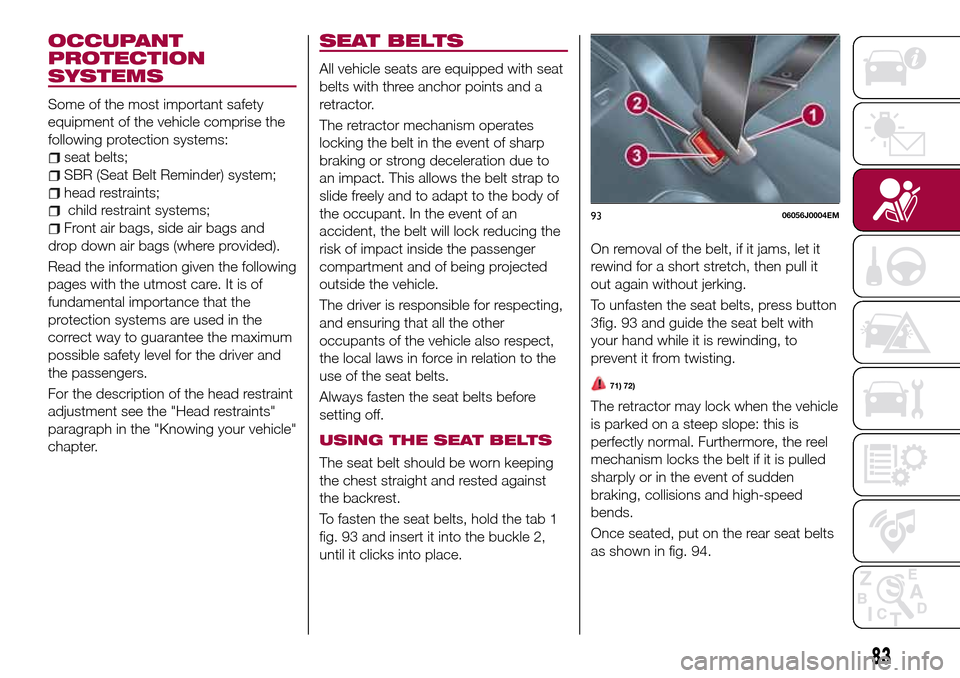
To fasten the seat belts, hold the tab 1
fig. 93 and insert it into the buckle 2,
until it clicks into place.On removal of the belt, if it jams, let it
rewind for a short stretch, then pull it
out again without jerking.
To unfasten the seat belts, press button
3fig. 93 and guide the seat belt with
your hand while it is rewinding, to
prevent it from twisting.
71) 72)
The retractor may lock when the vehicle
is parked on a steep slope: this is
perfectly normal. Furthermore, the reel
mechanism locks the belt if it is pulled
sharply or in the event of sudden
braking, collisions and high-speed
bends.
Once seated, put on the rear seat belts
as shown in fig. 94.
9306056J0004EM
83
Page 86 of 264

ADJUSTING THE FRONT
SEAT BELT HEIGHT
73) 74)
Four different adjustments in height are
possible.
To carry out window height adjustment,
from the top to the bottom, button 1
fig. 95 must be pressed, and the handle
must be slid downwards.
To carry out window height adjustment,
from the top to the bottom, the handle
must be slid (without pressing
anything).Always adjust the height of the seat
belts to fit the person wearing it: this
precaution could greatly reduce the risk
of injury in the event of collision.
Correct adjustment is obtained when
the belt passes approximately half way
between the shoulder and the neck.
WARNING
71)Never press button 3 when travelling.
72)Remember that, in the event of an
accident, the rear seat passengers not
wearing seat belts are exposed to a very
serious risk and also represent a serious
danger for the front seat occupants.
73)Make height adjustment of the seat
belts when the car is stationary.74)After the height adjustment, always
check that the grip is locked in one of the
preset positions. To do this, with button
1 released, exert further pressure
downwards to allow the locking device to
click if the grip has not been released in
one of the possible positions.
94P103FI84-000-0009506056J0003EM
84
SAFETY
Page 103 of 264
85)After installing a child restraint system,
do not move the seat: always remove the
child restraint system before making any
adjustment.
86)Always make sure that the diagonal
section of the seat belt does not pass
under the arms or behind the back of the
child. In the event of an accident the seat
belt will not be able to secure the child,
with the risk of injury, including fatal injury.
Therefore the child must always wear the
seat belt correctly.
87)Do not use the same lower anchorage
to install more than one child restraint
system.
88)If a Universal ISOFIX child seat system
is not fixed to all three anchorages, it will
not be able to protect the child correctly. In
a crash, the child could be seriously or
fatally injured.
89)Fit the child restraint system when the
car is stationary. The child restraint system
is correctly fixed to the brackets when you
hear the click. Follow the instructions for
assembly, disassembly and positioning that
the Manufacturer must supply with the
child restraint system.SUPPLEMENTARY
RESTRAINT SYSTEM
(SRS) - AIRBAG
The vehicle is equipped with:
front driver airbag;
front passenger airbag;
driver and passenger front side bags
for pelvis, chest and shoulder
protection (Side bags);
side bags for head protection of front
seat passengers and rear side seat
passengers (window bag).
The location of the airbags on the
vehicle is marked by the word
"AIRBAG" in the middle of the steering
wheel, on the dashboard, on the side
trim or on a label placed next to the
airbag deployment area.
FRONT AIRBAGS
The front (driver and passenger) airbags
protect the front seat occupants in the
event of head-on crashes of
medium-high severity, by placing the
cushion between the occupant and the
steering wheel or dashboard.
Therefore non-activation of airbags in
other types of collisions (side impacts,
rear shunts, roll-overs, etc.) does not
indicate a system malfunction.
Driver and passenger front airbags are
not a replacement of but
complementary to the seat belts, whichshould always be worn, as specified by
law in Europe and most non-European
countries.
In the event of impact, those not
wearing a seat belt are projected
forwards and may come into contact
with the bag which is still inflating. The
protection offered by the bag is
compromised in these circumstances.
Front airbags may not activate in the
following situations:
frontal impacts against highly
deformable objects not involving the
front surface of the vehicle (e.g. wing
collision against guard rail, etc.);
vehicle wedging under other
vehicles or protective barriers (e.g.
trucks or guard rails).
Failure to activate in the conditions
described above is due to the fact that
they may not provide any additional
protection compared with seat belts, so
their activation would be inappropriate.
In these cases, non-deployment does
not indicate a system malfunction.
The driver's and passenger's front
airbags have been designed and
calibrated to protect front seat
occupants wearing seat belts. At their
maximum inflation, their volume fills
most of the space between the steering
wheel and the driver and between the
dashboard and the passenger.
101
Page 148 of 264

UNDER DASHBOARD CONTROL UNIT
fig. 166
USERSFUSE AMPERE
Front door unlocking (driver side) 1 7.5
Front door unlocking (passenger side) 2 7.5
Rear door unlocking (left) 3 7.5
Rear door unlocking (right) 4 7.5
LUGGAGE COMPARTMENT FUSE BOX
fig. 169
USERSFUSE AMPERE
Rear 12 V socket F97 15
Driver's front seat heater F99 10
Passenger side front seat heater F92 10
Driver's front seat lumbar adjustment F90 10
WARNING
134)If the replaced fuse blows again, contact a Fiat Dealership.
135)Never replace a fuse with another with a higher amp rating; DANGER OF FIRE
136)If a fuse NOT indicated in this or the previous page is used, contact a Fiat Dealership.
137)Before replacing a fuse, make sure that the ignition device is at STOP, that the key, if mechanical, has been removed and that all devices
are switched off and/or disconnected.
146
IN AN EMERGENCY
Page 259 of 264

INDEX
ABS (system)...............73
Active Grille Shutter............49
Active safety systems...........73
Adaptive cruise control.........116
Airbag
Front airbags.............101
Side bags...............105
Airbag (SRS supplementary
restraint system)...........101
Automatic climate control system.......................31
Automatic light control..........23
AUX source.............228 ,241
Battery..................175
Battery recharging............177
Bluetooth® source........227 ,241
Bodywork (cleaning and
maintenance).............183
Bonnet....................33
Carrying children safely.........88
Changing a wheel............148
Checking levels..............170
Child protection systems........88
Child safety device............14
Climate control...............29
CO2 emissions..............208
Control buttons..............54
Control panel and on-board
instruments...............51CONTROLS
Controls on the front panel. . . .222
Controls on front panel.........234
Daytime running lights (DRL)......23
Daytime running lights (DRL) (bulb
replacement)..............136
Dimensions................195
Dipped headlights.............23
Dipped headlights (bulb
replacement)..............135
Direction indicators............25
Display....................54
Doors.....................14
Double load compartment (TIPO
STATION WAGON version)......38
Driving assistance systems.......76
DTC (system)................73
Electric power steering.........34
Electric windows..............33
Electronic Cruise Control........114
Engine...................188
marking................187
Engine compartment..........170
Engine compartment (washing). . . .184
Engine oil (consumption)........175
Engine oil (level check).........175
ERM (system)................74
ESC (system)................73
External lights...............23
Fiat Code (system)............13
Fix&Go Automatic kit..........152
Flashing the headlights..........24
Fluids and lubricants..........202
Front ceiling light..............26
Front fog light (bulb replacement) . .136
Front fog lights...............24
Front panel control summary
table...................235
Front seat electric heating........16
Front seats (manual adjustments) . . .16
Fuel consumption............206
Fuel cut-off system...........157
Full Brake Control (system).......76
Fuse boxes................142
Fuses (replacement)...........142
GSI (Gear Shift Indicator)........54
Hazard warning lights.........132
Emergency braking.........132
Head restraints...............20
Headlight alignment corrector.....24
Headlights..................40
Headlights (cleaning)..........184
Heavy-duty use of the vehicle
(scheduled servicing)........169
HHC (system)................74
Identification data
chassis marking...........187
engine marking............187