2017 FIAT TIPO 4DOORS Climate
[x] Cancel search: ClimatePage 32 of 240
9 - internal air recirculation on/off button;
10 - AUTO function activation button (automatic operation).
Stop/Start(where provided)
The automatic climate control system manages the Stop&Start system (engine off when vehicle speed is equal to 0 km/h) to
ensure adequate comfort inside the vehicle.
In particular, the climate control system deactivates the Stop/Start if:
the climate control system is in AUTO mode (LED on the button switched on) and the temperature conditions inside the
vehicle are far from a comfort temperature;
the climate control system is in MAX A/C;
the climate control system is in the MAX-DEF status.
When the Stop&Start system is active (engine off and vehicle speed equal to 0 km/h), the climate control system will request
restarting of the engine if the inside temperature conditions rapidly deteriorate (or if the user requests maximum cooling – MAX
A/C – or quick demisting – MAX-DEF).
With the Stop&Start system on (engine off and vehicle speed equal to 0 km/h), the flow is reduced as much as possible, to
keep the compartment comfort conditions for longer.
The climate control system control unit attempts to manage the decreased comfort caused by stopping the engine as far as
possible (switching off the compressor and engine coolant pump). It is anyway possible to prioritise the operation of the climate
control system, deactivating the Stop/Start system by pressing the
button, located on the central dashboard panel.
NOTE In particularly severe climate conditions it is recommended to limit the use of the Stop&Start system to prevent the
compressor from continuously switching on and off, with consequent rapid misting of the windows and accumulation of
humidity with unpleasant smells in the passenger compartment.
NOTE When the Stop&Start system is on (engine off and vehicle at a standstill), the automatic recirculation management is
turned off always taking air in from outside, to reduce the probability of the windows misting up (as the compressor is off).
IMPORTANT
1)The system uses a coolant that is compatible with the laws in force in countries where the vehicle is sold, R134a or R1234yf. In case of a
recharge operation, only use the gas indicated on the label placed in the engine compartment. The use of other coolants affects the efficiency
and condition of the system. The lubricant used for the compressor is also strictly linked to the type of cooling gas, please refer to a Fiat
Dealership.
30
KNOWING YOUR CAR
Page 112 of 240
When the engine has been stopped
automatically, keeping the brake pedal
pressed, the brake can be released
keeping the engine off by quickly
shifting the gear lever to P (Park).
To restart the engine, just move the
lever out of position P.
SYSTEM MANUAL
ACTIVATION/
DEACTIVATION
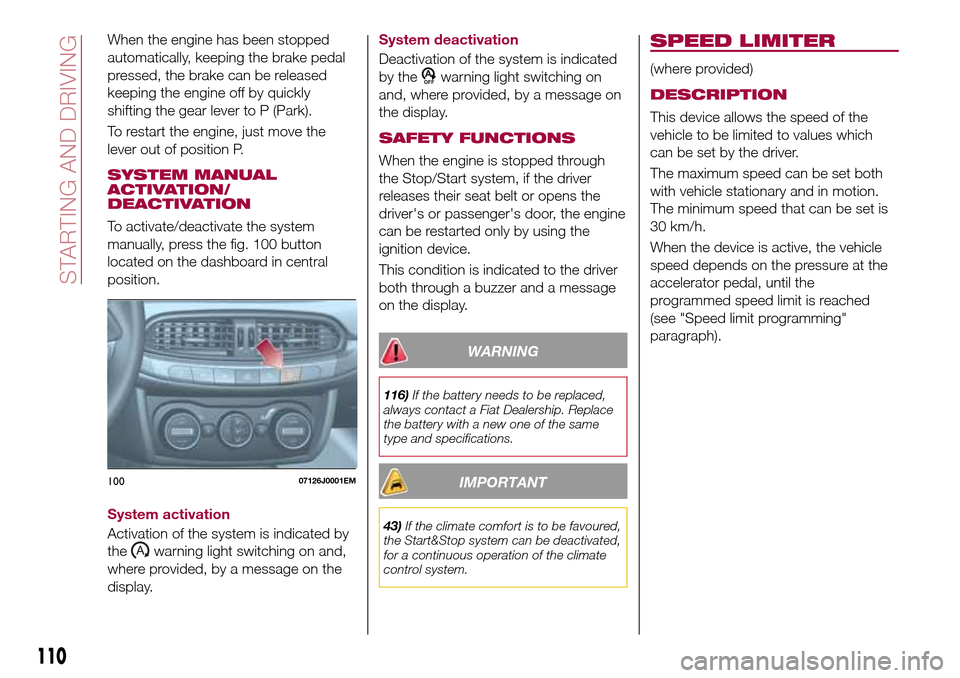
To activate/deactivate the system
manually, press the fig. 100 button
located on the dashboard in central
position.
System activation
Activation of the system is indicated by
the
warning light switching on and,
where provided, by a message on the
display.System deactivation
Deactivation of the system is indicated
by the
warning light switching on
and, where provided, by a message on
the display.
SAFETY FUNCTIONS
When the engine is stopped through
the Stop/Start system, if the driver
releases their seat belt or opens the
driver's or passenger's door, the engine
can be restarted only by using the
ignition device.
This condition is indicated to the driver
both through a buzzer and a message
on the display.
WARNING
116)If the battery needs to be replaced,
always contact a Fiat Dealership. Replace
the battery with a new one of the same
type and specifications.
IMPORTANT
43)If the climate comfort is to be favoured,
the Start&Stop system can be deactivated,
for a continuous operation of the climate
control system.
SPEED LIMITER
(where provided)
DESCRIPTION
This device allows the speed of the
vehicle to be limited to values which
can be set by the driver.
The maximum speed can be set both
with vehicle stationary and in motion.
The minimum speed that can be set is
30 km/h.
When the device is active, the vehicle
speed depends on the pressure at the
accelerator pedal, until the
programmed speed limit is reached
(see "Speed limit programming"
paragraph).
10007126J0001EM
110
STARTING AND DRIVING
Page 135 of 240

ENGINE COMPARTMENT FUSE BOX
USERSFUSE AMPERE
Two-tone horn F10 15
Heater mirrors F88 7.5
Heated rear window F20 30
DASHBOARD FUSE BOX
USERSFUSE AMPERE
Front electric window (driver side) F47 25
Front electric window (passenger side) F48 25
Supply forUconnect
™system, Climate Control system, EOBD
system, USB/AUX port, steering wheel controls.F36 15
Dead Lock device (Driver side door unlocking for
versions/markets, where provided)/Door unlocking/Central
locking/Electric rear flap unlockingF38 20
Windscreen washer pump F43 20
Rear left electric window F33 25
Rear right electric window F34 25
133
Page 145 of 240

FUEL CUT-OFF
SYSTEM
DESCRIPTION
Diesel and petrol versions
This intervenes in the case of an impact
causing:
the interruption of the fuel supply
with the engine consequently switching
off;
the automatic unlocking of the
doors;
turning on of the lights inside the
vehicle;
deactivation of climate control
system ventilation;
switching on of the hazard warning
lights (to deactivate the lights press the
button on the dashboard).
On some versions, the intervention of
the system is indicated by a message
shown on the display. In the same way,
a dedicated message on the display
warns the driver if system operation is
compromised.
IMPORTANT Carefully check the vehicle
for fuel leaks, for instance in the engine
compartment, under the vehicle or near
the tank area. After a collision, bring the
ignition device to STOP to prevent the
battery from running down.
LPG versions
(where provided)
On LPG versions, in addition to the
above, the fuel cut-off system stops
petrol supply immediately, closes the
LPG safety solenoid valve and stops
injection, consequently shutting off the
engine.
143
Page 156 of 240

Thousands of miles9 182736455463728190
Thousands of kilometres15 30 45 60 75 90 105 120 135 150
Years12345678910
Replace spark plugs (1.4 16V 95 HP E6 versions)
Replace spark plugs (1.4 T-jet 120 HP LPG E6 versions)
(4)
Replace spark plugs (1.4 16v 95 HP E4/ 1.6 E.Torque
E6 versions/ 1.6 E.Torque E4 versions) (5)
Replace toothed timing drive belt (1.4 16v 95 HP
E6 versions/ 1.4 16v 95 HP E4 versions/ 1.4 T-jet 120hp
LPG E6 versions)(6)
Replace timing drive belt(s) (1.4 16v 95 HP E6 versions/
1.4 16v 95 HP E4 versions/ 1.4 T-jet 120hp LPG
E6 versions)(6)
Replace accessory drive belt(s) (1.6 E.Torque
E6 versions/1.6 E.Torque E4 versions)
(4) For 1.4 T-jet LPG versions, to guarantee correct operation and prevent serious damage to the engine, it is essential to proceed as follows:
only use spark plugs specifically certified for these engines; all spark plugs should be of the same type and brand (see the "Engine"
paragraph in the "Technical specifications" chapter); strictly comply with the spark plugs replacement intervals in the Scheduled Servicing
Plan. It is advisable to contact a FIAT Dealership for plug replacement.
(5) This operation must be performed every 15,000 km if the vehicle is used in one of the following countries: Afghanistan, Algeria, Angola,
Armenia, Congo, Ethiopia, Ghana, Iran, Iraq, Jordan, Malawi, Mali, Mozambique, Nigeria, Senegal, Syria, Zimbabwe.
(6) Areas that are not dusty: recommended maximum mileage 120,000 km. The belt must be replaced every 6 years, regardless of distance
travelled. Dusty areas and/or demanding use of the vehicle (cold climates, town use, long periods of idling): advised maximum mileage
60,000 km. The belt must be replaced every 4 years, regardless of distance travelled.
154
SERVICING AND CARE
Page 160 of 240
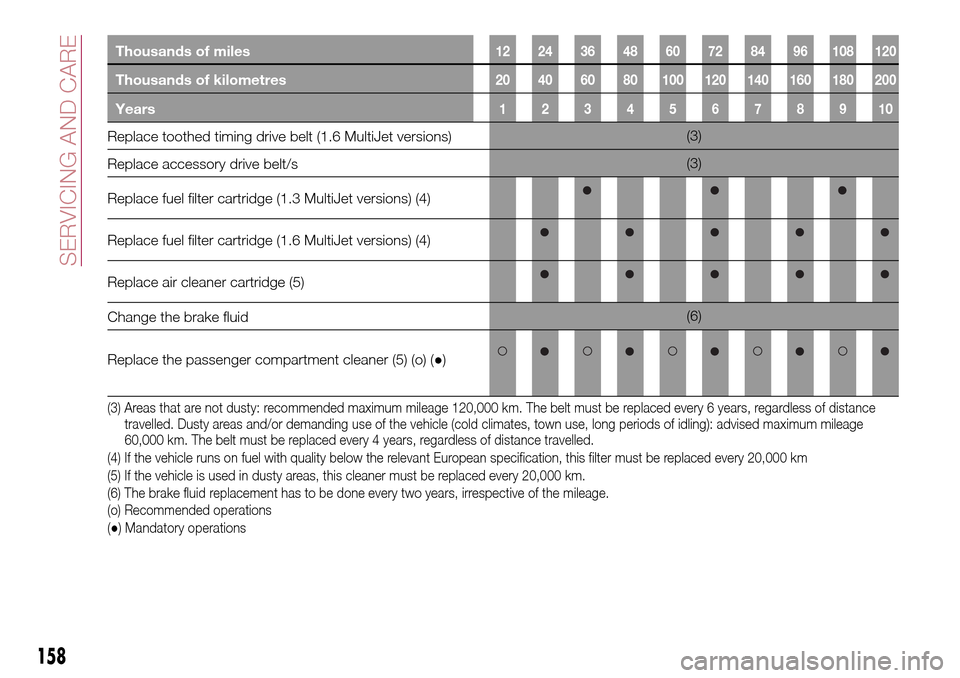
Thousands of miles12 24 36 48 60 72 84 96 108 120
Thousands of kilometres20 40 60 80 100 120 140 160 180 200
Years12345678910
Replace toothed timing drive belt (1.6 MultiJet versions)(3)
Replace accessory drive belt/s(3)
Replace fuel filter cartridge (1.3 MultiJet versions) (4)
Replace fuel filter cartridge (1.6 MultiJet versions) (4)
Replace air cleaner cartridge (5)
Change the brake fluid(6)
Replace the passenger compartment cleaner (5) (o) (●)
(3) Areas that are not dusty: recommended maximum mileage 120,000 km. The belt must be replaced every 6 years, regardless of distance
travelled. Dusty areas and/or demanding use of the vehicle (cold climates, town use, long periods of idling): advised maximum mileage
60,000 km. The belt must be replaced every 4 years, regardless of distance travelled.
(4) If the vehicle runs on fuel with quality below the relevant European specification, this filter must be replaced every 20,000 km
(5) If the vehicle is used in dusty areas, this cleaner must be replaced every 20,000 km.
(6) The brake fluid replacement has to be done every two years, irrespective of the mileage.
(o) Recommended operations
(●) Mandatory operations
158
SERVICING AND CARE
Page 175 of 240

EXHAUST SYSTEM
161) 162)
72)
Adequate maintenance of the engine
exhaust system represents the best
protection against leaks of carbon
monoxide into the passenger
compartment.
AUTOMATIC
TRANSMISSION
(where provided)
73)
Use only a gearbox oil with the same
characteristics as those indicated in the
"Fluids and lubricants" table (see
"Technical specifications" chapter).
Special additives
Do not use any type of additive with the
automatic transmission oil. The
automatic transmission oil is a product
designed specially for this vehicle and
its performance may be compromised
through the use of further additives.
Avoid the use of transmission sealers,
since they may compromise the
efficiency of the automatic transmission
seals.
IMPORTANT Do not use chemicals to
flush the transmission, since this may
damage its components.
Frequency of oil changes
In normal vehicle operating conditions,
it is not necessary to change the
transmission oil.
If oil leaks are noticed or irregular
operation of the transmission is
detected, have it checked immediately
at a Fiat Dealership.
IMPORTANT Driving the vehicle with an
insufficient oil level may cause serious
damage to the transmission.
WARNING
160)The air intake system (air cleaner,
rubber hoses, etc.) can be a protection in
the case of blowbacks from the engine. DO
NOT REMOVE this system unless you
need to carry out repair or servicing
operations. Before starting the engine,
ensure that the system has not been
removed: failure to observe this precaution
may result in serious injury.
161)Exhaust emissions are very
dangerous, and may be lethal. They
contain carbon monoxide, a colourless,
odourless gas which can cause fainting
and poisoning if inhaled.
162)The exhaust system may reach high
temperatures and may cause a fire if the
vehicle is parked on flammable material.
Dry grass or leaves can also catch fire if
they come into contact with the exhaust
system. Do not park or use the vehicle in a
place in which the exhaust system might
come into contact with flammable material.
IMPORTANT
66)It is recommended to have the vehicle
serviced by a Fiat Dealership. When
carrying out normal periodic operations and
small servicing interventions personally on
the vehicle, it is recommended to use
suitable equipment, genuine spare parts
and the necessary fluids. Do not carry out
any interventions if you don't have the
necessary experience.
67)Incorrect servicing of the vehicle or
failure to carry out operations or repairs
(when necessary) may lead to more
expensive repairs, damage to other
components or have a negative impact on
the vehicle performance. Have any
malfunction inspected immediately by a Fiat
Dealership.
68)The vehicle is equipped with fluids
which are optimised or protecting its
performance and life and extending service
intervals. Do not use chemicals for washing
these components since they may damage
the engine, the gearbox or the climate
control system. This damage is not covered
by the vehicle’s warranty. If any component
needs to be washed due to malfunctioning,
use only the specific liquid for that
procedure.
69)An excessive or insufficient amount of
oil inside the base is extremely damaging to
the engine. Make sure it is always at an
adequate level.
173
Page 201 of 240
FUEL CONSUMPTION
The fuel consumption figures given in the table below are determined on the basis of the type-approval tests laid down by
specific European Directives.
The following procedures are used to measure the fuel consumption:
urban cycle: cold starting followed by driving that simulates urban use of the vehicle;
extra-urban cycle: followed by driving simulating extra-urban use of the car with frequent accelerating in all gears, speed
varies between 0 and 120 km/h;
combined fuel consumption: calculated with a weighting of approximately 37% of the urban cycle and 63% of the
extra-urban cycle.
IMPORTANT The type of route, traffic conditions, weather conditions, driving style, general condition of the car, trim
level/equipment/accessories, use of the climate control system, car load, presence of roof racks and other situations that
adversely affect the aerodynamics or wind resistance lead to different fuel consumption values than those measured.
IMPORTANT The fuel consumption will get more regular only after having driven the first 3000 km.
199