2017 FIAT SPIDER ABARTH warning lights
[x] Cancel search: warning lightsPage 214 of 292

Warning!Do not adhere the speed restriction sticker
to the padded area on the steering wheel.
Adhering the speed restriction sticker to
the padded area on the steering wheel is
dangerous because the air bag may not
operate (deploy) normally resulting in
serious injury. In addition, do not adhere
the sticker to areas where warning lights or
the speedometer cannot be viewed.
14. Adhere the repaired tire sticker to
the wheel of the flat tire.
15. When the tire inflates to the
specified tire inflation pressure, turn the
air compressor switch off, turn the
sleeve of the injection hose to the left,
and pull it out of the tire valve. 16. Remove the air compressor hose
from the injection valve of the bottle.
Then, install the injection hose to the
injection valve of the bottle to prevent
leakage of any remaining sealant.
Note: The remaining sealant in the
hose may spray out when the hose is
removed. Remove the hose carefully
because you may not be able to
remove the sealant contacting clothing
or other objects.
17. Install the tire valve cap.
18. Place the Tire Service Kit back into
its storage location.
19. Start driving immediately to spread
the sealant in the tire.
Note: Carefully drive the vehicle at a
speed of 50 mph (80 km/h) or less. If
the vehicle is driven at a speed of
50 mph (80 km/h) or more, the vehicle
may vibrate. Note: With TPMS System: if the tire
is not properly inflated, the
warning
light will illuminate.
After driving the vehicle for about
10 minutes or 3 miles (5 km), connect
the air compressor to the tire using
Step nine of the procedure, and check
the tire inflation pressure using the tire
pressure gauge on the air compressor.
If the tire inflation pressure is lower than
the specified tire inflation pressure, turn
the air compressor on and wait until it
reaches the specified tire inflation
pressure.
The Tire Service Kit is completed
successfully if the tire inflation pressure
does not decrease. Carefully drive the
vehicle to the nearest authorized dealer
immediately and have the flat tire
replaced. Replacement with a new tire
is recommended. If the tire is to be
repaired or reused, consult an
authorized dealer.
Note:
If an emergency flat tire repair has
been performed using the Tire Service
Kit, FCA recommends that the tire be
replaced with a new one as soon as
possible. If the tire is to be repaired or
reused, contact an authorized dealer.
Thewheelcanbereusedifthe
sealant adhering to it is removed.
However, replace the valve with a new
one.08020202-031-667
Repaired Tire Sticker 08020202-031-668
Install Injection Hose To Sealant
Bottle
212
IN CASE OF EMERGENCY
Page 215 of 292

Sealing A Tire With Tire
Service Kit
Warning!Do not attempt to seal a tire on the side
of the vehicle closest to traffic. Pull far
enough off the road to avoid the danger of
being hit when using the Tire Service Kit.
Do not use Tire Service Kit or drive the
vehicle under the following circumstances:
If the puncture in the tire tread is
approximately 1/4 inch (6 mm) or larger.
If the tire has any sidewall damage.
If the tire has any damage from driving
with extremely low tire pressure.
If the tire has any damage from driving
on a flat tire.
If the wheel has any damage.
If you are unsure of the condition of the
tire or the wheel.
Keep Tire Service Kit away from open
flames or heat sources.
A loose Tire Service Kit thrown forward
in a collision or hard stop could endanger
the occupants of the vehicle. Always stow
the Tire Service Kit in the place provided.
Failure to follow these warnings can result
in injuries that are serious or fatal to you,
your passengers, and others around you.
Take care not to allow the contents of
Tire Service Kit to come in contact with
hair, eyes, or clothing. Tire Service Kit
sealant is harmful if inhaled, swallowed, or absorbed through the skin. It causes skin,
eye, and respiratory irritation. Flush
immediately with plenty of water if there is
any contact with eyes or skin. Change
clothing as soon as possible, if there is any
contact with clothing.
Tire Service Kit Sealant solution contains
latex. In case of an allergic reaction or rash,
consult a physician immediately. Keep Tire
Service Kit out of reach of children. If
swallowed, rinse mouth immediately with
plenty of water and drink plenty of water.
Do not induce vomiting! Consult a
physician immediately.
Mexico Market
Proceed as follows:
1. Pull over to a safe location and turn
on the vehicle’s Hazard Warning Lights.
2. Verify that the valve stem (on the
wheel with the deflated tire) is in a
position that is near to the ground. This
will allow the Tire Service Kit hoses to
reach the valve stem and keep the Tire
Service Kit flat on the ground. This will
provide the best positioning of the kit
when injecting the sealant into the
deflated tire and running the air pump.
Move the vehicle as necessary to place
the valve stem in this position before
proceeding.
3. Place the gear selector in REVERSE
for a manual transmission, or PARK for
automatic transmission. 4. Apply the parking brake with the
brake pedal pressed and turn the
engine OFF.
5. Unload passengers and cargo, then
remove the Tire Service Kit.
6. Gently shake the tire sealant. If the
bottle is shaken after the injection hose
is screwed on, tire sealant could spray
out from the injection hose. Tire sealant
contacting clothing or other objects
may be impossible to remove. Shake
the bottle before screwing on the
injection hose.
Note:
Do not shake the bottle
excessively. Otherwise, the sealant
could spray out of the injection hose,
and if the sealant contacts clothing or
other objects, you may not be able to
remove it.
The sealant hardens easily and
injecting it will be difficult under cold
weather conditions 32 °F (0 °C) or
below. Warm the sealant inside the
vehicle to facilitate injection.
7. Remove the cap from the bottle and
screw on the injection hose with the
bottle's inner cap left on to break the
inner cap.
213
Page 217 of 292

12. Pull out the injection hose from the
valve.
13. Reinsert the valve core into the
valve and turn it clockwise to install.
Note:
The tire sealant cannot be reused.
If the tire sealant kit has been used, or
is expired, purchase new one at an
authorized dealer.
Do not throw away the empty tire
sealant bottle after use. Return the
empty tire sealant bottle to an
authorized dealer when replacing the
tire. The empty tire sealant bottle will
need to be used to extract and
dispose of the used sealant from the
tire.
14. Install the injection hose to the tab
of the bottle to prevent leakage of any
remaining sealant. 15. Adhere the speed restriction sticker
to an area where it can be viewed easily
by the driver.
Warning!Do not adhere the speed restriction sticker
to the padded area on the steering wheel.
Adhering the speed restriction sticker to
the padded area on the steering wheel is
dangerous because the air bag may not
operate (deploy) normally resulting in
serious injury. In addition, do not adhere
the sticker to areas where warning lights or
the speedometer cannot be viewed.
16. Pull out the air compressor hose
and the air compressor plug from the
air compressor. 17. Install the air compressor hose to
the tire valve.
18. Insert the air compressor plug into
the accessory socket inside the vehicle
and place the ignition to ACC.
19. Turn the air compressor switch on
and inflate the tire carefully to the
correct inflation pressure. For the
correct pressure, check the tire inflation
pressure label on the driver's door
frame.
Note: When inserting the air
compressor plug into or removing it
from the accessory socket, make sure
that the air compressor switch is off.
When turning the air compressor on/off,
use the air compressor switch. Before
checking the tire inflation pressure using
the tire pressure gauge, turn the air
compressor switch off.08020202-03A-007AB
Turn Valve Core Clockwise To
Reinstall 08020202-36A-004
Air Compressor With Hose And
Plug
2 — Air Compressor Hose 08020202-03A-00BAB
Air Compressor Hose Into Valve
215
Page 227 of 292

At least monthly perform inspection
of:
Tire inflation pressures
At least twice a year (for example,
every spring and fall) perform
inspection of:
Engine coolant
Engine oil
As explained in the “Introduction”
paragraph, several procedures can be
done only by a qualified service
technician with special tools.
For details, read the separate Warranty
Booklet provided with the vehicle. If you
are unsure about any servicing or
maintenance procedure, have it done
by an authorized dealer.
There are strict environmental laws
regarding the disposal of waste oil and
fluids. Please dispose of your waste
properly and with due regard to the
environment.
We recommend that you entrust the oil
and fluid changes of your vehicle to an
authorized dealer. Periodic Checks
Every 620 miles (1,000 km) or before
long trips check and, if necessary, top
off:
Engine coolant level.
Brake fluid level.
Windshield washer fluid level.
Tire inflation pressure and condition.
Operation of lighting system
(headlights, direction indicators, hazard
warning lights, etc.).
Operation of windshield
washer/wiper system and
positioning/wear of windshield wiper
blades.
Every 1860 miles (3,000 km) check
and top off the engine oil level if
required.
Heavy-Duty Use Of The
Vehicle
If the vehicle is used under one of the
following conditions:
Dusty roads.
Short, repeated trips less than 4.4 -
5 miles ( 7-8km)atsub -zero outside
temperatures.
Engine idling for long periods of time
or driving long distances at low speeds
or long periods of inactivity. The following checks must be carried
out more often than indicated in the
Scheduled Servicing Plan:
Check front disc brake pad condition
and wear.
Check cleanliness of underhood area
and all door and trunk locks, cleanliness
and lubrication of linkage.
Visually inspect conditions of the:
engine, transmission, lines and hoses
(exhaust/fuel system/brakes) and
rubber elements (hoses/belts/etc.).
Check battery charge and battery
fluid level.
Visually inspect conditions of the
accessory drive belts.
Check and, if necessary, change
engine oil and replace oil filter.
Check and, if necessary, replace
cabin air filter.
Check and, if necessary, replace air
cleaner.
Severe Duty All Models
Change Engine Oil at 4,000 miles
(6,500 km) if the vehicle is operated in a
dusty and off road environment or is
operated predominately at idle or only
very low engine RPM’s. This type of
vehicle use is considered Severe Duty.
225
Page 228 of 292

Scheduled Servicing Plan
Mileage or time passed
(whichever comes first)
10,000
20,000
30,000
40,000
50,000
60,000
70,000
80,000
90,000
100,000
110,000
120,000
130,000
140,000
150,000Or Years: 123 456789101112131415
Or Kilometers:
16,000
32,000
48,000
64,000
80,000
96,000
112,000
128,000
144,000
160,000
176,000
192,000
208,000
224,000
240,000Check tire condition/wear
and adjust pressure, if
necessary, check TIREKIT
expiration date (if
provided). •••••••••••••••
Check operation of lighting
system (headlamps,
direction indicators, hazard
warning lights, luggage
compartment, passenger
compartment, glove
compartment, instrument
panel warning lights, etc.). •••••••••••••••
Check and, if necessary,
top up fluid levels
(brakes/hydraulic clutch,
windshield washer, battery,
engine coolant, etc.). •••••••••••••••
226
SERVICING AND MAINTENANCE
Page 286 of 292

INDEX About Your Brakes .......... .150
ABS system ............... .112
Active Adaptive Shift (AAS) ..... .156
Adaptive Front Lighting System
(AFS) ...................42
Additives, Fuel ............. .174
Advanced Keyless Entry System
Key Left In Trunk ............21
Key left In Vehicle ...........21
Locking Doors .............21
Passive Entry ..............21
Request Switch ............21
Unlocking Doors ............21
AirBag............... .131,135
Advance Front Air Bag . . . .131,135
Air Bag Warning Light ...... .147
Event Data Recorder (EDR) .145,222
FrontAirBag ............ .147
Maintaining Your Air Bag
System ............... .145
Air Bag Maintenance ......... .145
Air Pressure, Tires ........... .246
Alarm
Vehicle Security Alarm ..... .24,25
Alarm (Security Alarm) ....... .24,25
Aluminium wheel maintenance . . . .259
Automatic Dimming Mirror ........36
Automatic Headlights ...........40 Automatic Temperature Control
(ATC) ...................52
Automatic Transmission ....... .153
Auxiliary Power Outlet ..........63
B-Pillar Location ............ .242
Battery (maintenance) ......... .234
Battery charging procedure ..... .235
Battery recharging ........... .235
Blind Spot Monitoring ......... .114
Body and underbody warranty . . . .256
Body lubrication ............ .235
Bodywork (care and maintenance). .256
Boot, Convertible Top Lowering ....70
Boot, Convertible Top Precautions . .73
Boot, Convertible Top Raising .....71
Brake System .............. .150
Brake/clutch fluid (level check) . . . .233
Brakes ............... .150,271
Bright-metal maintenance ......
.259
Camera,
Rear ..............
.167
Carbon Monoxide Warning ..... .175
Center Seat Storage Compartment .......................60
Certification Label ........... .176
Changing A Flat Tire .... .203,204,237
Chart, Tire Sizing ............ .239
Check Engine Light (Malfunction
Indicator Light) ........... .110 Checking levels ............. .231
Child Restraint ............. .128
Child Restraints
Child Restraints .......... .128
Clean Air Gasoline ........... .173
Cleaning
Wheels ............... .251
Climate Control ..............45
Close The Hood ..............69
Compact Spare Tire .......... .250
Contract, Service ........... .281
Convertible Top ..............70
Convertible top maintenance .... .260
Cooling
Air Conditioning ............50
Cupholders .................64
Customer Assistance ......... .280
Data Recorder, Event ......... .145
Daytime Running Lights .........40
Diagnostic System, Onboard .... .109
Dimensions ............... .274
Disabled Vehicle Towing .... .220,221
Driver's Seat Back Tilt ..........33
Driving in flooded area ........ .181
Driving tips ............... .178
Electric power steering ..........74
Electric Remote Mirrors .........37
INDEX
Page 287 of 292

Electronic Brake Control System
Traction Control System ..... .112
Electronic Speed Control (Cruise
Control) ................ .159
Emergency fuel filler door release . .176
Emergency Key ..............16
Emergency, In Case Of ........ .208
Hazard Warning Flasher ..... .184
Jacking ......... .203,204,237
Jump Starting ........... .217
Overheating ............ .219
Towing ............. .220,221
Emission control system .........74
Emission Control System
Maintenance ............. .110
Engine .................. .269
Exhaust Gas Caution ....... .175
Fails To Start ............ .218
Flooded, Starting ......... .218
Jump Starting ........... .217
Overheating ............ .219
Starting ............. .20,218
Engine compartment ......... .231
Engine coolant (level check) ..... .232
Engine oil (level check) ........ .232
Environment protection systems ....74
Essential information ............3
Ethanol .................. .173
Event Data Recorder ......... .145 Exhaust Gas Caution ......... .175
Exterior Lights ...............38
Flash-To-Pass ...............40
Flashers
Hazard Warning .......... .184
Turn Signal ...............41
Flooded Engine Starting ....... .218
Fluid And Lubricants ......... .276
Fluid Capacities ............ .275
Fog Lights ..................41
Follow Me Home .............40
Front lights (light bulbs) ........
.187
Fr
ont Wipers
Wiper Operation ...........42
Fuel
Additives .............. .174
Clean Air .............. .173
Ethanol ............... .173
Materials Added .......... .174
Methanol .............. .173
Fuel Consumption Display ........85
Fuel Economy Monitor ..........84
Fuel filler cap .............. .175
Fuel filler door .............. .175
Fuse block (engine compartment) . .197
Fuse block (interior) .......... .201
Fuses (interior) ............. .195
Fuses (underhood) ........... .196 Gasoline, Clean Air .......... .173
Gasoline, Reformulated ....... .173
Gear selector positions ........ .154
GVWR .................. .176
Hazard Warning Flasher ....... .184
Hazardous driving ........... .178
Head Restraints ..............34
Headlight ..................38
Headlights
Adjusting The Headlight Abroad .......................42
High Beam ...............40
Passing .................40
Heavy-duty use of the vehicle
(scheduled servicing) ....... .225
HomeLink (Garage Door Opener) . . .58
Hood Release ...............68
How to use this manual ..........3
Identification Data ........... .266
Inside Rearview Mirror ..........36
Instrument Cluster Display
Information Display ....... .76,77
Interior Lights ................62
Interiors ................. .262
Internal Equipment ............60
Jack Location .............. .203
Jack Operation ....... .203,204,237
Jump Starting .............. .217
Page 288 of 292
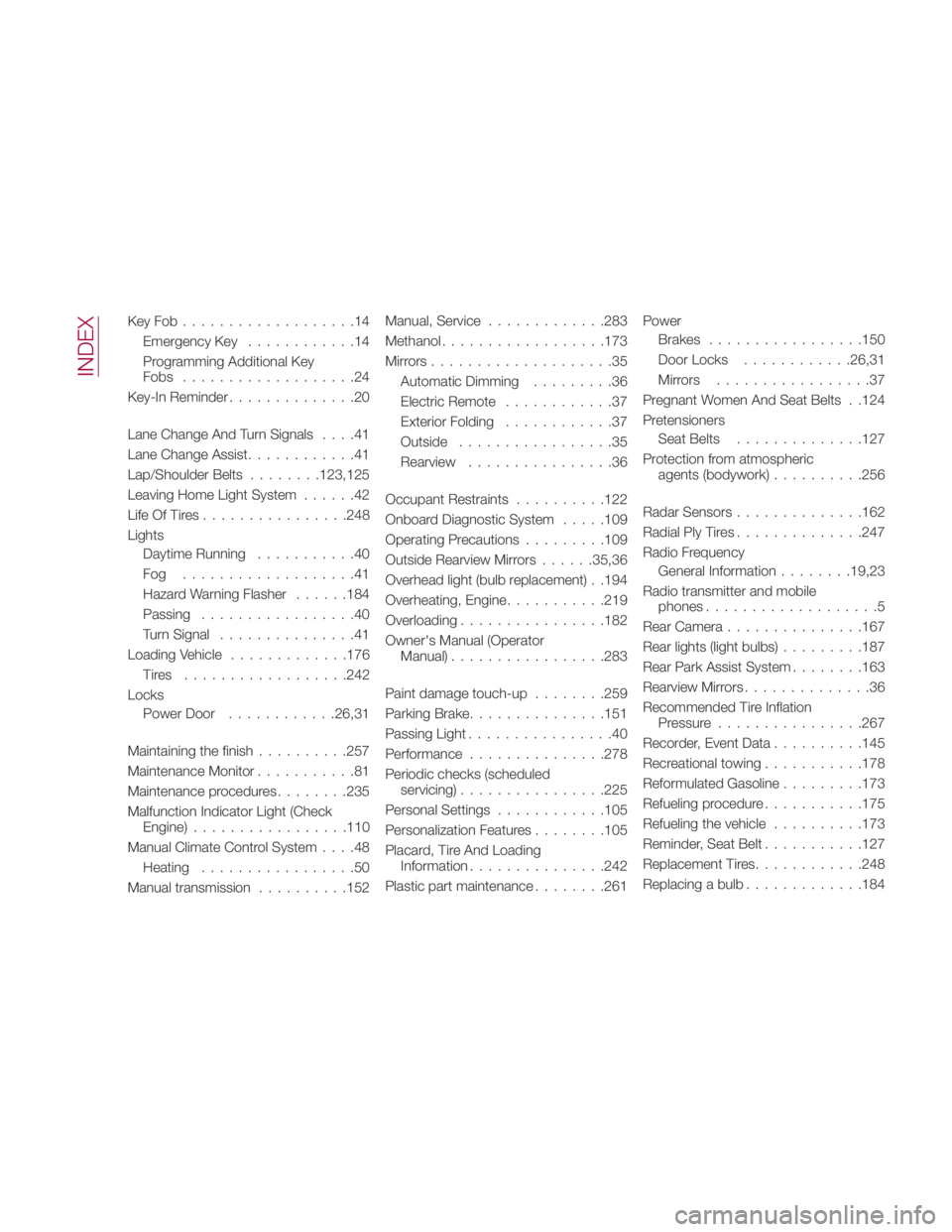
KeyFob...................14
Emergency Key ............14
Programming Additional Key
Fobs ...................24
Key-In Reminder ..............20
Lane Change And Turn Signals ....41
Lane Change Assist ............41
Lap/Shoulder Belts ....... .123,125
Leaving Home Light System ......42
Life Of Tires ............... .248
Lights
Daytime Running ...........40
Fog ...................41
Hazard Warning Flasher ..... .184
Passing .................40
Turn Signal ...............41
Loading Vehicle ............ .176
Tires ................. .242
Locks
PowerDoor ........... .26,31
Maintaining the finish ......... .257
Maintenance Monitor ...........81
Maintenance procedures ....... .235
Malfunction Indicator Light (Check
Engine) ................ .110
Manual Climate Control System ....48
Heating .................50
Manual transmission ......... .152 Manual, Service ............ .283
Methanol ................. .173
Mirrors....................35
Automatic Dimming .........36
Electric Remote ............37
Exterior Folding ............37
Outside .................35
Rearview ................36
Occupant Restraints ......... .122
Onboard Diagnostic System .... .109
Operating Precautions ........ .109
Outside Rearview Mirrors ..... .35,36
Overhead light (bulb replacement) . .194
Overheating, Engine .......... .219
Overloading ............... .182
Owner's Manual (Operator
Manual) ................ .283
Paint damage touch-up ....... .259
Parking Brake ..............
.151
Passing
Light ................ 40
Performance .............. .278
Periodic checks (scheduled
servicing) ............... .225
Personal Settings ........... .105
Personalization Features ....... .105
Placard, Tire And Loading
Information .............. .242
Plastic part maintenance ....... .261 Power
Brakes ................ .150
Door Locks ........... .26,31
Mirrors .................37
Pregnant Women And Seat Belts . .124
Pretensioners
Seat Belts ............. .127
Protection from atmospheric
agents (bodywork) ......... .256
Radar Sensors ............. .162
Radial Ply Tires ............. .247
Radio Frequency
General Information ....... .19,23
Radio transmitter and mobile
phones ...................5
Rear Camera .............. .167
Rear lights (light bulbs) ........ .187
Rear Park Assist System ....... .163
Rearview Mirrors ..............36
Recommended Tire Inflation
Pressure ............... .267
Recorder, Event Data ......... .145
Recreational towing .......... .178
Reformulated Gasoline ........ .173
Refueling procedure .......... .175
Refueling the vehicle ......... .173
Reminder, Seat Belt .......... .127
Replacement Tires ........... .248
Replacing a bulb ............ .184
INDEX