2017 FIAT SPIDER ABARTH steering wheel
[x] Cancel search: steering wheelPage 191 of 292

6. Disconnect the bulb from the
socket.
7. Install the new bulb in the reverse
order of the removal procedure. Fog Lights
Proceed as follows:
1. If you are changing the right bulb,
start the engine, turn the steering wheel
all the way to the right, and turn off
engine. If you are changing the left bulb,
turn the steering wheel to the left.
2. Make sure the ignition is switched
off, and the headlight switch is off.
3. Remove the fasteners in the five
locations and partially peel back the
mud guard.
4. Disconnect the connector from the
unit by pressing the tab on the
connector with your finger and pulling
the connector.
5. Turn the socket and bulb assembly
counterclockwise, extract the bulb and
remove it.
6. Disconnect the bulb from the
socket.
7. Install the new bulb in the reverse
order of the removal procedure.
Brake lights / Tail lights
Go to your authorized dealer when the
replacement of this lights is necessary. Side Direction Indicator Lights
Proceed as follows:
1. Make sure the ignition is placed in
the OFF mode, and the headlight
switch is off.
2. If you are changing the right bulb,
start the engine, turn the steering wheel
all the way to the right, and turn off
engine. If you are changing the left bulb,
turn the steering wheel to the left.
3. Remove the fasteners in the five
locations and partially peel back the
mud guard.
4. Disconnect the electrical connector
from the bulb by pressing the tab on
the connector with your finger and
pulling the connector.
5. Remove the lens assembly by
pressing the tab on the unit with your
finger and pulling the unit forward to
compress in the internal catch, then pull
the cluster outwards.
6. Lift up the lens assembly, and then
remove the cluster and install the new
side direction indicator lens assembly in
the reverse order of the removal
procedure.07031501-207-001
Front Direction Indicator Housing
1 — Socket Assembly
2 — Bulb 07031501-208-002AB
Direction Indicator Lamp Connector
189
Page 214 of 292

Warning!Do not adhere the speed restriction sticker
to the padded area on the steering wheel.
Adhering the speed restriction sticker to
the padded area on the steering wheel is
dangerous because the air bag may not
operate (deploy) normally resulting in
serious injury. In addition, do not adhere
the sticker to areas where warning lights or
the speedometer cannot be viewed.
14. Adhere the repaired tire sticker to
the wheel of the flat tire.
15. When the tire inflates to the
specified tire inflation pressure, turn the
air compressor switch off, turn the
sleeve of the injection hose to the left,
and pull it out of the tire valve. 16. Remove the air compressor hose
from the injection valve of the bottle.
Then, install the injection hose to the
injection valve of the bottle to prevent
leakage of any remaining sealant.
Note: The remaining sealant in the
hose may spray out when the hose is
removed. Remove the hose carefully
because you may not be able to
remove the sealant contacting clothing
or other objects.
17. Install the tire valve cap.
18. Place the Tire Service Kit back into
its storage location.
19. Start driving immediately to spread
the sealant in the tire.
Note: Carefully drive the vehicle at a
speed of 50 mph (80 km/h) or less. If
the vehicle is driven at a speed of
50 mph (80 km/h) or more, the vehicle
may vibrate. Note: With TPMS System: if the tire
is not properly inflated, the
warning
light will illuminate.
After driving the vehicle for about
10 minutes or 3 miles (5 km), connect
the air compressor to the tire using
Step nine of the procedure, and check
the tire inflation pressure using the tire
pressure gauge on the air compressor.
If the tire inflation pressure is lower than
the specified tire inflation pressure, turn
the air compressor on and wait until it
reaches the specified tire inflation
pressure.
The Tire Service Kit is completed
successfully if the tire inflation pressure
does not decrease. Carefully drive the
vehicle to the nearest authorized dealer
immediately and have the flat tire
replaced. Replacement with a new tire
is recommended. If the tire is to be
repaired or reused, consult an
authorized dealer.
Note:
If an emergency flat tire repair has
been performed using the Tire Service
Kit, FCA recommends that the tire be
replaced with a new one as soon as
possible. If the tire is to be repaired or
reused, contact an authorized dealer.
Thewheelcanbereusedifthe
sealant adhering to it is removed.
However, replace the valve with a new
one.08020202-031-667
Repaired Tire Sticker 08020202-031-668
Install Injection Hose To Sealant
Bottle
212
IN CASE OF EMERGENCY
Page 217 of 292

12. Pull out the injection hose from the
valve.
13. Reinsert the valve core into the
valve and turn it clockwise to install.
Note:
The tire sealant cannot be reused.
If the tire sealant kit has been used, or
is expired, purchase new one at an
authorized dealer.
Do not throw away the empty tire
sealant bottle after use. Return the
empty tire sealant bottle to an
authorized dealer when replacing the
tire. The empty tire sealant bottle will
need to be used to extract and
dispose of the used sealant from the
tire.
14. Install the injection hose to the tab
of the bottle to prevent leakage of any
remaining sealant. 15. Adhere the speed restriction sticker
to an area where it can be viewed easily
by the driver.
Warning!Do not adhere the speed restriction sticker
to the padded area on the steering wheel.
Adhering the speed restriction sticker to
the padded area on the steering wheel is
dangerous because the air bag may not
operate (deploy) normally resulting in
serious injury. In addition, do not adhere
the sticker to areas where warning lights or
the speedometer cannot be viewed.
16. Pull out the air compressor hose
and the air compressor plug from the
air compressor. 17. Install the air compressor hose to
the tire valve.
18. Insert the air compressor plug into
the accessory socket inside the vehicle
and place the ignition to ACC.
19. Turn the air compressor switch on
and inflate the tire carefully to the
correct inflation pressure. For the
correct pressure, check the tire inflation
pressure label on the driver's door
frame.
Note: When inserting the air
compressor plug into or removing it
from the accessory socket, make sure
that the air compressor switch is off.
When turning the air compressor on/off,
use the air compressor switch. Before
checking the tire inflation pressure using
the tire pressure gauge, turn the air
compressor switch off.08020202-03A-007AB
Turn Valve Core Clockwise To
Reinstall 08020202-36A-004
Air Compressor With Hose And
Plug
2 — Air Compressor Hose 08020202-03A-00BAB
Air Compressor Hose Into Valve
215
Page 224 of 292

If towing service is not available in an
emergency, the vehicle may be towed
with all four wheels on the ground using
the towing hook at the front of the
vehicle. Only tow the vehicle on paved
surfaces for short distances at low
speeds.
Follow these instructions when towing
the vehicle with all wheels on the
ground:
1. Shift to NEUTRAL for manual
transmission or automatic transmission.
2. Place the ignition to ACC.
3. Release the parking brake.
Note: Remember that power assist for
the brakes and steering will not be
available when the engine is not
running. EVENT DATA
RECORDER (EDR) This vehicle is equipped with an Event
Data Recorder (EDR). The main
purpose of an EDR is to record data
that will assist in understanding how a
vehicle’s systems performed under
certain crash or near crash-like
situations, such as an air bag
deployment or hitting a road obstacle.
Please refer to “Occupant Restraint
Systems” in “Safety” for further
information on the Event Data Recorder
(EDR).
222
IN CASE OF EMERGENCY
Page 229 of 292

Mileage or time passed
(whichever comes first)
10,000
20,000
30,000
40,000
50,000
60,000
70,000
80,000
90,000
100,000
110,000
120,000
130,000
140,000
150,000Or Years: 123 456789101112131415
Or Kilometers:
16,000
32,000
48,000
64,000
80,000
96,000
112,000
128,000
144,000
160,000
176,000
192,000
208,000
224,000
240,000Check engine control
system operation (via
diagnostic tool). •••••••••••••••
Visually inspect condition
of: exterior bodywork,
underbody protection,
pipes and hoses (exhaust -
fuel system - brakes),
rubber elements (boots,
sleeves, bushings, etc.). •••• • • •
Visually inspect conditions
of steering elements and
check their operation. •••• • • •
Check the front and rear
suspension, tie rods, CV
Joints, and replace if
necessary. •••• • • •
Check endfloat of wheel
bearings. •••• • • •
227
Page 251 of 292
It is recommended you contact your
authorized tire dealer or original
equipment dealer with any questions
you may have on tire specifications or
capability. Failure to use equivalent
replacement tires may adversely affect
the safety, handling, and ride of your
vehicle.
Warning!Do not use a tire, wheel size, load rating,
or speed rating other than that specified for
your vehicle. Some combinations of
unapproved tires and wheels may change
suspension dimensions and performance
characteristics, resulting in changes to
steering, handling, and braking of your
vehicle. This can cause unpredictable
handling and stress to steering and
suspension components. You could lose
control and have a collision resulting in
serious injury or death. Use only the tire
and wheel sizes with load ratings approved
for your vehicle.
Never use a tire with a smaller load
index or capacity, other than what was
originally equipped on your vehicle. Using a
tire with a smaller load index could result in
tire overloading and failure. You could lose
control and have a collision.
Failure to equip your vehicle with tires
having adequate speed capability can
result in sudden tire failure and loss of
vehicle control. Caution!Replacing original tires with tires of a
different size may result in false
speedometer and odometer readings.
Tire Types
All Season Tires — If Equipped All Season tires provide traction for all
seasons (Spring, Summer, Fall, and
Winter). Traction levels may vary
between different all season tires. All
season tires can be identified by the
M+S, M&S, M/S or MS designation on
the tire sidewall. Use all season tires
only in sets of four; failure to do so may
adversely affect the safety and handling
of your vehicle.
Summer Or Three Season Tires
— If Equipped Summer tires provide traction in both
wet and dry conditions, and are not
intended to be driven in snow or on ice.
If your vehicle is equipped with Summer
tires, be aware these tires are not
designed for Winter or cold driving
conditions. Install Winter tires on your
vehicle when ambient temperatures are
less than 40°F (5°C) or if roads are
covered with ice or snow. For more
information, contact an authorized
dealer. Summer tires do not contain the all
season designation or mountain/
snowflake symbol on the tire sidewall.
Use Summer tires only in sets of four;
failure to do so may adversely affect the
safety and handling of your vehicle.
Warning!Do not use Summer tires in snow/ice
conditions. You could lose vehicle control,
resulting in severe injury or death. Driving
too fast for conditions also creates the
possibility of loss of vehicle control.
Snow Tires Some areas of the country require the
use of snow tires during the Winter.
Snow tires can be identified by a
“mountain/snowflake” symbol on the
tire sidewall.
If you need snow tires,
select tires equivalent
in size and type to the
original equipment
tires. Use snow tires
onlyinsetsoffour;
failure to do so may adversely affect the
safety and handling of your vehicle.
Snow tires generally have lower speed
ratings than what was originally
equipped with your vehicle and should
not be operated at sustained speeds
over 75 mph (120 km/h). For speeds
above 75 mph (120 km/h) refer to
249
Page 255 of 292
Caution!To avoid damage to your vehicle or tires,
observe the following precautions:
Because of restricted traction device
clearance between tires and other
suspension components, it is important
that only traction devices in good condition
are used. Broken devices can cause
serious damage. Stop the vehicle
immediately if noise occurs that could
indicate device breakage. Remove the
damaged parts of the device before further
use.
Install device as tightly as possible and
then retighten after driving about ½ mile
(0.8 km).
Do not exceed 30 mph (48 km/h).
Drive cautiously and avoid severe turns
and large bumps, especially with a loaded
vehicle.
Do not drive for a prolonged period on
dry pavement.
Observe the traction device
manufacturer’s instructions on the method
of installation, operating speed, and
conditions for use. Always use the
suggested operating speed of the device
manufacturer’s if it is less than 30 mph
(48 km/h).
Do not use traction devices on a
compact spare tire. Caution!Using snow chains with tires with
non-original dimensions may damage the
vehicle.
Using different size or type (M+S, snow,
etc.) tires between front and rear axle may
adversely affect vehicle driveability, with the
risk of losing control of the vehicle and
resulting accidents.
Tire Rotation
Recommendations
The front and rear tires are subject to
different loads and stress due to
steering, maneuver and braking. For
this reason they are subject to uneven
wear. To resolve this problem, tires
should be rotated at the appropriate
time.
The following rotation methods must
NOT be used with one-way
unidirectional tires! This type of tires can
only be switched from the front axle to
the rear axle and vice versa, keeping
them on the same side of the vehicle.
Rotate one-way unidirectional tires
and radial tires that have an
asymmetrical tread pattern only from
front to rear, not from side to side. Tire
performance will be reduced if rotated
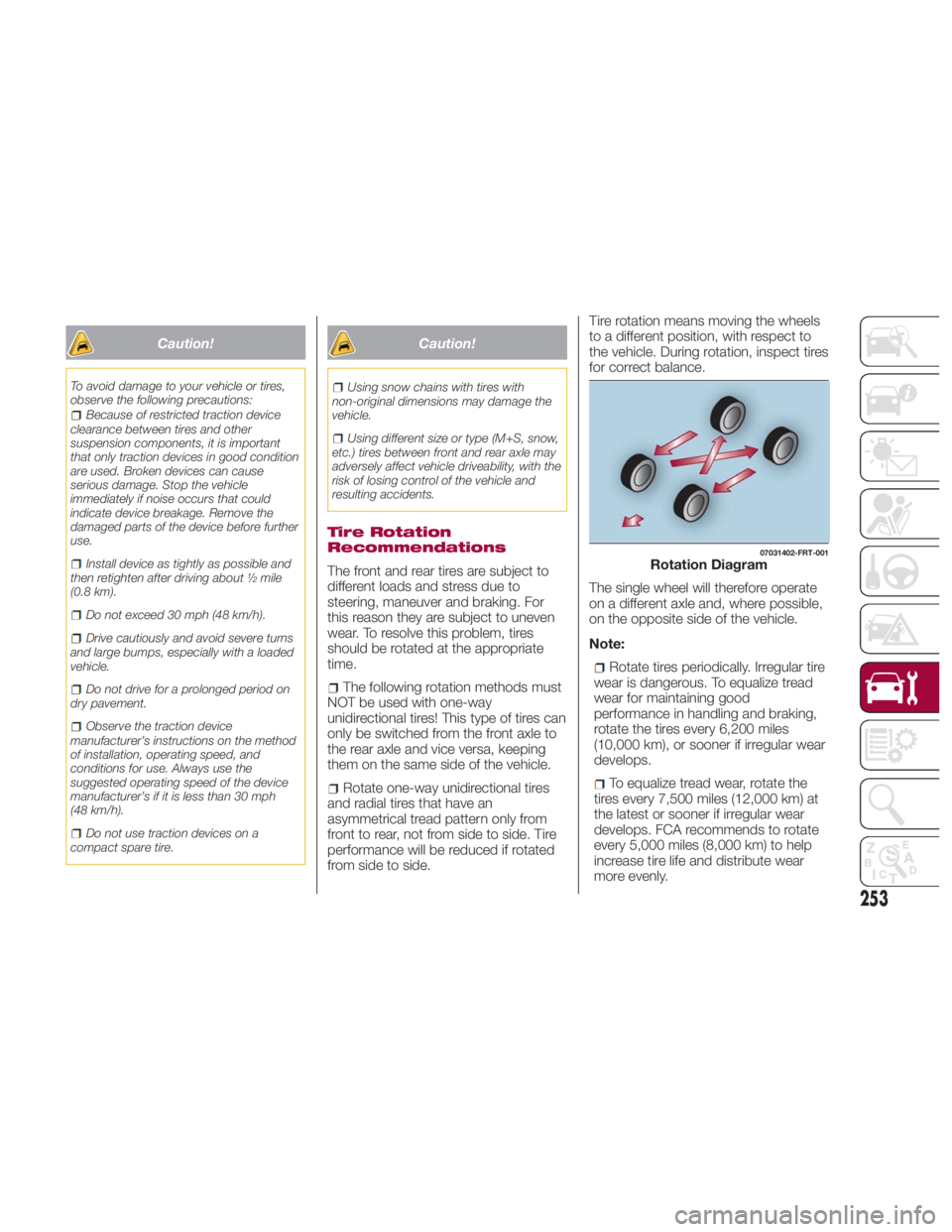
from side to side. Tire rotation means moving the wheels
to a different position, with respect to
the vehicle. During rotation, inspect tires
for correct balance.
The single wheel will therefore operate
on a different axle and, where possible,
on the opposite side of the vehicle.
Note:
Rotate tires periodically. Irregular tire
wear is dangerous. To equalize tread
wear for maintaining good
performance in handling and braking,
rotate the tires every 6,200 miles
(10,000 km), or sooner if irregular wear
develops.
To equalize tread wear, rotate the
tires every 7,500 miles (12,000 km) at
the latest or sooner if irregular wear
develops. FCA recommends to rotate
every 5,000 miles (8,000 km) to help
increase tire life and distribute wear
more evenly. 07031402-FRT-001
Rotation Diagram
253
Page 286 of 292

INDEX About Your Brakes .......... .150
ABS system ............... .112
Active Adaptive Shift (AAS) ..... .156
Adaptive Front Lighting System
(AFS) ...................42
Additives, Fuel ............. .174
Advanced Keyless Entry System
Key Left In Trunk ............21
Key left In Vehicle ...........21
Locking Doors .............21
Passive Entry ..............21
Request Switch ............21
Unlocking Doors ............21
AirBag............... .131,135
Advance Front Air Bag . . . .131,135
Air Bag Warning Light ...... .147
Event Data Recorder (EDR) .145,222
FrontAirBag ............ .147
Maintaining Your Air Bag
System ............... .145
Air Bag Maintenance ......... .145
Air Pressure, Tires ........... .246
Alarm
Vehicle Security Alarm ..... .24,25
Alarm (Security Alarm) ....... .24,25
Aluminium wheel maintenance . . . .259
Automatic Dimming Mirror ........36
Automatic Headlights ...........40 Automatic Temperature Control
(ATC) ...................52
Automatic Transmission ....... .153
Auxiliary Power Outlet ..........63
B-Pillar Location ............ .242
Battery (maintenance) ......... .234
Battery charging procedure ..... .235
Battery recharging ........... .235
Blind Spot Monitoring ......... .114
Body and underbody warranty . . . .256
Body lubrication ............ .235
Bodywork (care and maintenance). .256
Boot, Convertible Top Lowering ....70
Boot, Convertible Top Precautions . .73
Boot, Convertible Top Raising .....71
Brake System .............. .150
Brake/clutch fluid (level check) . . . .233
Brakes ............... .150,271
Bright-metal maintenance ......
.259
Camera,
Rear ..............
.167
Carbon Monoxide Warning ..... .175
Center Seat Storage Compartment .......................60
Certification Label ........... .176
Changing A Flat Tire .... .203,204,237
Chart, Tire Sizing ............ .239
Check Engine Light (Malfunction
Indicator Light) ........... .110 Checking levels ............. .231
Child Restraint ............. .128
Child Restraints
Child Restraints .......... .128
Clean Air Gasoline ........... .173
Cleaning
Wheels ............... .251
Climate Control ..............45
Close The Hood ..............69
Compact Spare Tire .......... .250
Contract, Service ........... .281
Convertible Top ..............70
Convertible top maintenance .... .260
Cooling
Air Conditioning ............50
Cupholders .................64
Customer Assistance ......... .280
Data Recorder, Event ......... .145
Daytime Running Lights .........40
Diagnostic System, Onboard .... .109
Dimensions ............... .274
Disabled Vehicle Towing .... .220,221
Driver's Seat Back Tilt ..........33
Driving in flooded area ........ .181
Driving tips ............... .178
Electric power steering ..........74
Electric Remote Mirrors .........37
INDEX