2017 FIAT PANDA Eco
[x] Cancel search: EcoPage 120 of 216

144)The vehicle's driving characteristics
will be modified with the space-saver wheel
fitted. Avoid violent acceleration and
braking, abrupt steering and fast cornering.
The overall duration of the space-saver
wheel is about 3000 km, after which the
relevant tyre must be replaced with another
one of the same type. Never install a
traditional tyre on a rim designed to be
used as a space-saver wheel. Have the
wheel repaired and refitted as soon as
possible. Using two or more space-saver
wheels at the same time is forbidden.
Do not apply grease to the bolt threads
before fitting: they could come unscrewed.
145)The jack is a tool developed and
designed only for changing a wheel, if a
tyre gets punctured or damaged, on the
vehicle with which it is supplied or on other
vehicles of the same model. Any other
use, e.g. to jack up other vehicle models or
different things, is strictly prohibited. Never
use for maintenance or repair activities
under the car or to exchange the
summer/winter wheels and vice versa.
Never go under the raised vehicle. If any
work under the vehicle is necessary,
contact the Fiat Service Network. Incorrect
positioning of the jack may cause the
raised vehicle to fall: use only in the
positions indicated. Do not use the jack for
loads higher than the one shown on its
label. Never start the engine with vehicle
raised. If the vehicle is raised more than
necessary, everything can become more
unstable, with the risk of the vehicle
dropping violently. Thus, lift the vehicle only
as needed in order to access the spare
wheel.146)If the hub cap is not fitted correctly, it
may come off when the car is travelling.
Never tamper with the inflation valve. Never
introduce tools of any kind between rim
and tyre. Check tyre and space-saver
wheel pressures regularly, complying with
the values given in the "Technical
specifications" chapter.
WARNING
53)When turning the jack handle make
sure that it can turn freely without scraping
your hand against the ground. The moving
components of the jack ("worm screw"
and joints) can also cause injuries: avoid
touching them. If you come into contact
with lubricating grease, clean yourself
thoroughly.
54)Contact a Fiat Dealership as soon as
possible to have the correct tightening
of the wheel bolts checked.
“Fix&Go Airflat” kit
The kit is located in the luggage
compartment under the load platform
cover.
The kit is composed of:
a spray bottle A fig. 115 with the
sealant, equipped with filling pipe B,
separated by the compressor C;
compressor C with pressure gauge,
fitting valve to couple the bottle A,
cable with supply socket D and pipe E
to restore pressure (this is inside the
body as shown);
adhesive label on the spray bottle A,
with the message "max. 80 km/h" to
be placed where the driver can easily
see it (for example on the dashboard)
after repairing the tyre;
instruction booklet, explaining the
quick and correct use of the Fix&Go;
a pair of protective gloves.
118
IN AN EMERGENCY
Page 132 of 216

Thousands of kilometres 15 30 45 60 75 90 105 120 135 150
Years12345678910
Check correct fitting of injectors (positioning, clip retention)
(Natural Power versions only)
Change engine oil and replace oil filter (4) (O) (●)
Replace spark plugs (1.2 8V 69 HP and 0.9 TwinAir Turbo
80 HP/85 HP versions) (5)
Replace spark plugs (0.9 TwinAir 60 HP/65 HP) (5)
Replace accessory drive belt/s(6)
(4) If the vehicle is used mainly on urban routes or the annual distance travelled is less than 10,000 km, the engine oil and engine oil filter must be changed every
year.
(O) Recommended operations
(●) Mandatory operations
(5) For 0.9 Twin Air versions, to guarantee correct operation and prevent serious damage to the engine, it is essential to proceed as follows: only use spark plugs
specifically certified for these engines; all spark plugs should be of the same type and brand (see the "Engine" paragraph in the "Technical specifications"
chapter); strictly comply with the spark plugs replacement intervals in the Scheduled Servicing Plan. It is advisable to contact a FIAT Dealership for plug
replacement.
(6) Areas that are not dusty: recommended maximum mileage 120,000 km. The belt must be replaced every 6 years, regardless of distance travelled. Dustyareas
and/or demanding use of the vehicle (cold climates, town use, long periods of idling): advised maximum mileage 60,000 km. The belt must be replaced every 4
years, regardless of distance travelled.
130
SERVICING AND CARE
Page 133 of 216

Thousands of kilometres 15 30 45 60 75 90 105 120 135 150
Years12345678910
Replace toothed timing drive belt (all 0.9 TwinAir versions
excluded)(6)
Replace air cleaner cartridge (7)
Change the brake fluid(8)
Replace filter inside the pressure regulator (LPG versions
only)
Replace paper filter (LPG in gaseous state) (LPG versions
only)
Replace the passenger compartment cleaner (7) (O) (●)
(6) Areas that are not dusty: recommended maximum mileage 120,000 km. The belt must be replaced every 6 years, regardless of distance travelled. Dustyareas
and/or demanding use of the vehicle (cold climates, town use, long periods of idling): advised maximum mileage 60,000 km. The belt must be replaced every 4
years, regardless of distance travelled.
(7) If the vehicle is used in dusty areas, this cleaner must be replaced every 15,000 km
(8) The brake fluid replacement has to be done every two years, irrespective of the mileage
(O) Recommended operations
(●) Mandatory operations
131
Page 136 of 216
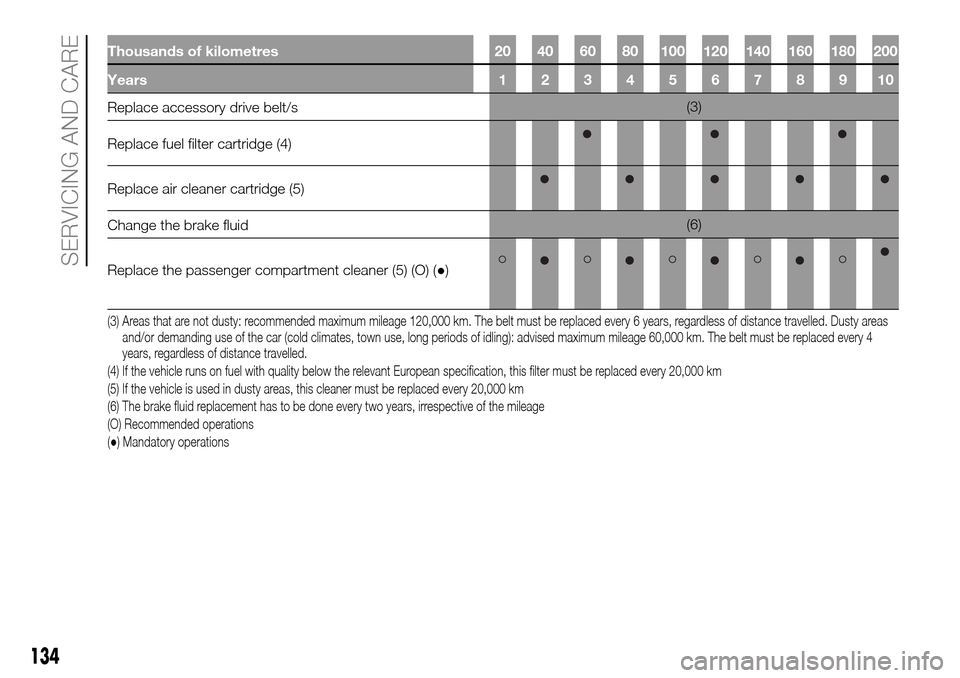
Thousands of kilometres 20 40 60 80 100 120 140 160 180 200
Years12345678910
Replace accessory drive belt/s(3)
Replace fuel filter cartridge (4)
Replace air cleaner cartridge (5)
Change the brake fluid(6)
Replace the passenger compartment cleaner (5) (O) (●)
(3) Areas that are not dusty: recommended maximum mileage 120,000 km. The belt must be replaced every 6 years, regardless of distance travelled. Dustyareas
and/or demanding use of the car (cold climates, town use, long periods of idling): advised maximum mileage 60,000 km. The belt must be replaced every 4
years, regardless of distance travelled.
(4) If the vehicle runs on fuel with quality below the relevant European specification, this filter must be replaced every 20,000 km
(5) If the vehicle is used in dusty areas, this cleaner must be replaced every 20,000 km
(6) The brake fluid replacement has to be done every two years, irrespective of the mileage
(O) Recommended operations
(●) Mandatory operations
134
SERVICING AND CARE
Page 137 of 216

BATTERY
RECHARGING
156) 157)
IMPORTANT After turning the ignition
key to STOP and having closed the
driver's side door, wait at least one
minute before disconnecting and then
reconnecting the battery electrical
supply.
IMPORTANT Charging should be slow
at a low ampere rating for
approximately 24 hours. Charging for a
longer time may damage the battery.
IMPORTANT The cables of the
electrical system must be correctly
reconnected to the battery, i.e. the
positive cable (+) to the positive
terminal and the negative cable (–) to
the negative terminal. The battery
terminals are marked with the positive
(+) and negative (–) symbols, and are
shown on the battery cover. The battery
terminals must also be corrosion-free.
IMPORTANT If a "quick-type" battery
charger is used with the battery fitted
on the vehicle, before connecting it
disconnect both cables of the battery
itself. Do not use a "quick-type" battery
charger to provide the starting voltage.IMPORTANT The battery recharging
procedure is given as information only.
You are advised to contact a Fiat
Dealership to have this operation
performed.
VERSIONS WITHOUT
Start&Stop SYSTEM
(for versions/markets, where provided)
Charge the battery as follows:
disconnect the negative battery
terminal;
connect the charger cables to the
battery terminals, observing the polarity;
turn on the charger;
when it is recharged, turn the
charger off before disconnecting it from
the battery;
reconnect the negative battery
terminal.
VERSIONS WITH
Stop/Start SYSTEM
(for versions/markets, where provided)
To recharge, proceed as follows:
disconnect the connector A fig. 122
(pressing the button B) from the sensor
C monitoring the battery conditions,
on the negative pole D of the battery;
connect the positive cable of the
battery charger to the positive battery
pole E and the negative cable to the
terminal of sensor D;
turn on the battery charger. At the
end of the charging process, switch the
battery charger off;
after having disconnected the
charging device, reconnect the
connector A to the sensor C.
122F1D0136
135
Page 142 of 216

ENGINE OIL
60) 61)3)
Check the oil level a few minutes (about
five) after the engine has stopped,
with the vehicle parked on level ground.
Check that the oil level is between the
MIN and MAX references on the
dipstick B. If the oil level is near or even
under the MIN mark, add oil using the
filler A to reach the MAX mark.
NOTE For the 0.9 TwinAir and 0.9
TwinAir Turbo versions, engine oil
dipstick B is integral with the cap A.
Take out the engine oil dipstick A, clean
it with a lint-free cloth and reinsert it.
Extract it again and check that the level
is between the MIN and MAX marks
on the dipstick.
Engine oil consumption
The maximum engine oil consumption
is usually 400 grams every 1000 km.
During the initial period of use the
engine oil consumption conditions
should be considered as having
stabilised after the first 5000 - 6000
km.
IMPORTANT After adding or changing
the oil, let the engine run for a few
seconds and wait a few minutes after
switching it off before checking the
level.ENGINE COOLANT FLUID
160)62)
The coolant level must be checked
when the engine is cold and must
range between the MIN and MAX
marks on the reservoir.
If the level is too low, unscrew reservoir
cap C and add the fluid described in
the "Technical Specifications" section.
WINDSCREEN/REAR
WINDOW WASHING FLUID
161)
If the level is too low, raise reservoir cap
D (see previous pages) and add the
fluid described in the chapter "Technical
Specifications".
BRAKE FLUID
162) 163)63)
Check that the fluid is at the maximum
level (the fluid level in the reservoir
must not exceed the MAX mark). If the
fluid level in the reservoir is too low,
undo reservoir cap E and add the fluid
described in the "Technical
Specifications" chapter.
DUALOGIC GEARBOX
HYDRAULIC ACTIVATION
SYSTEM OIL
4)
The fluid level should only be checked
at a Fiat Dealership.BATTERY
164) 165) 166) 167)
64)5)
Battery F does not require topping up
the electrolyte with distilled water. A
periodic check carried out at a Fiat
Dealership is, however, necessary to
check efficiency.
IMPORTANT After the battery is
disconnected, the steering must be
initialised. The
warning light on the
instrument panel switches on to
indicate this. To carry out this
procedure turn the steering wheel all
the way from one end to the other
or drive in a straight line for about a
hundred metres.
IMPORTANT If the charge level remains
under 50% for a long time, the battery
is damaged by sulphation, reducing
its capacity and efficiency at start-up.
CLIMATE CONTROL
SYSTEM MAINTENANCE
In winter, the climate control system
must be turned on at least once a
month for about 10 minutes. Before
summer, have the system checked at a
Fiat Dealership.
140
SERVICING AND CARE
Page 145 of 216

LIFTING THE
VEHICLE
169)
If the vehicle needs to be raised, go to
a Fiat Dealership which is equipped
with arm lifts and workshop lifts fig.
128.
WARNING
169)Lift the vehicle exclusively by
positioning the jack arms or the workshop
jack in the points illustrated.
WHEELS AND TYRES
170) 171)
66) 67) 68) 69)
SUGGESTIONS ABOUT
THE ROTATION OF THE
TYRES
The front and rear tyres are subject to
different loads and stress due to
steering, manoeuvres and braking. For
this reason they are subject to uneven
wear.
To resolve this problem, tyres should be
rotated at the appropriate time. This
operation is recommended for tyres
with a deep tread pattern, suitable both
for on-road and off-road driving.
Tyre rotation contributes to the
preservation of the grip and traction
performance on wet, muddy or snowy
roads, guaranteeing optimal driveability
of the vehicle.
In the case of irregular wear of the
tyres, the reason must be identified and
corrected before rotating them.
WARNING
170)Do not cross switch the tyres if they
are "unidirectional" type. In this case,
always take care not to fit the tyres with a
direction of rotation that is opposite to that
indicated: you would risk losing grip and
control of the vehicle.
171)Travelling with partially or completely
deflated tyres can cause safety problems
and damage the concerned tyre beyond
repair.
WARNING
66)The road holding qualities of the car
also depend on the correct inflation
pressure of the tyres.
67)If tyre pressure is too low, the tyre may
overheat and be severely damaged as a
result.
68)Do not switch tyres from the righthand
side of the vehicle to the lefthand side,
and vice versa.
69)Never submit alloy rims to repainting
treatments requiring the use of
temperatures exceeding 150°C. The
mechanical properties of the wheels could
be impaired.
128F1D0135
143
Page 148 of 216

IDENTIFICATION
DATA
VEHICLE IDENTIFICATION
NUMBER (VIN) PLATE
Depending on the version, the plate fig.
129 may be located to the right or at
the centre of the luggage compartment
(lift the carpet covering to access it). It
contains the following data:
AName of Manufacturer
BType-approval number.
CVehicle type identification code.
DChassis serial number.
EMaximum permitted weight of vehicle
fully laden.
FMaximum permitted weight of vehicle
fully laden plus trailer.
GMaximum permitted weight on first
axle (front).
HMaximum permitted weight on
second axle (rear).
IEngine type.
LBodywork version code.
MSpare part number.
NCorrect value of smoke coefficient
(for diesel engines).
BODYWORK PAINT
IDENTIFICATION PLATE
This is applied inside the bonnet (left
side) and bears the following data
fig. 130:
APaint manufacturer.
BColour name.
CFiat colour code.
DRespray and touch up code.CHASSIS MARKING
This is located on the right side of the
luggage compartment rear floor and
gives the following identification data:
type of vehicle;
chassis serial number.
ENGINE MARKING
It is stamped on the cylinder block and
includes the type and the engine serial
number.
129F1D0142
130F1D0128
146
TECHNICAL DATA