Page 249 of 370
occupants and cargo should never exceed XXX kg or
XXX lbs” on the Tire and Loading Information placard.
The combined weight of occupants, cargo/luggage and
trailer tongue weight (if applicable) should never ex-
ceed the weight referenced here.
Steps For Determining Correct Load Limit—
(1) Locate the statement “The combined weight of
occupants and cargo should never exceed XXX kg or
XXX lbs.” on your vehicle’s placard.
(2) Determine the combined weight of the driver and
passengers that will be riding in your vehicle.
(3) Subtract the combined weight of the driver and
passengers from XXX kg or XXX lbs.
(4) The resulting figure equals the available amount
of cargo and luggage load capacity. For example, if
“XXX” amount equals 1400 lbs. and there will be five
150 lb passengers in your vehicle, the amount of
available cargo and luggage load capacity is 650 lbs.
(1400-750 (5x150) = 650 lbs.)(5) Determine the combined weight of luggage and
cargo being loaded on the vehicle. That weight may
not safely exceed the available cargo and luggage
load capacity calculated in Step 4.
(6) If your vehicle will be towing a trailer, load from
your trailer will be transferred to your vehicle.
Consult this manual to determine how this reduces
the available cargo and luggage load capacity of your
vehicle.
Metric Example For Load Limit
For example, if “XXX” amount equals 635 kg and there
will be five 68 kg passengers in your vehicle, the
amount of available cargo and luggage load capacity is
295 kg (635-340 (5x68) = 295 kg) as shown in step 4.
NOTE:
•
If your vehicle will be towing a trailer, load from your
trailer will be transferred to your vehicle. The follow-
ing table shows examples on how to calculate total
load, cargo/luggage, and towing capacities of your
vehicle with varying seating configurations and num-
ber and size of occupants. This table is for illustration
purposes only and may not be accurate for the seating
and load carry capacity of your vehicle.
5
STARTING AND OPERATING 247
Page 255 of 370
Snow Tires
Some areas of the country require the use of snow tires
during the Winter. Snow tires can be identified by a
“mountain/snowflake” symbol on the tire sidewall.If you need snow tires, select tires
equivalent in size and type to the
original equipment tires. Use snow
tires only in sets of four; failure to do
so may adversely affect the safety
and handling of your vehicle.
Snow tires generally have lower speed ratings than
what was originally equipped with your vehicle and
should not be operated at sustained speeds over 75 mph
(120 km/h). For speeds above 75 mph (120 km/h), refer
to original equipment or an authorized tire dealer for
recommended safe operating speeds, loading and cold
tire inflation pressures.
While studded tires improve performance on ice, skid
and traction capability on wet or dry surfaces may be
poorer than that of non-studded tires. Some states
prohibit studded tires; therefore, local laws should be
checked before using these tire types.
Run Flat Tires — If Equipped
Run Flat tires allow you the capability to drive 50 miles
(80 km) at 50 mph (80 km/h) after a rapid loss of
inflation pressure. This rapid loss of inflation is referred
to as the Run Flat mode. A Run Flat mode occurs when
the tire inflation pressure is of/or below 14 psi (96 kPa).
Once a Run Flat tire reaches the run flat mode it has
limited driving capabilities and needs to be replaced
immediately. A Run Flat tire is not repairable.
It is not recommended driving a vehicle loaded at full
capacity or to tow a trailer while a tire is in the run flat
mode.
See the tire pressure monitoring section for more infor-
mation.
Spare Tires — If Equipped
NOTE: For vehicles equipped with Tire Service Kit
instead of a spare tire, please refer to the “Tire Service
Kit” section located in your Owner ’s Information kit for
further information.
5
STARTING AND OPERATING 253
Page 273 of 370
CAUTION!
To avoid fuel spillage and overfilling, do not “top
off” the fuel tank after filling.
WARNING!
•Never have any smoking materials lit in or near
the vehicle when the fuel door is open or the tank
is being filled.
• Never add fuel when the engine is running. This
is in violation of most state and federal fire
regulations and may cause the “Malfunction In-
dicator Light” to turn on.
• A fire may result if fuel is pumped into a portable
container that is inside of a vehicle. You could be
burned. Always place fuel containers on the
ground while filling.
TRAILER TOWING
Trailer towing with this vehicle is not recommended.
Emergency Fuel Filling Procedure
5
STARTING AND OPERATING 271
Page 274 of 370

RECREATIONAL TOWING (BEHIND MOTORHOME, ETC.)
Towing This Vehicle Behind Another Vehicle
Towing ConditionWheels OFF the Ground Automatic Transmission
Flat Tow NONENOT ALLOWED
Dolly Tow FrontOK
Rear NOT ALLOWED
On Trailer ALLOK
NOTE: When towing your vehicle, always follow ap-
plicable state and provincial laws. Contact state and
provincial Highway Safety offices for additional details.
This vehicle may be towed on a flatbed or vehicle trailer
provided all four wheels are OFF the ground.
This vehicle may also be towed using a tow dolly (with
the front wheels OFF the ground).
CAUTION!
• DO NOT flat tow any vehicle equipped with an
automatic transmission. Damage to the drivetrain
will result. If these vehicles require towing, make
sure all drive wheels are OFF the ground.
• Towing this vehicle in violation of the above
requirements can cause severe transmission dam-
age. Damage from improper towing is not covered
under the New Vehicle Limited Warranty.
272 STARTING AND OPERATING
Page 275 of 370

WHAT TO DO IN EMERGENCIES
CONTENTS
�HAZARD WARNING FLASHERS ..........274
� IF YOUR ENGINE OVERHEATS ..........274
� WHEEL AND TIRE TORQUE
SPECIFICATIONS .....................275
▫ Torque Specifications ..................275
� TIRE SERVICE KIT .....................277
� JACKING AND TIRE CHANGING — IF
EQUIPPED ..........................280
▫ Jack Location .......................280
▫ Spare Tire Removal ...................281
▫ Preparations For Jacking ...............281
▫ Jacking Instructions ..................282
▫ Spare Tire Stowage ...................285 �
JUMP-STARTING PROCEDURE ...........286
▫ Preparations For Jump-Start .............286
▫ Jump-Starting Procedure ...............287
� FREEING A STUCK VEHICLE ............289
� GEAR SELECTOR OVERRIDE ............290
� TOWING A DISABLED VEHICLE ..........292
� IGNITION KEY REMOVAL OVERRIDE ......293
� CAP-LESS FUEL FILL FUNNEL ...........294
� ENHANCED ACCIDENT RESPONSE SYSTEM
(EARS) ............................ .294
� EVENT DATA RECORDER (EDR) ..........295
6
Page 280 of 370

WARNING!(Continued)
– If you are unsure of the condition of the tire or
the wheel.
• Keep Tire Service Kit away from open flames or
heat source.
• A loose Tire Service Kit thrown forward in a
collision or hard stop could endanger the occu-
pants of the vehicle. Always stow the Tire Service
Kit in the place provided. Failure to follow these
warnings can result in injuries that are serious or
fatal to you, your passengers, and others around
you.
• Take care not to allow the contents of Tire Service
Kit to come in contact with hair, eyes, or clothing.
Tire Service Kit sealant is harmful if inhaled,
swallowed, or absorbed through the skin. It
causes skin, eye, and respiratory irritation. Flush
immediately with plenty of water if there is any
contact with eyes or skin. Change clothing as soon
as possible, if there is any contact with clothing.
• Tire Service Kit Sealant solution contains latex. In
case of an allergic reaction or rash, consult a
physician immediately. Keep Tire Service Kit out
(Continued)
WARNING! (Continued)
of reach of children. If swallowed, rinse mouth
immediately with plenty of water and drink
plenty of water. Do not induce vomiting! Consult
a physician immediately.
Insert the power plug into the vehicle power outlet
socket. Start the vehicle engine.
Push the Tire Service Kit power button to the “I”
position. The electric compressor will be turned on,
sealant and air will inflate the tire.
Minimum 26 psi (1.8 bar) of pressure should be reached
within 20 minutes. If the pressure has not been reached,
turn off and remove the Tire Service Kit, drive the
vehicle 30 feet (10 meters) back and forth, to better
distribute the sealant inside the tire.
Attach the Clear flexible filling and tube of the com-
pressor directly to the tire valve and repeat the inflation
process.
When the correct pressure has been reached, start
driving the vehicle to uniformly distribute the sealant
inside the tire. After 10 minutes, stop and check the tire
pressure. If the pressure is below 19 psi (1.3 bar), do not
278 WHAT TO DO IN EMERGENCIES
Page 283 of 370
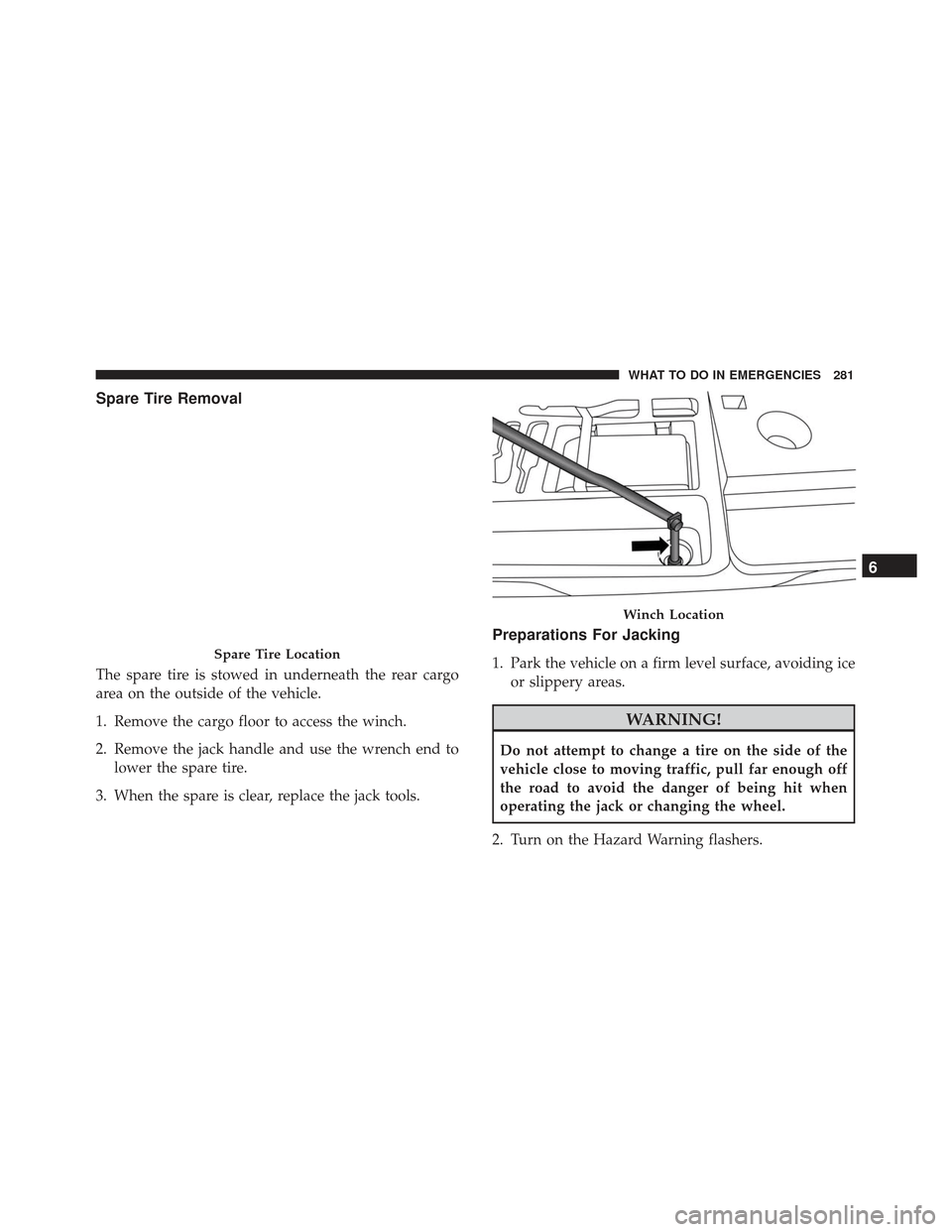
Spare Tire Removal
The spare tire is stowed in underneath the rear cargo
area on the outside of the vehicle.
1. Remove the cargo floor to access the winch.
2. Remove the jack handle and use the wrench end tolower the spare tire.
3. When the spare is clear, replace the jack tools.
Preparations For Jacking
1. Park the vehicle on a firm level surface, avoiding ice or slippery areas.
WARNING!
Do not attempt to change a tire on the side of the
vehicle close to moving traffic, pull far enough off
the road to avoid the danger of being hit when
operating the jack or changing the wheel.
2. Turn on the Hazard Warning flashers.
Spare Tire Location
Winch Location
6
WHAT TO DO IN EMERGENCIES 281
Page 287 of 370
8. Install the wheel bolts with the threaded end of thewheel bolt toward the wheel. Lightly tighten the
wheel bolts.
WARNING!
•To avoid the risk of forcing the vehicle off the
jack, do not tighten the lug nuts fully until the
vehicle has been lowered. Failure to follow this
warning may result in personal injury.
• To avoid possible personal injury, handle the
wheel covers with care to avoid contact with any
sharp edges.
9. Lower the vehicle to the ground by turning the jack handle counterclockwise.
10. Finish tightening the wheel bolts. Push down on the wrench while at the end of the handle for increased
leverage. Tighten the wheel bolts in a star pattern
until each wheel bolt has been tightened twice.
Refer to Torque Specifications in this section for
proper lug nut torque. If in doubt about the correct
tightness, have them checked with a torque wrench
by your authorized dealer or at a service station. 11. Stow the jack, tools and flat tire.
WARNING!
A loose tire or jack thrown forward in a collision or
hard stop could endanger the occupants of the
vehicle. Always stow the jack parts and the spare
tire in the places provided. Have the deflated (flat)
tire repaired or replaced immediately.
Spare Tire Stowage
Rotate the jack wrench tool on the winch drive nut
clockwise (the flat tire must not be connected to the
winch) until effort becomes heavy and an audible click
is heard indicating the winch is properly stowed.
Cover the flat tire with the Emergency Spare Tire Bag
and stow the flat tire into the trunk.
CAUTION!
The winch mechanism is designed for use with the
jack wrench extension tool only. Use of air wrench
or power tool may damage the winch.
6
WHAT TO DO IN EMERGENCIES 285