2017 FIAT 500L LIVING handbrake
[x] Cancel search: handbrakePage 4 of 240
READ THIS CAREFULLY
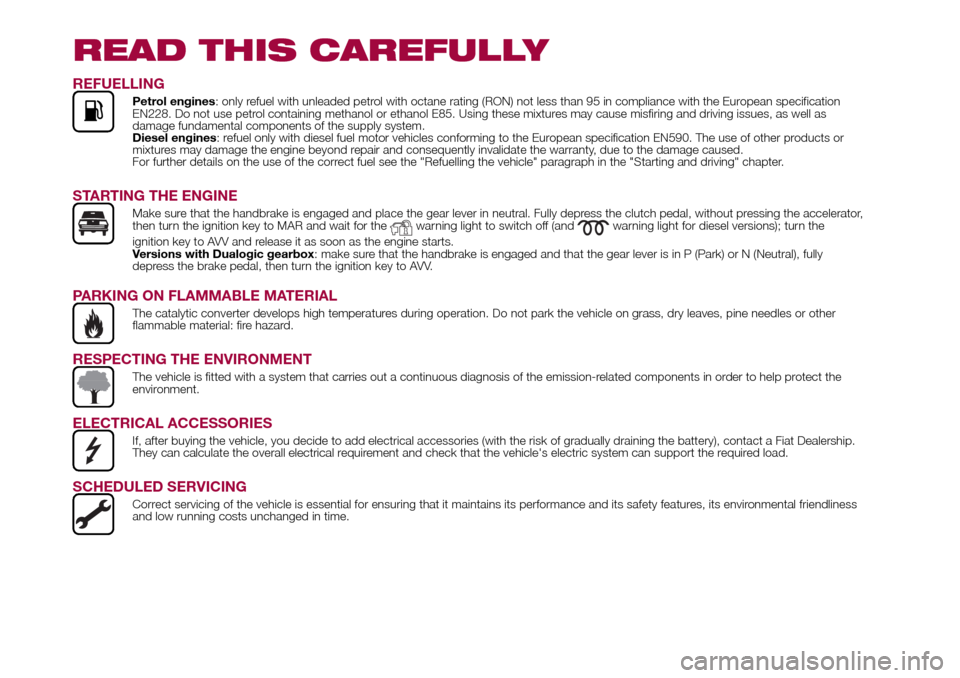
REFUELLING
Petrol engines: only refuel with unleaded petrol with octane rating (RON) not less than 95 in compliance with the European specification
EN228. Do not use petrol containing methanol or ethanol E85. Using these mixtures may cause misfiring and driving issues, as well as
damage fundamental components of the supply system.
Diesel engines: refuel only with diesel fuel motor vehicles conforming to the European specification EN590. The use of other products or
mixtures may damage the engine beyond repair and consequently invalidate the warranty, due to the damage caused.
For further details on the use of the correct fuel see the "Refuelling the vehicle" paragraph in the "Starting and driving" chapter.
STARTING THE ENGINE
Make sure that the handbrake is engaged and place the gear lever in neutral. Fully depress the clutch pedal, without pressing the accelerator,
then turn the ignition key to MAR and wait for thewarning light to switch off (andwarning light for diesel versions); turn the
ignition key to AVV and release it as soon as the engine starts.
Versions with Dualogic gearbox: make sure that the handbrake is engaged and that the gear lever is in P (Park) or N (Neutral), fully
depress the brake pedal, then turn the ignition key to AVV.
PARKING ON FLAMMABLE MATERIAL
The catalytic converter develops high temperatures during operation. Do not park the vehicle on grass, dry leaves, pine needles or other
flammable material: fire hazard.
RESPECTING THE ENVIRONMENT
The vehicle is fitted with a system that carries out a continuous diagnosis of the emission-related components in order to help protect the
environment.
ELECTRICAL ACCESSORIES
If, after buying the vehicle, you decide to add electrical accessories (with the risk of gradually draining the battery), contact a Fiat Dealership.
They can calculate the overall electrical requirement and check that the vehicle's electric system can support the required load.
SCHEDULED SERVICING
Correct servicing of the vehicle is essential for ensuring that it maintains its performance and its safety features, its environmental friendliness
and low running costs unchanged in time.
Page 12 of 240
WARNING
1)The electronic components inside the
key may be damaged if the key is
subjected to strong shocks. In order to
ensure complete efficiency of the
electronic devices inside the key, it should
never be exposed to direct sunlight.
WARNING
1)Used batteries should be disposed of,
as specified by law, in the special
containers, otherwise take them to a Fiat
Dealership, which will deal with their
disposal.
IGNITION DEVICE
3) 4) 5) 6)
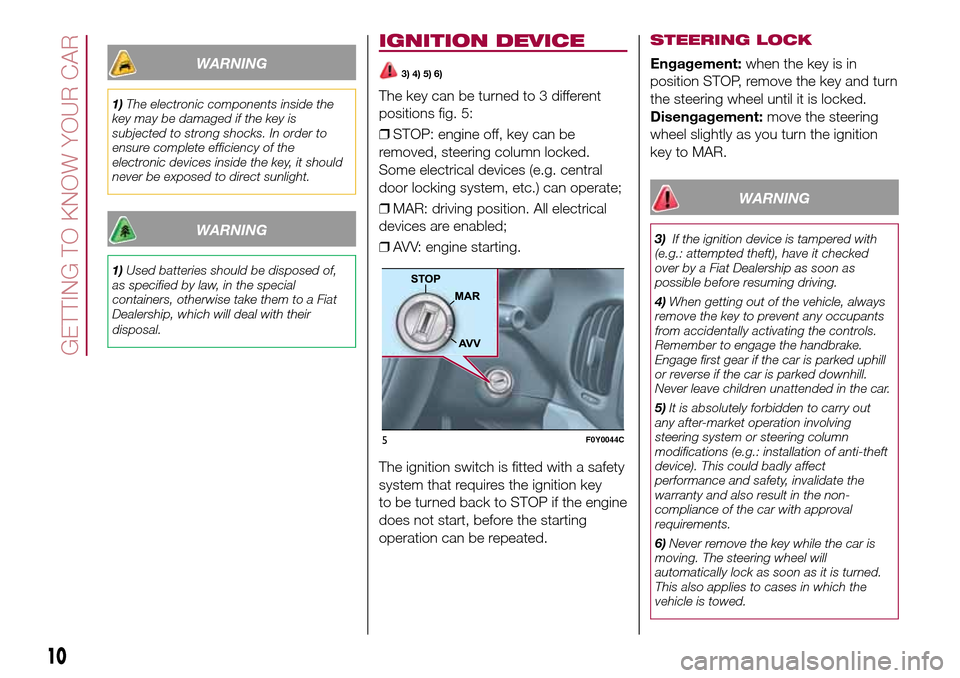
The key can be turned to 3 different
positions fig. 5:
❒STOP: engine off, key can be
removed, steering column locked.
Some electrical devices (e.g. central
door locking system, etc.) can operate;
❒MAR: driving position. All electrical
devices are enabled;
❒AVV: engine starting.
The ignition switch is fitted with a safety
system that requires the ignition key
to be turned back to STOP if the engine
does not start, before the starting
operation can be repeated.
STEERING LOCK
Engagement:when the key is in
position STOP, remove the key and turn
the steering wheel until it is locked.
Disengagement:move the steering
wheel slightly as you turn the ignition
key to MAR.
WARNING
3)If the ignition device is tampered with
(e.g.: attempted theft), have it checked
over by a Fiat Dealership as soon as
possible before resuming driving.
4)When getting out of the vehicle, always
remove the key to prevent any occupants
from accidentally activating the controls.
Remember to engage the handbrake.
Engage first gear if the car is parked uphill
or reverse if the car is parked downhill.
Never leave children unattended in the car.
5)It is absolutely forbidden to carry out
any after-market operation involving
steering system or steering column
modifications (e.g.: installation of anti-theft
device). This could badly affect
performance and safety, invalidate the
warranty and also result in the non-
compliance of the car with approval
requirements.
6)Never remove the key while the car is
moving. The steering wheel will
automatically lock as soon as it is turned.
This also applies to cases in which the
vehicle is towed.
5F0Y0044C
10
GETTING TO KNOW YOUR CAR
Page 47 of 240
WARNING LIGHTS AND MESSAGES
IMPORTANT The warning light switches on together with a dedicated message and/or acoustic signal when applicable. These
indications are indicative and precautionary and as such must not be considered as exhaustive and/or alternative to the
information contained in the Owner Handbook, which you are advised to read carefully in all cases. Always refer to the
information in this chapter in the event of a failure indication.
IMPORTANT The failure indicators appearing on the display are divided into two categories: very serious and less serious faults.
Serious faults are indicated by a repeated and prolonged warning "cycle". Less serious faults are indicated by a warning
"cycle" with a shorter duration. The display cycle of both categories can be interrupted. The instrument panel warning light will
stay on until the cause of the failure is eliminated.
WARNING LIGHTS ON INSTRUMENT PANEL
Red warning lights
Warning light What it means
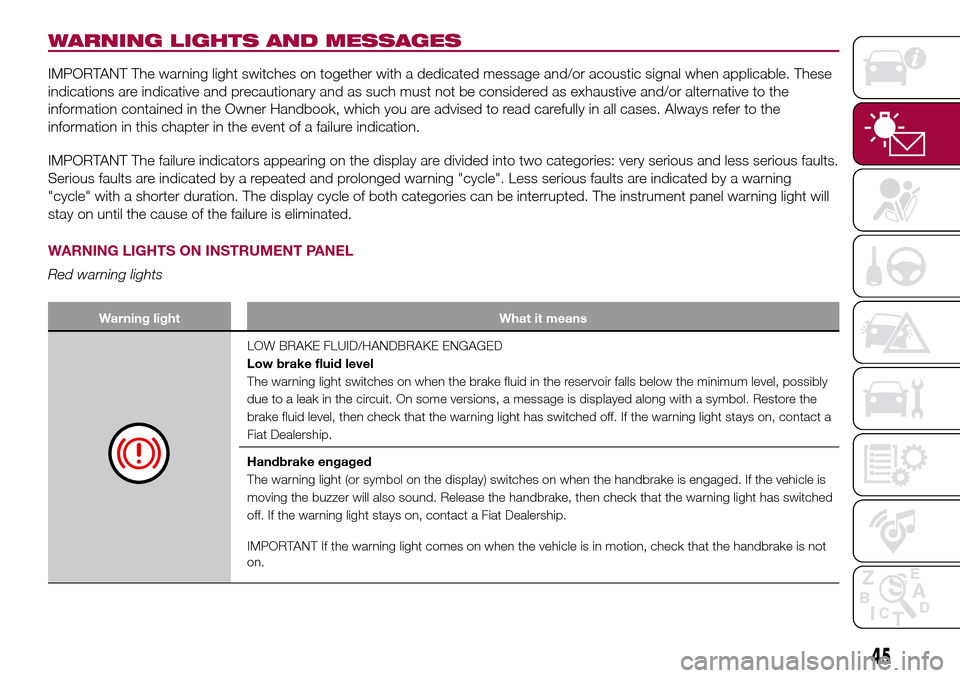
LOW BRAKE FLUID/HANDBRAKE ENGAGED
Low brake fluid level
The warning light switches on when the brake fluid in the reservoir falls below the minimum level, possibly
due to a leak in the circuit. On some versions, a message is displayed along with a symbol. Restore the
brake fluid level, then check that the warning light has switched off. If the warning light stays on, contact a
Fiat Dealership.
Handbrake engaged
The warning light (or symbol on the display) switches on when the handbrake is engaged. If the vehicle is
moving the buzzer will also sound. Release the handbrake, then check that the warning light has switched
off. If the warning light stays on, contact a Fiat Dealership.
IMPORTANT If the warning light comes on when the vehicle is in motion, check that the handbrake is not
on.
45
Page 69 of 240
54)The ESC system cannot alter the
natural laws of physics, and cannot
increase grip which depends on the
condition of the road.
55)The ESC system cannot prevent
accidents, including those due to excessive
speed on corners, driving on low-grip
surfaces or aquaplaning.
56)The capability of the ESC system must
never be tested irresponsibly and
dangerously, in such a way as to
compromise the safety of the driver, the
other occupants of the car or any other
road user.
57)For the correct operation of the ESC
and ASR systems it is extremely important
that the tyres are the same brand and
the same type on all the wheels, in perfect
condition and, above all, the
recommended type and size.
58)The performance of the ESC and ASR
systems must not encourage the driver
to take unnecessary risks. Your driving style
must always be suited to the road
conditions, visibility and traffic. The driver
is, in any case, responsible for safe driving.
59)The ESC functions even when the
space-saver wheel is being used. Always
remember that the space-saver wheel,
being smaller than the original wheel,
provides less grip.
60)The Hill Holder system is not a parking
brake; therefore, never leave the car
without having engaged the handbrake,
turned the engine off and engaged first
gear, so that the vehicle is parked in safe
conditions (for further information read the
"Parking" paragraph in the "Starting and
driving" chapter).61)There may be situations on small
gradients (less than 5%), with car laden, in
which the Hill Holder system may not
activate, causing a slight reversing motion
and increasing the risk of collision with
another vehicle or object. The driver is, in
any case, responsible for safe driving.
62)DST is an aid for driving and does not
relieve the driver of responsibility while
driving the vehicle.
63)The performance of a vehicle with ERM
must never be tested in imprudent or
dangerous ways, with the possibility of
putting the safety of the driver or other
people at risk.DRIVING
ASSISTANCE
SYSTEMS
The vehicle can be equipped with the
following active safety devices:
❒Traction Plus;
❒City Brake Control - "Collision
Mitigation";
❒iTPMS.
For the operation of the systems, see
the following pages.
TRACTION PLUS SYSTEM(for versions/markets, where provided)
The system works as a driving aid,
useful for setting off in poor grip
conditions (snow, ice, mud, etc.), which
allows the drive force to be distributed
optimally on the front axle.
The system acts by braking the wheels
with poor grip (or those slipping more
than the others), transferring the drive
force to those which have greater
grip on the ground.
The activation of the Traction Plus
system generates the differential locking
effect on the front axle through the
braking system, to optimise traction on
irregular terrain.
When the engine is started the system
is deactivated.
67
Page 94 of 240
STARTING AND DRIVING
Let’s get to the core of the vehicle:
seeing how you can exploit all of its
potential to the full.
We’ll look at how to drive it safely in any
situation, so that it can be a welcome
companion, with our comfort and
our wallets in mind.STARTING THE ENGINE ................. 93
HANDBRAKE .................................. 94
USING THE MANUAL GEARBOX .... 95
USING THE DUALOGIC
GEARBOX....................................... 96
STOP/START SYSTEM ................... 98
CRUISE CONTROL (CONSTANT
SPEED REGULATOR) ..................... 99
SPEED LIMITER ..............................100
PARKING SENSORS.......................101
REAR VIEW CAMERA .....................103
TOWING TRAILERS ........................104
REFUELLING THE VEHICLE ...........105
92
STARTING AND DRIVING
Page 95 of 240
STARTING THE
ENGINE
99) 100)51) 52) 53) 54) 55)
Before starting the engine, adjust the
seat, the interior rear view mirrors,
the door mirrors and fasten the seat
belt correctly.
Never press the accelerator pedal for
starting the engine.
VERSIONS WITH MANUAL
GEARBOX
Petrol versions
Proceed as follows:
❒engage the handbrake and place the
gear lever in neutral.For 0.9 TwinAir
Turbo 105 HP versionsengage the
handbrake and place the gear lever
in neutral or fully press the clutch pedal
if a gear other than neutral is engaged;
❒for all versions (except 0.9
TwinAir Turbo 105 HP)fully depress
the clutch pedal, without pressing
the accelerator;
❒turn the ignition key to AVV and
release it as soon as the engine starts.
Diesel versions
Proceed as follows:
❒engage the handbrake, put the gear
lever into neutral and turn the ignition
key to MAR: the warning lights
andon the instrument panel
will turn on;
❒wait for the warning lights
and
to turn off and then fully depress
the clutch pedal without pressing the
accelerator;
❒turn the ignition key to AVV as soon
as warning light
switches off.
Release the ignition key as soon as the
engine starts.
IMPORTANT If the engine does not
start at the first attempt, return the
ignition key to STOP before repeating
the procedure. If, with the ignition
key at MAR, the warning lights
and
(only for petrol versions) stay on
in the instrument panel, the ignition key
must be brought back to STOP and
then to MAR again. If the
warning
light stays on, retry with the other
keys provided. Contact a Fiat
Dealership if you still cannot start the
engine.
VERSIONS WITH
DUALOGIC GEARBOX
101)Engine starting is allowed both with a
gear engaged and with the gearbox
in neutral (N).
However, the brake pedal must always
be pressed first if neutral is not
engaged. It is therefore advisable to
place the gear lever in neutral (N) before
starting the engine.
LPG AND NATURAL
POWER VERSIONS
The engine always starts up on petrol
independently of the mode previously
selected.
There must therefore always be an
adequate reserve of petrol in the tank to
protect the petrol pump and to
guarantee temporary switching from
methane or LPG to petrol operation, if
high performance is required.
STOPPING THE ENGINE
Turn the ignition key to STOP while the
engine is idling.
IMPORTANT After a demanding drive,
before turning the engine off you should
allow it to idle to allow the temperature
in the engine compartment to
decrease.
93
Page 96 of 240
WARNING
99)It is dangerous to run the engine in
enclosed areas. The engine burns oxygen
and releases carbon dioxide, carbon
monoxide and other toxic gases.
100)Remember that the brake servo and
power steering are not operational until the
engine has been started, therefore you
need to apply much more force than usual
to the brake pedal and steering wheel.
101)If the engine fails to start with a gear
engaged, the potentially dangerous
situation due to the fact that the gearbox is
automatically placed in neutral will be
signalled by an acoustic signal.
WARNING
51)Warning lightflashing for 60
seconds after starting or during prolonged
cranking of the engine indicates a fault
with the glow plug heating system. You
can use the vehicle as usual if the engine
starts but you should contact a Fiat
Dealership as soon as possible.
52)It is advisable not to demand maximum
performance from your vehicle (e.g.
excessive acceleration, long distances at
maximum rpm, excessively intense braking,
etc.) when it is first used.
53)When the engine is off, do not leave
the key turned to MAR to prevent
unnecessary electrical consumption from
draining the battery.54)Never jump start the engine by
pushing, towing or coasting downhill.
These actions could cause the fuel to flow
into the catalytic converter and damage
it beyond repair.
55)Revving up before stopping the engine
is useless, it causes unnecessary fuel
consumption and can damage the engine,
in particular engines equipped with
turbocharger.
HANDBRAKE
102) 103)
The handbrake lever is located between
the two front seats.
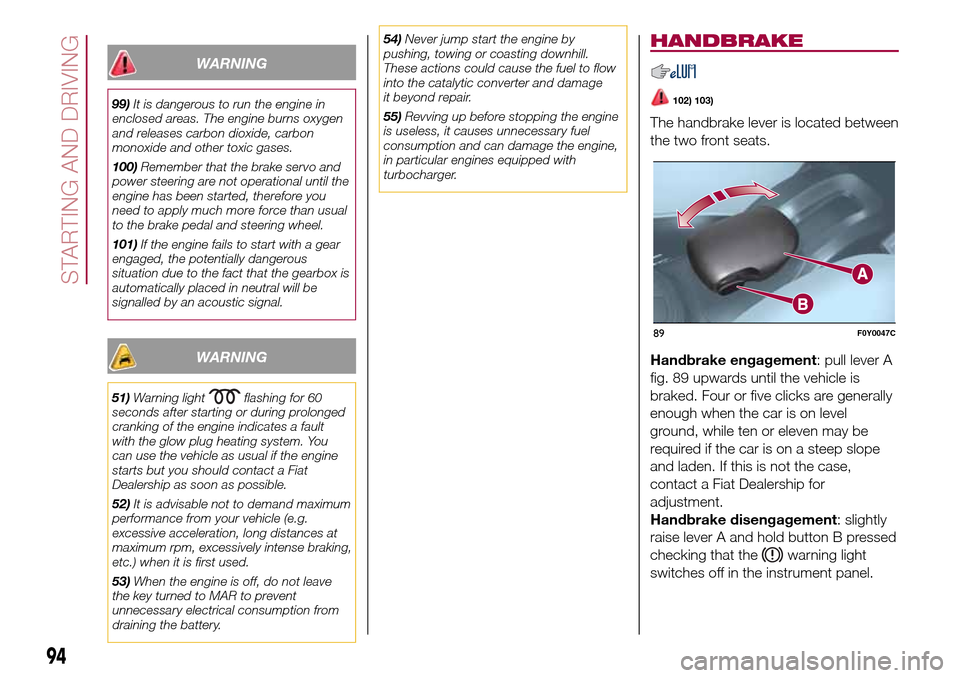
Handbrake engagement: pull lever A
fig. 89 upwards until the vehicle is
braked. Four or five clicks are generally
enough when the car is on level
ground, while ten or eleven may be
required if the car is on a steep slope
and laden. If this is not the case,
contact a Fiat Dealership for
adjustment.
Handbrake disengagement: slightly
raise lever A and hold button B pressed
checking that the
warning light
switches off in the instrument panel.
89F0Y0047C
94
STARTING AND DRIVING
Page 97 of 240
WARNING
102)Never leave children unattended in
the vehicle. Always remove the key from
the ignition device when leaving the vehicle
and take it with you.
103)For vehicles equipped with a front
armrest, lift it up to ensure that it does not
interfere with the action of the handbrake.
USING THE MANUAL
GEARBOX
104)56)
To engage the gears, press the clutch
pedal fully and put the gear lever into
the required position (the diagram
for gear engagement is shown on the
knob ).
Reverse engagement
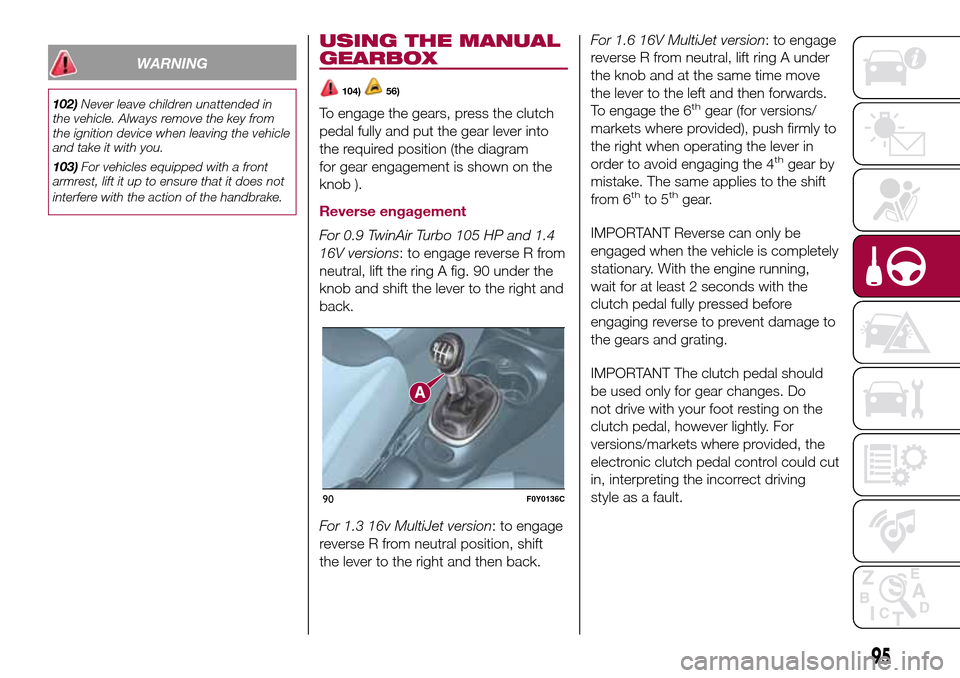
For 0.9 TwinAir Turbo 105 HP and 1.4
16V versions: to engage reverse R from
neutral, lift the ring A fig. 90 under the
knob and shift the lever to the right and
back.
For 1.3 16v MultiJet version: to engage
reverse R from neutral position, shift
the lever to the right and then back.For 1.6 16V MultiJet version: to engage
reverse R from neutral, lift ring A under
the knob and at the same time move
the lever to the left and then forwards.
To engage the 6
thgear (for versions/
markets where provided), push firmly to
the right when operating the lever in
order to avoid engaging the 4
thgear by
mistake. The same applies to the shift
from 6
thto 5thgear.
IMPORTANT Reverse can only be
engaged when the vehicle is completely
stationary. With the engine running,
wait for at least 2 seconds with the
clutch pedal fully pressed before
engaging reverse to prevent damage to
the gears and grating.
IMPORTANT The clutch pedal should
be used only for gear changes. Do
not drive with your foot resting on the
clutch pedal, however lightly. For
versions/markets where provided, the
electronic clutch pedal control could cut
in, interpreting the incorrect driving
style as a fault.
90F0Y0136C
95