2017 FIAT 500 ABARTH CABRIO service
[x] Cancel search: servicePage 143 of 338
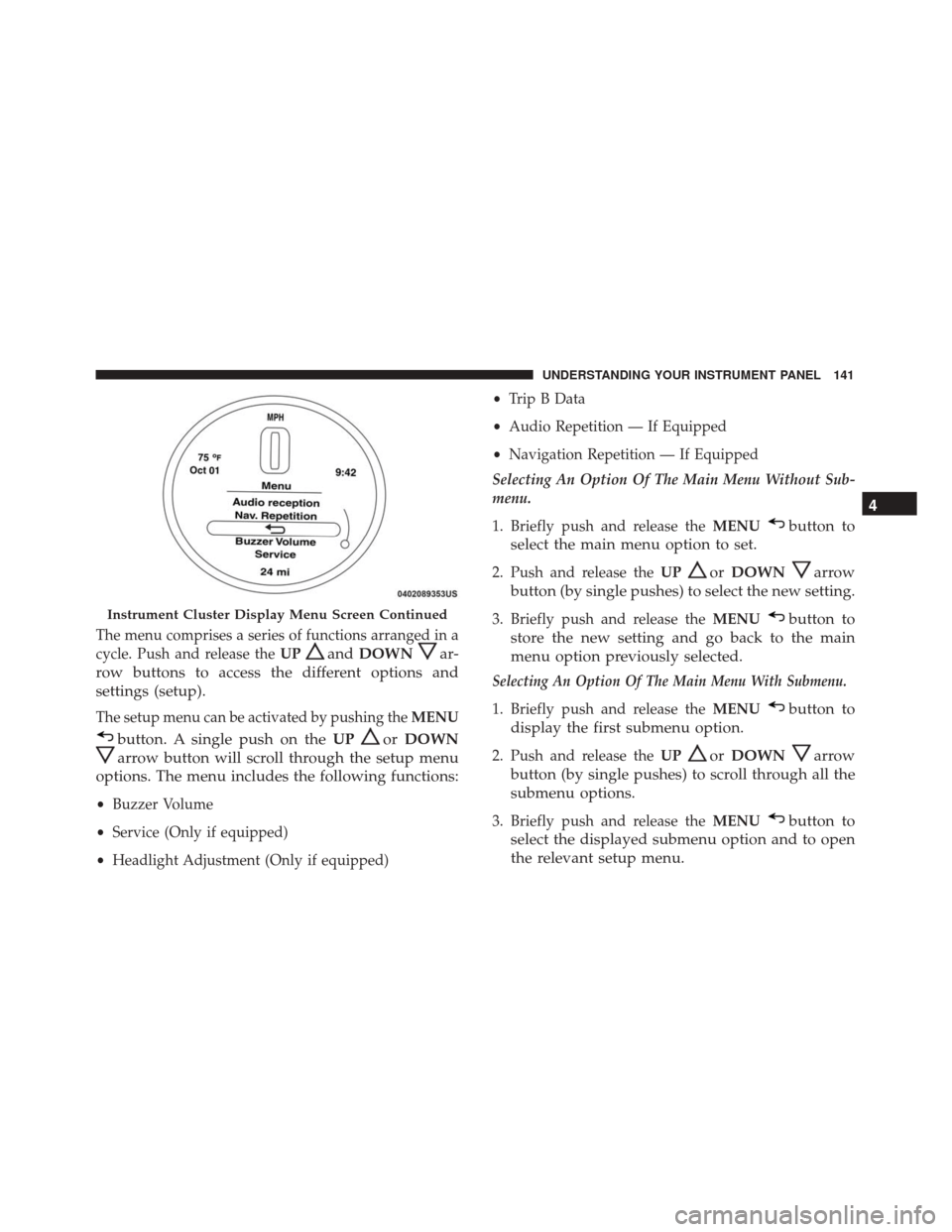
The menu comprises a series of functions arranged in a
cycle. Push and release theUP
andDOWNar-
row buttons to access the different options and
settings (setup).
The setup menu can be activated by pushing the MENU
button. A single push on theUPorDOWN
arrow button will scroll through the setup menu
options. The menu includes the following functions:
• Buzzer Volume
• Service (Only if equipped)
• Headlight Adjustment (Only if equipped) •
Trip B Data
• Audio Repetition — If Equipped
• Navigation Repetition — If Equipped
Selecting An Option Of The Main Menu Without Sub-
menu.
1. Briefly push and release the MENU
button to
select the main menu option to set.
2. Push and release the UPorDOWNarrow
button (by single pushes) to select the new setting.
3. Briefly push and release the MENUbutton to
store the new setting and go back to the main
menu option previously selected.
Selecting An Option Of The Main Menu With Submenu.
1. Briefly push and release the MENUbutton to
display the first submenu option.
2. Push and release the UPorDOWNarrow
button (by single pushes) to scroll through all the
submenu options.
3. Briefly push and release the MENUbutton to
select the displayed submenu option and to open
the relevant setup menu.
Instrument Cluster Display Menu Screen Continued
4
UNDERSTANDING YOUR INSTRUMENT PANEL 141
Page 148 of 338

Service – If Equipped
This function allows you to display the information
about mileage intervals for servicing your car.
To view this information, proceed as follows:
1. Briefly push and release theMENUbutton to enter
the Main MENU.
2. Push and release the UP
orDOWNarrow
button to select Service. Push and release the
MENU button, push and release the UP
or
DOWN
arrow button to reset.
NOTE: IMPORTANT The “Scheduled Servicing Plan”
includes car maintenance at fixed intervals.
This is displayed automatically, with ignition key at
MAR-ON, before servicing or, where provided, 30 days
before servicing.
Headlight Adjustment – If Equipped
When this function is activated the cluster will display
the headlight adjustment features.
Service Submenu Display
Headlight Adjustment Submenu Display
146 UNDERSTANDING YOUR INSTRUMENT PANEL
Page 162 of 338

SiriusXM Setup — If Equipped
After pressing the “SiriusXM Setup” button on the
touchscreen, the following settings will be available:
Setting NameSelectable Options
Tune Start OnOff
NOTE: “Tune Start” begins playing the current song from the beginning when you tune to a music channel us-
ing one of the twelve presets, so you can enjoy the complete song. This feature occurs the first time the preset
is selected during that current song. Tune Start works in the background, so you will not even realize it’s on,
except that you will miss the experience of joining your favorite song with only a few seconds left to play.
Channel Skip Channel Skip
NOTE: SiriusXM can be programmed to designate a group of channels that are the most desirable to listen to
or to exclude undesirable channels while scanning.
Subscription Information Subscription Info
NOTE:
•New vehicle purchasers or lessees will receive a free limited time subscription to SiriusXM Satellite Radio
with your radio. Following the expiration of the free services, it will be necessary to access the information
on the Subscription Information screen to re-subscribe.
•Write down the SIRIUS ID numbers for your receiver. To reactivate your service, either call the number listed
on the screen or visit the provider online.
NOTE: SiriusXM Travel Link is a separate subscription
and is available for U.S. residents only.
160 UNDERSTANDING YOUR INSTRUMENT PANEL
Page 180 of 338

Manual Operation Override
This system offers a full complement of manual over-
ride features. The AUTO symbol in the front ATC
display will be turned off when the system is being
used in the manual mode.
NOTE:The system will not automatically sense the
presence of fog, mist or ice on the windshield. DE-
FROST mode must be manually selected to clear the
windshield and side glass.
Operating Tips
NOTE: Refer to the chart at the end of this section for
suggested control settings for various weather conditions.
Summer Operation
The engine cooling system must be protected with a
high-quality antifreeze coolant to provide proper corro-
sion protection and to protect against engine overheating.
OAT coolant (conforming to MS.90032) is recommended.
Refer to “Maintenance Procedures” in “Maintaining Your
Vehicle” for proper coolant selection.
Winter Operation
To ensure the best possible heater and defroster perfor-
mance, make sure the engine cooling system is func-
tioning properly and the proper amount, type, and
concentration of coolant is used. Refer to “Maintenance
Procedures” in “Maintaining Your Vehicle” for proper
coolant selection. Use of the air Recirculation mode
during Winter months is not recommended because it
may cause window fogging.
Vacation/Storage
Before you store your vehicle, or keep it out of service
(i.e., vacation) for two weeks or more, run the air
conditioning system at idle for about five minutes, in
fresh air with the blower setting on high. This will
ensure adequate system lubrication to minimize the
possibility of compressor damage when the system is
started again.
Window Fogging
Vehicle windows tend to fog on the inside in mild, rainy
and/or humid weather. To clear the windows, select
Defrost or Mix mode and increase the front blower
speed. Do not use the Recirculation mode without A/C
for long periods, as fogging may occur.
178 UNDERSTANDING YOUR INSTRUMENT PANEL
Page 181 of 338

Outside Air Intake
Make sure the air intake, located directly in front of the
windshield, is free of obstructions such as leaves.
Leaves collected in the air intake may reduce airflow,
and if they enter the plenum, they could plug the water
drains. In winter months, make sure the air intake is
clear of ice, slush, and snow.
A/C Air Filter
The climate control system filters out dust and pollen
from the air. Contact your authorized dealer to service
your A/C air filter, and to have it replaced when
needed.
4
UNDERSTANDING YOUR INSTRUMENT PANEL 179
Page 196 of 338

CAUTION!
Towing the vehicle, coasting, or driving for any
other reason with the transmission in NEUTRAL
can cause severe transmission damage. Refer to
“Recreational Towing” in “Starting And Operating”
and “Towing A Disabled Vehicle” in “What To Do
In Emergencies” for further information.
DRIVE (D)
This range should be used for most city and highway
driving. It provides the smoothest upshifts and down-
shifts, and the best fuel economy. The transmission
automatically upshifts through all forward gears. The
DRIVE position provides optimum driving characteris-
tics under all normal operating conditions.
When frequent transmission shifting occurs (such as
when operating the vehicle under heavy loading con-
ditions, in hilly terrain, or traveling into strong head
winds), use the AutoStick shift control (refer to
AutoStick in this section for further information) to
select a lower gear. Under these conditions, using a
lower gear will improve performance and extend trans-
mission life by reducing excessive shifting and heat
buildup.
If the transmission temperature exceeds normal operating
limits, the transmission controller will expand the range
of torque converter clutch engagement. This is done to
prevent transmission damage due to overheating.
During cold temperatures, transmission operation may
be modified depending on engine coolant temperature.
Normal operation will resume once the engine tempera-
ture has risen to a suitable level.
Transmission Limp Home Mode
Transmission function is monitored electronically for
abnormal conditions. If a condition is detected that
could result in transmission damage, Transmission
Limp Home Mode is activated. In this mode, the
transmission remains in third gear regardless of which
forward gear is selected. PARK, REVERSE, and NEU-
TRAL will continue to operate. The Malfunction Indi-
cator Light (MIL) may be illuminated. Limp Home
Mode allows the vehicle to be driven to an authorized
dealer for service without damaging the transmission.
194 STARTING AND OPERATING
Page 197 of 338

In the event of a momentary problem, the transmission
can be reset to regain all forward gears by performing
the following steps:
1. Stop the vehicle.
2. Shift the transmission into PARK.
3. Turn the ignition to the OFF position.
4. Wait approximately 10 seconds.
5. Restart the engine.
6. Shift into the desired gear range. If the problem is nolonger detected, the transmission will return to nor-
mal operation.
NOTE: Even if the transmission can be reset, we rec-
ommend that you visit your authorized dealer at your
earliest possible convenience. Your authorized dealer
has diagnostic equipment to determine if the problem
could recur.
If the transmission cannot be reset, authorized dealer
service is required.AUTOSTICK
AutoStick is a driver-interactive transmission feature
providing manual shift control, giving you more control
of the vehicle. AutoStick allows you to maximize engine
braking, eliminate undesirable upshifts and downshifts,
and improve overall vehicle performance. This system
can also provide you with more control during passing,
city driving, cold slippery conditions, mountain driv-
ing, and many other situations.
Operation
When the gear selector is in the AutoStick position
(beside the Drive position), it can be moved forward
and rearward. This allows the driver to manually select
the transmission gear being used. Moving the gear
selector forward (-) triggers a downshift, and rearward
(+) an upshift. The current gear is displayed in the
instrument cluster.
NOTE: In AutoStick mode, the transmission will only
shift up or down when the driver moves the gear
selector rearward (+) or forward (-), except as described
below.
• The transmission will automatically upshift when
necessary to prevent engine over-speed.
5
STARTING AND OPERATING 195
Page 201 of 338

POWER STEERING
The electric power steering system will give you good
vehicle response and increased ease of maneuverability
in tight spaces. The system will vary its assist to provide
light efforts while parking and good feel while driving.
If the electric steering system experiences a fault that
prevents it from providing assist, you will still have the
ability to steer the vehicle manually.
WARNING!
Continued operation with reduced or no power
steering assist could pose a safety risk to yourself
and others. Service should be obtained as soon as
possible.
If the Steering icon is flashing, it indicates that the
vehicle needs to be taken to an authorized dealer for
service. It is likely the vehicle has lost power steering
assistance.
If the Steering icon is displayed and the “POWER
STEERING SYSTEM OVER TEMP” message is dis-
played on the instrument cluster screen, they indicate
that extreme steering maneuvers may have occurred
which caused an over temperature condition in the power steering system. Once driving conditions are
safe, pull over and let the vehicle idle for a few
moments until the icon and message turn off. Refer to
“Instrument Cluster Display” in “Understanding Your
Instrument Panel” for further information.
If the Steering icon is displayed and the “SERVICE
POWER STEERING – ASSIST OFF” message is displayed
on the instrument cluster screen, they indicate the vehicle
needs to be taken to an authorized dealer for service. Refer
to “Instrument Cluster Display” in “Understanding Your
Instrument Panel” for further information.
NOTE:
•
Even if the power steering assistance is no longer
operational, it is still possible to steer the vehicle.
Under these conditions there will be a substantial
increase in steering effort, especially at low speeds
and during parking maneuvers.
• If the condition persists, see your authorized dealer
for service.
5
STARTING AND OPERATING 199