2017 FIAT 124 SPIDER wheel
[x] Cancel search: wheelPage 122 of 300

A run-flat tire, snow tire, or tire chains
are used.
An emergency tire is used (thewarning light may flash and then
continue illuminating).
A tire is repaired using the
emergency flat tire repair kit.
The tire pressure is excessively
higher than the specified pressure, or
the tire pressure is suddenly lowered for
some reason such as a tire burst during
driving.
The vehicle speed is lower than
about 9 mph (15 km/h) (including when
the vehicle is stopped), or the drive
period is shorter than 5 minutes.
The vehicle is driven on an extremely
rough road or a slippery, icy road.
Hard steering and rapid
acceleration/deceleration are repeated
such as during aggressive driving on a
winding road.
Load on the vehicle is applied to a
tire such as by loading heavy luggage
to one side of the vehicle.
System initialization has not been
implemented with the specified tire
pressure. Tire Pressure Monitoring System
Initialization
In the following cases, system
initialization must be performed so that
the system operates normally:
A tire pressure is adjusted.
A tire rotation is performed. A tire or
wheel is replaced.
The battery is replaced or completely
discharged.
Thewarning light is illuminated.
Initialization Method
Proceed as follows:
1. Park the car in a safe place and
firmly apply the parking brake.
2. Be sure the tires are cool, then
adjust the tire pressure of all four (4)
tires to the specified pressure indicated
on the tire placard label located on the
driver's door frame (door open).
3. Place the ignition in the ON mode.
4. While the vehicle is parked, press
and hold the TPMS system set switch
and verify that the
warning light in
the instrument cluster flashes twice and
a beep sound is heard once. Note:
If the system initialization is
performed without adjusting the tire
pressure, the system cannot detect the
normal tire pressure and it may not
illuminate the
warning light even if a
tire pressure is low, or it may illuminate
the light even if the pressures are
normal.
Adjust the tire pressure on all four
tires and initialize the system when the
warning light is turned on. If the
warning light turns on for a reason
other than a flat tire, the tire pressure of
all four tires may have decreased
naturally.
The system initialization will not be
performed if the switch is pressed
while the vehicle is being driven.
05120101-12A-001TPMS Set Switch
120
SAFETY
Page 123 of 300

Tire Pressure Monitoring System —
Sport Grade
The TPMS system monitors the
pressure for each tire.
If tire pressure is too low in one or more
tires, the system will inform the driver
via the
warning light in the
instrument cluster and by the warning
beep sound.
The tire pressure sensors installed on
each wheel send tire pressure data by
radio signal to the receiver unit in the
vehicle.
TPMS does not alleviate your need to
check the pressure and condition of all
four tires regularly.
Each tire, including the spare (if
provided), should be checked monthly
when cold and inflated to the inflation
pressure recommended by the vehicle
manufacturer on the vehicle placard or
tire inflation pressure label. (If your
vehicle has tires of a different size than
the size indicated on the vehicle placard
or tire inflation pressure label, you
should determine the proper tire
inflation pressure for those tires.)
As an added safety feature, your vehicle
has been equipped with a tire pressure
monitoring system (TPMS) that
illuminates a low tire pressure telltale
when one or more of your tires is
significantly under-inflated. Accordingly,
when the low tire pressure telltale
illuminates, you should stop and check
your tires as soon as possible, and inflate them to the proper pressure.
Driving on a significantly under-inflated
tire causes the tire to overheat and can
lead to tire failure. Under-inflation also
reduces fuel efficiency and tire tread life,
and may affect the vehicle's handling
and stopping ability. Please note that
the TPMS is not a substitute for proper
tire maintenance, and it is the driver's
responsibility to maintain correct tire
pressure, even if under-inflation has not
reached the level to trigger illumination
of the TPMS low tire pressure telltale.
Your vehicle has also been equipped
with a TPMS malfunction indicator to
indicate when the system is not
operating properly. [For vehicles with a
dedicated MIL telltale, add the following
statement: The TPMS malfunction
indicator is provided by a separate
telltale, which displays the symbol
“TPMS” when illuminated.] [For vehicles
with a combined low tire pressure/MIL
telltale, add the following statement:
The TPMS malfunction indicator is
combined with the low tire pressure
telltale. When the system detects a
malfunction, the telltale will flash for
approximately one minute and then
remain continuously illuminated. This
sequence will continue upon
subsequent vehicle start-ups as long as
the malfunction exists.] When the
malfunction indicator is illuminated, the
system may not be able to detect or
signal low tire pressure as intended.
TPMS malfunctions may occur for a
variety of reasons, including the
installation of replacement or alternate
tires or wheels on the vehicle that
prevent the TPMS from functioning
properly. Always check the TPMS
malfunction telltale after replacing one
or more tires or wheels on your vehicle
to ensure that the replacement or
alternate tires and wheels allow the
TPMS to continue to function properly.
System Error Activation
When the
warning light flashes,
there may be a system malfunction.
Contact your Authorized Dealer.
A system error activation may occur in
the following cases:
When there is equipment or a device
near the vehicle using the same radio
frequency as that of the tire pressure
sensors.
When a metallic device such as a
non-genuine navigation system is
equipped near the center of the
dashboard, which may block radio
signals from the tire pressure sensor to
the receiver unit.
When using the following devices in
the vehicle that may cause radio
interference with the receiver unit.
A digital device such as a personal
computer.
A current converter device such as a
DC-AC converter.
121
Page 124 of 300

When excess snow or ice adheres to
the vehicle, especially around the
wheels.
When the tire pressure sensor
batteries are discharged.
When using a wheel with no tire
pressure sensor installed.
When using tires with steel wire
reinforcement in the side walls.
When using tire chains.
Tires And Wheels
Note: When inspecting or adjusting the
tire air pressures, do not apply
excessive force to the stem portion of
the wheel unit. The stem portion could
be damaged.
Changing Tires And Wheels
The following procedure allows the
TPMS to recognize a tire pressure
sensor's unique ID signal code
whenever tires or wheels are changed,
such as changing to and from winter
tires.
Note:
Each tire pressure sensor has a
unique ID signal code. The signal code
must be registered with the TPMS
before it can work. The easiest way to
do it is to have your Authorized Dealer
change your tire and complete ID
signal code registration.
When your Authorized Dealer
changes your vehicle's tires, they will
complete the tire pressure sensor ID
signal code registration.
If you or someone else changes tires,
you or someone else can also
undertake the steps for the TPMS to
complete the ID signal code
registration:
After tires have been changed, place
the ignition in the ON mode, then back
to ACC or OFF modes.
Wait for about 15 minutes.
After about 15 minutes, drive the
vehicle at a speed of at least 16 mph
(25 km/h) for 10 minutes and the tire
pressure sensor ID signal code will be
registered automatically.
Note: If the vehicle is driven within
about 15 minutes of changing tires, the
warning light will flash because the
sensor ID signal code would not have
been registered. If this happens, park
the vehicle for about 15 minutes, after
which the sensor ID signal code will
register upon driving the vehicle for
10 minutes. Replacing Tires And Wheels
Note:
When replacing/repairing the tires or
wheels or both, have the work done by
your Authorized Dealer, or the tire
pressure sensors may be damaged.
The wheels equipped on your
vehicle are specially designed for
installation of the tire pressure sensors.
Do not use non-genuine wheels,
otherwise it may not be possible to
install the tire pressure sensors.
Be sure to have the tire pressure
sensors installed whenever tires or
wheels are replaced.
When having a tire or wheel or both
replaced, the following types of tire
pressure sensor installations are
possible:
The tire pressure sensor is removed
from the old wheel and installed to the
new one.
The same tire pressure sensor is
used with the same wheel. Only the tire
is replaced.
A new tire pressure sensor is
installed to a new wheel.
122
SAFETY
Page 125 of 300

Note:
The tire pressure sensor ID signal
code must be registered when a new
tire pressure sensor is purchased. For
purchase of a tire pressure sensor and
registration of the tire pressure sensor
ID signal code, consult your Authorized
Dealer.
When reinstalling a previously
removed tire pressure sensor to a
wheel, replace the grommet (seal
between valve body/sensor and wheel)
for the tire pressure sensor.
Caution!
The TPMS has been optimized for the
original equipment tires and wheels.
TPMS pressures and warning have been
established for the tire size equipped on
your vehicle. Undesirable system operation
or sensor damage may result when using
replacement equipment that is not of the
same size, type, and/or style. Aftermarket
wheels can cause sensor damage.
Using aftermarket tire sealants may
cause the Tire Pressure Monitoring System
(TPMS) sensor to become inoperable.
After using an aftermarket tire sealant it is
recommended that you take your vehicle to
an Authorized Dealership to have your
sensor function checked.
After inspecting or adjusting the tire
pressure always reinstall the valve stem
cap. This will prevent moisture and dirt
from entering the valve stem, which could
damage the TPMS sensor.
The following regulatory statement
applies to all radio frequency (RF)
devices equipped in this vehicle:
This device complies with Part 15 of the
FCC Rules and with Industry Canada
license-exempt RSS standard(s).
Operation is subject to the following
two conditions:
(1) This device may not cause harmful
interference, and
(2) This device must accept any
interference received, including
interference that may cause undesired
operation.
Note:
Changes or modifications not expressly
approved by the party responsible for
compliance could void the user’s
authority to operate the equipment.
OCCUPANT
RESTRAINT
SYSTEMS
The most important safety equipment
of the vehicle comprise the following
protection systems:
Seat Belts
SBA (Seat Belt Alert) System
Head Restraints
Child Restraint Systems
Front Air Bags And Side Air Bags
Read the information given in the
following pages with the utmost care.
It is of fundamental importance that the
protection systems are used in the
correct way to guarantee the maximum
possible safety level for the driver and
the passengers.
123
Page 135 of 300
SUPPLEMENTARY
RESTRAINT SYSTEM
SRS — AIR BAG
Description
The front and side Supplementary
Restraint Systems (SRS) include
different types of Air Bags.
Note:
Please verify which kinds of Air Bags
are equipped on your vehicle by
locating the “SRS AIR BAG” location
indicators.
These indicators are visible in the area
where the Air Bags are installed.
The Air Bags are installed in the
following locations:
The steering wheel hub (Driver Air
Bag)
The passenger dashboard
(Passenger Air Bag)
The outer sides of the seat backs
(Side Air Bags) This vehicle has front air bags and
lap/shoulder belts for both the driver
and front passenger. The front air bags
are a supplement to the seat belt
restraint systems.
The Air Bag supplementary restraint
systems are designed to provide
supplementary protection in certain
situations so seat belts are always
important in the following ways.
Without seat belt usage, the Air Bags
cannot provide adequate protection
during an accident. Seat belt usage is
necessary to:
Keep the occupant from being
thrown into an inflating Air Bag.
Reduce the possibility of injuries
during an accident that is not designed
for Air Bag inflation, such as roll-over or
rear impact.
Reduce the possibility of injuries in
frontal, near frontal or side collisions
that are not severe enough to activate
the Air Bags.
Reduce the possibility of being
thrown from your vehicle.
Reduce the possibility of injuries to
lower body and legs during an accident
because the Air Bags provide no
protection to these parts of the body.
Hold the driver in a position which
allows better control of the vehicle.
If your vehicle is also equipped with
a passenger occupant classification
system, refer to the “Passenger
Occupant Classification System”
paragraph for further information.
If your vehicle is equipped with a
passenger occupant classification
system, the passenger Air Bag
deactivation indicator light illuminates
for a specified time after the ignition has
been placed in the ON position.
133
Page 136 of 300
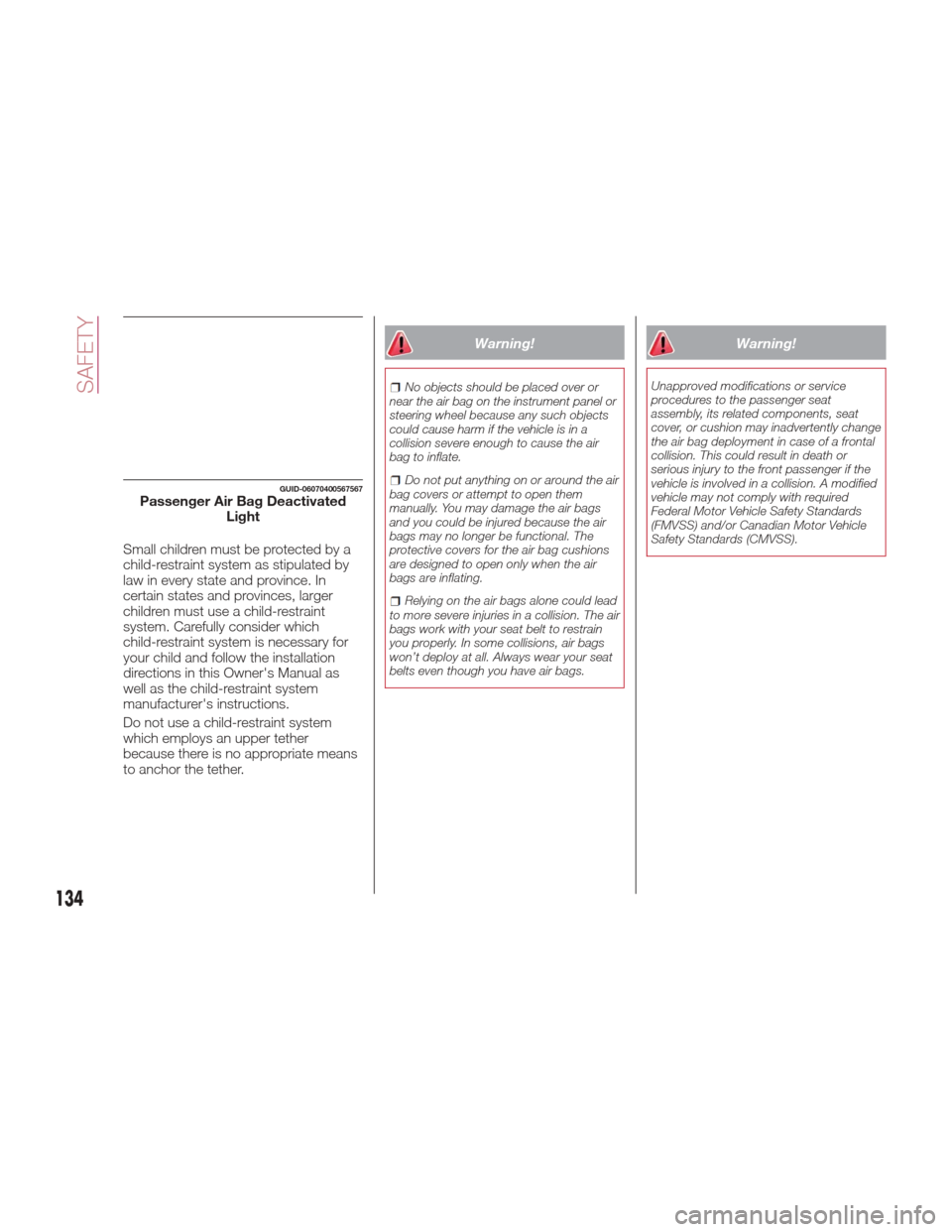
Small children must be protected by a
child-restraint system as stipulated by
law in every state and province. In
certain states and provinces, larger
children must use a child-restraint
system. Carefully consider which
child-restraint system is necessary for
your child and follow the installation
directions in this Owner's Manual as
well as the child-restraint system
manufacturer's instructions.
Do not use a child-restraint system
which employs an upper tether
because there is no appropriate means
to anchor the tether.
Warning!
No objects should be placed over or
near the air bag on the instrument panel or
steering wheel because any such objects
could cause harm if the vehicle is in a
collision severe enough to cause the air
bag to inflate.
Do not put anything on or around the air
bag covers or attempt to open them
manually. You may damage the air bags
and you could be injured because the air
bags may no longer be functional. The
protective covers for the air bag cushions
are designed to open only when the air
bags are inflating.
Relying on the air bags alone could lead
to more severe injuries in a collision. The air
bags work with your seat belt to restrain
you properly. In some collisions, air bags
won’t deploy at all. Always wear your seat
belts even though you have air bags.
Warning!
Unapproved modifications or service
procedures to the passenger seat
assembly, its related components, seat
cover, or cushion may inadvertently change
the air bag deployment in case of a frontal
collision. This could result in death or
serious injury to the front passenger if the
vehicle is involved in a collision. A modified
vehicle may not comply with required
Federal Motor Vehicle Safety Standards
(FMVSS) and/or Canadian Motor Vehicle
Safety Standards (CMVSS).
GUID-06070400567567Passenger Air Bag Deactivated Light
134
SAFETY
Page 139 of 300

How The SRS Air Bags
Work
Your vehicle is equipped with the
following types of SRS air bags. SRS air
bags are designed to work together
with the seat belts to help to reduce
injuries during an accident. The SRS air
bags are designed to provide further
protection for passengers in addition to
the seat belt functions. Be sure to wear
seat belts properly.
Seat Belt Pretensioners
The seat belt pretensioners are
designed to deploy in moderate or
severe frontal, near frontal collisions. In
addition, during a side collision, the
pretensioner operates on the side in
which the collision occurs.
The pretensioners operate differently
depending on what types of air bags
are equipped. For details on the seat
belt pretensioner operation, refer to the
SRS Air Bag Deployment Criteria.Driver Air Bag
The driver's air bag is mounted in the
steering wheel.
When Air Bag crash sensors detect a
frontal impact of greater than moderate
force, the driver's Air Bag inflates
quickly helping to reduce injury mainly
to the driver's head or chest caused by
directly hitting the steering wheel. For
more details about Air Bag deployment,
refer to "SRS Air Bag Deployment
Criteria" in this chapter for further
information.
(With Passenger Occupant
Classification System)
The driver's dual-stage air bag controls
air bag inflation in two energy stages.
During an impact of moderate severity,
the driver's air bag deploys with lesser
energy, whereas during more severe
impacts, it deploys with more energy.Passenger Air Bag
(Dual stage)
The passenger Air Bag is mounted in
the passenger dashboard.
The inflation mechanism for the
passenger Air Bag is the same as the
driver's Air Bag, as mentioned above.
For more details about Air Bag
deployment, refer to "SRS Air Bag
Deployment Criteria" in this chapter.
For further details about air bag
deployment, refer to "SRS Air Bag
deployment criteria" in this chapter.
Side Air Bags
The side air bags are mounted in the
outer sides of the seat backs. When the
air bag crash sensors detect a side
impact of greater than moderate force,
the system inflates the side air bag only
on the side in which the vehicle was hit.
06010203-126-123Spider Driver Side Air Bags06010204-126-123Spider Passenger Side Air Bag
137
Page 144 of 300

Limitations To Side Collision
Detection
Side collisions may not be detected as
severe enough to deploy the SRS air
bag equipment:
Side impacts involving trees or poles
A.
Side impacts with two-wheeled
vehicles B.
Roll-over.
Passenger Occupant
Classification Sensor
Your vehicle is equipped with a
passenger occupant classification
sensor as a part of the supplementary
restraint system. This sensor is
equipped in the passenger's seat
cushion. This sensor measures the
electrostatic capacity of the
passenger's seat.
The SRS unit is designed to prevent the
passenger front and side Air Bags and
seat belt pretensioner system from
deploying if the passenger Air Bag
deactivation indicator light turns on.
To reduce the chance of injuries caused
by deployment of the passenger Air
Bag, the system deactivates the
passenger front and side Air Bags and
also the seat belt pretensioner system
when the passenger Air Bag
deactivation indicator light turns on.
A
B
03040600-121-001Front/Near Front Collision
03040600-122-001Rear End Collision
A
B
03040600-123-001Side Collision
03040600-124-002Roll-Over Collision
142
SAFETY