2017 FIAT 124 SPIDER ECU
[x] Cancel search: ECUPage 71 of 300
HOOD
Opening The Hood
Proceed as follows:
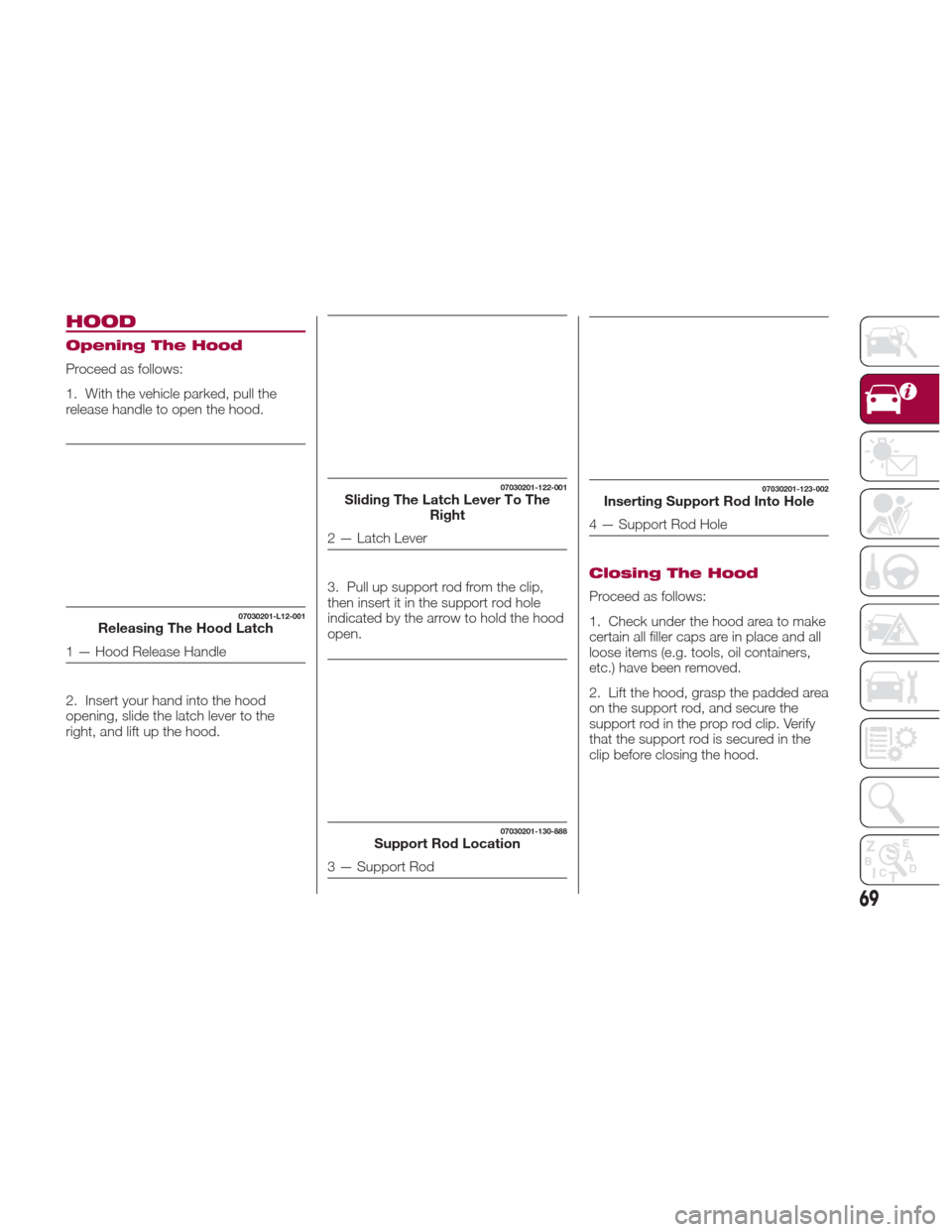
1. With the vehicle parked, pull the
release handle to open the hood.
2. Insert your hand into the hood
opening, slide the latch lever to the
right, and lift up the hood.3. Pull up support rod from the clip,
then insert it in the support rod hole
indicated by the arrow to hold the hood
open.
Closing The Hood
Proceed as follows:
1. Check under the hood area to make
certain all filler caps are in place and all
loose items (e.g. tools, oil containers,
etc.) have been removed.
2. Lift the hood, grasp the padded area
on the support rod, and secure the
support rod in the prop rod clip. Verify
that the support rod is secured in the
clip before closing the hood.
07030201-L12-001Releasing The Hood Latch
1 — Hood Release Handle
07030201-122-001Sliding The Latch Lever To The
Right
2 — Latch Lever
07030201-130-888Support Rod Location
3 — Support Rod
07030201-123-002Inserting Support Rod Into Hole
4 — Support Rod Hole
69
Page 73 of 300
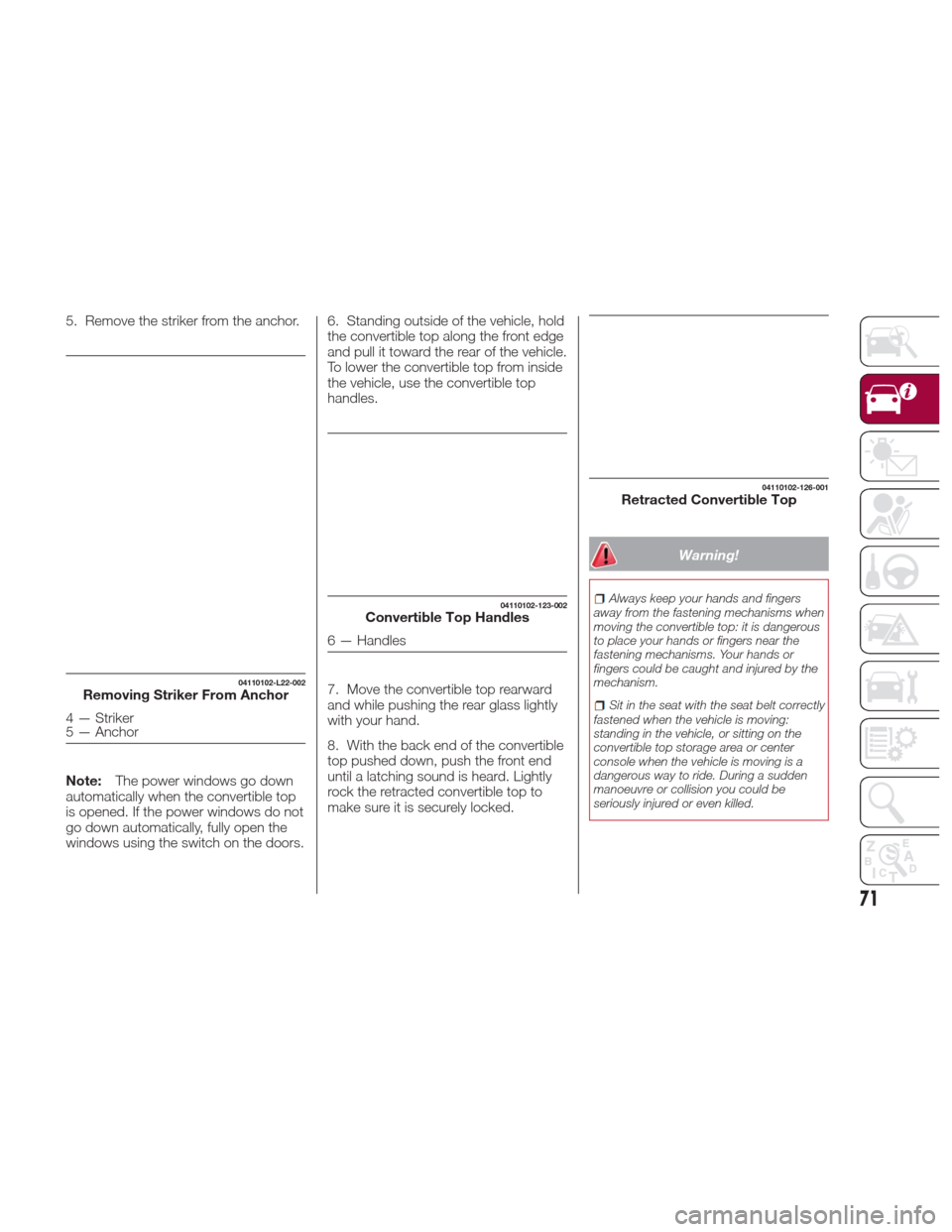
5. Remove the striker from the anchor.
Note:The power windows go down
automatically when the convertible top
is opened. If the power windows do not
go down automatically, fully open the
windows using the switch on the doors. 6. Standing outside of the vehicle, hold
the convertible top along the front edge
and pull it toward the rear of the vehicle.
To lower the convertible top from inside
the vehicle, use the convertible top
handles.
7. Move the convertible top rearward
and while pushing the rear glass lightly
with your hand.
8. With the back end of the convertible
top pushed down, push the front end
until a latching sound is heard. Lightly
rock the retracted convertible top to
make sure it is securely locked.
Warning!
Always keep your hands and fingers
away from the fastening mechanisms when
moving the convertible top: it is dangerous
to place your hands or fingers near the
fastening mechanisms. Your hands or
fingers could be caught and injured by the
mechanism.
Sit in the seat with the seat belt correctly
fastened when the vehicle is moving:
standing in the vehicle, or sitting on the
convertible top storage area or center
console when the vehicle is moving is a
dangerous way to ride. During a sudden
manoeuvre or collision you could be
seriously injured or even killed.
04110102-L22-002Removing Striker From Anchor
4 — Striker
5 — Anchor
04110102-123-002Convertible Top Handles
6 — Handles
04110102-126-001Retracted Convertible Top
71
Page 75 of 300
Caution!
Driving with the convertible top not fully
locked could damage the convertible top.
Note:
Do not spray water directly near the
seam of the window and convertible
top when flushing away dirt on the soft
top with water. Otherwise, water may
enter the vehicle (refer to “Convertible
Top Maintenance” in “Maintenance
And Care” chapter).
The convertible top may be
constricted if it is left retracted for a
long period. Therefore, if the top has
become constricted, it may be difficult
to hook the top latch striker to the
anchor.
Make sure the convertible top is
securely locked by pushing up on it. If
it still sounds loose (rattles) after being
locked by the top latch, contact an
Authorized Dealer.
Convertible Top
Precautions
Remove leaves or other debris that
may accumulate on and around the
convertible top. If leaves or other debris
block the drain filter, water may enter
the vehicle. Clean the drain filter at least
once a year.
Before lowering or raising the
convertible top, stop in a safe place off
of the road and park on a level surface.
When lowering the convertible top,
make sure objects inside the vehicle are
not blown away by the wind.
Secure all loose objects inside before
driving with the convertible top down.
To help prevent theft or vandalism
and to ensure that the passenger
compartment stays dry, close the
convertible top securely and lock both
doors when leaving the vehicle.
The soft top is made of high quality
material and if it is not maintained
correctly, the material could harden,
becomes stained, or have an uneven
gloss.
Lowering the convertible top while
it's wet can also cause water to drip
into the cabin.
The power windows go down
automatically in conjunction with the
convertible top opening/closing.
However, this is a function for improving
the operability, and it does not mean
there is a problem. If the vehicle battery
is disconnected for vehicle maintenance
or other reasons, the power windows
will not go down automatically. If the
power windows do not go down, the
automatic open/close mechanism for
the windows must be reset.
The windblocker reduces the amount
of wind coming into the cabin from
behind when driving with the
convertible top opened.
Before starting the vehicle make sure
the convertible top is correctly locked.
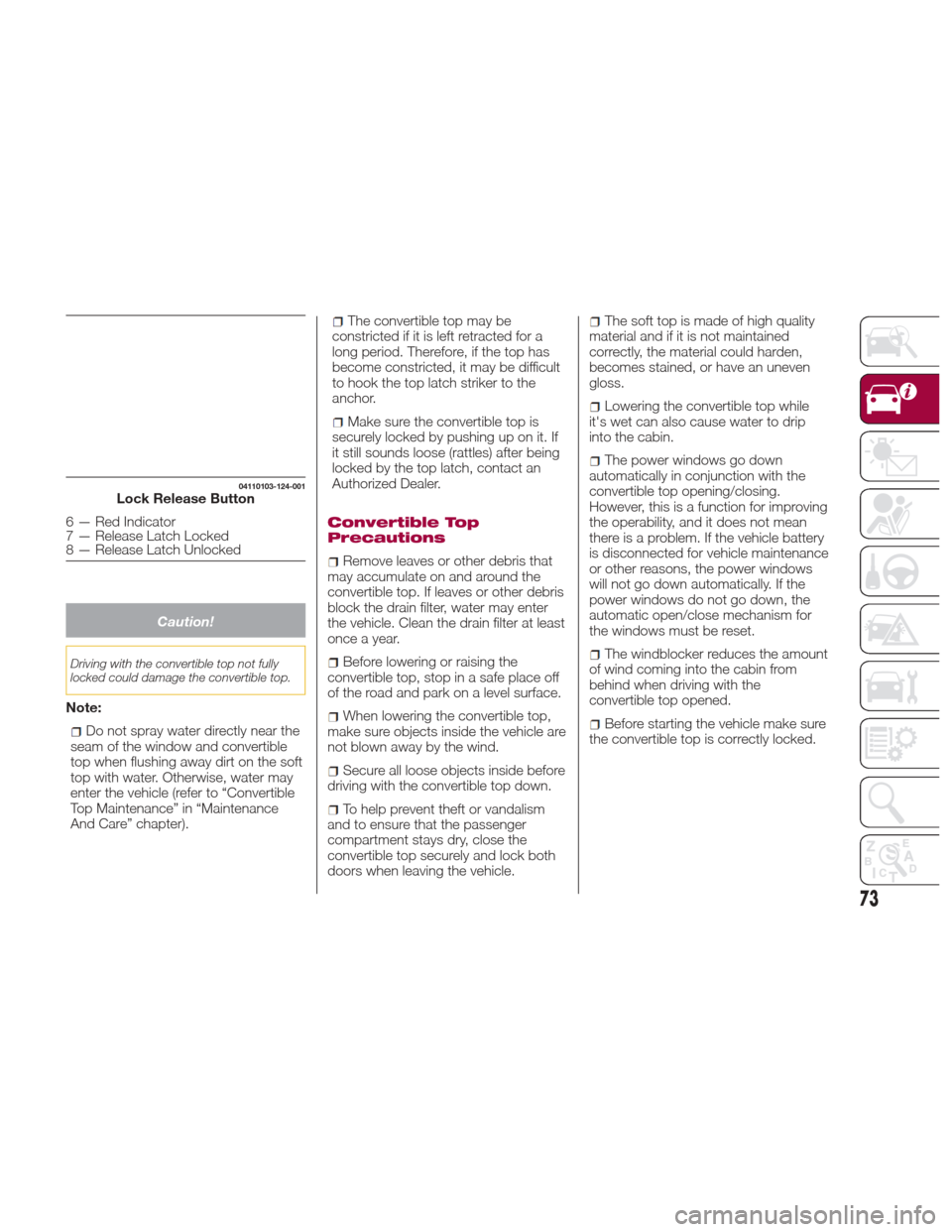
04110103-124-001Lock Release Button
6 — Red Indicator
7 — Release Latch Locked
8 — Release Latch Unlocked
73
Page 79 of 300

ONBOARD
DIAGNOSTIC
SYSTEM — OBD II
Your vehicle is equipped with a
sophisticated Onboard Diagnostic
system called OBD II. This system
monitors the performance of the
emissions, engine, and automatic
transmission control systems. When
these systems are operating properly,
your vehicle will provide excellent
performance and fuel economy, as well
as engine emissions well within current
government regulations.
If any of these systems require service,
the OBD II system will turn on the
Malfunction Indicator Light (MIL). It will
also store diagnostic codes and other
information to assist your service
technician in making repairs. Although
your vehicle will usually be drivable and
not need towing, see your authorized
dealer for service as soon as possible.
Caution!
Prolonged driving with the MIL on could
cause further damage to the emission
control system. It could also affect fuel
economy and driveability. The vehicle must
be serviced before any emissions tests can
be performed.
If the MIL is flashing while the engine is
running, severe catalytic converter damage
and power loss will soon occur. Immediate
service is required.
Onboard Diagnostic
System (OBD II)
Cybersecurity
Your vehicle is required to have an
Onboard Diagnostic system (OBD II)
and a connection port to allow access
to information related to the
performance of your emissions
controls. Authorized service technicians
may need to access this information to
assist with the diagnosis and service of
your vehicle and emissions system.
Warning!
ONLY an authorized service technician
should connect equipment to the OBD II
connection port in order to diagnose or
service your vehicle.
If unauthorized equipment is connected
to the OBD II connection port, such as a
driver-behavior tracking device, it may:
Be possible that vehicle systems,
including safety related systems, could be
impaired or a loss of vehicle control could
occur that may result in an accident
involving serious injury or death.
Access, or allow others to access,
information stored in your vehicle systems,
including personal information.
For further information, refer to “Privacy
Practices” and “Uconnect
CyberSecurity” in “All About Uconnect
Access” in your Owner’s Manual Radio
Supplement and “Cybersecurity” in
“Multimedia”.
77
Page 92 of 300

WARNING LIGHTS
AND MESSAGES
Warning Lights And
Messages
Note:
The warning light in the instrument
panel appears together with a
dedicated message and/or acoustic
signal when applicable. These
indications are indicative and
precautionary and as such must not be
considered as exhaustive and/or
alternative to the information contained
in the Owner’s Manual, which you are
advised to read carefully in all cases.
Always refer to the information in this
chapter in the event of a failure
indication.
Failure indications displayed are
divided into two categories: serious
and less serious failures. Serious
failures are indicated by a repeated
and prolonged warning "cycle". Less
serious failures are indicated by a
warning "cycle" with a shorter duration.
The display cycle of both categories
can be interrupted. The instrument
panel warning light will stay on until the
cause of the failure is eliminated. Vehicles With Fiat Connect 7.0
The warning contents can be verified
on the audio system.
Proceed as follows:
If the warning light is turned on,
selecticon on the home screen to
display the application screen.
Select “ Warning Guidance ”to
display the current warnings.
Select the applicable warning to view
the warning details.
For the following warning/indicator lights:
Master Warning Light
Brake System Warning Light
ABS Warning Light
Charging System Warning Light
Engine Oil Warning Light
Electric Throttle Warning Light
Cold Start Warning Light
Check Engine Warning Light
Coolant Temperature Warning Light
Automatic Transmission Warning
Light
Power Steering Malfunction Indicator
Light
Air Bag/Seat Belt Pretensioner
System Warning Light
Check Fuel Cap Warning Light
Low Fuel Warning Light
Seat Belt Warning Light
Door Ajar Warning Light
Low Washer Fluid Level Warning
Light
Tire Pressure Monitoring System
Warning Light
KEY Warning Light
LED Headlight KEY Warning Light
BSM (Blind Spot Monitoring) OFF
Indicator Light
Wrench Indicator Light
TCS/DSC Indicator Light
DSC OFF Indicator Light
Security Indicator Light
Indicator Light
Passenger Air Bag Deactivation
Warning Light
The light turns on when the ignition is
switched on for an operation check,
and turns off a few seconds later or
when the engine is started. If the light
does not turn on or remains turned on,
have the vehicle inspected at an
Authorized Dealership.
Note:
Only for “Brake System Warning Light”:
the light turns on continuously when the
parking brake is applied.
90
GETTING TO KNOW YOUR INSTRUMENT PANEL
Page 94 of 300

Warning LightWhat It Means
ALTERNATOR FAILURE
If the warning light illuminates while driving, it indicates a malfunction of the alternator or of the
charging system. Drive to the side of the road and park off the right-of-way. Stop the vehicle in a
safe place immediately and contact an Authorized Dealership.
Note:Do not continue driving when the charging system warning light is illuminated because the
engine could stop unexpectedly.
LOW ENGINE OIL PRESSURE
This warning light indicates low engine oil pressure.
Note:Do not run the engine if the oil pressure is low. Otherwise, it could result in extensive engine
damage.
If the light illuminates or the warning indication is displayed while driving:
Drive to the side of the road and park off the right-of-way on level ground.
Turn off the engine and wait five minutes for the oil to drain back into the sump.
Inspect the engine oil level. If it's low, add the appropriate amount of engine oil while being
careful not to overfill.
Start the engine and check the warning light.
Note:
Do not run the engine if the oil level is low. Otherwise, it could result in extensive engine damage.
If the light remains illuminated even though the oil level is normal or after adding oil, stop the
engine immediately and contact an Authorized Dealership.
DOOR-OPEN WARNING LIGHT
The light turns on if any door is not closed securely.
Close the door securely.
Warning!
Driving a vehicle with the red brake light on is dangerous. Part of the brake system may have failed. It will take longer to stop the vehicle. You
could have a collision. Have the vehicle checked immediately.
92
GETTING TO KNOW YOUR INSTRUMENT PANEL
Page 96 of 300
Red Warning Lights
Warning lightWhat It Means
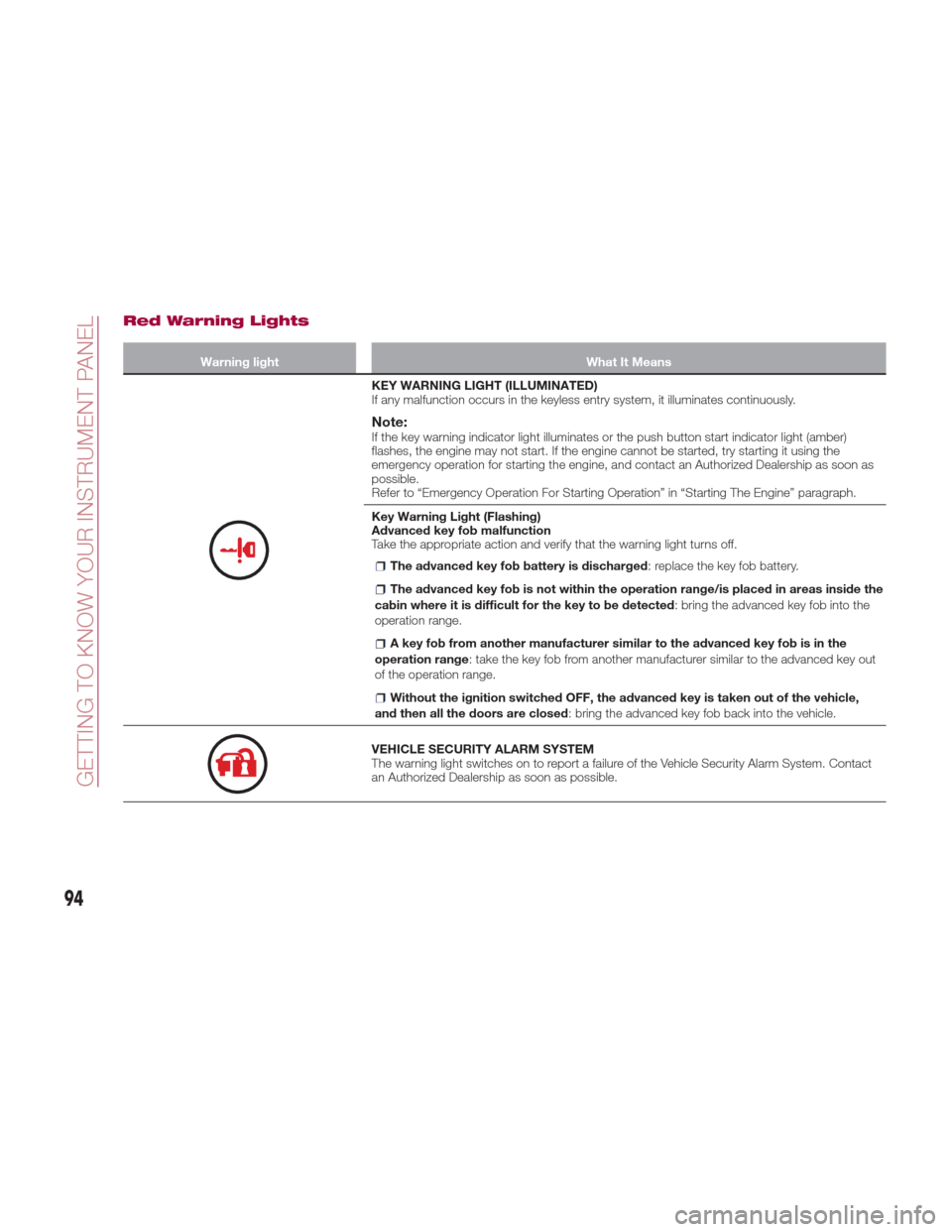
KEY WARNING LIGHT (ILLUMINATED)
If any malfunction occurs in the keyless entry system, it illuminates continuously.
Note:If the key warning indicator light illuminates or the push button start indicator light (amber)
flashes, the engine may not start. If the engine cannot be started, try starting it using the
emergency operation for starting the engine, and contact an Authorized Dealership as soon as
possible.
Refer to “Emergency Operation For Starting Operation” in “Starting The Engine” paragraph.
Key Warning Light (Flashing)
Advanced key fob malfunction
Take the appropriate action and verify that the warning light turns off.
The advanced key fob battery is discharged: replace the key fob battery.
The advanced key fob is not within the operation range/is placed in areas inside the
cabin where it is difficult for the key to be detected : bring the advanced key fob into the
operation range.
A key fob from another manufacturer similar to the advanced key fob is in the
operation range : take the key fob from another manufacturer similar to the advanced key out
of the operation range.
Without the ignition switched OFF, the advanced key is taken out of the vehicle,
and then all the doors are closed : bring the advanced key fob back into the vehicle.
VEHICLE SECURITY ALARM SYSTEM
The warning light switches on to report a failure of the Vehicle Security Alarm System. Contact
an Authorized Dealership as soon as possible.
94
GETTING TO KNOW YOUR INSTRUMENT PANEL
Page 97 of 300
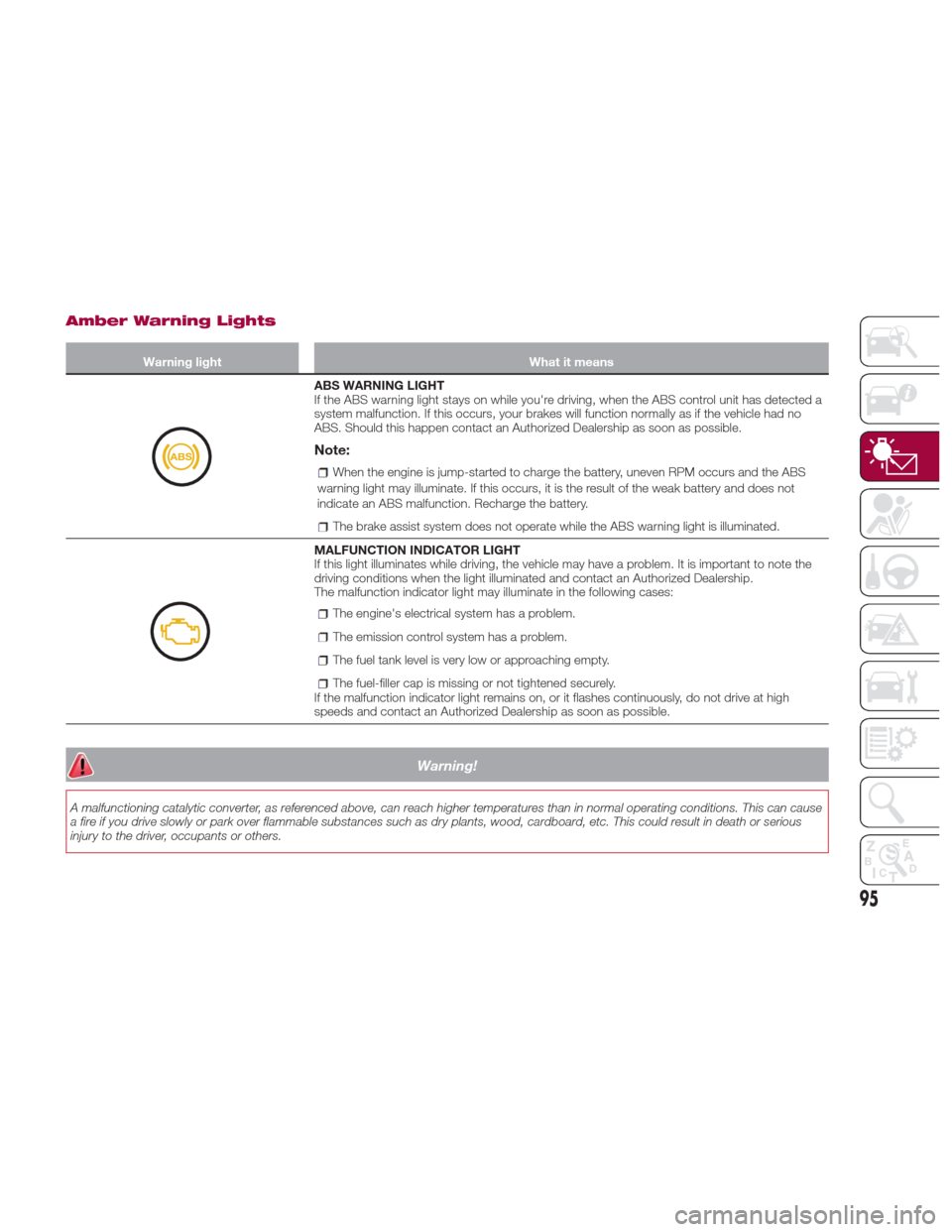
Amber Warning Lights
Warning lightWhat it means
ABS WARNING LIGHT
If the ABS warning light stays on while you're driving, when the ABS control unit has detected a
system malfunction. If this occurs, your brakes will function normally as if the vehicle had no
ABS. Should this happen contact an Authorized Dealership as soon as possible.
Note:
When the engine is jump-started to charge the battery, uneven RPM occurs and the ABS
warning light may illuminate. If this occurs, it is the result of the weak battery and does not
indicate an ABS malfunction. Recharge the battery.
The brake assist system does not operate while the ABS warning light is illuminated.
MALFUNCTION INDICATOR LIGHT
If this light illuminates while driving, the vehicle may have a problem. It is important to note the
driving conditions when the light illuminated and contact an Authorized Dealership.
The malfunction indicator light may illuminate in the following cases:
The engine's electrical system has a problem.
The emission control system has a problem.
The fuel tank level is very low or approaching empty.
The fuel-filler cap is missing or not tightened securely.If the malfunction indicator light remains on, or it flashes continuously, do not drive at high
speeds and contact an Authorized Dealership as soon as possible.
Warning!
A malfunctioning catalytic converter, as referenced above, can reach higher temperatures than in normal operating conditions. This can cause
a fire if you drive slowly or park over flammable substances such as dry plants, wood, cardboard, etc. This could result in death or serious
injury to the driver, occupants or others.
95