2017 FIAT 124 SPIDER service
[x] Cancel search: servicePage 175 of 300

REFUELING THE
VEHICLE
Refueling The Vehicle
Stop the engine before refueling.
Fuel Requirements
Vehicles with catalytic converters or
oxygen sensors must use ONLY
UNLEADED FUEL, which will reduce
exhaust emissions and keep spark plug
fouling to a minimum.
Fuel: Premium unleaded fuel.
Octane Rating (Anti-knock index): 91
(R + M)/2 method or above (96 RON or
above) (U.S. federal law requires that
octane ratings be posted on gasoline
station pumps).
Regular unleaded fuel with an octane
rating from 87 to 90 (91 to 95 RON) can
be used, but this will reduce
performance slightly, such as reduced
engine output, and engine knocking.
Fuel with a rating lower than 87 octane
(91 RON) will negatively affect the
emission control system performance
and could also cause engine knocking
and serious engine damage.
While operating on gasoline with an
octane number of 87, hearing a light
knocking sound from the engine is not
a cause for concern. However, if the
engine is heard making a heavy
knocking sound, see your Authorized
Dealer immediately. Use of gasoline
with an octane number lower than87 can cause engine failure and may
void or not be covered by the New
Vehicle Limited Warranty. Poor quality
gasoline can cause problems such as
hard starting, stalling, and hesitations. If
you experience these symptoms, try
another brand of gasoline before
considering service for the vehicle.
Gasoline blended with oxygenates such
as alcohol or ether compounds are
generally referred to as oxygenated
fuels.
The common gasoline blend that can
be used with your vehicle is ethanol
blended at no more than 15%. Gasoline
containing alcohol, such as ethanol or
methanol, may be marketed under the
name "Gasohol".
Vehicle damage and drivability
problems resulting from the use of the
following may not be covered by the
New Vehicle Limited Warranty:
Alcohol containing more than 15%
ethanol.
Gasoline or alcohol containing
methanol.
Leaded fuel or leaded alcohol.
Reformulated Gasoline
Many areas of the country require the
use of cleaner burning gasoline referred
to as “Reformulated Gasoline”.
Reformulated gasoline contains
oxygenates and are specifically blended to reduce vehicle emissions and
improve air quality.
The use of reformulated gasoline is
recommended. Properly blended
reformulated gasoline will provide
improved performance and durability of
engine and fuel system components.
Gasoline/Oxygenate
Blends
Some fuel suppliers blend unleaded
gasoline with oxygenates such as
ethanol.
Caution!
DO NOT use gasoline containing methanol
or gasoline containing more than 15%
ethanol (E-15). Use of these blends may
result in starting and drivability problems,
damage critical fuel system components,
cause emissions to exceed the applicable
standard, and/or cause the “Malfunction
Indicator Light” to illuminate. Please
observe pump labels as they should clearly
communicate if a fuel contains greater than
15% ethanol (E-15).
Problems that result from using
gasoline containing more than 15%
ethanol (E-15) or gasoline containing
methanol are not the responsibility of
the manufacturer and may void or not
be covered under New Vehicle Limited
Warranty.
173
Page 176 of 300
E-85 Usage In Non-Flex
Fuel Vehicles
Non-Flex Fuel Vehicles (FFV) are
compatible with gasoline containing up
to 15% ethanol (E-15). Gasoline with
higher ethanol content may void the
New Vehicle Limited Warranty.
If a Non-FFV vehicle is inadvertently
fueled with E-85 fuel, the engine will
have some or all of these symptoms:
Operate in a lean mode.
OBD II “Malfunction Indicator Light”
on.
Poor engine performance.
Poor cold start and cold drivability.
Increased risk for fuel system
component corrosion.
MMT In Gasoline
Methylcyclopentadienyl Manganese
Tricarbonyl (MMT) is a manganese-
containing metallic additive that is
blended into some gasoline to increase
octane. Gasoline blended with MMT
provides no performance advantage
beyond gasoline of the same octane
number without MMT. Gasoline blended
with MMT reduces spark plug life and
reduces emissions system performance
in some vehicles. The manufacturer
recommends that gasoline without
MMT be used in your vehicle. The MMT
content of gasoline may not be
indicated on the gasoline pump, therefore, you should ask your gasoline
retailer whether the gasoline contains
MMT. MMT is prohibited in Federal and
California reformulated gasoline.
Materials Added To Fuel
Besides using unleaded gasoline with
the proper octane rating, gasolines that
contain detergents, corrosion and
stability additives are recommended.
Using gasolines that have these
additives will help improve fuel
economy, reduce emissions, and
maintain vehicle performance.
Designated TOP TIER
Detergent Gasoline
contains a higher level
of detergents to further
aide in minimizing
engine and fuel system
deposits. When
available, the usage of Top Tier
Detergent gasoline is recommended.
Visit www.toptiergas.com for a list of
TOP TIER Detergent Gasoline Retailers.
Indiscriminate use of fuel system
cleaning agents should be avoided.
Many of these materials intended for
gum and varnish removal may contain
active solvents or similar ingredients.
These can harm fuel system gasket and
diaphragm materials.
Fuel System Cautions
Caution!
Follow these guidelines to maintain your
vehicle’s performance:
The use of leaded gasoline is prohibited
by Federal law. Using leaded gasoline can
impair engine performance and damage
the emissions control system.
An out-of-tune engine or certain fuel
or ignition malfunctions can cause the
catalytic converter to overheat. If you
notice a pungent burning odor or some
light smoke, your engine may be out of
tune or malfunctioning and may require
immediate service. Contact your
Authorized Dealer for service assistance.
The use of fuel additives, which are now
being sold as octane enhancers, is not
recommended. Most of these products
contain high concentrations of methanol.
Fuel system damage or vehicle
performance problems resulting from the
use of such fuels or additives is not the
responsibility of the manufacturer and may
void or not be covered under the New
Vehicle Limited Warranty.
Note:
Intentional tampering with the
emissions control system can result in
civil penalties being assessed against
you.
174
STARTING AND OPERATING
Page 186 of 300
IN CASE OF EMERGENCY
HAZARD WARNING LIGHTS . . . .185
REPLACING A BULB..........185
REPLACING FUSES ..........196
CHANGINGAWHEEL ........204
TIRE SERVICE KIT ...........209
JUMPSTARTING............218
OVERHEATING .............220
TOWINGTHEVEHICLE........221
184
IN CASE OF EMERGENCY
Page 198 of 300
REPLACING FUSES
General Information
Warning!
When replacing a blown fuse, always
use an appropriate replacement fuse with
the same amp rating as the original fuse.
Never replace a fuse with another fuse of
higher amp rating. Never replace a blown
fuse with metal wires or any other material.
Failure to use proper fuses may result in
serious personal injury, fire and/or property
damage.
Before replacing a fuse, make sure that
the ignition is off and that all the other
services are switched off and/or
disengaged.
If the replaced fuse blows again, contact
an authorized dealer.
If a general protection fuse for safety
systems (air bag system, braking system),
power unit systems (engine system,
gearbox system) or steering system blows,
contact an authorized dealer.
Your vehicle's electrical system is
protected by fuses.
If any lights, accessories, or controls do
not work, inspect the appropriate circuit
protector. If a fuse has blown, the inside
element will be melted. If the same fuse
blows again, go to an Authorized Dealer
as soon as possible.
Fuse location
Fuses are grouped together in two fuse
boxes located in the interior on the left
side of the vehicle and under the hood.
Interior Fuses
If the electrical system does not work,
first inspect the fuses on the vehicle's
left side.
Proceed as follows:
1. Make sure the ignition is placed in
the OFF mode, and other switches are
turned off.
2. Open the fuse panel cover (located
near the door). 3. Press retaining clip and remove
protection cover.
4. Pull the fuse straight out with the
fuse puller provided on the fuse block
located in the engine compartment.
5. Inspect the fuse and replace it if it is
blown.
07031601-121-001Fuse Panel Cover
07031601-122-001Fuse Puller
196
IN CASE OF EMERGENCY
Page 206 of 300
CHANGING A WHEEL
Warning!
Do not attempt to change a tire on the
side of the vehicle close to moving traffic.
Pull far enough off the road to avoid the
danger of being hit when operating the jack
or changing the wheel.
Being under a jacked-up vehicle is
dangerous. The vehicle could slip off the
jack and fall on you. You could be crushed.
Never put any part of your body under a
vehicle that is on a jack. If you need to get
under a raised vehicle, take it to a service
center where it can be raised on a lift.
The jack is designed to be used as a
tool for changing tires only. The jack should
not be used to lift the vehicle for service
purposes. The vehicle should be jacked on
a firm level surface only. Avoid ice or
slippery areas.
Tools Location
Your vehicle may be equipped with a
spare tire, jack, lug wrench, and tow
eyes. For details, contact an Authorized
Dealer.
Tools are stored in the trunk.
Jacking Instructions — If
Equipped
To Remove The Jack
Proceed as follows:
1. In the right side of the trunk, pull on
indentation on side of cover to remove. 2. Turn the wing bolt and jack screw
counterclockwise.
08020100-122-002Jack Tools
1 — Jack Lever
2 — Lug Wrench (If Equipped)
3 — Tow Eyes (If Equipped)
08020101-124-001Jack Location
1 — Indentation On Cover
2 — Jack And Tools Cover
08020101-122-001Jack Components
3 — Wing Bolt
4 — Jack Screw
204
IN CASE OF EMERGENCY
Page 208 of 300
Removing A Tire
Warning!
Carefully follow these tire changing
warnings to help prevent personal injury or
damage to your vehicle:
Always park on a firm, level surface as
far from the edge of the roadway as
possible before raising the vehicle.
Turn on the Hazard Warning flasher.
Block the wheel diagonally opposite the
wheel to be raised.
Set the parking brake firmly and set the
transmission in PARK.
Do not let any passenger sit in the
vehicle when it is on a jack.
Do not get under the vehicle when it is
on a jack. If you need to get under a raised
vehicle, take it to a service center where it
can be raised on a lift.
Only use the jack in the positions
indicated and for lifting this vehicle during a
tire change.
If working on or near a roadway, be
extremely careful of motor traffic.
Proceed as follows:
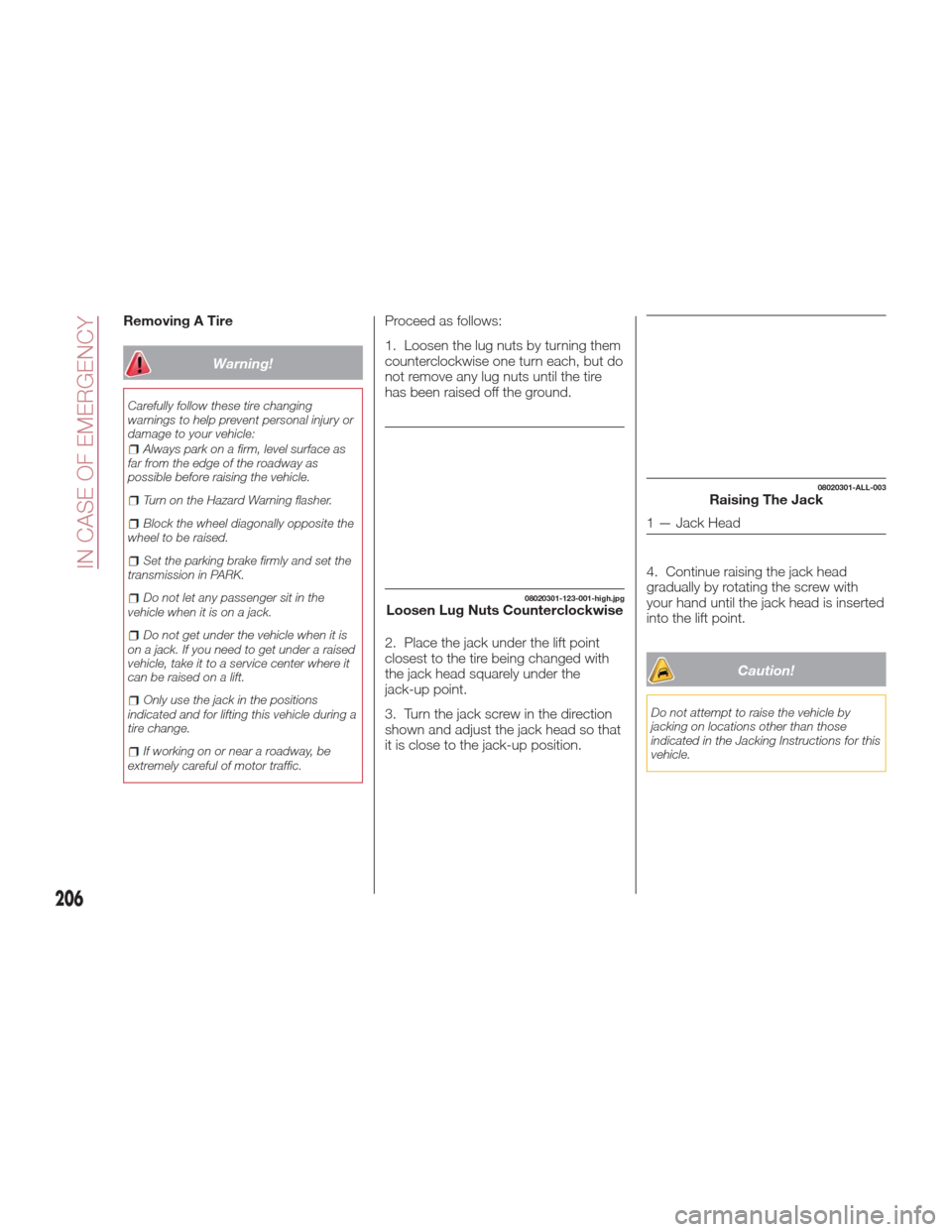
1. Loosen the lug nuts by turning them
counterclockwise one turn each, but do
not remove any lug nuts until the tire
has been raised off the ground.
2. Place the jack under the lift point
closest to the tire being changed with
the jack head squarely under the
jack-up point.
3. Turn the jack screw in the direction
shown and adjust the jack head so that
it is close to the jack-up position. 4. Continue raising the jack head
gradually by rotating the screw with
your hand until the jack head is inserted
into the lift point.
Caution!
Do not attempt to raise the vehicle by
jacking on locations other than those
indicated in the Jacking Instructions for this
vehicle.
08020301-123-001-high.jpgLoosen Lug Nuts Counterclockwise
08020301-ALL-003Raising The Jack
1 — Jack Head
206
IN CASE OF EMERGENCY
Page 209 of 300
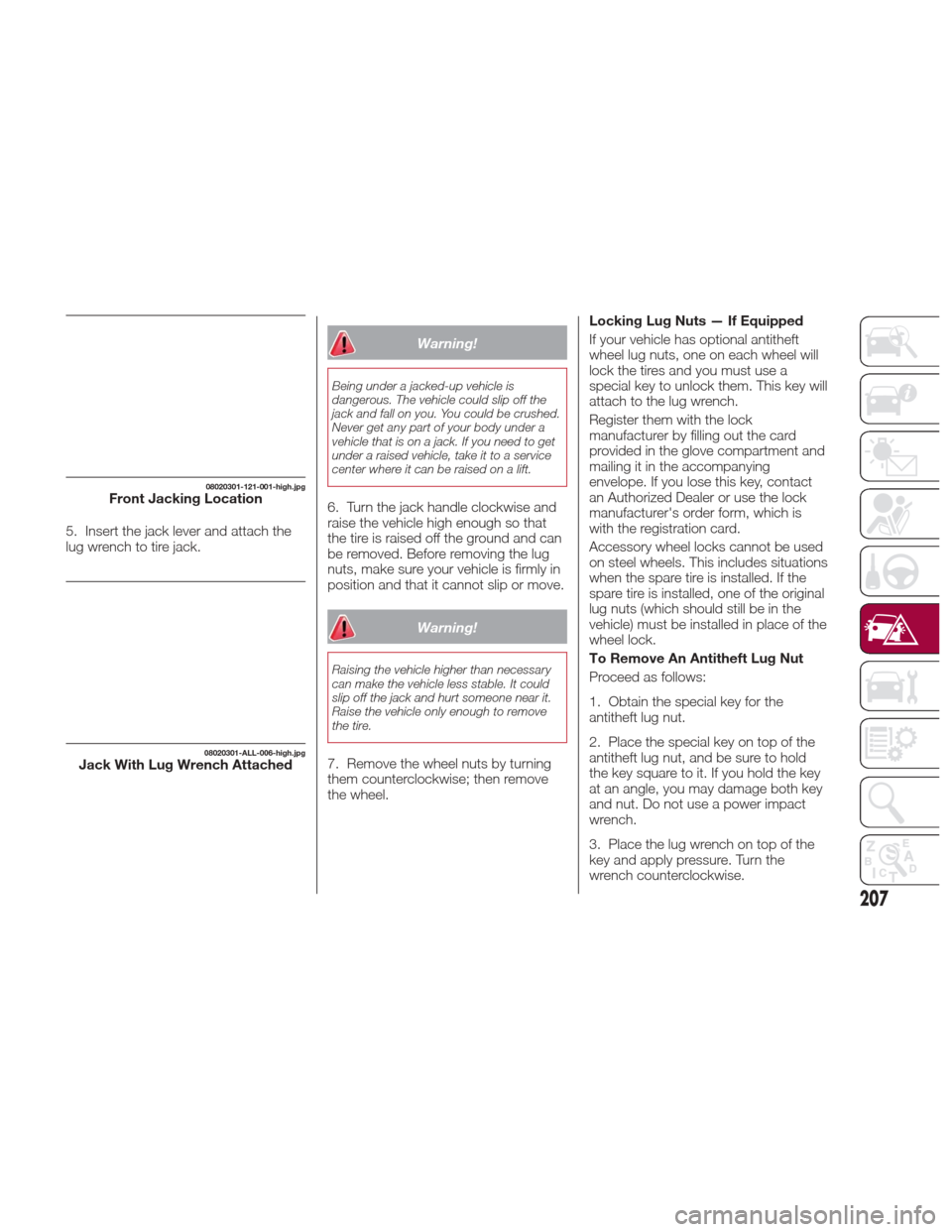
5. Insert the jack lever and attach the
lug wrench to tire jack.
Warning!
Being under a jacked-up vehicle is
dangerous. The vehicle could slip off the
jack and fall on you. You could be crushed.
Never get any part of your body under a
vehicle that is on a jack. If you need to get
under a raised vehicle, take it to a service
center where it can be raised on a lift.
6. Turn the jack handle clockwise and
raise the vehicle high enough so that
the tire is raised off the ground and can
be removed. Before removing the lug
nuts, make sure your vehicle is firmly in
position and that it cannot slip or move.
Warning!
Raising the vehicle higher than necessary
can make the vehicle less stable. It could
slip off the jack and hurt someone near it.
Raise the vehicle only enough to remove
the tire.
7. Remove the wheel nuts by turning
them counterclockwise; then remove
the wheel.Locking Lug Nuts — If Equipped
If your vehicle has optional antitheft
wheel lug nuts, one on each wheel will
lock the tires and you must use a
special key to unlock them. This key will
attach to the lug wrench.
Register them with the lock
manufacturer by filling out the card
provided in the glove compartment and
mailing it in the accompanying
envelope. If you lose this key, contact
an Authorized Dealer or use the lock
manufacturer's order form, which is
with the registration card.
Accessory wheel locks cannot be used
on steel wheels. This includes situations
when the spare tire is installed. If the
spare tire is installed, one of the original
lug nuts (which should still be in the
vehicle) must be installed in place of the
wheel lock.
To Remove An Antitheft Lug Nut
Proceed as follows:
1. Obtain the special key for the
antitheft lug nut.
2. Place the special key on top of the
antitheft lug nut, and be sure to hold
the key square to it. If you hold the key
at an angle, you may damage both key
and nut. Do not use a power impact
wrench.
3. Place the lug wrench on top of the
key and apply pressure. Turn the
wrench counterclockwise.
08020301-121-001-high.jpgFront Jacking Location
08020301-ALL-006-high.jpgJack With Lug Wrench Attached
207
Page 210 of 300
To Install The Antitheft Lug Nut
Proceed as follows:
1. Place the special key on top of the
nut, and be sure to hold the key square
to it. If you hold the key at an angle, you
may damage both key and nut. Do not
use a power impact wrench.
2. Place the lug wrench on top of the
special key, apply pressure, and turn it
clockwise.
Mounting The Tire
Proceed as follows:
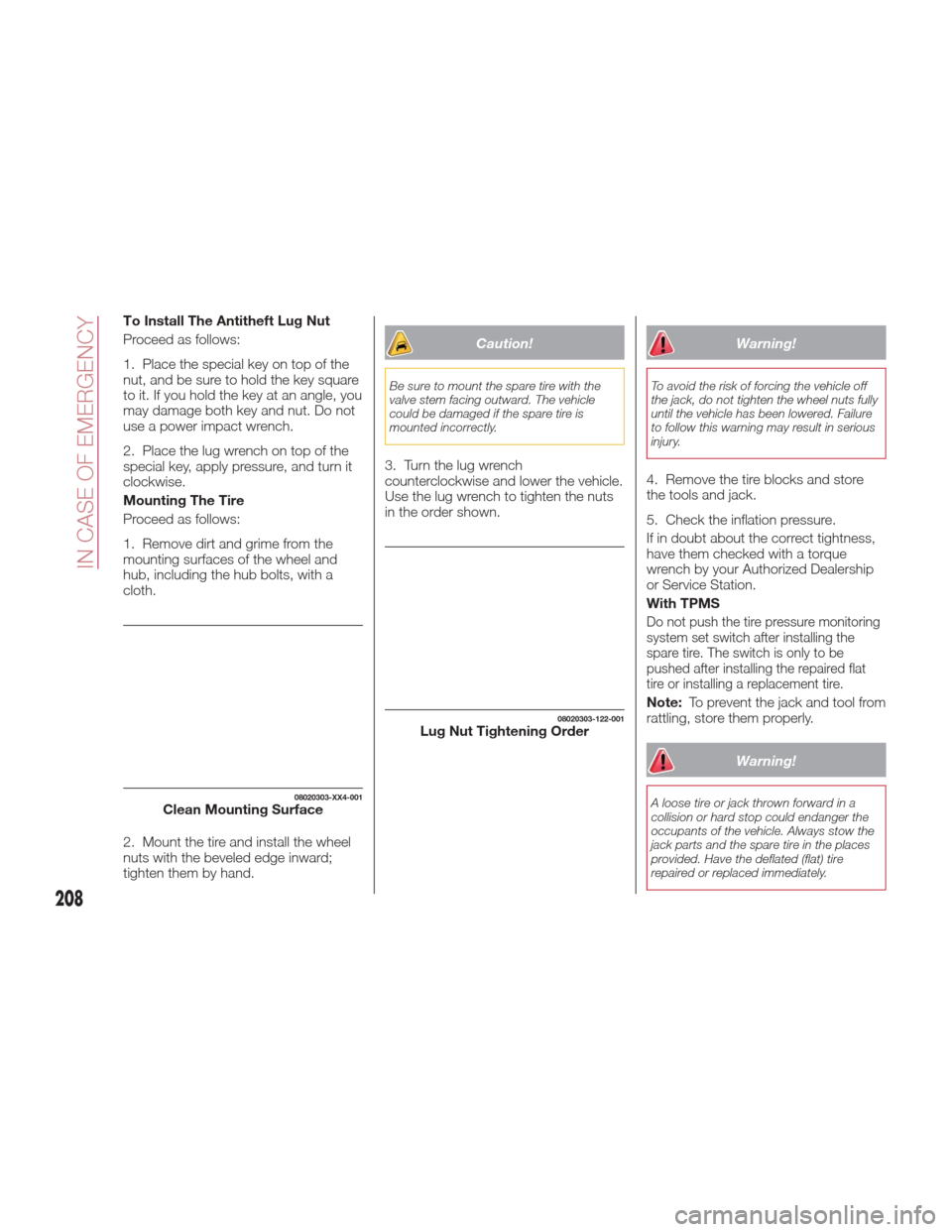
1. Remove dirt and grime from the
mounting surfaces of the wheel and
hub, including the hub bolts, with a
cloth.
2. Mount the tire and install the wheel
nuts with the beveled edge inward;
tighten them by hand.
Caution!
Be sure to mount the spare tire with the
valve stem facing outward. The vehicle
could be damaged if the spare tire is
mounted incorrectly.
3. Turn the lug wrench
counterclockwise and lower the vehicle.
Use the lug wrench to tighten the nuts
in the order shown.
Warning!
To avoid the risk of forcing the vehicle off
the jack, do not tighten the wheel nuts fully
until the vehicle has been lowered. Failure
to follow this warning may result in serious
injury.
4. Remove the tire blocks and store
the tools and jack.
5. Check the inflation pressure.
If in doubt about the correct tightness,
have them checked with a torque
wrench by your Authorized Dealership
or Service Station.
With TPMS
Do not push the tire pressure monitoring
system set switch after installing the
spare tire. The switch is only to be
pushed after installing the repaired flat
tire or installing a replacement tire.
Note:To prevent the jack and tool from
rattling, store them properly.
Warning!
A loose tire or jack thrown forward in a
collision or hard stop could endanger the
occupants of the vehicle. Always stow the
jack parts and the spare tire in the places
provided. Have the deflated (flat) tire
repaired or replaced immediately.08020303-XX4-001Clean Mounting Surface
08020303-122-001Lug Nut Tightening Order
208
IN CASE OF EMERGENCY