2017 FIAT 124 SPIDER ABARTH heating
[x] Cancel search: heatingPage 159 of 292

You can start out, from a stop, in
first or second gear. Tapping the gear
selector rearward (+) (at a stop) will
allow starting in second gear. Starting
out in second gear can be helpful in
snowy or icy conditions.
Paddle Mode — If
Equipped
Tapping one of the steering
wheel-mounted shift paddles (+/-), if
equipped, while the gear selector is in
DRIVE (D), will activate Paddle Mode (a
temporary manual mode). The current
gear will be displayed in the instrument
cluster, with the "M" also illuminated.
The transmission will revert back to
normal operation (if the gear selector
remains in DRIVE) after a period of time,
depending on accelerator pedal activity.
Note: Because Paddle mode is only
temporary, use of the MANUAL (M)
position is recommended if you need to
drive the vehicle in a particular gear for
long periods.
Driving Tips
Overtaking
For extra power when passing another
vehicle or climbing steep grades, press
the accelerator fully. The transmission
will shift to a lower gear, depending on
vehicle speed. Note:
The accelerator pedal may initially
feel heavy as it is being pressed, then
feel lighter as it is pressed further. This
change in pedal force controls whether
or not kickdown should be performed.
While the gear selector is in the
MANUAL (M) position and the Dynamic
Stability Control (DSC) is turned off,
manual shift mode does not switch to
automatic shift mode even if the
accelerator pedal is completely
pressed. Tap the gear selector forward
or rearward to select the appropriate
gear.
Climbing steep grades from a stop
To climb a steep grade from a stopped
position:
1. Press the brake pedal.
2. Shift to DRIVE (D) or M1, depending
on the load weight and grade
steepness.
3. Release the brake pedal while
gradually accelerating.
Descending steep grades
When descending a steep grade, shift
to lower gears, depending on load
weight and grade steepness.
Descend slowly, using the brakes only
occasionally to prevent them from
overheating.
ELECTRONIC SPEED
CONTROL
Electronic Speed
Control
This is an electronically controlled
driving assistance feature that allows
the desired vehicle speed to be
maintained, without having to press the
accelerator pedal.
This feature can be used at a speed
above 25 mph (40 km/h) on long
stretches of dry, straight roads with few
variations (e.g. motorways).
It is therefore not recommended to use
this feature on city roads with traffic. Do
not use it in town.
Warning!
Do not use the cruise control under the
following conditions:
hilly terrain
steep inclines
heavy or unsteady traffic
slippery or winding roads
similar restrictions that require
inconsistent speed
Using the cruise control under the following
conditions is dangerous and could result in
loss of vehicle control.
157
Page 180 of 292

Warning!
An improperly attached, damaged, folded,
or stacked floor mat, or damaged floor mat
fasteners may cause your floor mat to
interfere with the accelerator, brake, or
clutch pedals and cause a loss of vehicle
control. To prevent SERIOUS INJURY or
DEATH:
ALWAYS securely attachyour floor
mat using the floor mat fasteners. DO NOT
install your floor mat upside down or turn
your floor mat over. Lightly pull to confirm
mat is secured using the floor mat
fasteners on a regular basis.
ALWAYS REMOVE THE EXISTING
FLOOR MAT FROM THE VEHICLE
before installing any other floor mat.
NEVER install or stack an additional floor
mat on top of an existing floor mat.
ONLY install floor mats designed to fit
your vehicle. NEVER install a floor mat that
cannot be properly attached and secured
to your vehicle. If a floor mat needs to be
replaced, only use a FCA approved floor
mat for the specific make, model, and year
of your vehicle.
ONLY use the driver’s side floor mat on
the driver’s side floor area. To check for
interference, with the vehicle properly parked
with the engine off, fully depress the
accelerator, the brake, and the clutch pedal
(if present) to check for interference. If your
floor mat interferes with the operation of any
pedal, or is not secure to the floor, remove
the floor mat from the vehicle and place the
floor mat in your trunk.
ONLY use the passenger’s side floor
mat on the passenger’s side floor area.
ALWAYS make sure objects cannot fall
or slide into the driver’s side floor area
when the vehicle is moving. Objects can
become trapped under accelerator, brake,
or clutch pedals and could cause a loss of
vehicle control.
NEVER place any objects under the
floor mat (e.g., towels, keys, etc.). These
objects could change the position of the
floor mat and may cause interference with
the accelerator, brake, or clutch pedals.
If the vehicle carpet has been removed
and re-installed, always properly attach
carpet to the floor and check the floor mat
fasteners are secure to the vehicle carpet.
Fully depress each pedal to check for
interference with the accelerator, brake, or
clutch pedals then re-install the floor mats.
It is recommended to only use mild
soap and water to clean your floor mats.
After cleaning, always check your floor mat
has been properly installed and is secured
to your vehicle using the floor mat
fasteners by lightly pulling mat.
Rocking The Vehicle
Note: Too much rocking may cause
engine overheating, transmission failure,
and tire damage.
If you must rock the vehicle to free it
from snow, sand or mud, depress the
accelerator slightly and slowly move the
gear selector from 1 (D) to R.
Warning!
Fast spinning tires can be dangerous.
Forces generated by excessive wheel
speeds may cause damage, or even
failure, of the axle and tires. A tire could
explode and injure someone. Do not spin
your vehicle's wheels faster than 30 mph
(48 km/h) or for longer than 30 seconds
continuously without stopping when you
are stuck and do not let anyone near a
spinning wheel, no matter what the speed.
Caution!
When “rocking” a stuck vehicle by
shifting between DRIVE and REVERSE, do
not spin the wheels faster than 15 mph
(24 km/h), or drivetrain damage may result.
Revving the engine or spinning the
wheels too fast may lead to transmission
overheating and failure. It can also damage
the tires. Do not spin the wheels above
30 mph (48 km/h) while in gear (no
transmission shifting occurring).
Winter Driving
Carry emergency gear, including tire
chains, window scraper, flares, a small
shovel, jumper leads, and a small bag
of sand or salt.
178
STARTING AND OPERATING
Page 184 of 292
IN CASE OF EMERGENCY
HAZARD WARNING LIGHTS . . . .183
REPLACING A BULB..........183
REPLACING FUSES ..........194
CHANGINGAWHEEL ........202
TIRE SERVICE KIT ...........207
JUMPSTARTING............217
OVERHEATING .............219
TOWINGTHEVEHICLE........220
182
IN CASE OF EMERGENCY
Page 221 of 292

OVERHEATING
Overheating
In any of the following situations, you
can reduce the potential for overheating
by taking the appropriate action.
On the highways — slow down.
In city traffic — while stopped, place
the transmission in NEUTRAL, but do
not increase engine idle speed.
Note: There are steps that you can
take to slow down an impending
overheat condition:
If your air conditioner (A/C) is on,
turn it off. The A/C system adds heat
to the engine cooling system and
turning the A/C off can help remove
this heat.
You can also turn the temperature
control to maximum heat, the mode
control to floor and the blower control
to high. This allows the heater core to
act as a supplement to the radiator
and aids in removing heat from the
engine cooling system.
Warning!
You or others can be badly burned by hot
engine coolant (antifreeze) or steam from
your radiator. If you see or hear steam
coming from under the hood, do not open
the hood until the radiator has had time to
cool. Never try to open a cooling system
pressure cap when the radiator or coolant
bottle is hot.
Caution!
Driving with a hot cooling system could
damage your vehicle. If temperature gauge
reads “H”, pull over and stop the vehicle.
Idle the vehicle with the air conditioner
turned off until the pointer drops back into
the normal range. If the pointer remains on
the “H”, turn the engine off immediately,
and call for service.
If Steam Is Coming From The
Engine Compartment:
Do not go near the front of the vehicle.
Stop the engine. Wait until the steam
dissipates, then open the hood and
start the engine. If Neither Coolant Nor Steam Is
Escaping:
Open the hood and idle the engine until
it cools.
Note:
If the cooling fan does not operate
while the engine is running, the engine
temperature will increase. Stop the
engine and contact an authorized
dealer.
If the engine continues to overheat
or frequently overheats, have the
cooling system inspected. The engine
could be seriously damaged unless
repairs are made. Contact an
authorized dealer.
219
Page 245 of 292
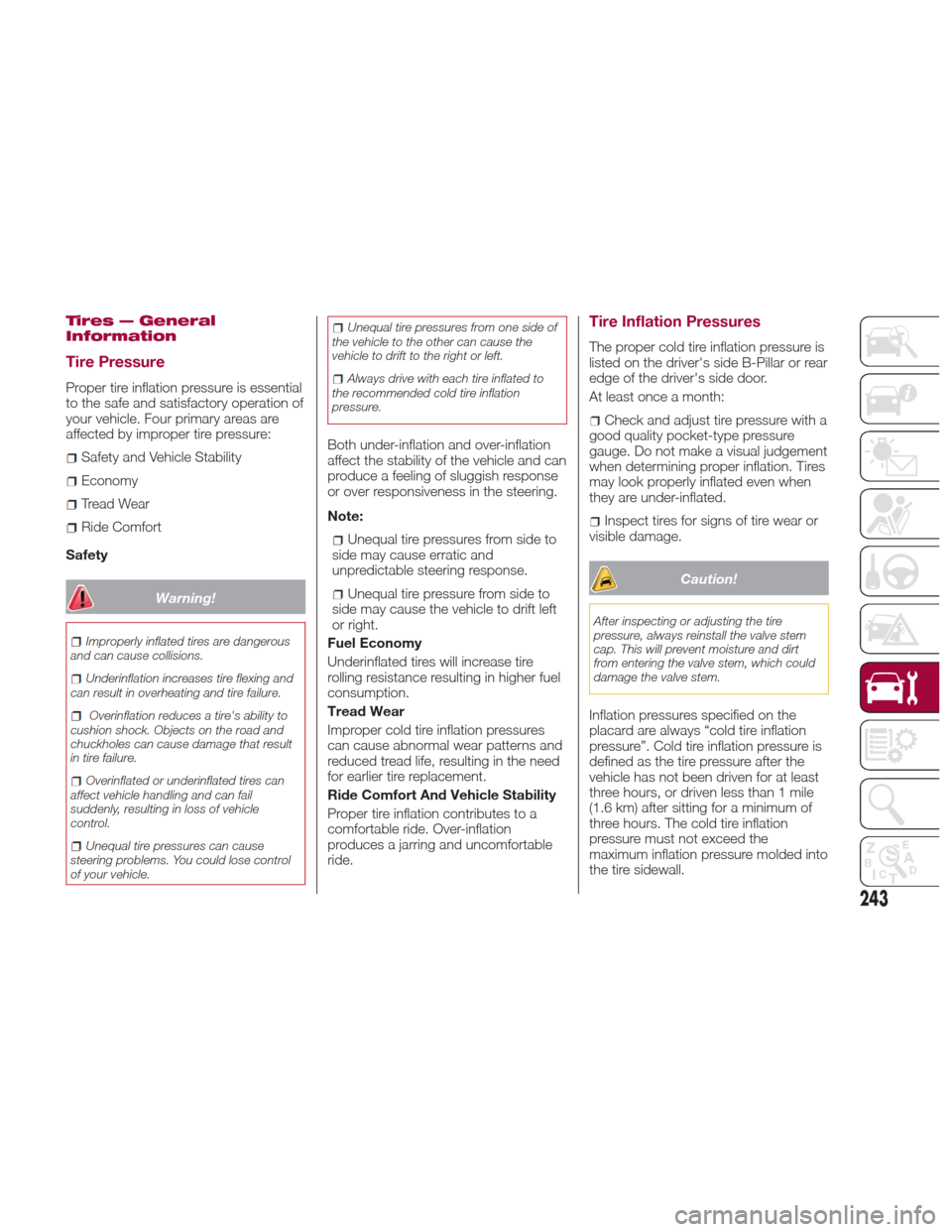
Tires — General
Information
Tire Pressure
Proper tire inflation pressure is essential
to the safe and satisfactory operation of
your vehicle. Four primary areas are
affected by improper tire pressure:
Safety and Vehicle Stability
Economy
Tread Wear
Ride Comfort
Safety
Warning!
Improperly inflated tires are dangerous
and can cause collisions.
Underinflation increases tire flexing and
can result in overheating and tire failure.
Overinflation reduces a tire's ability to
cushion shock. Objects on the road and
chuckholes can cause damage that result
in tire failure.
Overinflated or underinflated tires can
affect vehicle handling and can fail
suddenly, resulting in loss of vehicle
control.
Unequal tire pressures can cause
steering problems. You could lose control
of your vehicle.
Unequal tire pressures from one side of
the vehicle to the other can cause the
vehicle to drift to the right or left.
Always drive with each tire inflated to
the recommended cold tire inflation
pressure.
Both under-inflation and over-inflation
affect the stability of the vehicle and can
produce a feeling of sluggish response
or over responsiveness in the steering.
Note:
Unequal tire pressures from side to
side may cause erratic and
unpredictable steering response.
Unequal tire pressure from side to
side may cause the vehicle to drift left
or right.
Fuel Economy
Underinflated tires will increase tire
rolling resistance resulting in higher fuel
consumption.
Tread Wear
Improper cold tire inflation pressures
can cause abnormal wear patterns and
reduced tread life, resulting in the need
for earlier tire replacement.
Ride Comfort And Vehicle Stability
Proper tire inflation contributes to a
comfortable ride. Over-inflation
produces a jarring and uncomfortable
ride.
Tire Inflation Pressures
The proper cold tire inflation pressure is
listed on the driver's side B-Pillar or rear
edge of the driver's side door.
At least once a month:
Check and adjust tire pressure with a
good quality pocket-type pressure
gauge. Do not make a visual judgement
when determining proper inflation. Tires
may look properly inflated even when
they are under-inflated.
Inspect tires for signs of tire wear or
visible damage.
Caution!
After inspecting or adjusting the tire
pressure, always reinstall the valve stem
cap. This will prevent moisture and dirt
from entering the valve stem, which could
damage the valve stem.
Inflation pressures specified on the
placard are always “cold tire inflation
pressure”. Cold tire inflation pressure is
defined as the tire pressure after the
vehicle has not been driven for at least
three hours, or driven less than 1 mile
(1.6 km) after sitting for a minimum of
three hours. The cold tire inflation
pressure must not exceed the
maximum inflation pressure molded into
the tire sidewall.
243
Page 287 of 292

Electronic Vehicle Information
Center (EVIC) Setup Menu.....78
EVIC Display ..............78
Emergency flap opening ........174
Emergency Key ..............19
Emergency, In Case Of .........207
Hazard Warning Flasher ......183
Jacking ..........202,203,237
Jump Starting ............217
Overheating .............219
Towing ............. .220,221
Emission control system .........75
Engine .................. .266
Exhaust Gas Caution ........173
Fails To Start .............218
Flooded, Starting ..........218
Jump Starting ............217
Overheating .............219
Starting ..............21,218
Engine compartment ..........230
Engine coolant (level check) ......231
Engine oil (level check) .........231
Environment protection systems ....75
Essential information ............3
Ethanol .................. .172
Event Data Recorder ..........145
Exhaust Gas Caution ..........173
Exterior Lights ...............38Flash-To-Pass...............40
Flashers Hazard Warning ...........183
Turn Signal ...............41
Flooded Engine Starting ........218
Fluid And Lubricants ..........274
Fluid Capacities .............273
Fog Lights ..................41
Follow Me Home .............41
Front lights (light bulbs) .........186
Front Wipers Wiper Operation ...........42
Fuel Additives ...............173
Clean Air ...............172
Ethanol ............... .172
Materials Added ...........173
Methanol ...............172
Fuel Consumption Display ........88
Fuel Economy Monitor ..........87
Fuel filler cap ...............174
Fuel filler door ...............173
Fuse block (engine compartment) . .196
Fuse block (interior) ...........200
Fuses (interior) ..............194
Fuses (underhood) ............195
Gasoline, Clean Air...........172
Gasoline, Reformulated ........172Gear selector positions
.........153
GVWR .................. .175
Hazard Warning Flasher........183
Hazardous driving ............177
Head Restraints ............34,35
Headlight ..................38
Headlights Adjusting The Headlight
Abroad..................42
High Beam ...............40
Passing .................40
Heavy-duty use of the vehicle (scheduled servicing) ........224
HomeLink (Garage Door Opener) ........59
Hood Release ...............69
How to use this manual ..........3
Identification Data............263
Inside Rearview Mirror ..........36
Instrument Cluster Display DID Menu Items . . . .79,80,82,83,84
EVIC Menu Items . . .79,80,82,83,84
Interior Lights ................63
Interiors ................. .259
Internal Equipment ............61
Jack Location..............202
Jack Operation ........202,203,237
Jump Starting ...............217
Page 288 of 292

Key Fob..................14
Emergency Key ............14
Programming Additional Key
Fobs ...................24
Key-In Reminder ..............21
Keyless Entry System...........15
Lane Change And Turn Signals ....41
Lane Change Assist ............41
Lap/Shoulder Belts ........123,125
Leaving Home Light System ......42
Life Of Tires ............... .245
Lights Daytime Running ...........40
Fog ...................41
Hazard Warning Flasher ......183
Passing .................40
Turn Signal ...............41
Loading Vehicle .............175
Tires ................. .240
Locks PowerDoor ........... .26,31
Maintaining the finish.........254
Maintenance Monitor ...........85
Maintenance procedures ........234
Manual Climate Control System ....48
Heating .................50
Manual transmission ..........151
Manual Transmission ..........151Manual, Service
.............283
Methanol ................. .172
Mirrors....................36 Automatic Dimming .........37
Electric Remote ............38
Exterior Folding ............38
Outside .................36
Rearview ................36
Occupant Restraints ..........122
Onboard Diagnostic System ......77
Operating Precautions ..........77
Outside Rearview Mirrors ........36
Overhead light (bulb replacement) . .193
Overheating, Engine ...........219
Overloading ............... .181
Owner's Manual (Operator Manual) ..........283
Paint damage touch-up ........256
Parking Brake ...............150
Passing Light ................40
Performance ...............276
Periodic checks (scheduled servicing) ............... .224
Personal Settings ............107
Personalization Features ........107
Placard, Tire And Loading Information ...............240
Plastic part maintenance ........258Power
Brakes ................ .149
Door Locks ............26,31
Mirrors .................38
Pregnant Women And Seat Belts . .124
Pretensioners Seat Belts ..............127
Protection from atmospheric agents (bodywork) ..........252
Radar Sensors.............160
Radial Ply Tires ..............244
Radio Frequency General Information ........20,23
Radio transmitter and mobile phones ...................5
Rear Camera ...............166
Rear lights (light bulbs) .........186
Rear Park Assist System ........161
Rearview Mirrors ..............36
Recommended Tire Inflation Pressure ............... .264
Recorder, Event Data ..........145
Recreational towing ...........176
Reformulated Gasoline .........172
Refueling procedure ...........173
Refueling the vehicle ..........171
Reminder, Seat Belt ...........127
Replacement Tires ............246
Replacing a bulb .............183
INDEX