2017 CITROEN RELAY parking brake
[x] Cancel search: parking brakePage 5 of 292

3
cOnt
Ent
S
5. SAFEtY6. A cc ESSO r IES
7. c HE c KS8. Q
u I c K HELP
9. t E c H n I c AL
dA
t A
Parking brake 104
Hazard warning lamps 104
Horn
105
Braking assistance
systems
105
T
rajectory control
systems
107
Lane Departure W
arning
System
1
11
Traffic sign recognition
1
15
Seat belts
1
18
Airbags
122
Deactivating the
passenger's
front airbag
123
Child seats
125
ISOFIX seats
129T
owing a trailer 133
Roof carrying systems
135
Other accessories
136
Snow chains
137
Opening the bonnet
139
Underbonnet
140
Levels
141
Checks
144
Fuel
147
BlueHDi and
AdBlue
150Battery
156
Changing a fuse
159
Changing a bulb
163
Changing a wiper blade
169
Changing a wheel
170
Puncture repair kit
175
T
owing the vehicle
177
Detachable towball
178
Glossary of labels
182
Dimensions
186
Engines
191
W
eights
193
Identification markings
196
11. A ud IO and t
ELEMAt I c S
10. SPE
c IAL FEA
tur
ES
Crew cab 197
Chassis Cab / Floor Cab 199
Double cab
204
T
ipper body
208
T
ouch screen
Audio-Telematic
system
219
Audio system
267
Rear seat belts.
Child seats / ISOFIX
mountings at the rear.
contents
Page 8 of 292

6
ExtErIOr
Reversing camera 101
3rd brake lamp 163, 168
Left-hand side:
Fuel filler cap,
fuel tank
147-148
Fuel cut-of
f
149
AdBlue filler cap,
tank
150-153
T
opping-up the AdBlue
154-155
Load space
86-88
Rear doors
21
Rear lamps, direction indicators, foglamps
48, 163, 167-168
Number plate lamp
168
Rear parking sensors
100
Spare wheel, changing a wheel, jack, tools
170-174
Inflating tyres, pressures
176, 196
Snow chains
137
T
owing, lifting
177
T
owbar
133-134
Removable
towball
178-181 Dimensions
186-190, 20
0-203, 206-207
Accessories
136
Roof rack, roof bars
135
Brakes, pads
142, 144
T
yres, pressures
176, 196
Braking assistance systems
1
05-106
Trajectory control
107-1
10
Pneumatic suspension
102-103Key
, remote control, battery
14-17
Starting
18, 40-42
Central locking
22
Confidential card
18
Alarm
19
Wiper blade
169
Door mirror
90
Side repeater
166
Opening/closing doors
20-22
Remote control
14-15
Autoclose
92, 96
T
emporary puncture
repair kit
175-176
Front lamps, direction indicators,
front foglamps
48, 163-166
Headlamp beam
height adjustment
52
Headlamp wash
53
Changing bulbs
163-166
Location
Page 9 of 292
7
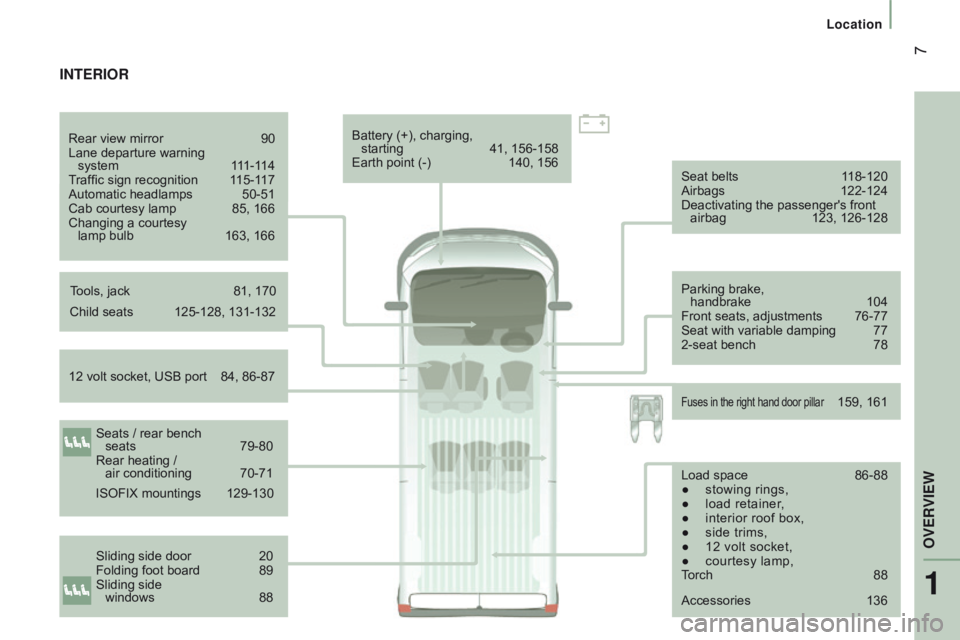
Seat belts 118-120
Airbags 122-124
Deactivating the passenger's front airbag
123, 126-128
Parking brake,
handbrake
104
Front seats, adjustments
76-77
Seat with variable damping
77
2-seat bench
78
Child seats
125-128, 131-132
12 volt socket, USB port
84, 86-87 Battery (+), charging,
starting
41, 156-158
Earth point (-)
140, 156
Fuses in the right hand door pillar 159, 161
IntErIOr
Seats / rear bench
seats 79-80
Rear heating /
air conditioning
70-71
Sliding side door
20
Folding foot board
89
Sliding side
windows
88
Rear view mirror
90
Lane departure warning
system
1
11-114
Traffic sign recognition
1
15-117
Automatic headlamps
50-51
Cab courtesy lamp
85, 166
Changing a courtesy
lamp bulb
163, 166
ISOFIX mountings
129-130
T
ools, jack
81, 170
Accessories
136
Load space
86-88
●
stowing rings,
●
load retainer
,
●
interior roof box,
●
side trims,
●
12 volt socket,
●
courtesy lamp,
T
orch
88
1
OVERVIEW
Location
Page 12 of 292

10
Changing a wiper
blade 169
Bulbs, lighting, changing
bulbs
163-168
V
ery cold conditions protectors
89
Opening the bonnet, stay
139
Under the bonnet
140
Labels / Precautions
182-185
Engines
191-192
Identification markings,
serial number
, paint,
tyres
196
Levels
141-143
●
dipstick,
●
brake fluid,
●
screenwash / headlamp wash
fluid
●
power steering fluid,
●
coolant. W
ater bleed, Diesel filter
145
Particle filter
146
Emission control
34, 153
Checks
144-146
●
battery
,
●
air/passenger compartment filter
,
●
oil filter
,
●
manual gearbox,
●
parking brake,
●
brake discs and pads.
tEcHnIcAL dAtA - M AI nt E n A nc E
Dimensions 186-190, 200-203, 206-207
W
eights
193-195 Engine fuses
159, 162
Location
Page 27 of 292
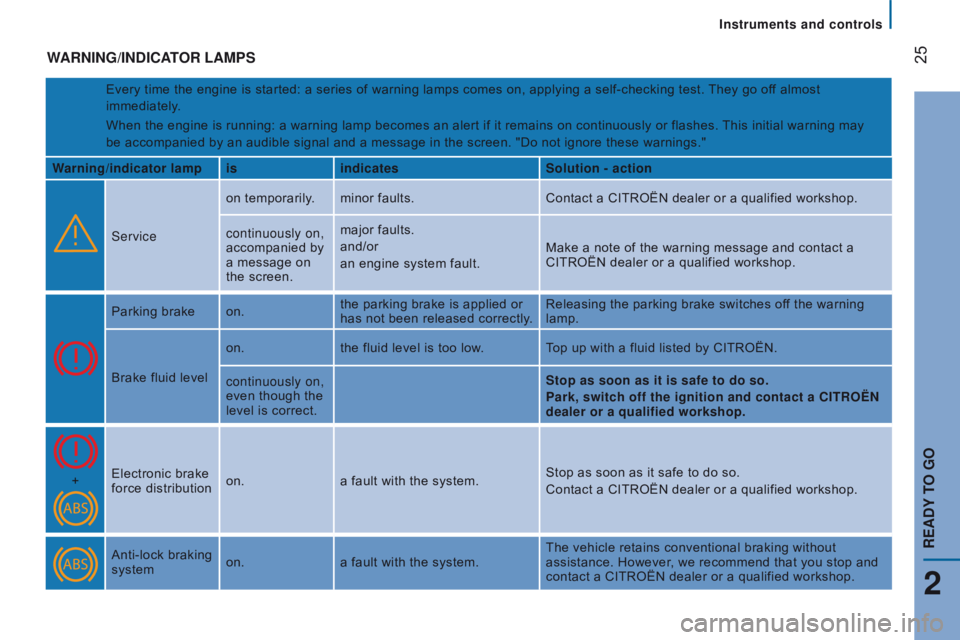
25WArn I n G / I nd I c AtO r LAMPS
Every time the engine is started: a series of warning lamps comes on, applying a self-checking test. They go off almost
immediately.
When the engine is running: a warning lamp becomes an alert if it remains on continuously or flashes. This initial warning may
be accompanied by an audible signal and a message in the screen. "Do not ignore these warnings."
Warning/indicator lamp isindicates Solution - action
Service on temporarily. minor faults.
Contact a CITROËN dealer or a qualified workshop.
continuously on,
accompanied by
a message on
the screen. major faults.
and/or
an engine system fault.
Make a note of the warning message and contact a
CITROËN dealer or a qualified workshop.
Parking brake on. the parking brake is applied or
has not been released correctly.Releasing the parking brake switches off the warning
lamp.
Brake fluid level on.
the fluid level is too low. Top up with a fluid listed by CITROËN.
continuously on,
even though the
level is correct. Stop as soon as it is safe to do so.
Park, switch off the ignition and contact a
c I tr OË n
dealer or a qualified workshop.
+ Electronic brake
force distribution on.
a fault with the system. Stop as soon as it safe to do so.
Contact a CITROËN dealer or a qualified workshop.
Anti-lock braking
system on.
a fault with the system. The vehicle retains conventional braking without
assistance. However, we recommend that you stop and
contact a CITROËN dealer or a qualified workshop.
2
rEAdY tO GO
Instruments and controls
Page 42 of 292

40
IGnItIOn SWItcH
StOP position: steering lock.
The ignition is off.
MA
r position: ignition on.
Certain accessories can be used.
AV V position: starter.
The starter is operated.
Starting the engine
Engine immobiliser warning lamp
If this warning lamp comes
on, use another key and have
the faulty key checked by a
CITROËN dealer.
d
iesel pre-heating warning lamp
With the parking brake applied
and the gearbox in neutral, turn
the key to the MA
r position.
Wait for this warning lamp to go off then
operate the starter (AV V position) until the
engine starts.
The period of illumination of the warning
lamp depends on the climatic conditions.
d
oor or bonnet open warning lamp
If this warning lamp comes on,
check that the doors and bonnet
are closed correctly.
Switching off the engine
Stop the vehicle and apply the parking
brake, then, with the engine at idle, return
the key to the S
t
OP
position.
In low temperatures
In mountainous and/or cold areas, it is
advisable to use a "winter" type fuel suited
to low or minus temperatures.
Avoid attaching heavy objects to the
key or the remote control, which would
weigh down on its blade in the ignition
switch and could cause a malfunction.
It could adversely affect the deployment of
the front airbag. With the engine hot, the warning lamp
comes on for a few moments, you can start
the engine without waiting.
As soon as the engine is running, release
the key.
Starting and switching off
Page 44 of 292

42
HILL StA rt ASSIS t
This system (also called HHC - Hill Holder
Control), linked to the dynamic stability
control system, makes hill starts easier and
is activated in the following conditions:
-
the vehicle must be stationary
, engine
running, foot on the brake,
-
the gradient of the road must be steeper
than 5%,
-
uphill, the gearbox must be in neutral or
in a gear other than reverse,
-
downhill, reverse gear must be engaged.
The Hill Start
Assist system is a driving
aid. It is not an automatic vehicle parking
function or an automatic parking brake.Operation
With the brake pedal and clutch pedal
pressed, from the time you release the brake
pedal, without using the parking brake, you
have approximately 2 seconds to move off
before the vehicle starts to roll back.
During the moving off phase, the function
is deactivated automatically, gradually
releasing the braking pressure. During
this phase, the characteristic noise of
mechanical release of the brakes may be
heard, indicating the imminent movement of
the vehicle.
Operating fault
If a malfunction of the system
occurs, this warning lamp comes
on accompanied by an audible
signal and confirmed by a message
in the screen. Have the system checked by a
CITROËN dealer or a qualified workshop. Hill start assist is deactivated in the following
situations:
-
when the clutch pedal is released,
-
when the parking brake is applied,
-
when the engine is switched of
f,
-
when the engine stalls.
Starting and switching off
Page 48 of 292

46drIVInG rEcOMMEndAtIO n S
Observe the driving regulations and remain
vigilant whatever the traffic conditions.
Pay close attention to the traffic and keep
your hands on the wheel so that you are
ready to react at any time to any eventuality.
On a long journey, a break every two hours
is strongly recommended.
In difficult weather, drive smoothly, anticipate
the need to brake and increase the distance
from other vehicles.
driving on flooded roads
We strongly advise against driving on
flooded roads, as this could cause serious
damage to the engine or gearbox, as well as
to the electrical systems of your vehicle. If you are obliged to drive through water:
-
check that the depth of water does not
exceed 15 cm, taking account of waves
that might be generated by other users,
-
deactivate the Stop & Start system,
-
drive as slowly as possible without
stalling. In all cases, do not exceed
6 mph (10 km/h),
-
do not stop and do not switch of
f the
engine.
On leaving the flooded road, as soon as
circumstances allow, make several light
brake applications to dry the brake discs
and
pads.
If in doubt on the state of your vehicle,
contact a CITROËN dealer or a qualified
workshop.
Important!
Never drive with the parking brake applied -
Risk of overheating and damage to the
braking system!
Do not park or run the engine when
stationary in areas where inflammable
substances and materials (dry grass, dead
leaves...) might come into contact with the
hot exhaust system - Risk of fire!
Never leave a vehicle unsupervised with
the engine running. If you have to leave
your vehicle with the engine running, apply
the parking brake and put the gearbox into
neutral.
Starting and switching off