Page 227 of 442
225
F Place the foot of the jack 2 on the ground and ensure that it is directly below the
front
A or rear B jacking point provided on
the underbody, whichever is closest to the
wheel to be changed. F
E xtend the jack 2 until its head comes into contact with the jacking point A or B used; the
vehicle’s contact sur face at A or B must engage with the central part of the head of the jack.
F
R
aise the vehicle until there is sufficient space between the wheel and the ground to admit the
spare (not punctured) wheel easily.
Ensure that the jack is stable. If the ground is slippery or loose, the jack might slip or drop - Risk of
injury!
Take care to position the jack only at one of the vehicle’s jacking points A or B under the vehicle,
ensuring that the contact sur face of the vehicle’s jacking point is centred on the head of the jack.
Other wise there is a risk of damage to the vehicle and/or that the jack might drop - Risk of injury!
8
In the event of a breakdown
Page 228 of 442
226
F Remove the bolts and store them in a clean place.
F
R
emove the wheel.
Stowing the wheel with
punctured tyre
The wheel with punctured tyre can be
stowed under the floor, in the housing
for the standard spare wheel.
To stow an alloy wheel, first remove the
trim from the middle of the wheel so that
the fixing parts (nut and bolt) can be put
in place.
In the case of a "space-saver" type
spare wheel, the wheel with punctured
tyre cannot be stowed under the floor. It
must be stowed in the boot; use a cover
to protect the inside of the boot.
In the event of a breakdown
Page 229 of 442
227
List of operations
F Put the wheel in place on the hub.
F S crew in the bolts fully by hand.
F
P
re-tighten the bolts using the
wheelbrace
1 o n l y.
Fitting a wheel
Fitting the spare wheel
If your vehicle is fitted with alloy wheels,
when tightening the bolts on fitting, it is
normal to notice that the washers do not
come into contact with the spare wheel.
The wheel is secured by the conical
sur face of each bolt.
After changing a wheel
When using a "space-saver" type of
spare wheel, do not exceed 50 mph
(80 km/h).
Have the tightening of the bolts and the
pressure of the spare wheel checked
by a CITROËN dealer or a qualified
workshop without delay.
Have the punctured wheel repaired
and refitted to the vehicle as soon as
possible.
8
In the event of a breakdown
Page 230 of 442
228
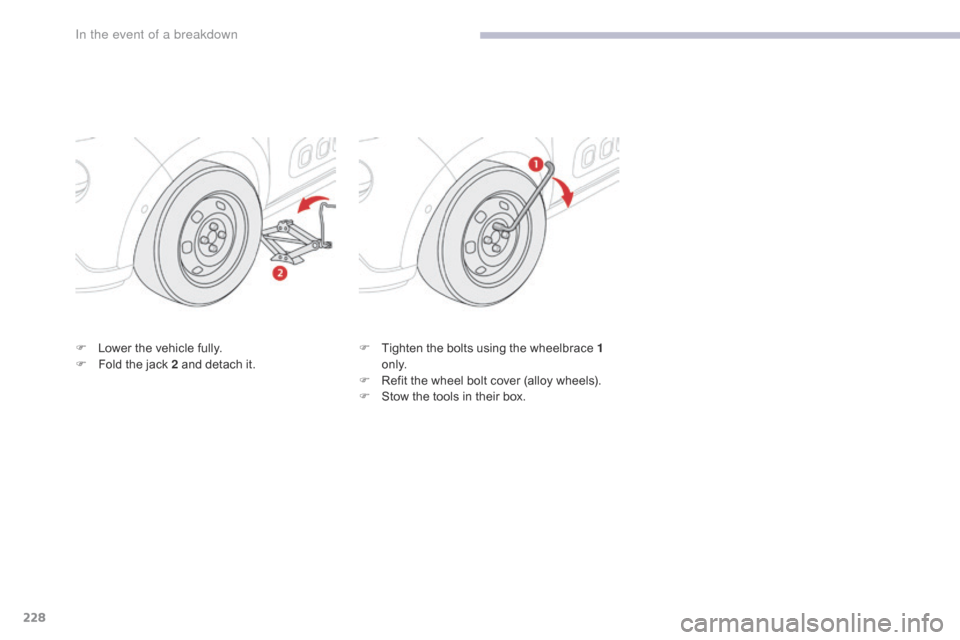
F Lower the vehicle fully.
F F old the jack 2 and detach it. F
T ighten the bolts using the wheelbrace 1
o n l y.
F
R
efit the wheel bolt cover (alloy wheels).
F
S
tow the tools in their box.
In the event of a breakdown
Page 235 of 442

233
1. Sidelamps (R10W).
2. Brake lamps (P21W).
3.
D
irection indicators (PY21W).
4.
R
eversing lamp (P21W), left-hand side, or
Foglamp (PR21W), right-hand side.
Rear lamps
Changing bulbs
To reassemble, carry out these operations in
reverse order. F
S
pread the bulb holder retaining tabs and
remove the bulb holder.
F
T
urn the bulb a quarter turn and change it.
These bulbs are changed from inside the boot.
F
O
pen the boot.
F
R
emove the access cover on the
corresponding side trim.
F
D
isconnect the lamp unit connector.
F
S
lacken and remove the nut ( take care not
to drop it inside the wing ).
F
U
nclip the lamp unit and carefully remove
it by pulling it horizontally towards the
outside. Take care to engage the lamp unit in its
guides, while keeping it in line with the
vehicle.
Tighten sufficiently to ensure sealing,
but without damaging the lamp.
It may be necessary to use slip joint pliers or
the wheelbrace (depending on equipment) to
remove the nut.
8
In the event of a breakdown
Page 249 of 442
247
To w i n g
General recommendations
Observe the legislation in force in your country.
Ensure that the weight of the towing vehicle is higher than that of the towed vehicle.
The driver must remain at the wheel of the towed vehicle and must have a valid driving licence.
When towing a vehicle with all four wheels on the ground, always use an approved towing arm;
rope and straps are prohibited.
The towing vehicle must move off gently.
When towing a vehicle with the engine off, there is no longer any power assistance for braking or
steering.
In the following cases, you must always call on a professional recovery service:
- vehicle broken down on a motor way or fast road,- four-wheel drive vehicle,- when it is not possible to put the gearbox into neutral, unlock the steering, or release the
parking brake,
- towing with only two wheels on the ground,- where there is no approved towing arm available...
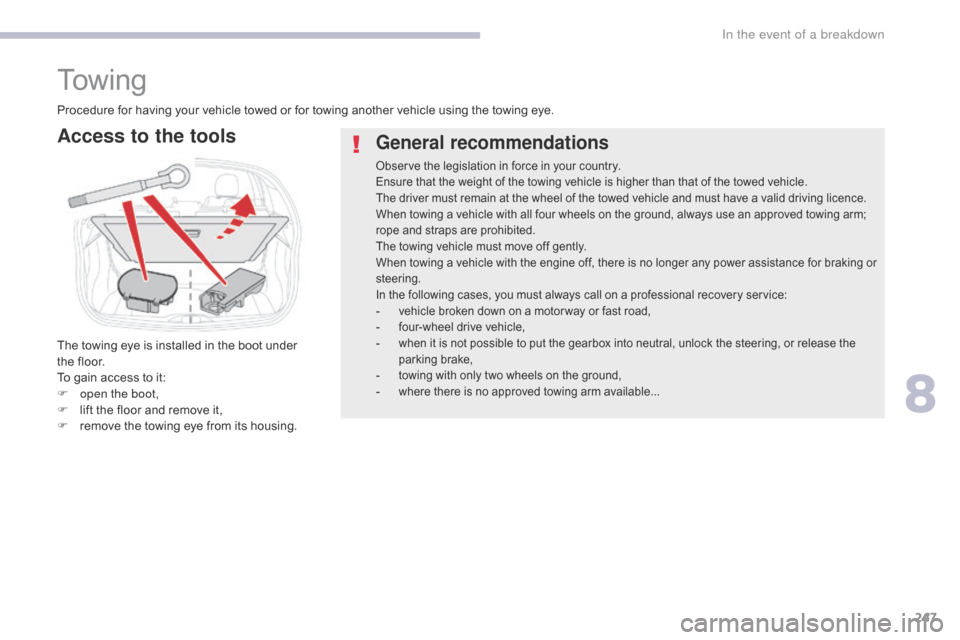
Procedure for having your vehicle towed or for towing another vehicle using the towing eye.
Access to the tools
The towing eye is installed in the boot under
the floor.
To gain access to it:
F
o
pen the boot,
F
l
ift the floor and remove it,
F
r
emove the towing eye from its housing.
8
In the event of a breakdown
Page 252 of 442
250
* The maximum power corresponds to the value type-approved on a test bed, under conditions defined in European legislation (Directive 1999/99/EC).
Engines and towed loads - PETROL
Engine PureTech 70
manual PureTech 82
manual PureTech 110 S&S
VTI 115 EAT6
Gearbox 5-speed
manual(BVM5) 5-speed
manual(BVM5) 5-speed
manual(BVM5) 6-speed
automatic ( E AT 6 ) 6-speed
automatic ( E AT 6 )
Code EB2FB - MA EB2F - MAEB2DT - BM -
S T Td EB2DT - AT6III -
S T Td EC5F - AT6III
Model code Wheel 640 = /A...
Wheel 620 = /B… SXHMP6/B0 -
SXHMP6/A0 SXHMZ6/…
B0 - B1 - A0 - B0M - A0M SXHNZ6/A0S
SXHNZT/A0S SXNFPT/A0
Capacity (cm
3) 1 1991 1991 1991 1991 587
Maximum power: EU standard (kW)* 5060 818185
Fuel Unleaded Unleaded Unleaded Unleaded Unleaded
Braked trailer (within GTW limit) on a 10 or 12%
gradient (kg) 450
450600 450450
Unbraked trailer (kg) 450450450450450
Recommended nose weight (kg) 2626 323232
Technical data
Page 253 of 442
251
Engines and towed loads - DIESEL
* The maximum power corresponds to the value type-approved on a test bed, under conditions defined in European legislation (Directive 1999/99/EC).Engine
BlueHDi 75 S&S manualHDi 90 BlueHDi 100 S&S manual
Gearbox 5-speed manual
(BVM5) 5-speed manual
(BVM5) 5-speed manual
(BVM5)
Code DV6FE - BE - STTdDV6DM - BEDV6FD - BE - STTd
Model code Wheel 640 = /A...
Wheel 620 = /B… SXBHW6/…
B0S - B1S - A0S SX9HJC/B0 - SX9HJC/A0
SXBHY6/B0S - SXBHY6/A0S
Capacity (cm
3) 1 5601 5601 560
Maximum power: EU standard (kW)* 5566 73
Fuel DieselDieselDiesel
Braked trailer (within GTW limit) on a 10 or 12%
gradient (kg) 600
600600
Unbraked trailer (kg) 450450450
Recommended nose weight (kg) 323232
9
Technical data