2017 Citroen C3 RHD air condition
[x] Cancel search: air conditionPage 127 of 442

125
Airbags
General information
The airbags do not operate when the
ignition is switched off.
This equipment will only deploy once.
If a second impact occurs (during the
same or a subsequent accident), the
airbag will not be deployed again.Deployment of one or more of the
airbags is accompanied by a slight
emission of smoke and a noise, due
to the activation of the pyrotechnic
cartridge incorporated in the system.
This smoke is not harmful, but sensitive
individuals may experience slight
irritation.
The noise of detonation associated with
the deployment of one or more airbags
may result in a slight loss of hearing for
a short time.
Impact detection zones
A. Front impact zone.
B. S
ide impact zone.
System designed to contribute towards
improving the safety of the occupants (with
the exception of the rear centre passenger)
in the event of violent collisions. The airbags
supplement the action of the seat belts fitted
with force limiters (all except the centre rear
passenger belt).
If a collision occurs, the electronic detectors
record and analyse the front and side impacts
sustained in the impact detection zones:
-
i
n the case of a serious impact, the airbags
are deployed instantly and contribute
towards better protection of the occupants
of the vehicle (with the exception of the
rear centre passenger); immediately after
the impact, the airbags deflate rapidly so
that they do not hinder visibility or the exit
of the occupants,
-
i
n the case of a minor or rear impact or in
certain roll-over conditions, the airbags
may not be deployed; the seat belt
alone contributes towards ensuring your
protection in these situations.
5
Safety
Page 188 of 442

186
Driving with under-inflated tyres
increases fuel consumption.The under-inflation detection system
does not replace the need for vigilance
on the part of the driver.
This system does not avoid the need to
check the tyre pressures (including the
spare wheel) every month as well as
before a long journey.
Driving with under-inflated tyres impairs
road holding, extends braking distances
and causes premature tyre wear,
particularly under arduous conditions
(high loading, high speed, long journey).
The inflation pressures defined for
your vehicle can be found on the tyre
pressure label.
For more information on the
Identification markings
, refer to the
corresponding section.
Snow chains
The system does not have to be
reinitialised after fitting or removing
snow chains.
Under-inflation detection
System which automatically checks the pressures of the tyres while driving.
The system monitors the pressures in the four
tyres, once the vehicle is moving.
It compares the information given by the four
wheel speed sensors with reference values,
which must be reinitialised ever y time the
tyre pressures are adjusted or a wheel
changed .
The system triggers an alert as soon as it
detects a drop in the inflation pressure of one
or more tyres. Checking tyre pressures
This check should be done when
the
tyres are "cold" (vehicle stopped
for
1 hour or after a journey of less than
6 miles (10 km) at moderate speeds).
Other wise, add 0.3 bar to the pressures
shown on the label.
Driving
Page 200 of 442

198
Load reduction mode
System which manages the use of certain
functions according to the level of charge
remaining in the battery.
When the vehicle is being driven, the load
reduction function temporarily deactivates
certain functions, such as the air conditioning,
the heated rear screen...
The deactivated functions are reactivated
automatically as soon as conditions permit.System which manages the duration of use of
certain functions to conserve a sufficient level
of charge in the battery.
After the engine has stopped, you can
still use functions such as the audio and
telematics system,
windscreen wipers, dipped
beam headlamps,
courtesy lamps, etc. for
a maximum combined duration of about
forty
m
inutes.
Energy economy mode
Switching to economy mode
A message appears in the instrument panel
screen indicating that the vehicle has switched
to economy mode and the active functions are
put on standby.
If a telephone call is being made at this time, it
will be maintained for around 10 minutes with
the Bluetooth
® hands-free system of your audio
system.
Exiting economy mode
These functions are reactivated automatically
next time the vehicle is driven.
In order to restore the use of these functions
immediately, start the engine and let it run:
-
f
or less than ten minutes, to use the
equipment for approximately five minutes,
-
f
or more than ten minutes, to use the
equipment for up to approximately
thirty
m
inutes.
Let the engine run for the duration specified to
ensure that the battery charge is sufficient.
Do not repeatedly and continuously restart the
engine in order to charge the battery.
A flat battery prevents the engine from
starting.
For more information on the 12 V
battery , refer to the corresponding
section.
Practical information
Page 210 of 442
208
Checking components
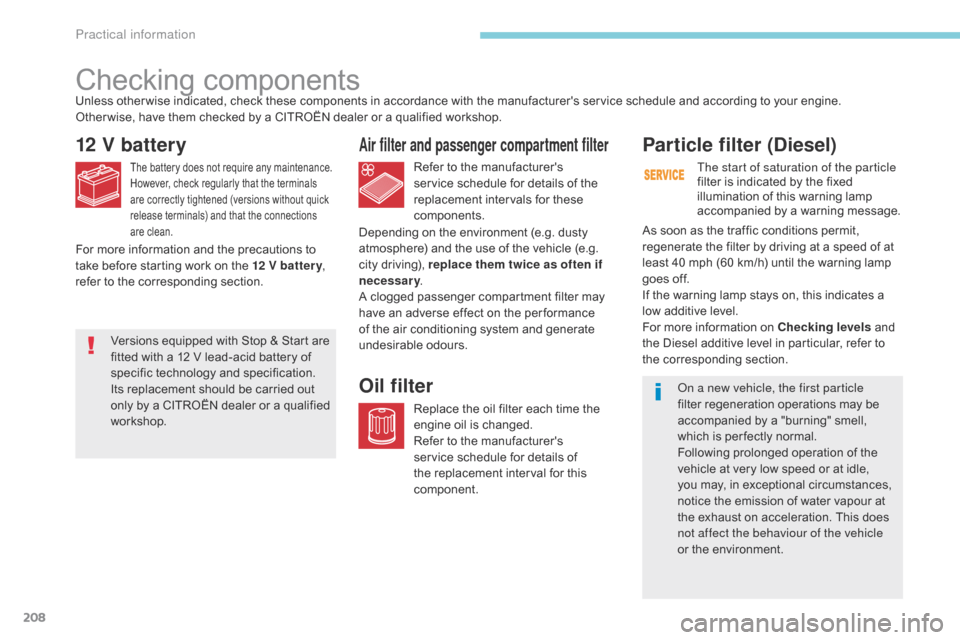
12 V battery
The battery does not require any maintenance.
However, check regularly that the terminals
are correctly tightened (versions without quick
release terminals) and that the connections
are clean.Refer to the manufacturer's
service schedule for details of the
replacement intervals for these
components.
Air filter and passenger compartment filter
Replace the oil filter each time the
engine oil is changed.
Refer to the manufacturer's
service schedule for details of
the replacement interval for this
component.
Oil filter
Unless other wise indicated, check these components in accordance with the manufacturer's service schedule and according to your engine.
Other wise, have them checked by a CITROËN dealer or a qualified workshop.Depending on the environment (e.g. dusty
atmosphere) and the use of the vehicle (e.g.
city driving), replace them twice as often if
necessary.
A clogged passenger compartment filter may
have an adverse effect on the per formance
of the air conditioning system and generate
undesirable odours.
Particle filter (Diesel)
The start of saturation of the particle
filter is indicated by the fixed
illumination of this warning lamp
accompanied by a warning message.
As soon as the traffic conditions permit,
regenerate the filter by driving at a speed of at
least 40 mph (60 km/h) until the warning lamp
goes off.
If the warning lamp stays on, this indicates a
low additive level.
For more information on Checking levels and
the Diesel additive level in particular, refer to
the corresponding section.
On a new vehicle, the first particle
filter regeneration operations may be
accompanied by a "burning" smell,
which is per fectly normal.
Following prolonged operation of the
vehicle at very low speed or at idle,
you may, in exceptional circumstances,
notice the emission of water vapour at
the exhaust on acceleration. This does
not affect the behaviour of the vehicle
or the environment.
For more information and the precautions to
take before starting work on the 12 V batter y
,
refer to the corresponding section.
Versions equipped with Stop & Start are
fitted with a 12 V lead-acid battery of
specific technology and specification.
Its replacement should be carried out
only by a CITROËN dealer or a qualified
workshop.
Practical information
Page 241 of 442
239
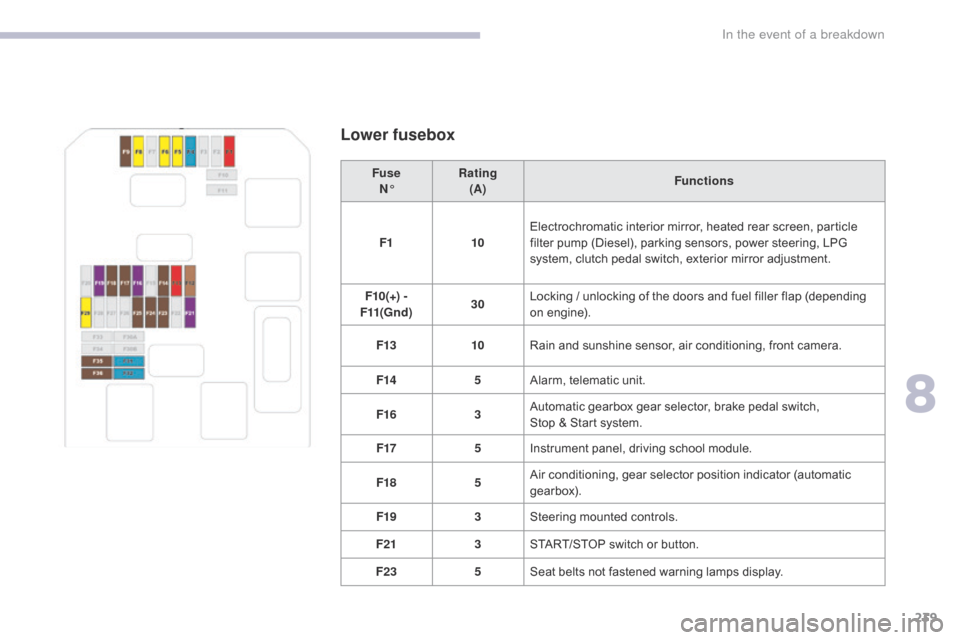
Lower fusebox
FuseN° Rating
(A) Functions
F1 10Electrochromatic interior mirror, heated rear screen, particle
filter pump (Diesel), parking sensors, power steering, LPG
system, clutch pedal switch, exterior mirror adjustment.
F10(+) -
F11(Gnd) 30Locking / unlocking of the doors and fuel filler flap (depending
on engine).
F13 10Rain and sunshine sensor, air conditioning, front camera.
F14 5Alarm, telematic unit.
F16 3Automatic gearbox gear selector, brake pedal switch,
Stop & Start system.
F17 5Instrument panel, driving school module.
F18 5Air conditioning, gear selector position indicator (automatic
gearbox).
F19 3Steering mounted controls.
F21 3START/STOP switch or button.
F23 5Seat belts not fastened warning lamps display.
8
In the event of a breakdown
Page 243 of 442

241
Engine compartment fuses
Access to the fuses
F Unclip the cover.
F C hange the fuse.
F
W
hen you have finished, close the cover
carefully to ensure correct sealing of the
fusebox. Fuse
N° Rating
(A) Functions
F1 40Air conditioning.
F10 15Engine management.
F11 20Engine management.
F12 5Engine management.
F13 5Engine management.
F14 5Battery charge status unit (depending on engine).
F15 5Not used.
F16 20Front foglamp.
F17 5Engine management.
F18 10Right-hand main beam headlamp.
F19 10Left-hand main beam headlamp.
F2 60A B S / E S P.
F20 30Engine management.
F21 30Starter motor (depending on engine).
F22 30Not used.
F23 40Starter unit (with Stop & Start and depending on engine).
F24 40Passenger compartment fusebox.
The fusebox is placed in the engine
compartment near the battery.
8
In the event of a breakdown
Page 256 of 442

254
Accessories .......................................... 113, 153
AdBlue® ............................... ...... 23, 33, 210, 211
Adjusting headlamps .................................... 10
8
Adjusting head restraints
................................ 74
A
djusting seats
................................................ 73
A
djusting the air distribution
..................... 8
1, 84
Adjusting the air flow
................................. 8
1, 84
Adjusting the date
..................................... 3
8, 51
Adjusting the height and reach of the steering wheel
.................................... 78
A
djusting the temperature
........................ 8
1, 84
Adjusting the time
............................... 3
8, 51, 52
Advice on driving
..............................
....147, 148
Airbags
...............
............................. 26, 125, 133
Airbags, curtain
..................................... 12
8, 129
Airbags, front......................................... 126, 129
Airbags, lateral
...................................... 12
7, 129
AIRBUMP
® .................................................... 2 14
Air conditioning ............................... ............9, 83
Air conditioning, automatic
.......................8
0, 84
Air conditioning, manual
...........................8
0, 82
Air intake
...............
....................................82, 84
Air vents
..............................
............................ 79
Alarm
............................................................... 69
A
nti-lock braking system (ABS)
....................11
9
Anti-slip regulation (ASR)
............................. 11
9
Anti-theft
..............................
.........................149
Armrest, front
............................................9
2, 94
Assistance call
...............................
........115 , 117
Assistance, emergency braking
................... 11
9
Audio system
...............................
....................38
Auxiliary socket
............................................... 98
ABChild seats, ISOFIX .......................1 3 9 -141, 143
C ITROËN C onnect Box ........................11
5 , 117
CITROËN ConnectedCAM™
....................... 18
9
C
ITROËN
Localised Emergency
Call
........
............................................... 115 , 117
Closing the boot
...............................
.........54, 66
Closing the doors
..........................5
4, 57, 58, 65
Coat hanger
..............................
......................95
Configuration, vehicle
......................... 3
8, 41, 43
Control, electric windows
................................71
C
ontrol, emergency
boot release
...............................
...................66
Control, emergency door
................................ 61
C
ontrol stalk, lighting
.............. 1
4, 101, 102, 106
Control stalk, wipers
..............................1
0 9 -111
Courtesy lamp
...............................
..........90, 235
Cruise control
................................ 1
66, 169, 174
Cruise control by speed limit recognition
.................................................. 16
9
Cup holder
...............................
........................92
Capacity, fuel tank
..............................
.......... 192
Cap, fuel filler
................................................ 19
2
Central locking
.................................... 5
7, 58, 67
Changing a bulb
........................... 2
29, 233, 235
Changing a fuse
............................2
36, 238, 241
Changing a wheel
...............................
.. 221, 222
Changing a wiper blade
........................ 1
12, 199
Changing the remote control battery
.............. 63
C
hecking the engine oil level
.......................... 32
C
hecking the levels
............................... 20
4-207
Checking tyre pressures (using the kit)
..............................
................ 216
Checks
...............
.................. 202, 203, 208, 209
Child lock
...............................
........................ 146
Children
...............................
... 137, 139 -141, 143
Child seats
............ 1
24, 130 -132, 136, 137, 145
Child seats, i-Size
...............................
.......... 143 Date (setting)
...............................
.............. 38, 51
Daytime running lamps
........ 1
02, 106, 229, 230
Deactivating the passenger
airbag
.................................................. 1
26, 133
Deadlocking
...............................
...............54, 59
Demisting - defrosting
..................................... 89
D
imensions
..............................
.....................252
Dipstick
................
....................................32, 204
Direction indicators
...... 1
04, 106, 229, 230, 233
Display screen, instrument panel
.................16
1
C
D
Battery ................................... 198, 208, 243 -246
Battery, charging ............................... ............245
Battery, remote control
.............................6
0, 63
Blind, panoramic roof
...................................... 91
B
lind spot monitoring system
........................18
0
Blind spot sensors
.................................. 1
6, 180
BlueHDi
...............................
...... 29, 33, 210, 215
Bonnet
...............
............................................ 201
Boot
........
.............................................66, 91, 96
Brake discs
.................................................... 20
9
Brake lamps
...............................
...................233
Brakes
.....................................................2
0, 209
Bulbs (changing)
...............................
... 229, 233
Alphabetical index
Page 269 of 442

3
.
12:13
18,5 21,5
23 °C
Audio and Telematics
Select the audio source (depending on version): - FM / DAB * / AM * radio stations. - USB memory stick. - CD player. - Media player connected via the auxiliary socket (Jack, cable not supplied). - Telephone connected by Bluetooth * using
Bluetooth * audio streaming.
* Depending on equipment.
Certain information is displayed permanently in the upper band of the touch screen: - Reminder of the air conditioning information and direct access to the corresponding menu. - Go directly to the selection of the audio source, to the list of radio stations (or list of titles depending on the source).
- Go to the message notifications, emails, map updates and, depending on the services, the navigation notifications. - Go to the settings for the touch screen and the digital instrument panel.
In very hot conditions, the volume may be limited to protect the system. It may go into standby (screen and sound off) for at least 5 minutes.
The return to normal takes place when the temperature in the passenger compartment has dropped.
In the "Settings" menu you can create a profile for just one person or a group of people with common points, with the possibility of entering a multitude of settings (radio presets, audio settings, navigation history, contact favourites, ...); these settings are taken into account automatically.