Page 199 of 442

197
You must observe the maximum trailer
weight, indicated on the registration
certificate or in the technical
specification for your vehicle.
Towing a trailer
We recommend the use of genuine
CITROËN towbars and their harnesses
that have been tested and approved
from the design stage of your vehicle,
and that the fitting of the towbar is
entrusted to a CITROËN dealer or a
qualified workshop.
If the towbar is not fitted by a
CITROËN dealer, it must still be
fitted in accordance with the vehicle
manufacturer's instructions.
Your vehicle is primarily designed for
transporting people and luggage, but it may
also be used for towing a trailer.
Driving with a trailer places greater
demands on the towing vehicle and the
driver must take particular care.
For more information on Driving
advice
, particularly when towing, refer
to the corresponding section.
For more information on Weights (and
the towed loads which apply to your
vehicle) refer to the corresponding
section.
Closer
For towing, the closer must be removed if fitted
on your vehicle.
It is located behind the lower air intake grille.
To remove it, consult a CITROËN dealer or a
qualified workshop.
7
Practical information
Page 249 of 442
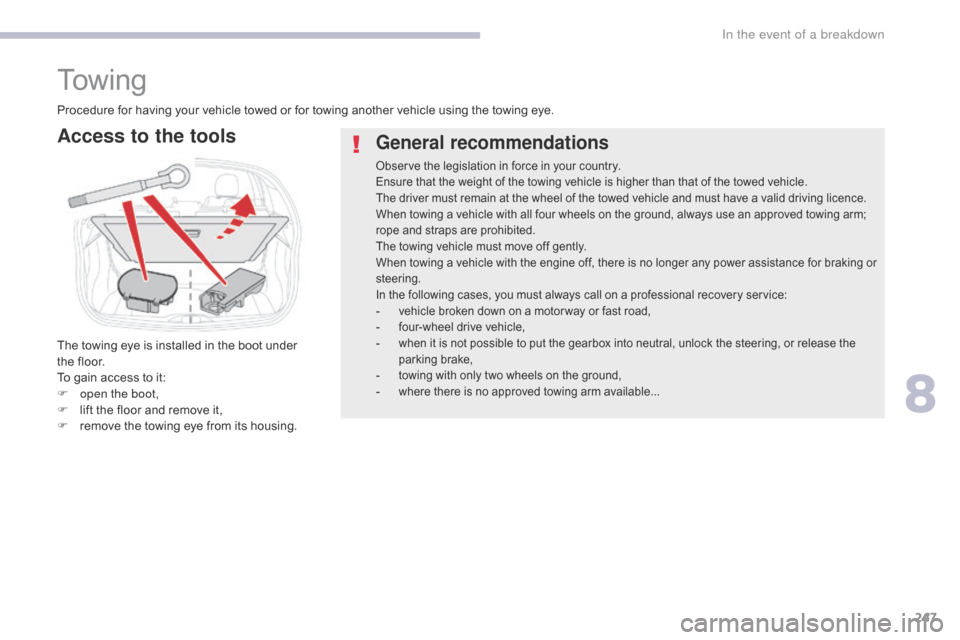
247
To w i n g
General recommendations
Observe the legislation in force in your country.
Ensure that the weight of the towing vehicle is higher than that of the towed vehicle.
The driver must remain at the wheel of the towed vehicle and must have a valid driving licence.
When towing a vehicle with all four wheels on the ground, always use an approved towing arm;
rope and straps are prohibited.
The towing vehicle must move off gently.
When towing a vehicle with the engine off, there is no longer any power assistance for braking or
steering.
In the following cases, you must always call on a professional recovery service:
- vehicle broken down on a motor way or fast road,- four-wheel drive vehicle,- when it is not possible to put the gearbox into neutral, unlock the steering, or release the
parking brake,
- towing with only two wheels on the ground,- where there is no approved towing arm available...
Procedure for having your vehicle towed or for towing another vehicle using the towing eye.
Access to the tools
The towing eye is installed in the boot under
the floor.
To gain access to it:
F
o
pen the boot,
F
l
ift the floor and remove it,
F
r
emove the towing eye from its housing.
8
In the event of a breakdown
Page 251 of 442

249
Engines
Engine characteristics
The engine characteristics (capacity, maximum
power, maximum engine speed, fuel, CO
2
emissions, etc.) for your vehicle are given in
the registration document, as well as in sales
brochures.
These characteristics correspond to the
values type-approved on a test bed, under
conditions defined in European legislation
(Directive
1
999/99/EC).
For more information, contact a CITROËN
dealer or a qualified workshop.
Weights
Weights and towed loads
The maximum weights and towed loads for your
vehicle are given are given in the registration
document, as well as in sales brochures.
These values are also present on the
manufacturer's plate or label.
For more information, contact a CITROËN
dealer or a qualified workshop.
The kerb weight is equal to the unladen
weight
+ driver (75 kg).
The GTW and towed load values indicated
apply up to a maximum altitude of
1
000 metres; the towed load mentioned
must be reduced by 10 % for every additional
1
000 metres.
The weight of the braked trailer can be
increased, within the GTW limit, on condition
that the GV W of the towing vehicle is reduced
by the same amount.
The recommended nose weight is the vertical
load on the towbar ball (removable with or
without tools).
GV W: gross vehicle weight, the maximum
authorised vehicle weight.
GT W: gross train weight, the maximum
authorised weight of vehicle plus trailer. High exterior temperatures may result
in a reduction in the per formance of
the vehicle to protect the engine; when
the exterior temperature is higher than
37
°C, limit the towed weight.
Towing with a lightly loaded vehicle can
adversely affect roadholding.
Braking distances are increased when
towing a trailer.
Never exceed 60 mph (100 km/h) when
towing (comply with the legislation in
force in your country).
If the exterior temperature is high, it
is recommended that the engine be
allowed to idle for 1 to 2 minutes after
the vehicle comes to a stop, to facilitate
its cooling.
9
Technical data
Page 252 of 442
250
* The maximum power corresponds to the value type-approved on a test bed, under conditions defined in European legislation (Directive 1999/99/EC).
Engines and towed loads - PETROL
Engine PureTech 70
manual PureTech 82
manual PureTech 110 S&S
VTI 115 EAT6
Gearbox 5-speed
manual(BVM5) 5-speed
manual(BVM5) 5-speed
manual(BVM5) 6-speed
automatic ( E AT 6 ) 6-speed
automatic ( E AT 6 )
Code EB2FB - MA EB2F - MAEB2DT - BM -
S T Td EB2DT - AT6III -
S T Td EC5F - AT6III
Model code Wheel 640 = /A...
Wheel 620 = /B… SXHMP6/B0 -
SXHMP6/A0 SXHMZ6/…
B0 - B1 - A0 - B0M - A0M SXHNZ6/A0S
SXHNZT/A0S SXNFPT/A0
Capacity (cm
3) 1 1991 1991 1991 1991 587
Maximum power: EU standard (kW)* 5060 818185
Fuel Unleaded Unleaded Unleaded Unleaded Unleaded
Braked trailer (within GTW limit) on a 10 or 12%
gradient (kg) 450
450600 450450
Unbraked trailer (kg) 450450450450450
Recommended nose weight (kg) 2626 323232
Technical data
Page 253 of 442
251
Engines and towed loads - DIESEL
* The maximum power corresponds to the value type-approved on a test bed, under conditions defined in European legislation (Directive 1999/99/EC).Engine
BlueHDi 75 S&S manualHDi 90 BlueHDi 100 S&S manual
Gearbox 5-speed manual
(BVM5) 5-speed manual
(BVM5) 5-speed manual
(BVM5)
Code DV6FE - BE - STTdDV6DM - BEDV6FD - BE - STTd
Model code Wheel 640 = /A...
Wheel 620 = /B… SXBHW6/…
B0S - B1S - A0S SX9HJC/B0 - SX9HJC/A0
SXBHY6/B0S - SXBHY6/A0S
Capacity (cm
3) 1 5601 5601 560
Maximum power: EU standard (kW)* 5566 73
Fuel DieselDieselDiesel
Braked trailer (within GTW limit) on a 10 or 12%
gradient (kg) 600
600600
Unbraked trailer (kg) 450450450
Recommended nose weight (kg) 323232
9
Technical data
Page 255 of 442

253
Identification markings
A. Vehicle identification number (VIN),
under the bonnet.
The number is engraved on the body structure.-
t he maximum authorised vehicle weight
(the Gross Vehicle Weight or GV W),
-
t
he maximum authorised vehicle + trailer
weight (the Gross Train Weight or GTW),
-
t
he maximum weight on the front axle,
-
t
he maximum weight on the rear axle.-
t
he spare tyre pressure.
It also indicates the paint colour code.
B. Vehicle identification number (VIN), on
the dashboard.
The number is on a label, visible through the
windscreen. Checking tyre pressures
The tyre pressures should be checked when
cold at least monthly.
The pressures given on the label are valid for
cold tyres. If you have driven for more than
10
minutes or more than 6 miles (10 kilometres)
at more than 30 mph (50 km/h), the tyres will be
warm; in this case 0.3 bar (30 kPa) should be
added to the pressures given on the label.
Different visible markings for the identification of your vehicle.
Low tyre pressures increase fuel
consumption.Never reduce the pressure of a warm
tyre. The original tyres fitted to the vehicle
may have a load index or speed rating
higher than those given on the label;
this has no effect on the inflation
pressures.
C. Manufacturer's label.
This self-destructing label is affixed to the right-
hand door aperture.
It bears the following information:
-
t
he name of the manufacturer,
-
t
he European Whole Vehicle Type Approval
number,
-
t
he vehicle identification number (VIN), D. Tyres / paint code label.
This label is affixed to the driver's door
aperture.
It bears the following information on the tyres:
-
t
he tyre pressures, unladen and laden,
-
t
he reference, size, type, load index and
speed rating,
9
Technical data

