2017 Citroen C3 RHD spare wheel
[x] Cancel search: spare wheelPage 5 of 442
.
Driving recommendations 147
Starting / Switching off the engine with the key
1
49
Starting / Switching off the engine with Keyless Entry and Starting
1
52
Parking brake
1
55
5 -speed manual gearbox
1
56
Automatic gearbox (EAT6)
1
57
Gear ef ficiency indicator
1
61
Hill start assist
1
62
Stop & Start
1
63
Memorising speeds
1
66
Speed limit recognition
1
67
Speed limiter
1
71
Cruise control
1
74
Fatigue detection system
1
78
Lane Departure Warning System
1
79
Blind Spot Monitoring System
1
80
Parking sensors
1
83
Reversing camera
1
85
Under-inflation detection
1
86
ConnectedCAM C
ITROËN
™ 18
9
Driving
Fuel tank 192
Misfuel prevention (Diesel)
1
94
Snow chains
1
96
Towing a trailer
1
97
Energy economy mode
1
98
Changing a wiper blade
1
99
Roof bars
2
00
Bonnet
20
1
Petrol engines
2
02
Diesel engines
2
03
Checking levels
2
04
Checking components
20
8
AdBlue
® and SCR system
(BlueHDi Diesel) 2 10
AIRBUMP
® protectors 2 14
Practical information
Warning triangle 2 15
Running out of fuel (Diesel)
2
15
Temporary puncture repair kit
2
16
Spare wheel
2
21
Changing a bulb
2
29
Changing a fuse
2
36
12 V battery
2
43
To w i n g
2
47
In the event of a breakdown
Engines 249
Weights
2
49
Dimensions
2
52
Identification markings
2
53
Technical data
Alphabetical index
For the audio and telematic systems,
refer to the supplement to the handbook
or go to the following internet address:
http://service.citroen.com/ddb/
Contents
Page 6 of 442

4
Remote control key / Keyless Entry and Starting system 5 3 - 64
-
l
ocking / unlocking the vehicle
-
b
attery
Starting / switching off the engine
15
0 -155Exterior
Fuel tank, misfuel prevention (Diesel) 19 2-195
Running out of Diesel fuel
2
15
AdBlue
® tank 21 0 -213
AIRBUMP® protectors 2 14
Boot
6
6
-
o
pening / closing
-
b
ack-up release
Temporary puncture repair kit
2
16 -220
Spare wheel
2
21-228
-
t
ools
-
r
emoving / refitting
Snow chains
1
96
Changing bulbs
2
33-234
-
r
ear lamps
-
3rd brake lamp
-
n
umber plate lamps Glass panoramic sunroof
9
1
CITROËN ConnectedCAM™
1
89-190
Roof bars
2
00
Wiper control stalk
1
09 -112
Changing a wiper blade
1
99
Door mirrors
9
9
Blind Spot Monitoring System
1
80 -182
Doors
65
-
o
pening / closing
Central locking
6
7
Electric windows
7
1-72
Alarm 6 9-70
Lighting control stalk
1
01-108
Guide-me-home lighting
1
07
Daytime running lamps
1
06
Headlamp beam height adjustment
1
08
Changing bulbs
2
29-232
-
f
ront lamps
-
fo
glamps
-
d
irection indicator repeaters
Electronic stability control (ESC):
ABS, EBFD, EBA, ASR, DSC
1
19 -121
Under-inflation detection
1
86-188
Tyre pressures
2
53
Reversing camera
1
85
Parking sensors
1
83 -184
Towbar
1
48, 197
Towing
24
7-248
Over view
Page 7 of 442

5
Boot fittings 96 -97
- r ear parcel shelf
-
h
ooks
-
s
torage box
Boot lamp
9
1
Warning triangle
2
15
Temporary puncture repair kit
2
16 -220
Spare wheel
2
21-228
Interior
Child seats 130 -138, 145
ISOFIX child seats 1 39 -142, 145
i-Size child seats
1
43 -145
Rear seats
7
5 -77
Interior fittings
9
2-95
-
s
un visor
-
g
love box
-
1
2 V accessory socket
-
U
SB port
-
a
uxiliary socket
-
f
ront armrest
- c oat hooks
Mats 9 5
Front seats
7
3 -74
Seat belts
1
22-124A ir bags
12
5 -129
Deactivating the passenger's front airbag
1
26
Electric child lock
1
46
.
Over view
Page 12 of 442

10
Limit the causes of excess consumption
Spread loads throughout the vehicle; place the heaviest items in the
bottom of the boot, as close as possible to the rear seats.
Limit the loads carried in the vehicle and reduce wind resistance (roof
bars, roof rack, bicycle carrier, trailer...). Use a roof box in preference.
Remove roof bars and roof racks after use.
At the end of winter, remove snow tyres and refit your summer tyres.
Observe the recommendations on
maintenance
Check the tyre pressures regularly, when cold, referring to the label in
the door aperture, driver's side.
Carry out this check in particular:
-
b
efore a long journey,
-
a
t each change of season,
-
a
fter a long period out of use.
Don't forget the spare wheel and the tyres on any trailer or caravan.
Have your vehicle serviced regularly (engine oil, oil filter, air filter,
passenger compartment filter...) and observe the schedule of
operations recommended in the manufacturer's service schedule.
With a BlueHDi Diesel engine, if the SCR system is faulty your vehicle
becomes polluting; go to a CITROËN dealer or a qualified workshop
without delay to have the emissions of nitrogen oxides brought back to
the legal level.
When refuelling, do not continue after the third cut-off of the nozzle to
avoid any over flow.
At the wheel of your new vehicle, it is only after the first 1 800 miles
(3
000 kilometres) that you will see the fuel consumption settle down to
a consistent average.
Eco-driving
Page 100 of 442
98
Rear parcel shelf (enterprise version)
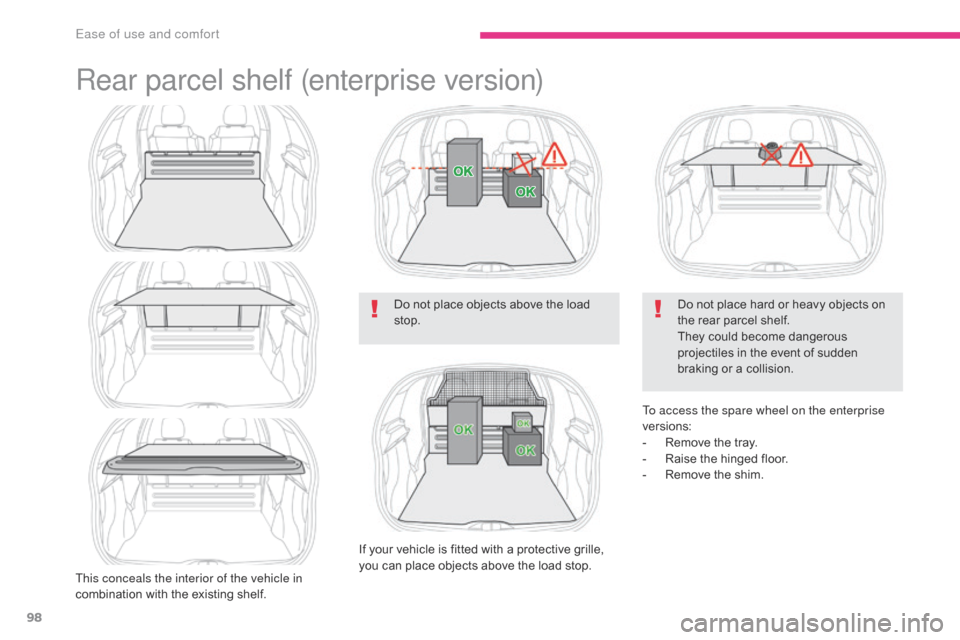
This conceals the interior of the vehicle in
combination with the existing shelf.Do not place objects above the load
stop.
If your vehicle is fitted with a protective grille,
you can place objects above the load stop. Do not place hard or heavy objects on
the rear parcel shelf.
They could become dangerous
projectiles in the event of sudden
braking or a collision.
To access the spare wheel on the enterprise
versions:
-
R
emove the tray.
-
R
aise the hinged floor.
-
R
emove the shim.
Ease of use and comfort
Page 171 of 442

169
Operating limits
The legislation on speed limits is specific to
each country.
The system does not take account of reduced
speed limits in the following cases:
-
p
oor weather (rain, snow),
-
a
tmospheric pollution,
-
t
railer, caravan,
-
d
riving with a space-saver type spare
wheel or snow chains fitted,
-
p
uncture repair using the temporary
repair
k
it,
-
y
oung drivers,
-
...
T
he system may be disrupted or not work at all
in the following situations:
-
p
oor visibility (inadequate street lighting,
falling snow, rain, fog),
-
w
indscreen area ahead of the camera dirty,
misty, frosty, covered with snow, damaged
or masked by a sticker,
-
f
ault with the camera,
-
o
bsolete or incorrect mapping,
-
h
idden road signs (other vehicles,
vegetation, snow),
-
s
peed limit signs that do not conform to the
standard, are damaged or distorted.
Memorising the speed setting
This memorisation is in addition to the display
of Speed limit recognition .
The driver can choose to adapt the speed
setting to the speed limit suggested, by
pressing the memorisation button at the speed
limiter / cruise control switch.
This speed setting then replaces the previous
speed setting for the speed limiter and/or cruise
control. For more information on the Speed
limiter or the Cruise control , refer to
the corresponding sections.
Steering mounted controls
1. Select speed limiter / cruise control mode.
2. M emorise a speed setting.
Display in the instrument panel
3. Speed limiter indication.
4. Memorise the speed.
5.
C
urrent vehicle speed.
6.
C
urrent speed setting.
6
Driving
Page 188 of 442

186
Driving with under-inflated tyres
increases fuel consumption.The under-inflation detection system
does not replace the need for vigilance
on the part of the driver.
This system does not avoid the need to
check the tyre pressures (including the
spare wheel) every month as well as
before a long journey.
Driving with under-inflated tyres impairs
road holding, extends braking distances
and causes premature tyre wear,
particularly under arduous conditions
(high loading, high speed, long journey).
The inflation pressures defined for
your vehicle can be found on the tyre
pressure label.
For more information on the
Identification markings
, refer to the
corresponding section.
Snow chains
The system does not have to be
reinitialised after fitting or removing
snow chains.
Under-inflation detection
System which automatically checks the pressures of the tyres while driving.
The system monitors the pressures in the four
tyres, once the vehicle is moving.
It compares the information given by the four
wheel speed sensors with reference values,
which must be reinitialised ever y time the
tyre pressures are adjusted or a wheel
changed .
The system triggers an alert as soon as it
detects a drop in the inflation pressure of one
or more tyres. Checking tyre pressures
This check should be done when
the
tyres are "cold" (vehicle stopped
for
1 hour or after a journey of less than
6 miles (10 km) at moderate speeds).
Other wise, add 0.3 bar to the pressures
shown on the label.
Driving
Page 189 of 442

187
Under-inflation alertReinitialisation
Before reinitialising the system, ensure
that the pressures of the four tyres are
correct for the use of the vehicle and in
line with the recommendations on the
tyre pressure label.
The under-inflation alert can only
be relied on if the reinitialisation of
the system has been done with the
pressures in the four tyres correctly
adjusted.
The under-inflation detection system
does not give a warning if a pressure is
incorrect at the time of reinitialisation.
This is given by fixed illumination of
this warning lamp, accompanied by
an audible signal and, depending on
equipment, the display of a message.
It is necessary to reinitialise the system every
time one or more tyre pressures are adjusted,
and after changing one or more wheels.
F
R
educe speed immediately, avoid
excessive steering movements and sudden
braking.
F
S
top the vehicle as soon as it is safe to
do
so. F
I
f you have a compressor, such as the one
in the temporary puncture repair kit, check
the pressures of the four tyres when cold.
F
I
f it is not possible to make this check
immediately, drive carefully at reduced
speed.
or
F
I
n the event of a puncture, use the
temporary puncture repair kit or the spare
wheel (depending on equipment).
The loss of pressure detected does not
always cause visible bulging of the tyre.
Do not satisfy yourself with just a visual
check. The alert is maintained until the system
is reinitialised.
6
Driving