2017 CITROEN C-ELYSÉE wheel
[x] Cancel search: wheelPage 107 of 260

105
C-elysee_en_Chap07_securite_ed01-2016
Group of supplementary systems which help you to obtain optimum braking in complete
s
afety in emergency situations:
-
a
nti-lock braking system (ABS),
-
e
lectronic brake force distribution (EBFD),
-
e
mergency braking assistance (EBA).
Braking assistance systems
Anti-lock braking system
and electronic brake force
distribution
Linked systems which improve the stability and manoeuvrability of your vehicle when braking,
i
n particular on poor or slippery sur faces.
Activation
The anti-lock braking system comes into operation automatically when there is a risk of
w
heel lock.
Normal
operation of the ABS may make itself
f
elt by slight vibration of the brake pedal.
Operating fault
Emergency braking assistance
System which, in an emergency, enables you to obtain the optimum braking pressure more
q
uickly, thus reducing the stopping distance.
When
braking in an emergency, press
f
irmly without releasing the pressure.
When
braking
in
an
emergency,
press
v
ery
firmly
without
releasing
the
p
ressure. When
replacing
wheels
(tyres
and
r
ims),
ensure
that
they
conform
to
the
ma
nufacturer's
r
ecommendations.
If
this
warning
lamp
comes
on,
a
ccompanied
by
an
audible
signal
a
nd
a
message
in
the
screen,
it
i
ndicates
a
malfunction
of
the
anti-lock
braking
s
ystem
which
could
result
in
loss
of
control
of
t
he
vehicle
when
braking.
If
this
warning
lamp
comes
on,
t
ogether
with
the
STOP
and
ABS
warning
lamps,
accompanied
by
an
a
udible
signal
and
a
message
in
the
screen,
it
i
ndicates
a
malfunction
of
the
electronic
brake
f
orce
distribution
which
could
result
in
loss
of
c
ontrol
of
the
vehicle
when
braking.
You must stop as soon as it is safe to do so.
In
either
case,
contact
a
CITROËN
dealer
or
a
q
ualified
w
orkshop.
Activation
It is triggered by the speed at which the brake p edal is pressed.
The
effect of this is a reduction in the
r
esistance of the pedal and an increase in
b
raking
e
fficiency.
Coasting
with
the
engine
off
results
in
a
l
oss
of
power
assistance
for
braking.
7
Safety
Page 108 of 260
106
C-elysee_en_Chap07_securite_ed01-2016
Anti-slip regulation (ASR)
and electronic stability
programme (ESP)
The anti-slip regulation (also known as Traction Control) optimises traction to prevent skidding o
f the wheels, by acting on the brakes of the
d
riving wheels and on the engine.
The
electronic stability programme acts on the
b
rake of one or more wheels and on the engine
t
o keep the vehicle on the trajectory required by
t
he driver, within the limits of the laws of physics.
This
is indicated by flashing of this
w
arning lamp in the instrument panel. The
ASR /ESP systems offer
e
xceptional safety in normal driving, but
t
his should not encourage the driver to
t
ake extra risks or drive at high speed.
The
correct functioning of these
s
ystems depends on observation of
t
he
ma
nufacturer's
r
ecommendations
r
egarding the wheels (tyres and rims),
t
he braking components, the electronic
c
omponents and the assembly
a
nd repair procedures used by the
C
ITROËN dealer network.
After
an impact, have these systems
c
hecked by a CITROËN dealer or a
q
ualified
w
orkshop.
Operating fault
Illumination of the warning lamp, accompanid by a message in the
s
creen indicates a malfunction of
t
hese systems.
Reactivation
These systems are reactivated automatically every time the ignition is switched of, or from
3
0 mph (50 km/h).
F
P
ress this button again to reactivate them
m
anually.
T
he lamp in the button goes off.
The
symbol going off in the instrument panel
i
ndicates the reactivation of the ASR and
ES
P systems.
Deactivation
In exceptional conditions (starting a vehicle which is bogged down, stuck in snow, on soft
g
round, ...), it may be advisable to deactivate
t
he ASR and ESP systems, so that the wheels
c
an move freely and regain grip.
Trajectory control systems
Activation
These systems are activated automatically each time the vehicle is started.
They
come into operation in the event of a grip
o
r
t
rajectory
pro
blem. The
display of this symbol indicates
t
hat the ASR and ESP systems are
d
eactivated.
F
P
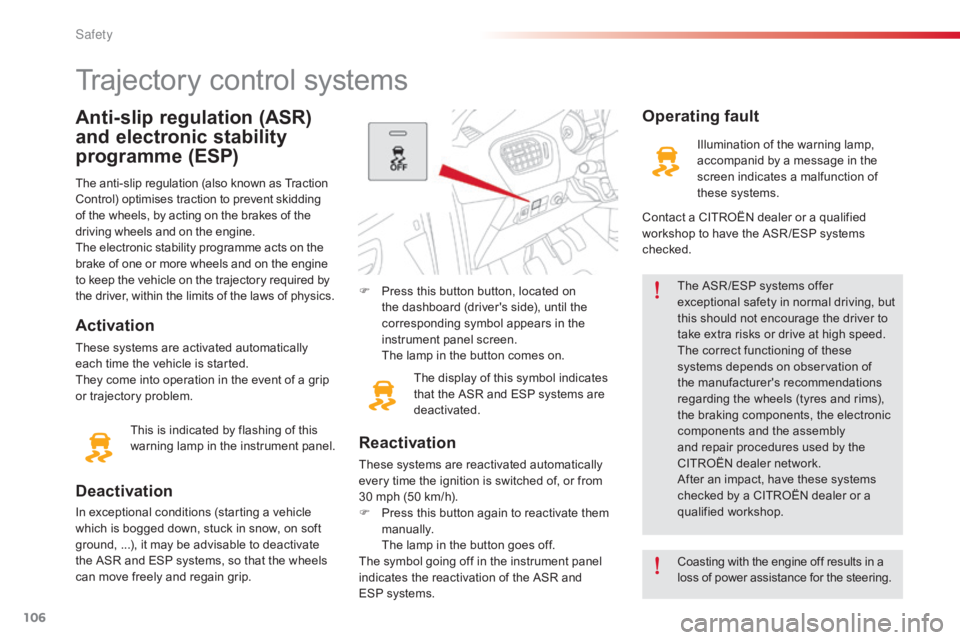
ress this button button, located on
t
he dashboard (driver's side), until the
c
orresponding symbol appears in the i
nstrument panel screen. T
he lamp in the button comes on.Contact
a CITROËN dealer or a qualified
w
orkshop to have the ASR /ESP systems
c
hecked.
Coasting with the engine off results in a
l
oss of power assistance for the steering.
S
Page 112 of 260

110
C-elysee_en_Chap07_securite_ed01-2016
Airbags
Designed to contribute towards the safety of the occupants in the event of violent collisions.
T
he airbags supplement the action of the force-
limiting
seat belts.
If
a collision occurs, the electronic detectors
r
ecord and analyse the front and side impacts
s
ustained in the impact detection zones:
-
i
n the case of a serious impact, the airbags
a
re deployed instantly and contribute
t
owards better protection of the occupants
o
f the vehicle; immediately after the impact,
t
he airbags deflate rapidly so that they
d
o not hinder visibility or the exit of the
o
ccupants,
-
i
n the case of a minor or rear impact or in
c
ertain roll-over conditions, the airbags
m
ay not be deployed; the seat belt alone
c
ontributes towards providing your
p
rotection in these situations.
The airbags do not operate when the
ignition is switched off.
This
equipment will only deploy once.
I
f a second impact occurs (during the
s
ame or a subsequent accident), the
a
irbag will not be deployed again.The
deployment of an airbag is
a
ccompanied by a slight emission
o
f smoke and a noise, due to the
d
etonation of the pyrotechnic charge
i
ncorporated in the system.
This
smoke is not harmful, but sensitive
i
ndividuals may experience slight
ir
ritation.
The
detonation noise associated with
t
he deployment of an airbag may result
i
n a slight loss of hearing for a short
t
ime.
Impact detection zones
A. Front impact zone.
B. S ide impact zone.
Front airbags
Deployment
The airbags are deployed, except the passenger's front airbag if it has been deactivated, in the event o
f a serious front impact to all or part of the front
i
mpact zone A, in the longitudinal centreline of the
v
ehicle on a horizontal plane and directed from the
f
ront to the rear of the vehicle.
The
front airbag inflates between the thorax and
h
ead of the front occupant of the vehicle and the
s
teering wheel, driver's side, and the dashboard,
p
assenger's side to cushion their for ward
m
ovement.
System
which protects the driver and front
p
assenger in the event of a serious front impact
i
n order to limit the risk of injury to the head and
t
horax.
The driver's airbag is fitted in the centre of the
s
teering wheel; the front passenger's airbag is
f
itted in the dashboard above the glove box.
Safety
Page 115 of 260

113
C-elysee_en_Chap07_securite_ed01-2016
Sit in a normal upright position.
W ear a correctly adjusted seat belt.
Do
not leave anything between the
o
ccupants and the airbags (a child, pet,
o
bject...), nor fix or attach anything close to
t
he inflation trajectory of the airbags; this
c
ould cause injuries during their deployment.
Never
modify the original definition of your
v
ehicle, particularly in the area directly
a
round the airbags.
After
an accident or if the vehicle has been
s
tolen or broken into, have the airbag
s
ystems checked.
All
work on the airbag system must be
c
arried out by a CITROËN dealer or a
q
ualified
w
orkshop.
Even
if all of the precautions mentioned
a
re observed, a risk of injury or of minor
b
urns to the head, chest or arms when an
a
irbag is deployed cannot be ruled out. The
b
ag inflates almost instantly (within a few
m
illiseconds) then deflates within the same
t
ime discharging the hot gas via openings
p
rovided for this purpose.Lateral airbags
Use only approved covers on the seats, compatible with the deployment the lateral
a
irbags. For information on the range of seat
c
overs suitable for your vehicle, you can
contact
a CITROËN dealer.
For
more information on accessories, refer
t
o the corresponding section.
Do
not fix or attach anything to the seat
b
acks (clothing...). This could cause injury
t
o the chest or arms if the lateral airbag is
d
eployed.
Do
not sit with the upper part of the body any
n
earer to the door than necessary.
Front airbags
Do not drive holding the steering wheel by its spokes or resting your hands on the centre
p
art of the wheel.
Passengers
must not place their feet on the
das
hboard.
Do
not smoke as deployment of the airbags
c
an cause burns or the risk of injury from a
c
igarette or pipe.
Never
remove
or
pierce
the
steering
wheel
or
h
it it violently.
Do
not fit or attach anything to the steering
w
heel or dashboard, this could cause
i
njuries with deployment of the airbags.
Advice
For the airbags to be fully effective, observe the safety recommendations below:
7
Safety
Page 142 of 260

140
C-elysee_en_Chap09_info-pratiques_ed01-2016
1. 12 V compressor, with integral pressure ga
uge.
2.
S
ealant cartridge, with integral hose.
3.
S
peed limit sticker.
Composition of the kit
The speed limit sticker must be secured to the interior of the vehicle in the
driver's
field of vision, to remind you
t
hat a wheel is in temporary use.
This
k
it
i
s
i
nstalled
i
n
t
he
s
torage
b
ox,
u
nder
t
he
b
oot
floor.
Comprising
a
compressor
and
a
sealant
c
artridge,
it
allows
the
temporary repair
of
a
tyre
so
that
you
can
drive
to
the
nearest
g
arage.
It
is
designed
to
repair
most
punctures
which
c
ould
affect
the
tyre,
located
on
the
tyre
tread
o
r
shoulder.
Temporary pu
ncture r epair k it
Access to the kit
The vehicle's electric system allows the c
onnection of the compressor for long
e
nough to inflate a tyre after a puncture
r
epair.
Do
not exceed a speed of 50 mph
(
80 km/h) when driving with a tyre
r
epaired using this type of kit.
Practical information
Page 147 of 260

145
C-elysee_en_Chap09_info-pratiques_ed01-2016
Spare wheel
The tools are installed in the boot under the fl o o r.
To
gain access to them:
F
o
pen the boot,
F
l
ift the floor and remove it.
F
r
emove the storage box containing the
to
ols.
Access to the tools
List of tools
Procedure for changing a wheel with a punctured tyre for the spare wheel using the tools provided with the vehicle.
T hese tools are specific to your vehicle and
c
an vary according to the level of equipment.
D
o not use them for any purpose other than
d
etailed
belo
w.
1.
W
heelbrace.
F
or removing the wheel trim and removing
t
he wheel bolts.
2.
J
ack with integral handle.
F
or raising the vehicle.
3.
W
heel bolt cover removal tool.
F
or removing the wheel bolt cover on alloy
w
heels.
4.
T
owing eye.
For
more information on towing, refer to the
c
orresponding
s
ection.
The
jack must only be used to change a
w
heel with a damaged tyre.
The
jack does not require any
m
aintenance.
The
jack conforms to European
l
egislation, such as defined in the
M
achinery Directive 2006/42/CE.
9
Practical information
Page 148 of 260

146
C-elysee_en_Chap09_info-pratiques_ed01-2016
The spare wheel is installed in the boot under the floor.
Depending
on engine, the spare wheel is
a
standard wheel or the space-saver type
(
BlueHDi 100).
Access to the spare wheel
Taking out the wheel
F Unclip the tool storage box (standard spare w
heel).
F
U
nscrew the central nut.
F
R
emove the fixing parts (nut and bolt).
F
R
aise the spare wheel towards you from
t
he rear.
F
T
ake the wheel out of the boot.
Pr
Page 149 of 260

147
C-elysee_en_Chap09_info-pratiques_ed01-2016
Putting the wheel back in place
F Put the wheel back in its housing.
F U nscrew the nut a few turns on the bolt.
F
P
osition the fixing parts (nut and bolt) in the
m
iddle of the wheel.
F
T
ighten the central nut until it clicks to
r
etain the wheel correctly. If
there is no wheel in the well, the fixing
p
arts (nut and bolt) cannot be refitted.
F
C lip the tool storage box back into place
(
standard
spar
e
w
heel).
9
Pr