2017 CITROEN C-ELYSÉE wheel
[x] Cancel search: wheelPage 65 of 260

63
C-elysee_en_Chap05_conduite_ed01-2016
Never drive with the parking brake applied - Risk of overheating and
d
amage to the braking system!
Do
not park or run the engine when
s
tationary in areas where inflammable
s
ubstances and materials (dry grass,
d
ead leaves...) might come into contact
w
ith the hot exhaust system - Risk of
f
ire!
Never
leave a vehicle unsupervised
w
ith the engine running. If you have
t
o leave your vehicle with the engine
r
unning, apply the parking brake
a
nd put the gearbox into neutral or
p
osition
N or P,
depending on the type
o
f gearbox.
Driving recommendations
Observe the driving regulations and remain vigilant whatever the traffic conditions.
Pay
close attention to the traffic and keep your
h
ands on the wheel so that you are ready to
r
eact at any time to any eventuality.
On
a long journey, a break every two hours is
s
trongly
re
commended.
In
difficult weather, drive smoothly, anticipate
t
he need to brake and increase the distance
f
rom other vehicles. If
you are obliged to drive through water:
-
c
heck that the depth of water does not
e
xceed 15 cm, taking account of waves
t
hat might be generated by other users,
-
d
eactivate the Stop & Start system,
-
d
rive as slowly as possible without
s
talling. In all cases, do not exceed 6 mph
(
10 km/h),
-
d
o not stop and do not switch off the
e
ngine.
On
leaving the flooded road, as soon as
c
ircumstances allow, make several light brake
a
pplications to dry the brake discs and pads.
If
in doubt on the state of your vehicle, contact
a
CITROËN dealer or a qualified workshop.Important!
Driving on flooded
roads
We strongly advise against driving on flooded r
oads, as this could cause serious damage
t
o the engine or gearbox, as well as to the
e
lectrical systems of your vehicle.
5
Driving
Page 67 of 260

65
C-elysee_en_Chap05_conduite_ed01-2016
In certain cases, you may have to apply more force to the steering (wheels on
f
ull lock, for example).
Starting the engine
F With a petrol engine, operate the starter m
otor by turning the key to position 3
without
pressing the accelerator pedal,
u
ntil the engine starts. Once the engine is
r
unning, release the key. F
W
ith a Diesel engine, turn the key to
p
osition 2
, ignition on, to operate the
eng
ine
p
re-heating
s
ystem.
With the parking brake applied and the gearbox
i
n neutral or position N or P
:
F
d
epress the clutch pedal fully (manual
g
earbox),
or
F
p
ress the brake pedal firmly (electronic or
a
utomatic gearbox),
F
i
nsert the key into the ignition switch; the
s
ystem recognises the code,
F
u
nlock the steering column by
s
imultaneously turning the steering and
t
he key.
Wait until this warning lamp goes off in the i
nstrument panel then operate the starter m
otor by turning the key to position 3
without
pressing the accelerator pedal,
u
ntil the engine starts. Once the engine is
r
unning, release the key.
If the engine does not start straight away, switch off the ignition. Wait a
f
ew moments before operating the
s
tarter motor again. If the engine does
n
ot start after several attempts, do not
k
eep trying: you risk damaging the
s
tarter motor or the engine. Contact
a
CITROËN dealer or a qualified
w
orkshop.
In
wintry conditions, the warning lamp
c
an stay on for a longer period. When
t
he engine is hot, the warning lamp
d
oes not come on. Never leave the engine running in
a
n enclosed area without adequate
v
entilation:
in
ternal
c
ombustion
e
ngines emit toxic exhaust gases,
s
uch as carbon monoxide. Danger of
i
ntoxication and death.
In very severe wintry conditions
(
temperatures below -23°C), to ensure
t
he correct operation and durability of
t
he mechanical components of your
v
ehicle, engine and gearbox, it is n
ecessary to leave the engine running f
or 4 minutes before moving off.
In
temperate conditions, do not leave
t
he engine at idle to warm up but move
o
ff straight away and drive at moderate
s
peed.
5
Driving
Page 87 of 260

85
C-elysee_en_Chap05_conduite_ed01-2016
Speed limiter
System which prevents the vehicle from exceeding the speed programmed by the driver.
When
the programmed speed limit is reached,
p
ressing the accelerator pedal in the normal
m
anner no longer has any effect.
The
speed limiter is switched on
m
anually:
i
t requires a programmed speed of at least
2
0 mph (30 km/h).
The
speed limiter is switched off by manual
o
peration of the control.
The
programmed speed can be exceeded
t
emporarily by pressing the accelerator firmly.
To
return to the programmed speed, simply
s
low down to a speed below the programmed
s
peed. The
speed limiter cannot, in any
c
ircumstances, replace the need to
r
espect speed limits, nor can it replace the
n
eed for vigilance on the part of the driver.The
controls of this system are grouped
t
ogether on stalk A.
1.
S
peed limiter mode selection thumb wheel.
2.
V
alue decrease button.
3.
V
alue increase button.
4.
S
peed limiter on / off button.Steering mounted controls
The programmed information is grouped together in the instrument panel screen.
5.
S
peed limiter on / off indication.
6.
S
peed limiter mode selection indication.
7.
P
rogrammed speed value.
Displays in the instrument panel
The programmed s peed r emains i n t he m emory w
hen the ignition is switched off.
5
Driving
Page 88 of 260
86
C-elysee_en_Chap05_conduite_ed01-2016
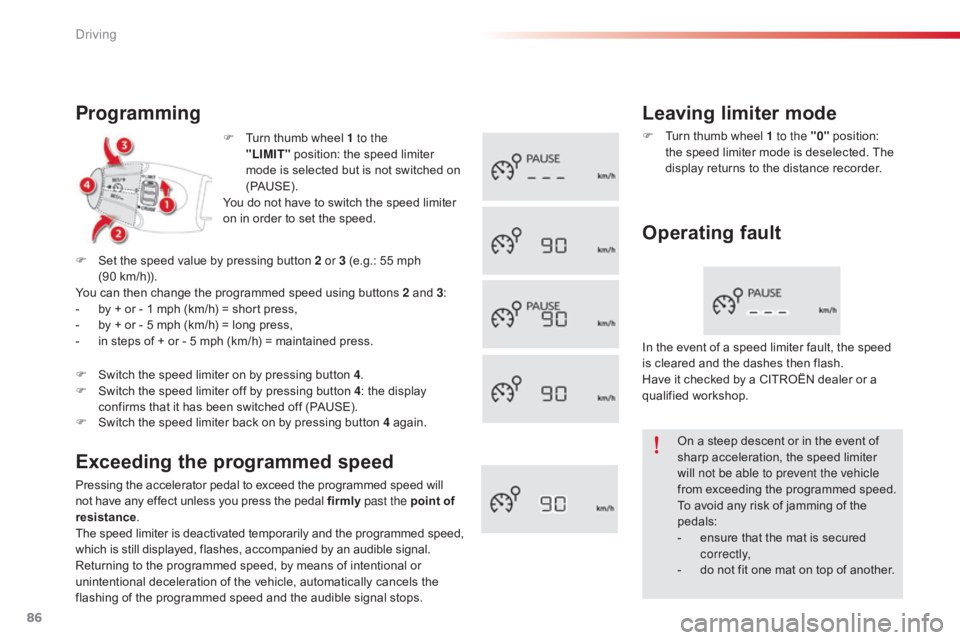
F Turn thumb wheel 1 to the
"LIMIT" position:
the speed limiter
m
ode is selected but is not switched on
(
PAUS E).
You
do not have to switch the speed limiter
o
n in order to set the speed.
Programming Leaving limiter mode
F Turn thumb wheel 1 to the "0" position: t
he speed limiter mode is deselected. The
d
isplay returns to the distance recorder.
On
a steep descent or in the event of
s
harp acceleration, the speed limiter
w
ill not be able to prevent the vehicle
from
exceeding the programmed speed.
To
avoid any risk of jamming of the
ped
als:
-
e
nsure that the mat is secured
c
o r r e c t l y,
-
d
o not fit one mat on top of another.
In
the event of a speed limiter fault, the speed
i
s cleared and the dashes then flash.
Have
it checked by a CITROËN dealer or a
q
ualified
w
orkshop.
Operating fault
F Set the speed value by pressing button 2 or 3 (e.g.: 55 mph (
90 km/h)).
You
can then change the programmed speed using buttons 2 and 3:
-
b
y + or - 1 mph (km/h) = short press,
-
b
y + or - 5 mph (km/h) = long press,
-
i
n steps of + or - 5 mph (km/h) = maintained press.
Exceeding the programmed speed
Pressing the accelerator pedal to exceed the programmed speed will not have any effect unless you press the pedal firmly past the point of
resistance .
The
speed
limiter
is
deactivated
temporarily
and
the
programmed
speed,
w
hich is still displayed, flashes, accompanied by an audible signal.
Returning
to the programmed speed, by means of intentional or
u
nintentional deceleration of the vehicle, automatically cancels the
f
lashing of the programmed speed and the audible signal stops.
F
S
witch the speed limiter back on by pressing button 4
ag
ain.
F
S
witch the speed limiter on by pressing button 4
.
F
S
witch the speed limiter off by pressing button 4
: the display
c
onfirms that it has been switched off (PAUSE).
Driving
Page 90 of 260

88
C-elysee_en_Chap05_conduite_ed01-2016
F Turn thumb wheel 1 to the
"CRUISE" position:
the cruise control
m
ode is selected but is not switched on
(
PAUS E).
Programming
You can then change the programmed speed using buttons 2 and 3:
- b y + or - 1 mph (km/h) = short press,
-
b
y + or - 5 mph (km/h) = long press,
-
i
n steps of + or - 5 mph (km/h) = maintained press. When
the cruise control is switched on,
b
e careful if you maintain the pressure
o
n one of the programmed speed
c
hanging buttons: this may result in a
v
ery rapid change in the speed of your
v
ehicle.
Do not use the cruise control on
slippery
roads or in heavy traffic.
On
a steep descent, the cruise control
w
ill not be able to prevent the vehicle
from
exceeding the programmed speed.
To
avoid any risk of jamming of the
ped
als:
-
e
nsure that the mat is secured
c
o r r e c t l y,
-
n
ever fit one mat on top of another.
In
the event of a cruise control malfunction,
t
he speed is cleared resulting in flashing of the d
ashes. Have it checked by a CITROËN dealer o
r a qualified workshop.
Operating fault
Leaving cruise control mode
F Turn thumb wheel 1 to the "0" position: the cruise control mode is d
eselected. The display returns to the distance recorder.
Exceeding the programmed speed
Intentional or unintentional exceeding of the programmed speed results in flashing of this speed in the screen.
Return
to the programmed speed, by means of intentional or
u
nintentional deceleration of the vehicle, automatically cancels the
f
lashing of the speed.F
S
et the programmed speed by
a
ccelerating to the required speed,
t
hen press button 2 or 3 (e.g.: 70 mph
(
110 km/h)).
F
S
witch off the cruise control by pressing button 4
: the screen
c
onfirms that it has been switched off (PAUSE).
F
S
witch the cruise control back on by pressing button 4
ag
ain.
Driving
Page 98 of 260

96
C-elysee_en_Chap06_visibilite_ed01-2016
Headlamp beam height adjustment
To avoid causing a nuisance to other road users, the headlamp beams should be adjusted according to the load in the vehicle.
This
adjustment can be carried out using the control located:
-
u
nder the bonnet,
-
b
elow and to the left of the steering wheel (depending on version).
The
initial setting is position "0".
0
1
or 2 people in the front seats.
-
5
people.
1
5
people + maximum authorised load in
t
he boot.
-
D
river + maximum authorised load in the
b
oot.
The
higher number positions can be used,
b
ut may limit the area illuminated by the
h
eadlamps.
Under the bonnet
F Raise the bonnet for access to the control (one per headlamp).
F
T
urn the control to adjust the height of the
h
eadlamp
b
eam.
Travelling abroad
The design of the dipped beam headlamps allows, without modification,
d
riving in a country that drives on the
o
ther side of the road to the country in
w
hich your vehicle was sold.
To the left of the steering wheel
Visibility
Page 103 of 260

101
C-elysee_en_Chap07_securite_ed01-2016
Under-inflation detection
The under-inflation detection system d
oes not replace the need for vigilance
o
n the part of the driver.
This
system does not avoid the need to
c
heck the tyre pressures (including the
s
pare wheel) every month as well as
b
efore a long journey.
Driving
with under-inflated tyres impairs
r
oad holding, extends braking distances
a
nd causes premature tyre wear,
p
articularly under arduous condition
(
high loading, high speed, long journey).The
inflation pressures defined for y
our vehicle can be found on the tyre
p
ressure label.
For
more information on the
i
dentification markings, refer to the
c
orresponding
s
ection.
Tyre
pressures should be checked
w
hen the tyres are "cold" (vehicle
s
topped for 1 hour or after a journey of
l
ess than 6 miles (10 km) at moderate
s
peeds).
Other wise
(when hot), add 0.3 bar to
t
he pressures shown on the label.
Driving
with under-inflated tyres
i
ncreases fuel consumption.
System
which
automatically
checks
the
pressures
of
the
tyres while driving.
The
system
monitors
the
pressures
in
the
four
t
yres,
once
the
vehicle
is
moving.
It
compares
the
information
given
by
the
four
w
heel
speed
sensors
with
reference values,
which must be reinitialised ever y time the
tyre pressures are adjusted or a wheel
changed .
The
system
triggers
an
alert
as
soon
as
it
d
etects
a
drop
in
the
inflation
pressure
of
one
o
r
more
tyres.
7
S
Page 104 of 260

102
C-elysee_en_Chap07_securite_ed01-2016
Before reinitialising the system, ensure that the pressures of the four tyres are
correct
for the use of the vehicle and in
l
ine with the recommendations on the
t
yre pressure label.
The
under-inflation alert can only be
r
elied on if the reinitialisation of the
s
ystem has done with the pressures in
t
he four tyres correctly adjusted.
The
under-inflation detection system
d
oes not give a warning if a pressure is
i
ncorrect at the time of reinitialisation.
The
loss
of
pressure
detected
does
not
a
lways
cause
visible
bulging
of
the
tyre.
D
o
not
satisfy
yourself
with
just
a
visual
c
heck. The
alert
is
maintained
until
the
system
i
s
r
einitialised.
Under-inflation alert
This is given by fixed illumination of t his warning lamp, accompanied by
a
n audible signal and the display of a
m
essage.
F
R
educe speed immediately, avoid
e
xcessive steering movements and sudden
b
raking
F
S
top the vehicle as soon as it is safe to
do so. F
I f you have a compressor (such as the one
i
n the temporary puncture repair kit), check
t
he pressures of the four tyres when cold.
I
f it is not possible to carry out this check
s
traight away, drive carefully at reduced
s
peed.
or
F
I
n the event of a puncture, use the
temporary
puncture repair kit or the spare
w
heel (depending on equipment),
Reinitialisation
It is necessary to reinitialise the system every time one or more tyre pressures are adjusted,
a
nd after changing one or more wheels.
Safety