2017 Citroen BERLINGO replace
[x] Cancel search: replacePage 21 of 292

19
Berlingo2VP_en_Chap03_Pret-a-partir_ed02-2016
Good practice
Take care not to allow the remote control to come into contact with
grease, dust, rain or a damp
environment.
A
heavy object attached to the key
(key
ring, ...) weighing on the shaft
of
the key in the switch, may cause a
malfunction.
REMOTE CONTROL
Reinitialising the remote
control
Following changing of the remote
control battery or disconnection of the
vehicle battery, the remote control may
have
to be reinitialised.
Wait at least one minute before using
the
remote control.
Insert
the key in the ignition switch with
the
buttons (padlocks) of the remote
control
facing you.
Switch
on the ignition.
Press
the locking padlock for at
least
five seconds within the next
ten seconds.
Switch
off the ignition.
Wait at least one minute before using
the
remote control.
The
remote control is now working
again.
Use only identical batteries or
batteries of an equivalent type to
those recommended by CITROËN
dealers.
Do not discard the remote control
batteries, they contain metals which
are
harmful
to
the
environment.
Deposit them at a CITROËN
dealership, or at an authorised
collection
point.
Unfolding / folding
Changing the battery
Battery ref.: CR1620 / 3 volts.
The "battery flat" information is given
by an audible signal, accompanied by
a
message in the screen.
To replace the battery, unclip the
casing
using a coin at the ring.
If
the remote control does not work
after the battery has been changed,
reinitialise
the remote control.
There
is a risk of damage if the
replacement battery is not the correct
type.If you do not press the button,
you
may damage the key's
folding
mechanism.
Access
READY TO GO
3
Page 22 of 292

20
Berlingo2VP_en_Chap03_Pret-a-partir_ed02-2016
Don't forget
When leaving the vehicle, check that
the lighting is of
f and nothing of value
is
visible.
As a safety precaution (with children
on
board), remove the key from the
ignition when leaving the vehicle, even
for
a short time.
Good practice
Do not make any modifications to the electronic immobiliser system.
Operating the remote control, even
when
it is in your pocket, may result in
involuntary
unlocking of the doors.
The simultaneous use of other
high frequency equipment (mobile
telephones, domestic alarms…), may
interfere with the operation of the
remote
control temporarily.
The remote control does not operate
while
the key is in the ignition, even if
the
ignition is off.
ELECTRONIC
IMMOBILISER
If you lose your keys
Visit a CITROËN dealer with the
vehicle's V5 registration certificate and
your
identification document.
A CITROËN dealer will be able
to
retrieve the key code and
the transponder code so that a
replacement
key can be ordered.When purchasing a second-hand
vehicle,
have the keys memorised by
a CITROËN dealer
, so as to be sure
that the keys in your possession are
the only ones that can be used to start
the
vehicle.
ALARM
If fitted on your vehicle, this provides two
types of protection:
-
exterior
protection: it sounds if a
front/rear
door or the bonnet is
opened.
-
interior
protection: it sounds if
the volume inside the passenger
compartment
changes (breaking of
a window or a movement inside the
vehicle).
If
your
vehicle
is
fitted
with
a
separation
partition, the interior protection is not
active
in the load space.
Locking the vehicle with
complete alarm
Setting the alarm
- Switch off the ignition and get out of
the vehicle.
-
Set
the alarm within five minutes of
getting
out of the vehicle, by locking
or
deadlocking using the remote
control.
The
red LED, located in the
button,
flashes once per second.
All of the keys contain an electronic immobiliser device.
This
device locks the engine supply
system.
It is activated automatically
when
the key is removed from the
ignition.
After the ignition is switched on, a
dialogue
is established between the key
and
the electronic immobiliser system.
The
metal part of the key must be
unfolded correctly for correct dialogue
to
take place.
Access
Page 43 of 292

41
Berlingo2VP_en_Chap03_Pret-a-partir_ed02-2016
Instruments and controls
Berlingo2VP_en_Chap03_Pret-a-partir_ed02-2016
EMISSIONS CONTROLS
EOBD (European On Board
Diagnosis) is a diagnostics
system which complies with,
among others, the standards
on emissions limits of:
-
CO (carbon monoxide),
-
HC (unburnt hydrocarbons),
-
NOx (nitrogen oxides), detected
by oxygen sensors placed
downstream of the catalytic
converters,
-
particles.
UNDER-INFLATION DETECTION
This system
continuously monitors
the pressures of the four
tyres, as soon as the
vehicle is moving.
A pressure sensor is located in the
valve of each tyre (except the spare
wheel).
The system triggers an alert if a drop
in pressure is detected in one or more
tyres.
The
tyre
under-inflation detection
system is an aid to driving which
does not replace the need for
vigilance
on the part of the driver.
The driver is warned of any
malfunction of this emissions
control system by the illumination
of this warning lamp in the instrument
panel.
If this warning lamp comes on, have
it
checked
by
a
CITROËN
dealer
or
a
qualified
workshop. This system does not avoid the
need
to check the tyre pressures
regularly (including the spare
wheel)
and before a long journey.
Driving
with under-inflated tyres
adversely af
fects road holding,
extends
braking distances and causes
premature tyre wear
, particularly under
arduous conditions (vehicle loaded,
high
speed, long journey).
Driving
with under-inflated tyres
increases
fuel consumption.
The tyre pressures for your vehicle
can be found on the tyre pressure
label.
Refer
to chapter 9, "Identification
markings"
section.
The
tyre pressures must be checked
when the tyres cold (vehicle stopped
for 1 hour or after driving for less then
6
miles (10 km) at moderate speed).
Otherwise,
add 0.3 bar to the values
indicated
on the label.
READY TO GO
3
Page 44 of 292

42
Berlingo2VP_en_Chap03_Pret-a-partir_ed02-2016
Instruments and controls
Berlingo2VP_en_Chap03_Pret-a-partir_ed02-2016
The alert is maintained until
the tyre or tyres concerned is
reinflated, repaired or replaced.
The spare wheel (space-saver type or
a
steel rim) does not have a sensor.
Operating fault
Under-inflation alert
The loss of pressure detected
does not always lead to visible
deformation
of
the
tyre.
Do
not
rely
on
just a visual check.The alert is given by the fixed illumination of this warning lamp,
accompanied by an audible signal,
and depending on equipment, the
display
of a message.The flashing and then fixed illumination of the
under-inflation
warning
lamp accompanied by the
illu
mination of the "Service" warning
lamp, and depending on equipment,
the display of a message indicates a
fault
with the system.
In this case, monitoring of the tyre
pressures
is not assured.
In the event of a problem on one of
the tyres, the symbol or the message
appears, according to equipment, to
identify
it.
-
Reduce speed, avoid sudden
steering
movements
or
harsh
brake
applications.
-
Stop
as
soon
as
it
is
safe
to
do
so.
-
In the event of a puncture, use
the
temporary
puncture
repair
kit
or the spare wheel (according to
equipment),
or
-
if you have a compressor
, the one
in the temporary puncture repair
kit
for
example,
check
the
four
tyre
pressures when cold,
or
-
if
it
is
not
possible
to
check
the
tyre pressures at the time, drive
carefully
at
reduced
speed.
This alert is also displayed when
one
or more wheels is not fitted
with a sensor (for example, a
space-saver
or steel spare wheel).
Go
to
a CITROËN dealer or a qualified
workshop to
have the system checked
or
, following the repair of a puncture, to
have the original wheel, equipped with
a
sensor, refitted.
Page 45 of 292

43
Berlingo2VP_en_Chap03_Pret-a-partir_ed02-2016
Instruments and controls
Berlingo2VP_en_Chap03_Pret-a-partir_ed02-2016
UNDER-INFLATION DETECTION WITH REINITIALISATION
System which automatically checks the pressures of the tyres while driving.
The system monitors the pressures
in the four tyres, once the vehicle is
moving.
It compares the information given by
the four wheel speed sensors with
reference values, which must be
reinitialised every time the tyre
pressures are adjusted or a wheel
changed.
The system triggers an alert as soon
as
it detects a drop in the inflation
pressure
of one or more tyres. The under-inflation detection system does not replace the need
for vigilance on the part of the
driver
.
This system does not avoid the need to
check
the tyre pressures (including the
spare wheel) every month as well as
before
a long journey.
Driving
with under-inflated tyres
impairs
road holding, extends braking
distances and causes premature
tyre wear
, particularly under arduous
condition (high loading, high speed,
long
journey).
Driving
with under-inflated tyres
increases
fuel consumption.The
inflation pressures defined for your vehicle can be found on the
tyre
pressure label.
For more information on the
identification
markings, refer to the
corresponding
section.
Tyre
pressures should be checked
when the tyres are "cold" (vehicle
stopped
for 1 hour or after a journey of
less
than 6 miles (10 km) at moderate
speeds).
Otherwise
(when hot), add 0.3 bar to
the
pressures shown on the label.
READY TO GO
3
Page 64 of 292

62
Berlingo2VP_en_Chap04_Ergonomie_ed02-2016
Screenwash
Pull the stalk towards you, the wash-
wipe is accompanied by a timed sweep
of
the wipers.
Turn
the ring past the first
position:
the rear screenwash
then the rear wiper operates
for
a fixed time.
In winter, in the event of a
considerable amount of snow
or ice, switch on the heated
rear
screen. Once the screen is
clear
, remove the snow or ice which
has accumulated on the rear wiper
blade.
Y
ou can then operate the rear
windscreen
wiper.
To top up the level, refer to the
"Levels"
section of chapter 7.
Special position of the
windscreen wipers
In the minute following switching
off of the ignition, any action on the
stalk positions the wipers against the
windscreen
uprights.
This action enables you to position
the
wiper blades for winter parking,
cleaning
or replacement.
Refer to the "Changing a windscreen
wiper
blade" section of chapter 8.
To
park the wipers in their normal
position after this has been done,
switch on the ignition and move the
stalk. T
urn the ring to the first
position.
Rear wiperRear screenwash
Steering mounted controls
Page 68 of 292
66
Berlingo2VP_en_Chap04_Ergonomie_ed02-2016
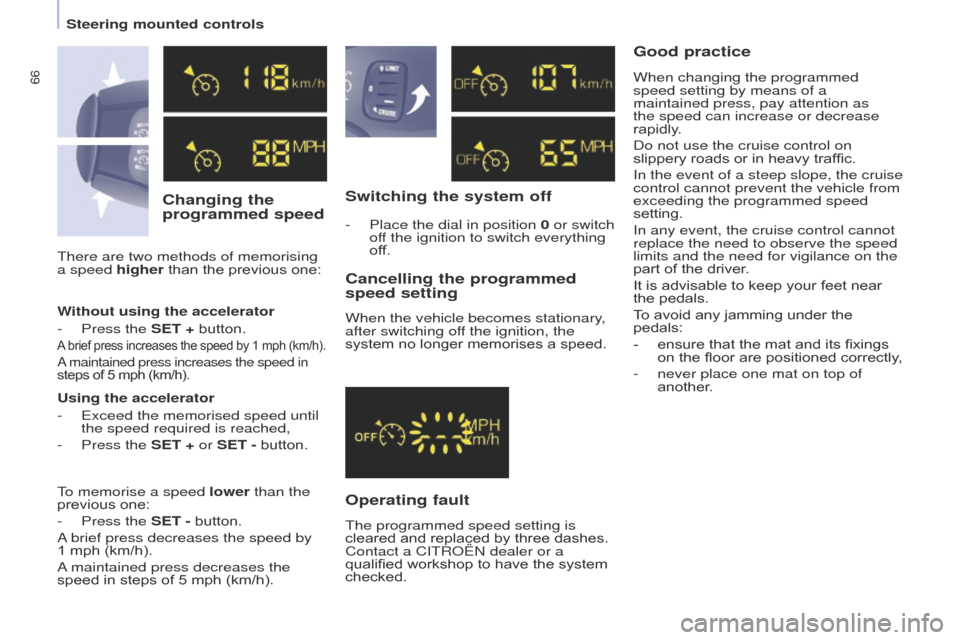
Changing the
programmed speedSwitching the system off
Operating fault Cancelling the programmed
speed setting
When the vehicle becomes stationary,
after switching off the ignition, the
system
no longer memorises a speed.
There are two methods of memorising
a speed higher
than
the
previous
one:
-
Place the dial in position
0 or switch
off the ignition to switch everything
off.
Good practice
Without using the accelerator
-
Press the
SET + button.
A brief press increases the speed by 1 mph (km/h).
A maintained press increases the speed in
steps
of 5 mph (km/h).
Using the accelerator
-
Exceed the memorised speed until
the speed required is reached,
-
Press the
SET + or SET - button.
To memorise a speed lower than the
previous
one:
-
Press the
SET - button.
A brief press decreases the speed by
1
mph (km/h).
A maintained press decreases the
speed
in steps of 5 mph (km/h).The programmed speed setting is
cleared
and replaced by three dashes.
Contact a CITROËN dealer or a
qualified
workshop to have the system
checked.When changing the programmed
speed setting by means of a
maintained press, pay attention as
the speed can increase or decrease
rapidly
.
Do not use the cruise control on
slippery roads or in heavy traffic.
In the event of a steep slope, the cruise
control cannot prevent the vehicle from
exceeding the programmed speed
setting.
In any event, the cruise control cannot
replace the need to observe the speed
limits and the need for vigilance on the
part of the driver.
It is advisable to keep your feet near
the
pedals.
To avoid any jamming under the
pedals:
-
ensure
that the mat and its fixings
on
the floor are positioned correctly,
-
never place one mat on top of
another
.
Steering mounted controls
Page 71 of 292

69
Berlingo2VP_en_Chap04_Ergonomie_ed02-2016
Exceeding the programmed
speedSwitching the function offOperating fault
The programmed speed is cleared
then
replaced by three dashes.
Contact a CITROËN dealer or a
qualified
workshop to have the system
checked.
Flashing of the speed setting
Good practice
In any event, the speed limiter cannot
replace the need to observe speed
limits, nor can it replace the need for
vigilance
on the part of the driver.
Always
pay attention to the profile
of the road and sharp acceleration
and stay in complete control of your
vehicle.
T
o avoid any jamming under the
pedals:
-
ensure
that the mat and its fixings
on
the floor are positioned correctly,
-
never place one mat on top of
another
.
Pressing the accelerator pedal in order
to exceed the programmed speed
will have no effect unless you press
the pedal firmly beyond the point of
resistance.
The limiter is deactivated temporarily
and
the
programmed
speed
flashes
accompanied
by
an
audible
signal.
To return to the limiter function, reduce
your speed to below the programmed
speed.
The
speed
setting
flashes:
-
following forcing of the accelerator
point of resistance,
-
when the limiter cannot prevent an
increase in the vehicle speed due
to
the
profile
of
the
road
or
on
a
steep descent,
-
in
the
event
of
sharp
acceleration. -
Place the switch in position
0 or
switch off the ignition to switch the
system
off.
The last programmed speed remains in
the
memory.
Steering mounted controls
EASE OF USE and COMFORT
4