2017 CHRYSLER PACIFICA engine overheat
[x] Cancel search: engine overheatPage 606 of 828
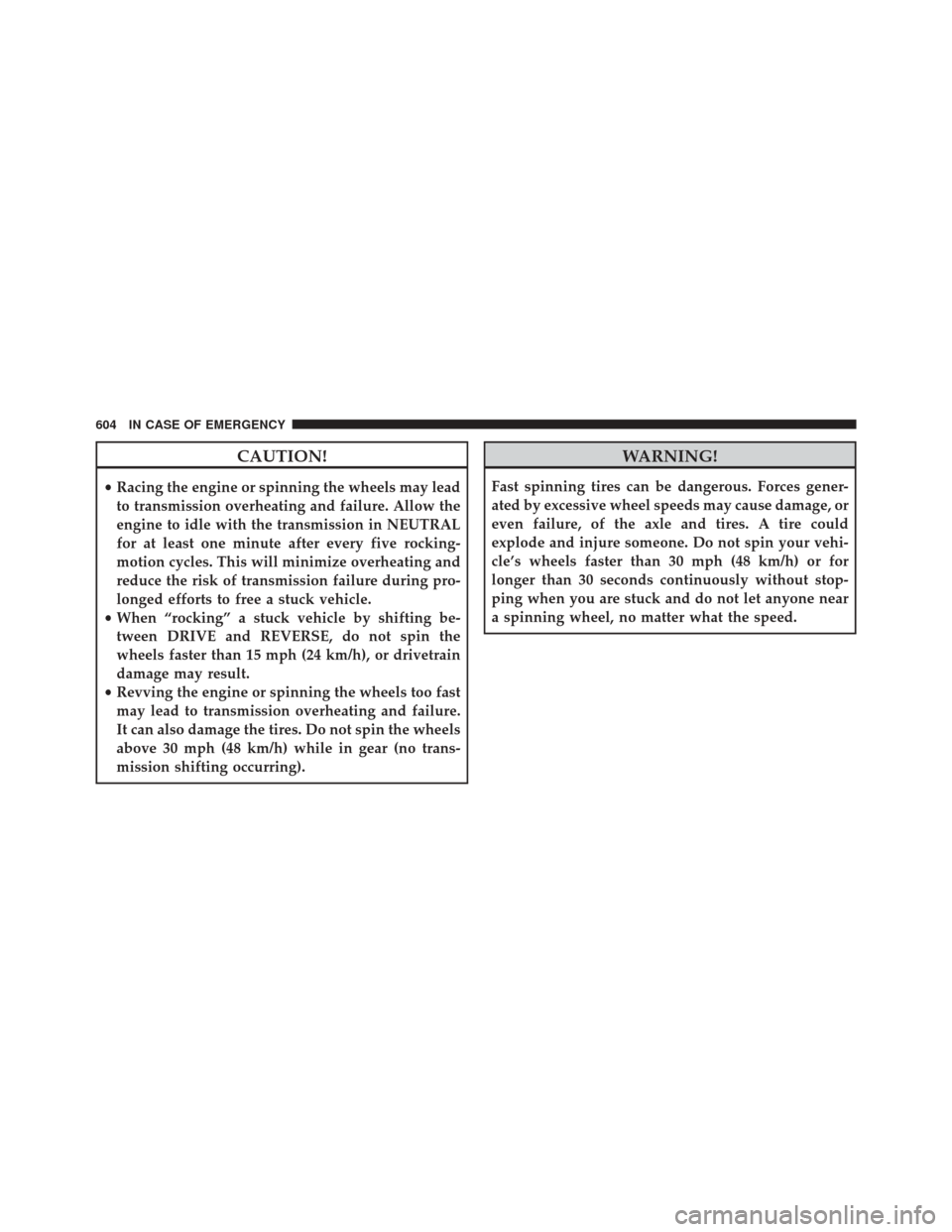
CAUTION!
•Racing the engine or spinning the wheels may lead
to transmission overheating and failure. Allow the
engine to idle with the transmission in NEUTRAL
for at least one minute after every five rocking-
motion cycles. This will minimize overheating and
reduce the risk of transmission failure during pro-
longed efforts to free a stuck vehicle.
• When “rocking” a stuck vehicle by shifting be-
tween DRIVE and REVERSE, do not spin the
wheels faster than 15 mph (24 km/h), or drivetrain
damage may result.
• Revving the engine or spinning the wheels too fast
may lead to transmission overheating and failure.
It can also damage the tires. Do not spin the wheels
above 30 mph (48 km/h) while in gear (no trans-
mission shifting occurring).
WARNING!
Fast spinning tires can be dangerous. Forces gener-
ated by excessive wheel speeds may cause damage, or
even failure, of the axle and tires. A tire could
explode and injure someone. Do not spin your vehi-
cle’s wheels faster than 30 mph (48 km/h) or for
longer than 30 seconds continuously without stop-
ping when you are stuck and do not let anyone near
a spinning wheel, no matter what the speed.
604 IN CASE OF EMERGENCY
Page 630 of 828

Exhaust System
The best protection against carbon monoxide entry into
the vehicle body is a properly maintained engine exhaust
system.
If you notice a change in the sound of the exhaust system;
or if the exhaust fumes can be detected inside the vehicle;
or when the underside or rear of the vehicle is damaged;
have an authorized technician inspect the complete ex-
haust system and adjacent body areas for broken, dam-
aged, deteriorated, or mispositioned parts. Open seams
or loose connections could permit exhaust fumes to seep
into the passenger compartment. In addition, have the
exhaust system inspected each time the vehicle is raised
for lubrication or oil change. Replace as required.
CAUTION!
•The catalytic converter requires the use of un-
leaded fuel only. Leaded gasoline will destroy the
effectiveness of the catalyst as an emissions control
device and may seriously reduce engine perfor-
mance and cause serious damage to the engine.
• Damage to the catalytic converter can result if your
vehicle is not kept in proper operating condition.
In the event of engine malfunction, particularly
involving engine misfire or other apparent loss of
performance, have your vehicle serviced promptly.
Continued operation of your vehicle with a severe
malfunction could cause the converter to overheat,
resulting in possible damage to the converter and
vehicle.
628 MAINTAINING AND CARING FOR YOUR VEHICLE
Page 631 of 828

WARNING!
•Exhaust gases can injure or kill. They contain
carbon monoxide (CO), which is colorless and
odorless. Breathing it can make you unconscious
and can eventually poison you. To avoid breathing
CO, refer to “Safety Tips” in “Safety” for further
information.
• A hot exhaust system can start a fire if you park
over materials that can burn. Such materials might
be grass or leaves coming into contact with your
exhaust system. Do not park or operate your ve-
hicle in areas where your exhaust system can con-
tact anything that can burn.
Under normal operating conditions, the catalytic con-
verter will not require maintenance. However, it is im-
portant to keep the engine properly tuned to assure
proper catalyst operation and prevent possible catalyst
damage. NOTE:
Intentional tampering with emissions control
systems can result in civil penalties being assessed
against you.
In unusual situations involving grossly malfunctioning
engine operation, a scorching odor may suggest severe
and abnormal catalyst overheating. If this occurs, stop
the vehicle, turn off the engine and allow it to cool.
Service, including a tune-up to manufacturer’s specifica-
tions, should be obtained immediately.
To minimize the possibility of catalytic converter dam-
age:
• Do not shut off the engine or interrupt the ignition,
when the transmission is in gear and the vehicle is in
motion.
• Do not try to start the engine by pushing or towing the
vehicle.
8
MAINTAINING AND CARING FOR YOUR VEHICLE 629
Page 635 of 828

Please note that it is the owner’s responsibility to main-
tain the proper level of protection against freezing ac-
cording to the temperatures occurring in the area where
the vehicle is operated.
NOTE:
•Some vehicles require special tools to add coolant
properly. Failure to fill these systems properly could
lead to severe internal engine damage. If any coolant is
needed to be added to the system, please contact your
local authorized dealer.
• Mixing engine coolant (antifreeze) types is not recom-
mended and can result in cooling system damage. If
HOAT and OAT coolant are mixed in an emergency,
have a authorized dealer drain, flush, and refill with
OAT coolant (conforming to MS.90032) as soon as
possible.Cooling System Pressure Cap
The cap must be fully tightened to prevent loss of engine
coolant (antifreeze), and to ensure that engine coolant
(antifreeze) will return to the radiator from the coolant
recovery tank.
The cap should be inspected and cleaned if there is any
accumulation of foreign material on the sealing surfaces.
WARNING!
• Do not open hot engine cooling system. Never add
engine coolant (antifreeze) when the engine is
overheated. Do not loosen or remove the cap to cool
an overheated engine. Heat causes pressure to
build up in the cooling system. To prevent scalding
or injury, do not remove the pressure cap while the
system is hot or under pressure.
(Continued)
8
MAINTAINING AND CARING FOR YOUR VEHICLE 633
Page 682 of 828
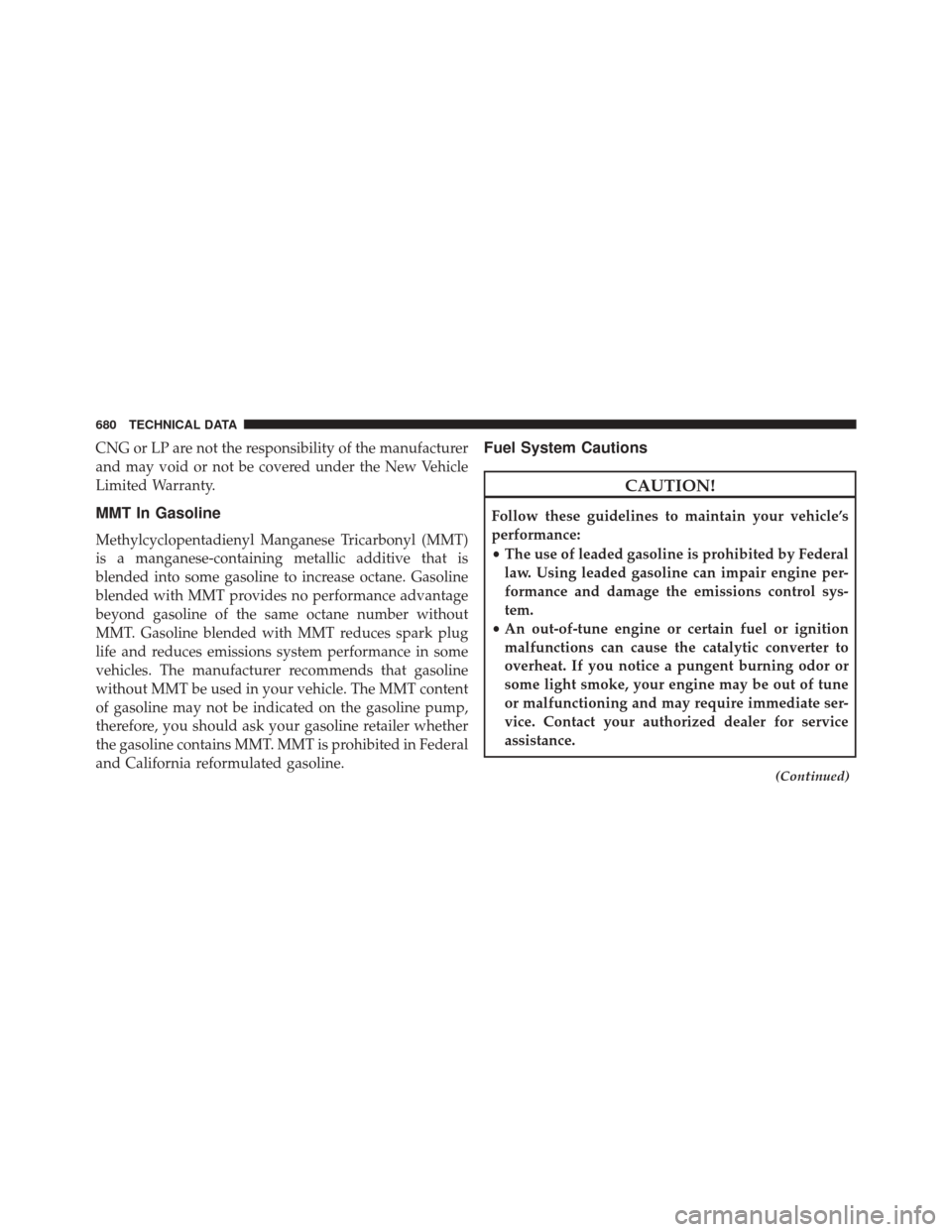
CNG or LP are not the responsibility of the manufacturer
and may void or not be covered under the New Vehicle
Limited Warranty.
MMT In Gasoline
Methylcyclopentadienyl Manganese Tricarbonyl (MMT)
is a manganese-containing metallic additive that is
blended into some gasoline to increase octane. Gasoline
blended with MMT provides no performance advantage
beyond gasoline of the same octane number without
MMT. Gasoline blended with MMT reduces spark plug
life and reduces emissions system performance in some
vehicles. The manufacturer recommends that gasoline
without MMT be used in your vehicle. The MMT content
of gasoline may not be indicated on the gasoline pump,
therefore, you should ask your gasoline retailer whether
the gasoline contains MMT. MMT is prohibited in Federal
and California reformulated gasoline.
Fuel System Cautions
CAUTION!
Follow these guidelines to maintain your vehicle’s
performance:
•The use of leaded gasoline is prohibited by Federal
law. Using leaded gasoline can impair engine per-
formance and damage the emissions control sys-
tem.
• An out-of-tune engine or certain fuel or ignition
malfunctions can cause the catalytic converter to
overheat. If you notice a pungent burning odor or
some light smoke, your engine may be out of tune
or malfunctioning and may require immediate ser-
vice. Contact your authorized dealer for service
assistance.
(Continued)
680 TECHNICAL DATA
Page 813 of 828

Overheating.......................... .600
Towing ............................. .605
Engine Air Cleaner .......................... .625
Block Heater ......................... .386
Break-In Recommendations ................388
Checking Oil Level ..................... .619
Compartment ......................... .618
Compartment Identification ................618
Coolant (Antifreeze) .....................687
Cooling ............................. .630
Exhaust Gas Caution .................374, 681
Fails To Start ......................... .385
Flooded, Starting ...................... .385
Fuel Requirements ..................... .677
Oil .......................... .622, 686, 687
Oil Filter ............................ .624
Oil Selection ...................... .622, 686
Oil Synthetic ......................... .624Overheating
.......................... .600
Starting ............................. .383
Engine Oil Viscosity ...................... .623
Engine Oil Viscosity Chart ...................623
Enhanced Accident Response Feature ........341, 608
Ethanol ............................ .679, 682
Event Data Recorder ...................... .345
Exhaust Gas Caution ...................374, 681
Exhaust System ...................... .374, 628
Exterior Lighting ......................... .543
Exterior Lights .................110, 377, 537, 543
Filters Air Cleaner .......................... .625
Air Conditioning ...................... .147
Engine Oil ........................ .624, 687
Engine Oil Disposal .....................624
Flashers Hazard Warning ....................... .529
12
INDEX 811
Page 819 of 828

Filter Disposal........................ .624
Identification Logo ..................... .623
Materials Added To ..................... .624
Pressure Warning Light ...................239
Recommendation ....................622, 686
Synthetic ............................ .624
Viscosity ......................... .623, 686
Oil Filter, Change ........................ .624
Oil Filter, Selection ....................... .624
Oil Pressure Light ........................ .239
Onboard Diagnostic System ..................261
Opener, Garage Door (HomeLink) .............175
Operating Precautions ..................... .261
Operator Manual (Owner’s Manual) .............4
Outside Rearview Mirrors ................104, 106
Overheating, Engine ...................... .600
Owner’s Manual (Operator Manual) ..........4,803
Paint Care ............................. .667Parking Brake
........................... .389
ParkSense System, Rear ..................436, 447
Personalized Menu Bar .....................694
Pets .................................. .373
Placard, Tire And Loading Information ..........644
Power Inverter ............................. .197
Mirrors ............................. .106
Outlet (Auxiliary Electrical Outlet) ...........194
Seats ............................. .84, 87
Power Seats Forward ..............................85
Rearward ..............................85
Pregnant Women And Seat Belts ...............317
Preparation For Jacking .....................562
Pretensioners Seat Belts ............................ .318
Radial Ply Tires ......................... .652
12
INDEX 817