Page 127 of 828
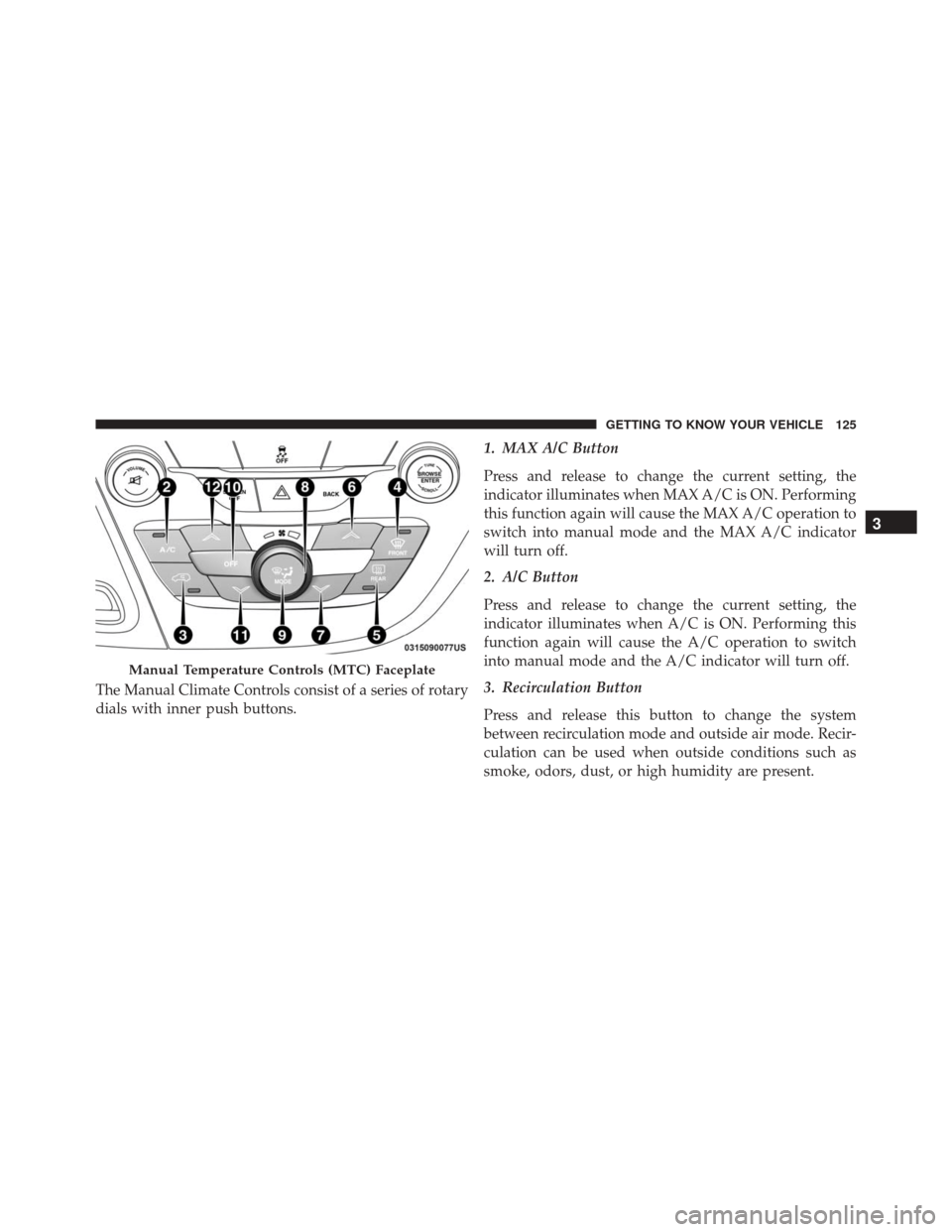
The Manual Climate Controls consist of a series of rotary
dials with inner push buttons.1. MAX A/C Button
Press and release to change the current setting, the
indicator illuminates when MAX A/C is ON. Performing
this function again will cause the MAX A/C operation to
switch into manual mode and the MAX A/C indicator
will turn off.
2. A/C Button
Press and release to change the current setting, the
indicator illuminates when A/C is ON. Performing this
function again will cause the A/C operation to switch
into manual mode and the A/C indicator will turn off.
3. Recirculation Button
Press and release this button to change the system
between recirculation mode and outside air mode. Recir-
culation can be used when outside conditions such as
smoke, odors, dust, or high humidity are present.
Manual Temperature Controls (MTC) Faceplate
3
GETTING TO KNOW YOUR VEHICLE 125
Page 128 of 828

NOTE:•Continuous use of the Recirculation mode may make
the inside air stuffy and window fogging may occur.
Extended use of this mode is not recommended.
• The use of the Recirculation mode in cold or damp
weather could cause windows to fog on the inside,
because of moisture buildup inside the vehicle. Se-
lect the outside air position for maximum defogging.
• Recirculation can be used in all modes except for
Defrost.
• The A/C can be deselected manually without dis-
turbing the mode control selection.
4. Front Defrost Button
Press and release to change the current airflow setting to
Defrost mode. The indicator illuminates when this fea-
ture is ON. Air comes from the windshield and side window demist outlets. When the defrost button is
selected, the blower level will increase. Use Defrost mode
with maximum temperature settings for best windshield
and side window defrosting and defogging. Performing
this function will cause the ATC to switch into manual
mode. If the front defrost mode is turned off the climate
system will return the previous setting.
5. Rear Defrost Button
Push and release the Rear Defrost Control button to turn
ON the rear window defroster and the heated outside
mirrors (if equipped). An indicator will illuminate when
the rear window defroster is ON. The rear window
defroster automatically turns OFF after 10 minutes.
126 GETTING TO KNOW YOUR VEHICLE
Page 129 of 828

CAUTION!
Failure to follow these cautions can cause damage to
the heating elements:
•Use care when washing the inside of the rear
window. Do not use abrasive window cleaners on
the interior surface of the window. Use a soft cloth
and a mild washing solution, wiping parallel to the
heating elements. Labels can be peeled off after
soaking with warm water.
• Do not use scrapers, sharp instruments, or abrasive
window cleaners on the interior surface of the
window.
• Keep all objects a safe distance from the window.
6. Passenger Temperature Control Up Button
Provides the passenger with independent temperature
control. Push the button on the faceplate for warmer
temperature settings or on the touchscreen, press and slide the temperature bar towards the red arrow button
on the touchscreen for warmer temperature settings.
When the SYNC feature is active, the passenger ’s tem-
perature will move up with the driver ’s temperature,
when it is increased.
7. Passenger Temperature Control Down Button
Provides the passenger with independent temperature
control. Push the button on the faceplate for cooler
temperature settings or on the touchscreen, press and
slide the temperature bar towards the blue arrow button
on the touchscreen for cooler temperature settings. When
the SYNC feature is active, the passenger ’s temperature
will move up with the driver ’s temperature, when it is
increased.
8. Blower Control
Blower control is used to regulate the amount of air
forced through the climate system. There are seven
blower speeds available. Adjusting the blower will cause
3
GETTING TO KNOW YOUR VEHICLE 127
Page 131 of 828

•Floor
Air is directed through the floor outlets with a
small amount flowing through the defrost and
side window demister outlets.
• Mix
Air is directed through the floor, defrost, and
side window demister outlets. This setting
works best in cold or snowy conditions that
require extra heat to the windshield. This setting is
good for maintaining comfort while reducing mois-
ture on the windshield.
10. Climate Control OFF Button
Press and release this button to turn the Climate Control
ON/OFF. 11. Driver Temperature Control Down Button
Provides the driver with independent temperature con-
trol. Push the button on the faceplate for cooler tempera-
ture settings or on the touchscreen, press and slide the
temperature bar button towards the blue arrow for cooler
temperature settings. When the SYNC feature is active,
the driver ’s temperature will move down with the pas-
senger ’s temperature, when it is decreased.
12. Driver Temperature Control Up Button
Provides the driver with independent temperature con-
trol. Push the button on the faceplate for warmer tem-
perature settings or on the touchscreen, press and slide
the temperature bar button towards the red arrow for
warmer temperature settings. When the SYNC feature is
active, the driver ’s temperature will move up with the
passenger ’s temperature, when it is increased.
3
GETTING TO KNOW YOUR VEHICLE 129
Page 132 of 828
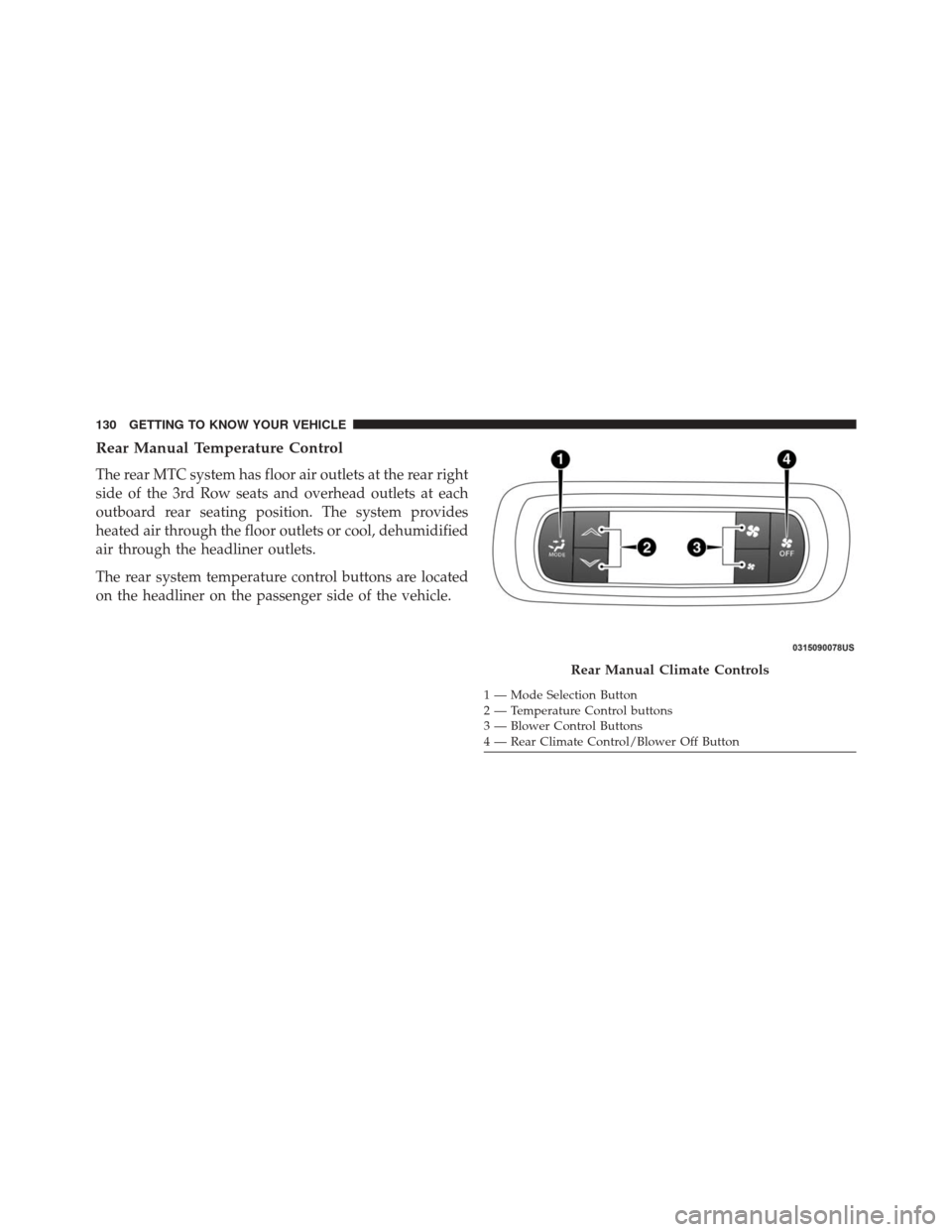
Rear Manual Temperature Control
The rear MTC system has floor air outlets at the rear right
side of the 3rd Row seats and overhead outlets at each
outboard rear seating position. The system provides
heated air through the floor outlets or cool, dehumidified
air through the headliner outlets.
The rear system temperature control buttons are located
on the headliner on the passenger side of the vehicle.
Rear Manual Climate Controls
1 — Mode Selection Button
2 — Temperature Control buttons
3 — Blower Control Buttons
4 — Rear Climate Control/Blower Off Button
130 GETTING TO KNOW YOUR VEHICLE
Page 134 of 828
CAUTION!
Interior air enters the Rear Automatic Temperature
Control System through an intake grille, located in
floor under the passengers’ seats. Do not block or
place objects directly in front of the inlet grille or
heater outlets. The electrical system could overload
causing damage to the blower motor.
Rear Climate Control/Blower Off
To manually set the rear blower controls to off, press the
Rear Climate Control/Blower Off button.
Automatic Temperature Control (ATC) – 3 Zone —
If Equipped
Buttons On The Faceplate
The buttons on the faceplate are located below the
Uconnect screen.
Uconnect 5.0 Automatic Climate Controls — Buttons On The Touchscreen
132 GETTING TO KNOW YOUR VEHICLE
Page 135 of 828
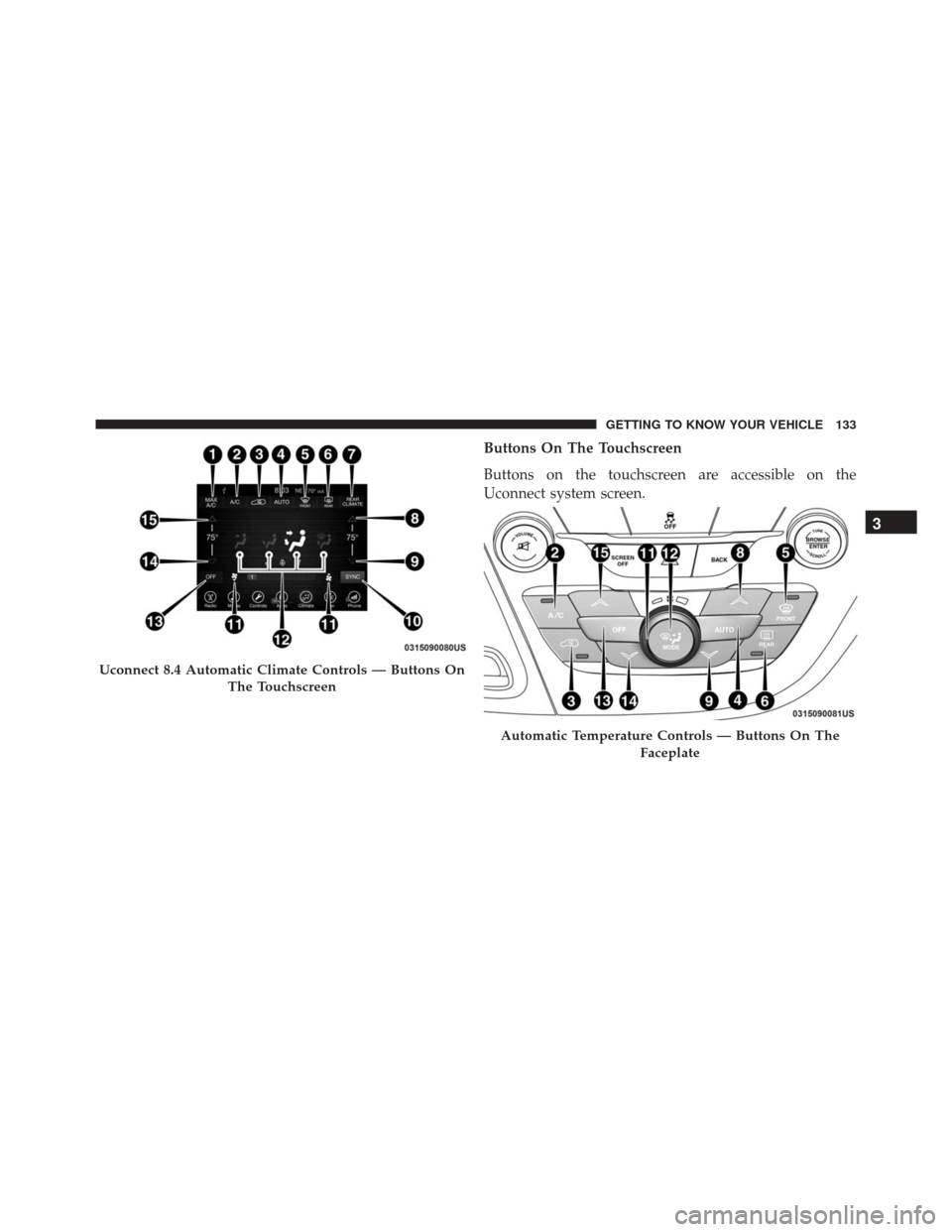
Buttons On The Touchscreen
Buttons on the touchscreen are accessible on the
Uconnect system screen.
Uconnect 8.4 Automatic Climate Controls — Buttons OnThe Touchscreen
Automatic Temperature Controls — Buttons On The Faceplate
3
GETTING TO KNOW YOUR VEHICLE 133
Page 137 of 828
with maximum temperature settings for best windshield
and side window defrosting and defogging. Performing
this function will cause the Automatic Temperature Con-
trol (ATC) to switch into manual mode. If the front
defrost mode is turned off the climate system will return
the previous setting.
6. Rear Defrost Button
Press and release this button to turn on the rear window
defroster and the heated outside mirrors (if equipped).
An indicator will illuminate when the rear window
defroster is on. The rear window defroster automatically
turns off after 10 minutes.CAUTION!
Failure to follow these cautions can cause damage to
the heating elements:
•Use care when washing the inside of the rear
window. Do not use abrasive window cleaners on
the interior surface of the window. Use a soft cloth
and a mild washing solution, wiping parallel to the
heating elements. Labels can be peeled off after
soaking with warm water.
• Do not use scrapers, sharp instruments, or abrasive
window cleaners on the interior surface of the
window.
• Keep all objects a safe distance from the window.
7. Rear Climate Control Button
Press and release this button to access the rear climate
controls. The indicator will illuminate when the rear
climate controls are ON.
3
GETTING TO KNOW YOUR VEHICLE 135