Page 413 of 539
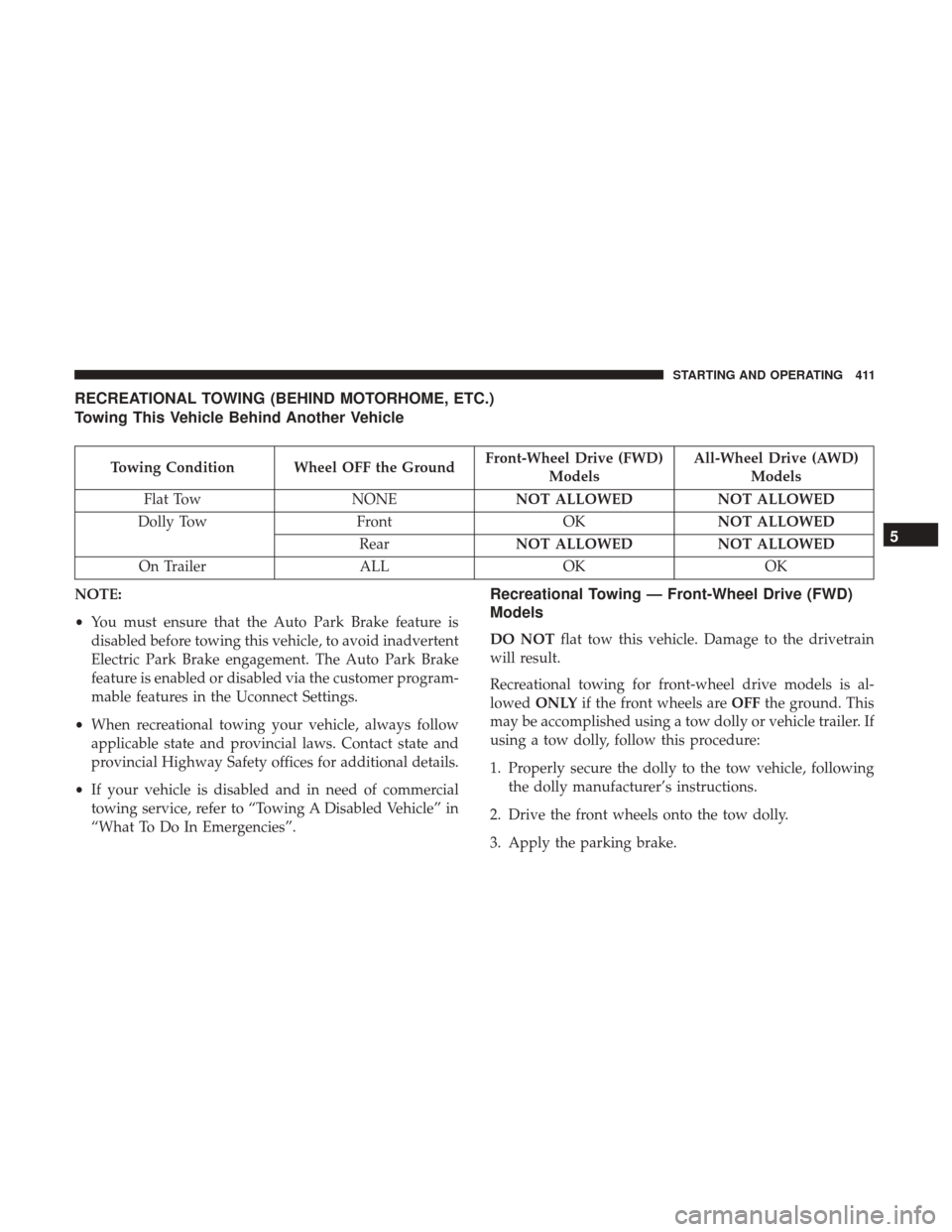
RECREATIONAL TOWING (BEHIND MOTORHOME, ETC.)
Towing This Vehicle Behind Another Vehicle
Towing Condition Wheel OFF the GroundFront-Wheel Drive (FWD)
Models All-Wheel Drive (AWD)
Models
Flat Tow NONENOT ALLOWED NOT ALLOWED
Dolly Tow FrontOKNOT ALLOWED
Rear NOT ALLOWED NOT ALLOWED
On Trailer ALLOKOK
NOTE:
• You must ensure that the Auto Park Brake feature is
disabled before towing this vehicle, to avoid inadvertent
Electric Park Brake engagement. The Auto Park Brake
feature is enabled or disabled via the customer program-
mable features in the Uconnect Settings.
• When recreational towing your vehicle, always follow
applicable state and provincial laws. Contact state and
provincial Highway Safety offices for additional details.
• If your vehicle is disabled and in need of commercial
towing service, refer to “Towing A Disabled Vehicle” in
“What To Do In Emergencies”.
Recreational Towing — Front-Wheel Drive (FWD)
Models
DO NOT flat tow this vehicle. Damage to the drivetrain
will result.
Recreational towing for front-wheel drive models is al-
lowed ONLY if the front wheels are OFFthe ground. This
may be accomplished using a tow dolly or vehicle trailer. If
using a tow dolly, follow this procedure:
1. Properly secure the dolly to the tow vehicle, following the dolly manufacturer’s instructions.
2. Drive the front wheels onto the tow dolly.
3. Apply the parking brake.
5
STARTING AND OPERATING 411
Page 414 of 539

4. Place the transmission in PARK.
5. Turn the engine OFF.
6. Properly secure the front wheels to the dolly, followingthe dolly manufacturer’s instructions.
7. Turn the ignition to the ON/RUN mode, but do not start the engine.
8. Press and hold the brake pedal.
9. Release the parking brake.
10. Turn the ignition OFF.
11. Remove the key fob.
12. Release the brake pedal.
CAUTION!
• DO NOT flat tow this vehicle. Damage to the drive-
train will result. If this vehicle requires towing,
make sure the drive wheels are OFF the ground.
• Ensure that the Electric Park Brake is released, and
remains released, while being towed.
(Continued)
CAUTION! (Continued)
•Towing this vehicle in violation of the above require-
ments can cause severe transmission damage. Dam-
age from improper towing is not covered under the
New Vehicle Limited Warranty.
Recreational Towing — All-Wheel Drive (AWD)
Models
Recreational towing is not allowed. These models do not
have a NEUTRAL (N) position in the power transfer unit.
NOTE: This vehicle may be towed on a flatbed or vehicle
trailer provided all four wheels are OFF the ground.
CAUTION!
Towing this vehicle with ANY of its wheels on the
ground can cause severe transmission and/or power
transfer unit damage. Damage from improper towing
is not covered under the New Vehicle Limited War-
ranty.
412 STARTING AND OPERATING
Page 415 of 539

WHAT TO DO IN EMERGENCIES
CONTENTS
�HAZARD WARNING FLASHERS ............414
� IF YOUR ENGINE OVERHEATS .............414
� WHEEL AND TIRE TORQUE SPECIFICATIONS . .415
▫ Torque Specifications ....................415
� TIRE SERVICE KIT — IF EQUIPPED ..........416
▫ Tire Service Kit Storage ...................417
▫ Tire Service Kit Components And Operation . . . .418
▫ Tire Service Kit Usage Precautions ..........419
▫ Sealing A Tire With Tire Service Kit ..........420
� JACKING AND TIRE CHANGING ...........425
▫ Jack Location/Spare Tire Stowage ...........425
▫ Preparations For Jacking .................426
▫ Jacking Instructions .....................427 ▫
Road Tire Installation ....................433
� JUMP-STARTING PROCEDURES ............435
▫ Preparations For Jump-Start ...............436
▫ Jump-Starting Procedure ..................437
� FREEING A STUCK VEHICLE ..............438
� MANUAL PARK RELEASE .................439
� TOWING A DISABLED VEHICLE ............442
▫ Front-Wheel Drive (FWD) Models ..........444
▫ All-Wheel Drive (AWD) Models ............444
� ENHANCED ACCIDENT RESPONSE
SYSTEM (EARS) ....................... .445
� EVENT DATA RECORDER (EDR) ............445
6
Page 419 of 539
Tire Service Kit Storage
The Tire Service Kit is stowed under an access cover in the
trunk.
1. Open the trunk.
2. Lift the access cover using the pull strap.3. Remove the fastener securing the Tire Service Kit.
Pull Strap
Tire Service Kit Fastener
6
WHAT TO DO IN EMERGENCIES 417
Page 422 of 539

WARNING!
•Do not attempt to seal a tire on the side of the vehicle
closest to traffic. Pull far enough off the road to avoid
the danger of being hit when using the Tire Service
Kit.
• Do not use Tire Service Kit or drive the vehicle under
the following circumstances:
– If the puncture in the tire tread is approximately 1/4 inch (6 mm) or larger.
– If the tire has any sidewall damage.
– If the tire has any damage from driving with extremely low tire pressure.
– If the tire has any damage from driving on a flat tire.
– If the wheel has any damage.
– If you are unsure of the condition of the tire or the wheel.
• Keep Tire Service Kit away from open flames or heat
source.
• A loose Tire Service Kit thrown forward in a collision
or hard stop could endanger the occupants of the
vehicle. Always stow the Tire Service Kit in the place
provided. Failure to follow these warnings can result
(Continued)
WARNING! (Continued)
in injuries that are serious or fatal to you, your
passengers, and others around you.
• Take care not to allow the contents of Tire Service Kit
to come in contact with hair, eyes, or clothing. Tire
Service Kit sealant is harmful if inhaled, swallowed,
or absorbed through the skin. It causes skin, eye, and
respiratory irritation. Flush immediately with plenty
of water if there is any contact with eyes or skin.
Change clothing as soon as possible, if there is any
contact with clothing.
• Tire Service Kit Sealant solution contains latex. In
case of an allergic reaction or rash, consult a physi-
cian immediately. Keep Tire Service Kit out of reach
of children. If swallowed, rinse mouth immediately
with plenty of water and drink plenty of water. Do
not induce vomiting! Consult a physician immedi-
ately.
Sealing A Tire With Tire Service Kit
(A) Whenever You Stop To Use Tire Service Kit:
1. Pull over to a safe location and turn on the vehicle’s Hazard Warning flashers.
420 WHAT TO DO IN EMERGENCIES
Page 427 of 539

JACKING AND TIRE CHANGING
WARNING!
•Do not attempt to change a tire on the side of the
vehicle close to moving traffic. Pull far enough off
the road to avoid the danger of being hit when
operating the jack or changing the wheel.
• Being under a jacked-up vehicle is dangerous. The
vehicle could slip off the jack and fall on you. You
could be crushed. Never put any part of your body
under a vehicle that is on a jack. If you need to get
under a raised vehicle, take it to a service center
where it can be raised on a lift.
• Never start or run the engine while the vehicle is on
a jack.
• The jack is designed to be used as a tool for changing
tires only. The jack should not be used to lift the
vehicle for service purposes. The vehicle should be
jacked on a firm level surface only. Avoid ice or
slippery areas.
Jack Location/Spare Tire Stowage
The jack, wheel chocks and spare tire are stowed under an
access cover in the trunk. Follow these steps to access the
jack, wheel chocks and spare tire.
1. Open the trunk.
2. Lift the access cover using the pull strap.
Pull Strap
6
WHAT TO DO IN EMERGENCIES 425
Page 428 of 539

3. Remove the fastener securing the jack and spare tire.
4. Remove the scissors jack, wheel bolt wrench and wheelchocks from the spare wheel as an assembly. Remove the
chocks from the jack assembly. Turn the jack screw to the
left to loosen the wheel bolt wrench, and remove the
wrench from the jack assembly.
5. Remove the spare tire.WARNING!
A loose tire or jack thrown forward in a collision or
hard stop could endanger the occupants of the vehicle.
Always stow the jack parts and the spare tire in the
places provided. Have the deflated (flat) tire repaired
or replaced immediately.
Preparations For Jacking
1. Park the vehicle on a firm level surface as far from the edge of the roadway as possible. Avoid icy or slippery
areas.
WARNING!
Do not attempt to change a tire on the side of the
vehicle close to moving traffic, pull far enough off the
road to avoid being hit when operating the jack or
changing the wheel.
2. Turn on the Hazard Warning flasher.
3. Set the parking brake.
4. Place the shifter into the park position.
5. Turn the ignition off to the LOCK position.
Jack And Spare Tire Fastener
426 WHAT TO DO IN EMERGENCIES
Page 429 of 539

6. Chock both the front and rear of the wheel diagonallyopposite of the jacking position. For
example, if changing the right front
tire, chock the left rear wheel. Place
both chocks under the tire.
NOTE: Passengers should not remain in the vehicle when
the vehicle is being jacked.
Jacking Instructions
WARNING!
Carefully follow these tire changing warnings to help
prevent personal injury or damage to your vehicle:
• Always park on a firm, level surface as far from the
edge of the roadway as possible before raising the
vehicle.
• Turn on the Hazard Warning flasher.
• Chock the wheel diagonally opposite the wheel to be
raised.
• Set the parking brake firmly and set an automatic
transmission in PARK.
• Never start or run the engine with the vehicle on a
jack.
(Continued)
WARNING! (Continued)
•Do not let anyone sit in the vehicle when it is on a
jack.
• Do not get under the vehicle when it is on a jack. If
you need to get under a raised vehicle, take it to a
service center where it can be raised on a lift.
• Only use the jack in the positions indicated and for
lifting this vehicle during a tire change.
• If working on or near a roadway, be extremely
careful of motor traffic.
• To assure that spare tires, flat or inflated, are securely
stowed, spares must be stowed with the valve stem
facing the ground.
6
WHAT TO DO IN EMERGENCIES 427