2017 CHEVROLET MALIBU ABS
[x] Cancel search: ABSPage 238 of 419
Chevrolet Malibu Owner Manual (GMNA-Localizing-U.S./Canada/Mexico-10122664) - 2017 - crc - 5/23/16
Driving and Operating 237
If driving safely on a wet road and itbecomes necessary to slam on thebrakes and continue braking toavoid a sudden obstacle, acomputer senses the wheels areslowing down. If one of the wheelsis about to stop rolling, the computerwill separately work the brakes ateach wheel.
ABS can change the brake pressureto each wheel, as required, fasterthan any driver could. This can helpyou steer around the obstacle whilebraking hard.
As the brakes are applied, thecomputer keeps receiving updateson wheel speed and controlsbraking pressure accordingly.
Remember: ABS does not changethe time needed to get a foot up tothe brake pedal or always decreasestopping distance. If you get tooclose to the vehicle in front of you,there will not be enough time toapply the brakes if that vehiclesuddenly slows or stops. Alwaysleave enough room up ahead tostop, even with ABS.
Using ABS
Do not pump the brakes. Just holdthe brake pedal down firmly and letABS work. You may hear the ABSpump or motor operating and feelthe brake pedal pulsate. This isnormal.
Braking in Emergencies
ABS allows you to steer and brakeat the same time. In manyemergencies, steering can helpmore than even the very bestbraking.
Parking Brake
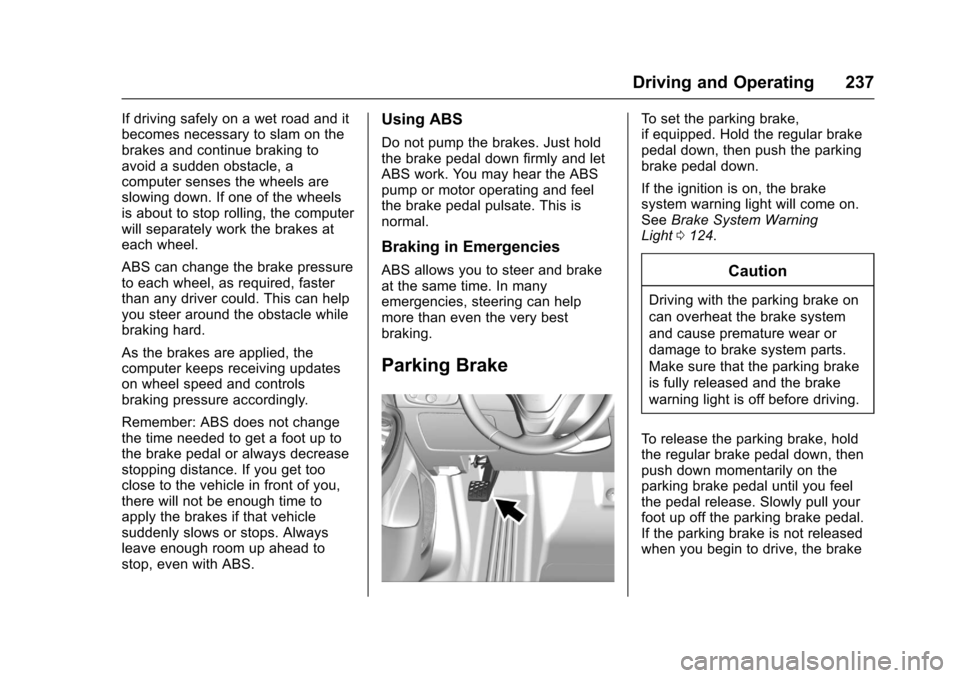
To s e t t h e p a r k i n g b r a k e ,if equipped. Hold the regular brakepedal down, then push the parkingbrake pedal down.
If the ignition is on, the brakesystem warning light will come on.SeeBrake System WarningLight0124.
Caution
Driving with the parking brake on
can overheat the brake system
and cause premature wear or
damage to brake system parts.
Make sure that the parking brake
is fully released and the brake
warning light is off before driving.
To r e l e a s e t h e p a r k i n g b r a k e , h o l dthe regular brake pedal down, thenpush down momentarily on theparking brake pedal until you feelthe pedal release. Slowly pull yourfoot up off the parking brake pedal.If the parking brake is not releasedwhen you begin to drive, the brake
Page 240 of 419
Chevrolet Malibu Owner Manual (GMNA-Localizing-U.S./Canada/Mexico-10122664) - 2017 - crc - 5/23/16
Driving and Operating 239
If the EPB fails to apply, the rearwheels should be blocked toprevent vehicle movement.
EPB Release
To r e l e a s e t h e E P B :
1. Place the ignition in the ACC/ACCESSORY or ON/RUNposition.
2. Apply and hold the brakepedal.
3. Push down momentarily on theEPB switch.
The EPB is released when the redparking brake status light is off.
If the amber parking brake warninglight is on, release the EPB bypushing down on the EPB switchand holding it down. Continue tohold the switch until the red parkingbrake status light is off. If either lightstays on after release is attempted,see your dealer.
Caution
Driving with the parking brake on
can overheat the brake system
and cause premature wear or
damage to brake system parts.
Make sure that the parking brake
is fully released and the brake
warning light is off before driving.
Automatic EPB Release
The EPB will automatically release ifthe vehicle is running, placed intogear, and an attempt is made todrive away. Avoid rapid accelerationwhen the EPB is applied, topreserve parking brake lining life.
If parking on a hill, or if the vehicleis pulling a trailer, seeDrivingCharacteristics and TowingTips0272.
Brake Assist
The Brake Assist feature isdesigned to assist the driver instopping or decreasing vehiclespeed in emergency drivingconditions. This feature uses thestability system hydraulic brakecontrol module to supplement thepower brake system underconditions where the driver hasquickly and forcefully applied thebrake pedal in an attempt to quicklystop or slow down the vehicle. Thestability system hydraulic brakecontrol module increases brakepressure at each corner of thevehicle until the ABS activates.Minor brake pedal pulsation orpedal movement during this time isnormal and the driver shouldcontinue to apply the brake pedal asthe driving situation dictates. TheBrake Assist feature willautomatically disengage when thebrake pedal is released or brakepedal pressure is quicklydecreased.
Page 276 of 419
Chevrolet Malibu Owner Manual (GMNA-Localizing-U.S./Canada/Mexico-10122664) - 2017 - crc - 5/23/16
Driving and Operating 275
If parking the rig on a hill:
1. Press the brake pedal, but donot shift into P (Park) yet. Turnthe wheels into the curb iffacing downhill or into traffic iffacing uphill.
2. Have someone place chocksunder the trailer wheels.
3. When the wheel chocks are inplace, release the brake pedaluntil the chocks absorbthe load.
4. Reapply the brake pedal. Thenapply the parking brake andshift into P (Park).
5. Release the brake pedal.
Leaving After Parking on a Hill
1. Apply and hold the brake pedalwhile you:
1.1. Start the engine.
1.2. Shift into a gear.
1.3. Release the parkingbrake.
2. Let up on the brake pedal.
3. Drive slowly until the trailer isclear of the chocks.
4. Stop and have someone pickup and store the chocks.
Maintenance When Trailer
Towing
The vehicle needs service moreoften when pulling a trailer. See theMaintenance Schedule0369.Things that are especially importantin trailer operation are automatictransmission fluid, engine oil, axlelubricant, belts, cooling system, andbrake system. Inspect these beforeand during the trip.
Check periodically to see that allhitch nuts and bolts are tight.
Engine Cooling When Trailer
Towing
The cooling system may temporarilyoverheat during severe operatingconditions. SeeEngineOverheating0297.
Trailer Towing
Before pulling a trailer, threeimportant considerations have to dowith weight:
.Weight of the trailer.
.Weight of the trailer tongue.
.To t a l w e i g h t o n y o u r v e h i c l e ' stires.
Weight of the Trailer
How heavy can a trailer safely be?
It should never weigh more than454 kg (1,000 lb). But even that canbe too heavy.
It depends on how the rig is used.For example, speed, altitude, roadgrades, outside temperature, andhow much the vehicle is used to pullatrailerareallimportant.Itcandepend on any special equipmenton the vehicle, and the amount oftongue weight the vehicle can carry.See“Weight of the Trailer Tongue”following.
Maximum trailer weight is calculatedassuming the tow vehicle has thedriver, a front seat passenger and
Page 302 of 419
Chevrolet Malibu Owner Manual (GMNA-Localizing-U.S./Canada/Mexico-10122664) - 2017 - crc - 5/23/16
Vehicle Care 301
{Warning
If too much brake fluid is added, it
can spill on the engine and burn,
if the engine is hot enough. You
or others could be burned, and
the vehicle could be damaged.
Add brake fluid only when work is
done on the brake hydraulic
system.
When the brake fluid falls to a lowlevel, the brake warning light comeson. SeeBrake System WarningLight0124.
Brake fluid absorbs water over timewhich degrades the effectiveness ofthe brake fluid. Replace brake fluidat the specified intervals to preventincreased stopping distance. SeeMaintenance Schedule0369.
What to Add
Use only GM approved DOT 3brake fluid from a clean, sealedcontainer. SeeRecommendedFluids and Lubricants0377.
{Warning
The wrong or contaminated brake
fluid could result in damage to the
brake system. This could result in
the loss of braking leading to a
possible injury. Always use the
proper GM approved brake fluid.
Caution
If brake fluid is spilled on the
vehicle's painted surfaces, the
paint finish can be damaged.
Immediately wash off any painted
surface.
Battery - North America
The original equipment battery ismaintenance free. Do not removethe cap and do not add fluid.
The non-hybrid vehicle has astandard 12-volt battery under thehood. SeeEngine CompartmentOverview0283.
Refer to the replacement numbershown on the original battery labelwhen a new 12-volt battery isneeded.
Hybrid Vehicle
The hybrid vehicle 12-volt battery isin the trunk on the driver side.Hybrid vehicles also have a highvoltage battery. Only a trainedservice technician with the properknowledge and tools should inspect,test, or replace the high voltagebattery. See your dealer if the highvoltage battery needs service. Thedealer has information on how torecycle the high voltage battery.
The hybrid high voltage battery iscooled with air drawn from thevehicle interior. The cold air intakefor the battery is under the rearseat. Do not block the area in frontof the cold air intake.
Page 303 of 419
Chevrolet Malibu Owner Manual (GMNA-Localizing-U.S./Canada/Mexico-10122664) - 2017 - crc - 5/23/16
302 Vehicle Care
{Warning
Damage to the high voltage
battery or high voltage system
can create a risk of electric shock,
overheating, or fire.
If the vehicle is damaged from a
moderate to severe crash, flood,
fire, or other event, the vehicle
should be inspected as soon as
possible. Until the vehicle has
been inspected, store it outside at
least 15 m (50 ft) from any
structure or anything that can
burn. Ventilate the vehicle by
opening a window or a door.
Contact Customer Assistance as
soon as possible to determine
whether an inspection is needed.
SeeCustomer Assistance
Offices0385.
Stop/Start System
If equipped with the 1.5L L4 engine,the vehicle has a stop/start systemto shut off the engine to helpconserve fuel. SeeStarting theEngine0227.
Vehicles with a 1.5L engine have anAbsorbed Glass Mat (AGM) 12-voltbattery. Installation of a standard12-volt battery will result in reduced12-volt battery life.
When using a 12-volt batterycharger on the 12-volt AGM battery,some chargers have an AGMbattery setting on the charger.If available, use the AGM setting onthe charger, to limit charge voltageto 14.8 volts.
{Warning
WA R N I N G :Battery posts,
terminals, and related
accessories contain lead and lead
compounds, chemicals known to
the State of California to cause
cancer and birth defects or other
(Continued)
Warning (Continued)
reproductive harm. Batteries also
contain other chemicals known to
the State of California to cause
cancer.WASH HANDS AFTER
HANDLING.
SeeCalifornia Proposition
65 Warning0279.
Vehicle Storage
{Warning
Batteries have acid that can burn
you and gas that can explode.
Yo u c a n b e b a d l y h u r t i f y o u a r e
not careful. SeeJump Starting -
North America0352for tips on
working around a battery without
getting hurt.
Infrequent Usage: Remove the12-volt battery black, negative (✓)cable from the battery to keep thebattery from running down.
Page 314 of 419
Chevrolet Malibu Owner Manual (GMNA-Localizing-U.S./Canada/Mexico-10122664) - 2017 - crc - 5/23/16
Vehicle Care 313
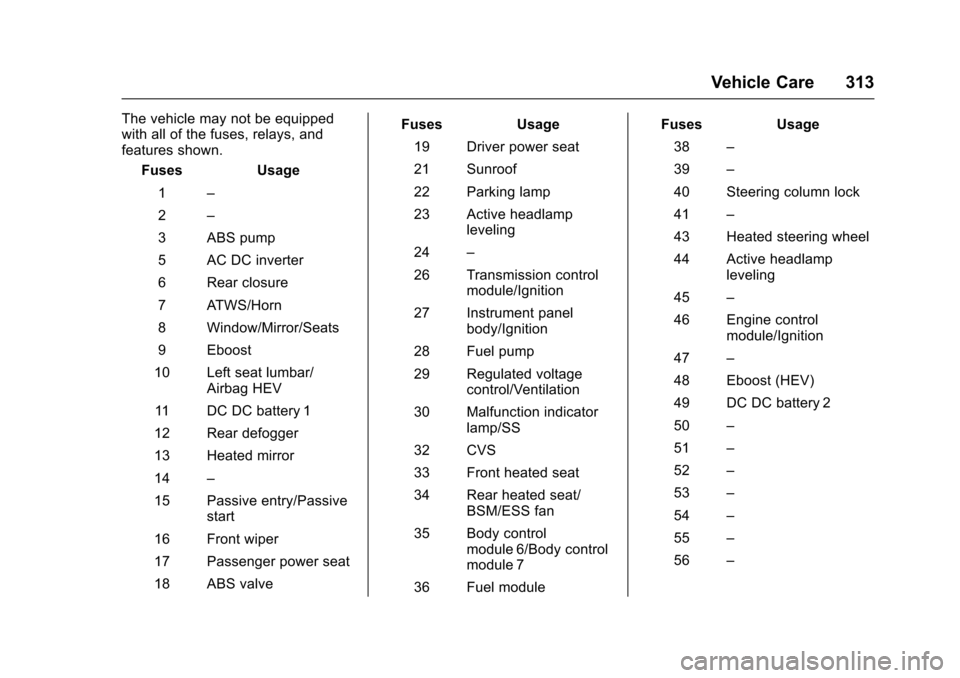
The vehicle may not be equippedwith all of the fuses, relays, andfeatures shown.
Fuses Usage
1–
2–
3ABSpump
5ACDCinverter
6Rearclosure
7ATWS/Horn
8Window/Mirror/Seats
9Eboost
10 Left seat lumbar/Airbag HEV
11 D C D C b a t t e r y 1
12 Rear defogger
13 Heated mirror
14–
15 Passive entry/Passivestart
16 Front wiper
17 Passenger power seat
18 ABS valve
Fuses Usage
19 Driver power seat
21 Sunroof
22 Parking lamp
23 Active headlampleveling
24–
26 Transmission controlmodule/Ignition
27 Instrument panelbody/Ignition
28 Fuel pump
29 Regulated voltagecontrol/Ventilation
30 Malfunction indicatorlamp/SS
32 CVS
33 Front heated seat
34 Rear heated seat/BSM/ESS fan
35 Body controlmodule 6/Body controlmodule 7
36 Fuel module
Fuses Usage
38–
39–
40 Steering column lock
41–
43 Heated steering wheel
44 Active headlampleveling
45–
46 Engine controlmodule/Ignition
47–
48 Eboost (HEV)
49 DC DC battery 2
50–
51–
52–
53–
54–
55–
56–
Page 316 of 419
Chevrolet Malibu Owner Manual (GMNA-Localizing-U.S./Canada/Mexico-10122664) - 2017 - crc - 5/23/16
Vehicle Care 315
Instrument Panel Fuse
Block
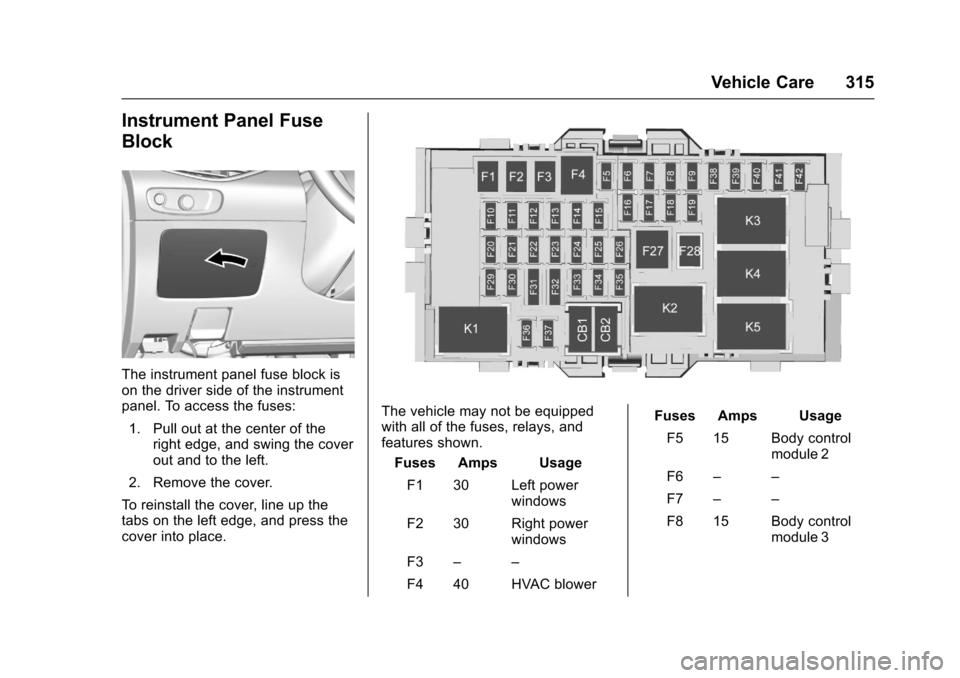
The instrument panel fuse block ison the driver side of the instrumentpanel. To access the fuses:
1. Pull out at the center of theright edge, and swing the coverout and to the left.
2. Remove the cover.
To r e i n s t a l l t h e c o v e r, l i n e u p t h etabs on the left edge, and press thecover into place.
The vehicle may not be equippedwith all of the fuses, relays, andfeatures shown.
Fuses Amps Usage
F1 30 Left powerwindows
F2 30 Right powerwindows
F3––
F4 40 HVAC blower
Fuses Amps Usage
F5 15 Body controlmodule 2
F6––
F7––
F8 15 Body controlmodule 3
Page 352 of 419
Chevrolet Malibu Owner Manual (GMNA-Localizing-U.S./Canada/Mexico-10122664) - 2017 - crc - 5/23/16
Vehicle Care 351
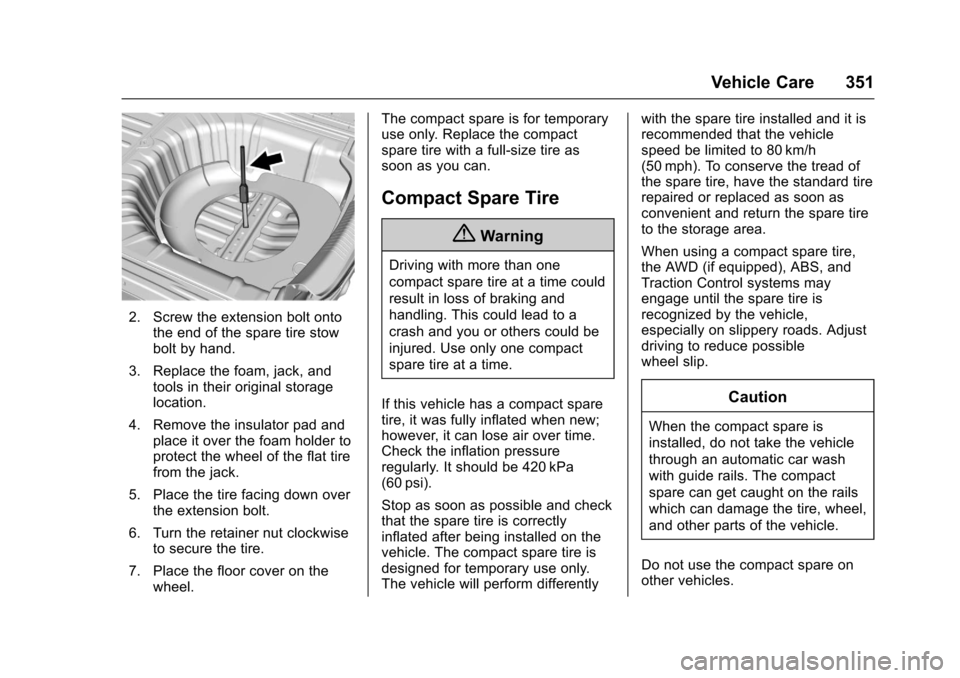
2. Screw the extension bolt ontothe end of the spare tire stowbolt by hand.
3. Replace the foam, jack, andtools in their original storagelocation.
4. Remove the insulator pad andplace it over the foam holder toprotect the wheel of the flat tirefrom the jack.
5. Place the tire facing down overthe extension bolt.
6. Turn the retainer nut clockwiseto secure the tire.
7. Place the floor cover on thewheel.
The compact spare is for temporaryuse only. Replace the compactspare tire with a full-size tire assoon as you can.
Compact Spare Tire
{Warning
Driving with more than one
compact spare tire at a time could
result in loss of braking and
handling. This could lead to a
crash and you or others could be
injured. Use only one compact
spare tire at a time.
If this vehicle has a compact sparetire, it was fully inflated when new;however, it can lose air over time.Check the inflation pressureregularly. It should be 420 kPa(60 psi).
Stop as soon as possible and checkthat the spare tire is correctlyinflated after being installed on thevehicle. The compact spare tire isdesigned for temporary use only.The vehicle will perform differently
with the spare tire installed and it isrecommended that the vehiclespeed be limited to 80 km/h(50 mph). To conserve the tread ofthe spare tire, have the standard tirerepaired or replaced as soon asconvenient and return the spare tireto the storage area.
When using a compact spare tire,the AWD (if equipped), ABS, andTraction Control systems mayengage until the spare tire isrecognized by the vehicle,especially on slippery roads. Adjustdriving to reduce possiblewheel slip.
Caution
When the compact spare is
installed, do not take the vehicle
through an automatic car wash
with guide rails. The compact
spare can get caught on the rails
which can damage the tire, wheel,
and other parts of the vehicle.
Do not use the compact spare onother vehicles.