2017 CHEVROLET COLORADO warning
[x] Cancel search: warningPage 344 of 419
Chevrolet Colorado Owner Manual (GMNA-Localizing-U.S./Canada/Mexico-10122675) - 2017 - crc - 8/22/16
Vehicle Care 343
11 . Ti g h t e n e a c h w h e e l n u t b yhand. Then use the wheelwrench to tighten the nuts untilthe wheel is held againstthe hub.
12. Turn the wheel wrenchcounterclockwise to lower thevehicle. Lower the jackcompletely.
{Warning
If wheel studs are damaged, they
can break. If all the studs on a
wheel broke, the wheel could
come off and cause a crash.
If any stud is damaged because
of a loose-running wheel, it could
be that all of the studs are
damaged. To be sure, replace all
studs on the wheel. If the stud
holes in a wheel have become
larger, the wheel could collapse in
operation. Replace any wheel if
its stud holes have become larger
or distorted in any way. Inspect
hubs and hub⇣piloted wheels for
damage. Because of loose
(Continued)
Warning (Continued)
running wheels, piloting pad
damage may occur and require
replacement of the entire hub, for
proper centering of the wheels.
When replacing studs, hubs,
wheel nuts or wheels, be sure to
use GM original equipment parts.
{Warning
Wheel nuts that are improperly or
incorrectly tightened can cause
the wheels to become loose or
come off. The wheel nuts should
be tightened with a torque wrench
to the proper torque specification
after replacing. Follow the torque
specification supplied by the
aftermarket manufacturer when
using accessory locking wheel
nuts. SeeCapacities and
Specifications0380for original
equipment wheel nut torque
specifications.
Caution
Improperly tightened wheel nuts
can lead to brake pulsation and
rotor damage. To avoid expensive
brake repairs, evenly tighten the
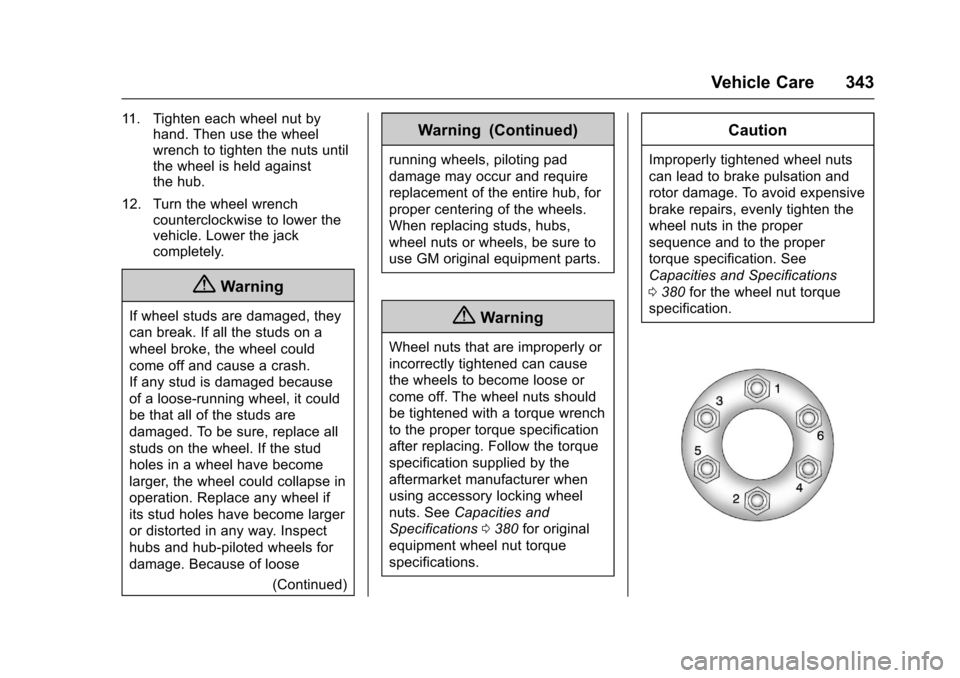
wheel nuts in the proper
sequence and to the proper
torque specification. See
Capacities and Specifications
0380for the wheel nut torque
specification.
Page 345 of 419
Chevrolet Colorado Owner Manual (GMNA-Localizing-U.S./Canada/Mexico-10122675) - 2017 - crc - 8/22/16
344 Vehicle Care
13. Tighten the nuts firmly in acrisscross sequence, asshown, by turning the wheelwrench clockwise.
When reinstalling the regular wheeland tire, also reinstall the centercap. Place the cap on the wheeland push it into place until it seats.The cap may only go on one way.Be sure to line up any tabs on thecenter cap with correspondingindentations on the wheel.
Storing a Flat or Spare Tire
and Tools
{Warning
Storing a jack, a tire, or other
equipment in the passenger
compartment of the vehicle could
cause injury. In a sudden stop or
collision, loose equipment could
strike someone. Store all these in
the proper place.
Caution
Storing an aluminum wheel with a
flat tire under your vehicle for an
extended period of time or with
the valve stem pointing up can
damage the wheel. Always stow
the wheel with the valve stem
pointing down and have the
wheel/tire repaired as soon as
possible.
Caution
The tire hoist can be damaged if
there is no tension on the cable
when using it. To have the
necessary tension, the spare or
road tire and wheel assembly
must be installed on the tire hoist
to use it.
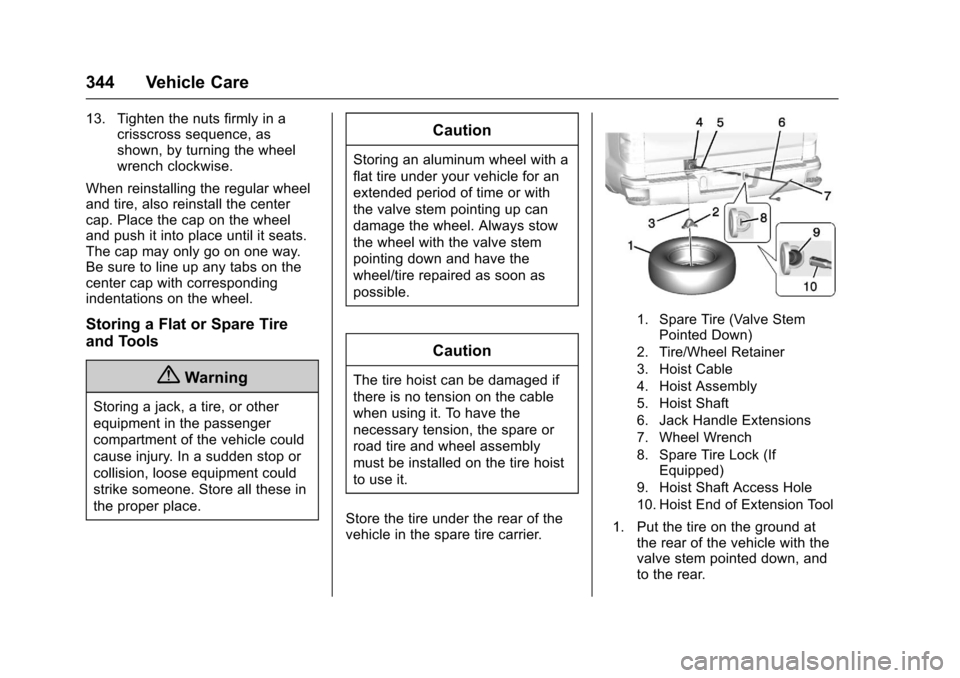
Store the tire under the rear of thevehicle in the spare tire carrier.
1. Spare Tire (Valve StemPointed Down)
2. Tire/Wheel Retainer
3. Hoist Cable
4. Hoist Assembly
5. Hoist Shaft
6. Jack Handle Extensions
7. Wheel Wrench
8. Spare Tire Lock (IfEquipped)
9. Hoist Shaft Access Hole
10. Hoist End of Extension Tool
1. Put the tire on the ground atthe rear of the vehicle with thevalve stem pointed down, andto the rear.
Page 347 of 419
Chevrolet Colorado Owner Manual (GMNA-Localizing-U.S./Canada/Mexico-10122675) - 2017 - crc - 8/22/16
346 Vehicle Care
and then try to turn the tire.If the tire moves, use the wheelwrench to tighten the cable.
8. Reinstall the spare tire lock,if the vehicle has one.
To s t o r e t h e j a c k a n d t o o l s , r e v e r s ethe steps for removing them.
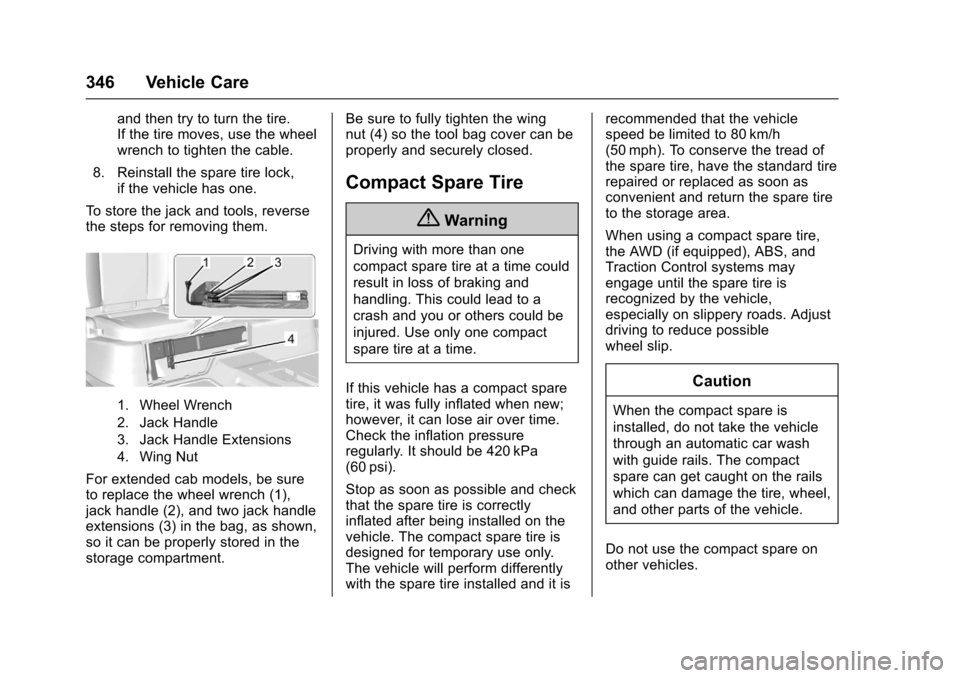
1. Wheel Wrench
2. Jack Handle
3. Jack Handle Extensions
4. Wing Nut
For extended cab models, be sureto replace the wheel wrench (1),jack handle (2), and two jack handleextensions (3) in the bag, as shown,so it can be properly stored in thestorage compartment.
Be sure to fully tighten the wingnut (4) so the tool bag cover can beproperly and securely closed.
Compact Spare Tire
{Warning
Driving with more than one
compact spare tire at a time could
result in loss of braking and
handling. This could lead to a
crash and you or others could be
injured. Use only one compact
spare tire at a time.
If this vehicle has a compact sparetire, it was fully inflated when new;however, it can lose air over time.Check the inflation pressureregularly. It should be 420 kPa(60 psi).
Stop as soon as possible and checkthat the spare tire is correctlyinflated after being installed on thevehicle. The compact spare tire isdesigned for temporary use only.The vehicle will perform differentlywith the spare tire installed and it is
recommended that the vehiclespeed be limited to 80 km/h(50 mph). To conserve the tread ofthe spare tire, have the standard tirerepaired or replaced as soon asconvenient and return the spare tireto the storage area.
When using a compact spare tire,the AWD (if equipped), ABS, andTraction Control systems mayengage until the spare tire isrecognized by the vehicle,especially on slippery roads. Adjustdriving to reduce possiblewheel slip.
Caution
When the compact spare is
installed, do not take the vehicle
through an automatic car wash
with guide rails. The compact
spare can get caught on the rails
which can damage the tire, wheel,
and other parts of the vehicle.
Do not use the compact spare onother vehicles.
Page 349 of 419
Chevrolet Colorado Owner Manual (GMNA-Localizing-U.S./Canada/Mexico-10122675) - 2017 - crc - 8/22/16
348 Vehicle Care
Have the damaged or flat road tirerepaired or replaced and installedback onto the vehicle as soon aspossible so the spare tire will beavailable in case it is needed again.
Do not mix tires and wheels ofdifferent sizes, because they will notfit. Keep your spare tire and itswheel together. If the vehicle has aspare tire that does not match theoriginal road tires and wheels in sizeand type, do not include the spare inthe tire rotation.
Jump Starting
Jump Starting - North
America
For more information about thevehicle battery, seeBattery - NorthAmerica0300.
If the battery has run down, try touse another vehicle and somejumper cables to start your vehicle.Be sure to use the following steps todo it safely.
{Warning
WA R N I N G :Battery posts,
terminals, and related
accessories contain lead and lead
compounds, chemicals known to
the State of California to cause
cancer and birth defects or other
reproductive harm. Batteries also
contain other chemicals known to
the State of California to cause
cancer.WASH HANDS AFTER
HANDLING.
(Continued)
Warning (Continued)
SeeCalifornia Proposition
65 Warning0280.
{Warning
Batteries can hurt you. They can
be dangerous because:
.They contain acid that canburn you.
.They contain gas that canexplode or ignite.
.They contain enoughelectricity to burn you.
If you do not follow these steps
exactly, some or all of these
things can hurt you.
Page 351 of 419
Chevrolet Colorado Owner Manual (GMNA-Localizing-U.S./Canada/Mexico-10122675) - 2017 - crc - 8/22/16
350 Vehicle Care
4. Turn the ignition to LOCK/OFF.Turn off all lights andaccessories in both vehicles,except the hazard warningflashers if needed.
{Warning
An electric fan can start up even
when the engine is not running
and can injure you. Keep hands,
clothing, and tools away from any
underhood electric fan.
{Warning
Using a match near a battery can
cause battery gas to explode.
People have been hurt doing this,
and some have been blinded.
Use a flashlight if you need more
light.
Battery fluid contains acid that
can burn you. Do not get it on
you. If you accidentally get it in
(Continued)
Warning (Continued)
your eyes or on your skin, flush
the place with water and get
medical help immediately.
{Warning
Fans or other moving engine
parts can injure you badly. Keep
your hands away from moving
parts once the engine is running.
5. Connect one end of the redpositive (+) cable to thepositive (+) terminal on thedischarged battery.
6. Connect the other end of thered positive (+) cable to thepositive (+) terminal of the goodbattery.
7. Connect one end of the blacknegative (–)cabletothenegative (–)terminalofthegood battery.
8. Connect the other end of theblack negative (–)cabletothenegative (–)groundingstudforthe discharged battery.
9. Start the engine in the vehiclewith the good battery and runthe engine at idle speed for atleast four minutes.
10. Try to start the vehicle that hadthe dead battery. If it will notstart after a few tries, itprobably needs service.
Caution
If the jumper cables are
connected or removed in the
wrong order, electrical shorting
may occur and damage the
vehicle. The repairs would not be
covered by the vehicle warranty.
Always connect and remove the
jumper cables in the correct order,
making sure that the cables do
not touch each other or other
metal.
Page 353 of 419
Chevrolet Colorado Owner Manual (GMNA-Localizing-U.S./Canada/Mexico-10122675) - 2017 - crc - 8/22/16
352 Vehicle Care
Caution (Continued)
warranty. If using a shield, only
use one that attaches to the
towing vehicle.
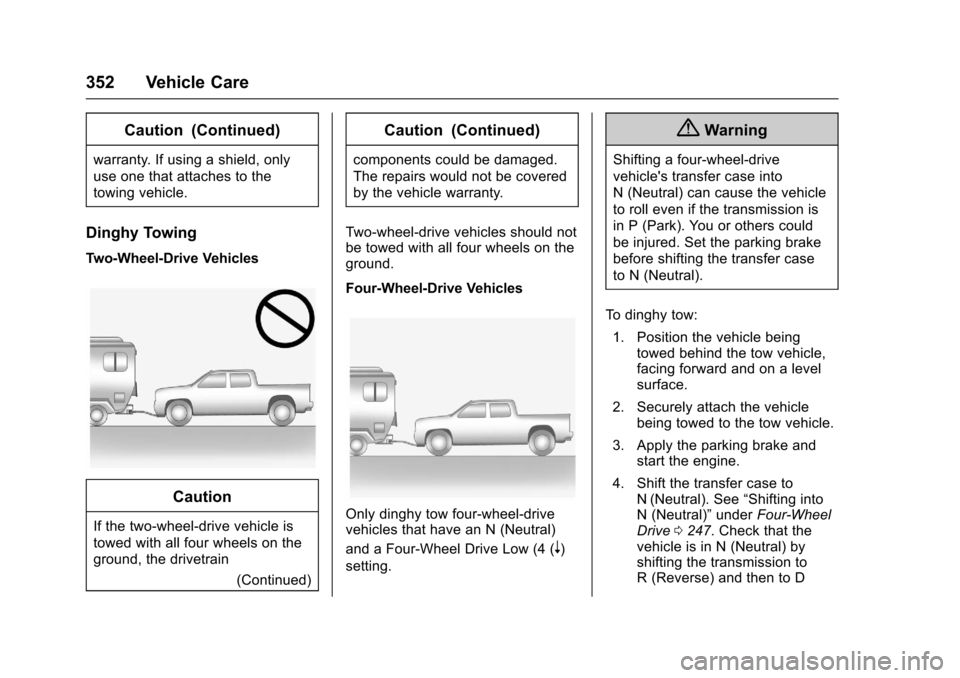
Dinghy Towing
Two-Wheel-Drive Vehicles
Caution
If the two-wheel-drive vehicle is
towed with all four wheels on the
ground, the drivetrain
(Continued)
Caution (Continued)
components could be damaged.
The repairs would not be covered
by the vehicle warranty.
Tw o - w h e e l - d r i v e v e h i c l e s s h o u l d n o tbe towed with all four wheels on theground.
Four-Wheel-Drive Vehicles
Only dinghy tow four-wheel-drivevehicles that have an N (Neutral)
and a Four-Wheel Drive Low (4 (n)
setting.
{Warning
Shifting a four-wheel-drive
vehicle's transfer case into
N(Neutral)cancausethevehicle
to roll even if the transmission is
in P (Park). You or others could
be injured. Set the parking brake
before shifting the transfer case
to N (Neutral).
To d i n g h y t o w :
1. Position the vehicle beingtowed behind the tow vehicle,facing forward and on a levelsurface.
2. Securely attach the vehiclebeing towed to the tow vehicle.
3. Apply the parking brake andstart the engine.
4. Shift the transfer case toN(Neutral). See“Shifting intoN(Neutral)”underFour-WheelDrive0247.Checkthatthevehicle is in N (Neutral) byshifting the transmission toR(Reverse)andthentoD
Page 355 of 419

Chevrolet Colorado Owner Manual (GMNA-Localizing-U.S./Canada/Mexico-10122675) - 2017 - crc - 8/22/16
354 Vehicle Care
Dolly Towing
Front Towing (Front Wheels Offthe Ground)–Two-Wheel-DriveVehicles
Caution
If a two-wheel-drive vehicle is
towed with the rear wheels on the
ground, the transmission could be
damaged. The repairs would not
be covered by the vehicle
warranty. Never tow the vehicle
with the rear wheels on the
ground.
Tw o - w h e e l - d r i v e v e h i c l e s s h o u l d n o tbe towed with the rear wheels onthe ground. Two-wheel-drivetransmissions have no provisionsfor internal lubrication while beingtowed.
To d o l l y t o w a t w o - w h e e l - d r i v evehicle, the vehicle must be towedwith the rear wheels on the dolly.See“Rear Towing (Rear Wheels Offthe Ground)”later in this section.
Front Towing (Front Wheels Offthe Ground)–Four-Wheel-DriveVehicles
To d o l l y t o w a f o u r - w h e e l - d r i v evehicle from the front:
1. Attach the dolly to the towvehicle following the dollymanufacturer's instructions.
2. Drive the front wheels onto thedolly.
3. Shift the transmission toP(Park).
4. Set the parking brake.
{Warning
Shifting a four-wheel-drive
vehicle's transfer case into
N(Neutral)cancausethevehicle
to roll even if the transmission is
in P (Park). You or others could
be injured. Set the parking brake
before shifting the transfer case
to N (Neutral).
5. Use a clamping devicedesigned for towing to ensurethat the front wheels are lockedinto the straight position.
Page 356 of 419
Chevrolet Colorado Owner Manual (GMNA-Localizing-U.S./Canada/Mexico-10122675) - 2017 - crc - 8/22/16
Vehicle Care 355
6. Secure the vehicle to the dollyfollowing the manufacturer'sinstructions.
7. Shift the transfer case toN(Neutral). See“Shifting intoN(Neutral)”underFour-WheelDrive0247for the properprocedure.
8. Release the parking brake onlyafter the vehicle being towed isfirmly attached to the towvehicle.
9. Turn the ignition to LOCK/OFF.
Rear Towing (Rear Wheels Off
the Ground)
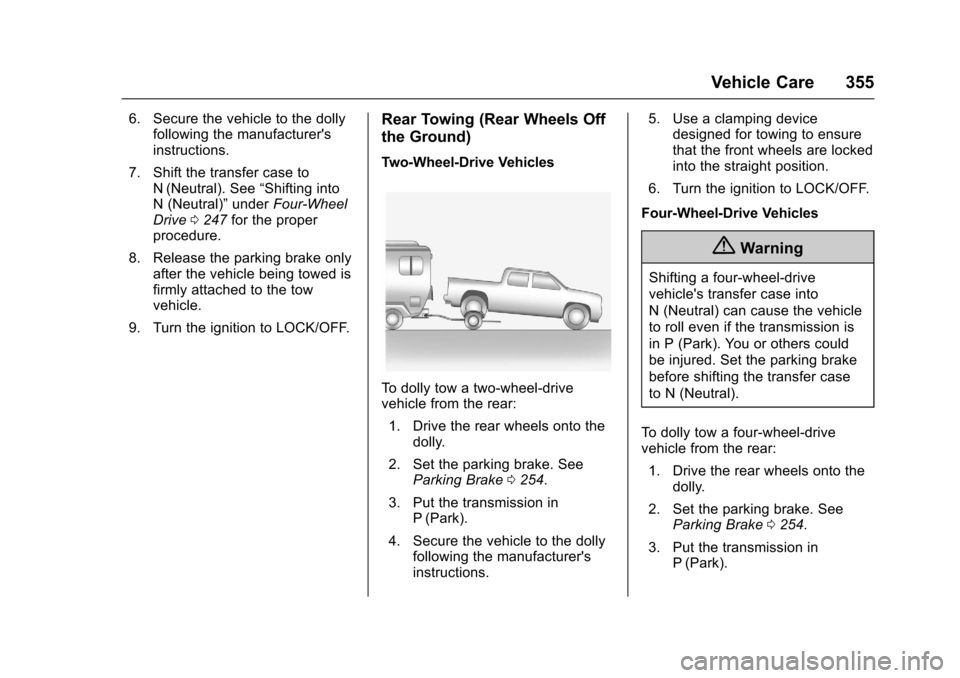
Two-Wheel-Drive Vehicles
To d o l l y t o w a t w o - w h e e l - d r i v evehicle from the rear:
1. Drive the rear wheels onto thedolly.
2. Set the parking brake. SeeParking Brake0254.
3. Put the transmission inP(Park).
4. Secure the vehicle to the dollyfollowing the manufacturer'sinstructions.
5. Use a clamping devicedesigned for towing to ensurethat the front wheels are lockedinto the straight position.
6. Turn the ignition to LOCK/OFF.
Four-Wheel-Drive Vehicles
{Warning
Shifting a four-wheel-drive
vehicle's transfer case into
N(Neutral)cancausethevehicle
to roll even if the transmission is
in P (Park). You or others could
be injured. Set the parking brake
before shifting the transfer case
to N (Neutral).
To d o l l y t o w a f o u r - w h e e l - d r i v evehicle from the rear:
1. Drive the rear wheels onto thedolly.
2. Set the parking brake. SeeParking Brake0254.
3. Put the transmission inP(Park).