2017 CADILLAC XTS steering
[x] Cancel search: steeringPage 240 of 314

Cadillac XTS Owner Manual (GMNA-Localizing-MidEast-10292881) - 2017 -
crc - 7/1/16
VEHICLE CARE 239
To check the power steering fluid:1. Remove the engine cover. Refer toEngine Cover 0227.
2. Wipe the cap and the top of the reservoir clean.
3. Turn the cap counterclockwise and pull it straight up.
4. Wipe the dipstick with a clean rag.
5. Replace the cap and completely tighten it.
6. Remove the cap again and look at the fluid level on the dipstick.
The fluid level should be
between MIN and MAX on the
dipstick.
What to Use
To determine what kind of fluid to
use, see Recommended Fluids and
Lubricants 0295. Always use the
proper fluid.
Washer Fluid
What to Use
When adding windshield washer fluid
to the vehicle, be sure to read the
manufacturer instructions before use.
If you will be operating your vehicle in
an area where the temperature may
fall below freezing, use a fluid that
has sufficient protection against
freezing.
Adding Washer Fluid
The appropriate message will appear
on the Driver Information Center (DIC)
when the fluid level is low. See Washer
Fluid Messages 0143.
Open the cap with the washer symbol
on it. Add washer fluid until the tank
is full. See Engine Compartment
Overview 0224 for reservoir location.
Caution
.
Do not use washer fluid that
contains any type of water
repellent coating. This can
cause the wiper blades to
chatter or skip.
. Do not use engine coolant
(antifreeze) in the windshield
washer. It can damage the
windshield washer system
and paint.
. Do not mix water with
ready-to-use washer fluid.
Water can cause the solution
(Continued)
Page 250 of 314

Cadillac XTS Owner Manual (GMNA-Localizing-MidEast-10292881) - 2017 -
crc - 7/1/16
VEHICLE CARE 249
The vehicle may not be equipped with
all of the fuses, relays, and features
shown.Fuses Usage
1 Transmission control module
2 Engine control module
3 A/C clutch
4 – Fuses Usage
5 Engine control module/Run/Crank
6 Wiper
8 Ignition coils –even
(V6 engine)
9 Ignition coils –odd
(V6 engine) Fuses Usage
10 Engine control module/Switched
battery
11 Post-catalytic converter O2 sensor
heater (V6 engine)/
Mass air flow sensor/
Flex fuel sensor
12 Starter
13 Transmission control module/Chassis
control module/Run/
Crank
14 Right rear heated seat
15 Left rear heated seat
16 –
17 Body Run/Crank
18 Autonet Run/Crank
20 –
21 Rear power windows
22 Sunroof
23 Variable effort steering
Page 251 of 314

Cadillac XTS Owner Manual (GMNA-Localizing-MidEast-10292881) - 2017 -
crc - 7/1/16
250 VEHICLE CARE
FusesUsage
24 Front power windows
25 Retained accessory power
26 ABS pump
27 Electric parking brake
28 Rear window defogger
29 Passive entry/Passive start
30 AWD module
31 Left front heated seat
32 Body control module 6
33 Right front heated seat
34 ABS valves
35 Amplifier
37 Right high-beam headlamp
38 Left high-beam headlamp
41 Brake vacuum assist pump Fuses
Usage
42 Cooling fan K2
44 Headlamp washer
45 Cooling fan K1
46 Cooling fan relay
47 Pre-catalytic converter O2 sensor
heater (V6 engine)/
Canister purge
solenoid
48 Coolant pump
49 Right HID headlamp
50 Left HID headlamp
51 Horn
52 Run/Crank
53 Interior rearview mirror/Run/Crank/
Rear vision camera
54 Run/Crank/HVAC
55 Exterior rearview mirror/Front window
switches
56 Windshield washer
57 Steering column lock Fuses
Usage
60 Heated mirror
62 Massage memory bolster
64 Adaptive forward lighting module
66 Trunk release
67 Chassis control module
69 Regulated voltage control sensor
70 Vent canister solenoid
71 Memory module
Relays Usage
1 A/C clutch
2 Starter
4 Wiper speed
5 Wiper control
7 Engine control module
8 –
9 Cooling fan
Page 253 of 314
Cadillac XTS Owner Manual (GMNA-Localizing-MidEast-10292881) - 2017 -
crc - 7/1/16
252 VEHICLE CARE
FusesUsage
14 Diagnostic link connector
15 Airbag AOS
16 Glove box
17 HVAC controller
18 Logistics
19 –
20 Telematics (OnStar)
21 CGM
22 Steering wheel controls/Backlight
23 Body control module 3
24 Body control module 2
25 Power steering column
26 AC DC inverter
Relays Usage
R1 Glove box
R2 Logistics Relays
Usage
R3 Retained accessory power
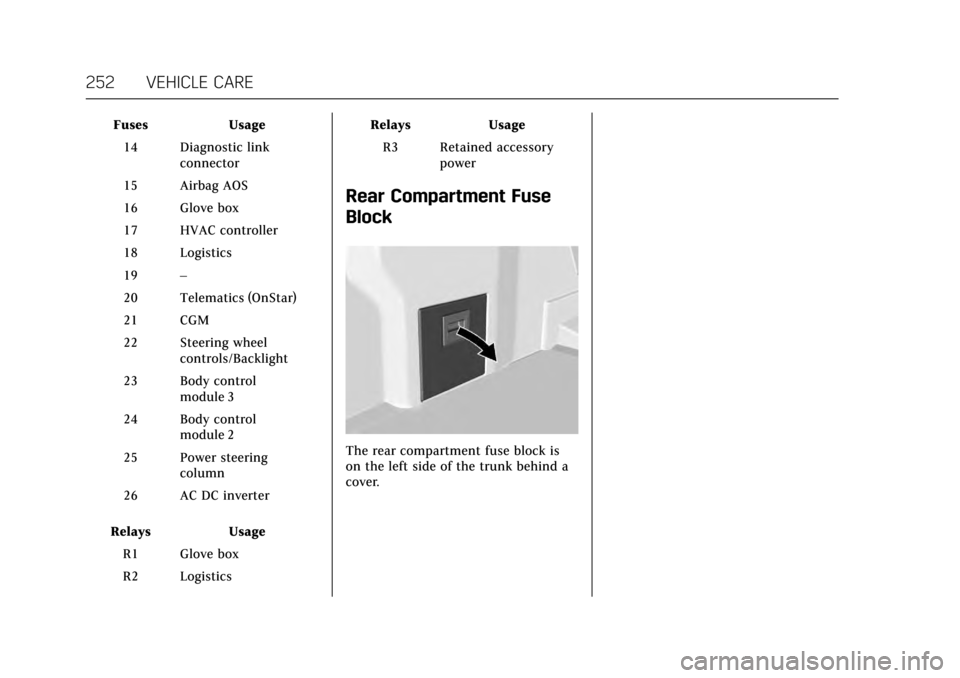
Rear Compartment Fuse
Block
The rear compartment fuse block is
on the left side of the trunk behind a
cover.
Page 262 of 314

Cadillac XTS Owner Manual (GMNA-Localizing-MidEast-10292881) - 2017 -
crc - 7/1/16
VEHICLE CARE 261
service if the TPMS malfunction light
and DIC message comes on and
stays on.
TPMS Sensor Matching Process
Each TPMS sensor has a unique
identification code. The identification
code needs to be matched to a new
tire/wheel position after rotating the
vehicle’s tires or replacing one or more
of the TPMS sensors. The TPMS
sensor matching process should also
be performed after replacing a spare
tire with a road tire containing the
TPMS sensor. The malfunction light
and the DIC message should go off at
the next ignition cycle. The sensors
are matched to the tire/wheel
positions, using a TPMS relearn tool,
in the following order: driver side
front tire, passenger side front tire,
passenger side rear tire, and driver
side rear. See your dealer for service or
to purchase a relearn tool.
There are two minutes to match the
first tire/wheel position, and
five minutes overall to match all four
tire/wheel positions. If it takes longer,
the matching process stops and must
be restarted.The TPMS sensor matching process is:
1. Set the parking brake.
2. Place the vehicle power mode in ON/RUN/START. See Ignition
Positions 0177.
3. Make sure the Tire Pressure info display option is turned on. The
info displays on the DIC can be
turned on and off through the
Settings menu. See Driver
Information Center (DIC) 0128.
4. Use the five-way DIC control on the right side of the steering
wheel to scroll to the Tire
Pressure screen under the DIC
info page. See Driver Information
Center (DIC) 0128.
5. Press and hold SEL located in the center of the five-way DIC
control.
The horn sounds twice to signal
the receiver is in relearn mode
and the TIRE LEARNING ACTIVE
message displays on the DIC
screen.
6. Start with the driver side front tire. 7. Place the relearn tool against the
tire sidewall, near the valve stem.
Then press the button to activate
the TPMS sensor. A horn chirp
confirms that the sensor
identification code has been
matched to this tire and wheel
position.
8. Proceed to the passenger side front tire, and repeat the
procedure in Step 7.
9. Proceed to the passenger side rear tire, and repeat the
procedure in Step 7.
10. Proceed to the driver side rear tire, and repeat the procedure in
Step 7. The horn sounds two
times to indicate the sensor
identification code has been
matched to the driver side rear
tire, and the TPMS sensor
matching process is no longer
active. The TIRE LEARNING
ACTIVE message on the DIC
display screen goes off.
11. Shut the ignition off.
Page 268 of 314

Cadillac XTS Owner Manual (GMNA-Localizing-MidEast-10292881) - 2017 -
crc - 7/1/16
VEHICLE CARE 267
Warning (Continued)
size combination and road
conditions. Follow that
manufacturer's instructions. To
avoid vehicle damage, drive slow
and readjust or remove the traction
device if it contacts the vehicle. Do
not spin the wheels. If traction
devices are used, install them on
the front tires.
If a Tire Goes Flat
It is unusual for a tire to blow out
while driving, especially if the tires are
maintained properly. SeeTires0254.
If air goes out of a tire, it is much
more likely to leak out slowly. But if
there ever is a blowout, here are a few
tips about what to expect and what
to do:
If a front tire fails, the flat tire creates
a drag that pulls the vehicle toward
that side. Take your foot off the
accelerator pedal and grip the steering
wheel firmly. Steer to maintain lane
position, and then gently brake to a
stop, well off the road, if possible. A rear blowout, particularly on a
curve, acts much like a skid and may
require the same correction as used in
a skid. Stop pressing the accelerator
pedal and steer to straighten the
vehicle. It may be very bumpy and
noisy. Gently brake to a stop, well off
the road, if possible.
{Warning
Driving on a flat tire will cause
permanent damage to the tire.
Re-inflating a tire after it has been
driven on while severely
underinflated or flat may cause a
blowout and a serious crash. Never
attempt to re-inflate a tire that has
been driven on while severely
underinflated or flat. Have your
dealer or an authorized tire service
center repair or replace the flat tire
as soon as possible.
{Warning
Lifting a vehicle and getting under
it to do maintenance or repairs is
dangerous without the appropriate
safety equipment and training. If a
jack is provided with the vehicle, it
is designed only for changing a flat
tire. If it is used for anything else,
you or others could be badly injured
or killed if the vehicle slips off the
jack. If a jack is provided with the
vehicle, only use it for changing a
flat tire.
If a tire goes flat, avoid further tire
and wheel damage by driving slowly
to a level place, well off the road,
if possible. Turn on the hazard
warning flashers. See Hazard Warning
Flashers 0154.
{Warning
Changing a tire can be dangerous.
The vehicle can slip off the jack and
roll over or fall causing injury or
(Continued)
Page 283 of 314

Cadillac XTS Owner Manual (GMNA-Localizing-MidEast-10292881) - 2017 -
crc - 7/1/16
282 VEHICLE CARE
Brake System
Visually inspect brake lines and hoses
for proper hook-up, binding, leaks,
cracks, chafing, etc. Inspect disc brake
pads for wear and rotors for surface
condition. Inspect drum brake linings/
shoes for wear or cracks. Inspect all
other brake parts.
Steering, Suspension, and
Chassis Components
Visually inspect steering, suspension,
and chassis components for damaged,
loose, or missing parts or signs of
wear at least once a year.
Inspect power steering for proper
attachment, connections, binding,
leaks, cracks, chafing, etc.
Visually check constant velocity joint
boots and axle seals for leaks.
Body Component Lubrication
Lubricate all key lock cylinders, hood
hinges, liftgate hinges, and the steel
fuel door hinges, unless the
components are plastic. Applying
silicone grease on weatherstrips with aclean cloth will make them last
longer, seal better, and not stick or
squeak.
Underbody Maintenance
At least twice a year, spring and fall,
use plain water to flush any corrosive
materials from the underbody. Take
care to thoroughly clean any areas
where mud and other debris can
collect.
Do not directly power wash the
transfer case and/or front/rear axle
output seals. High pressure water can
overcome the seals and contaminate
the fluid. Contaminated fluid will
decrease the life of the transfer case
and/or axles and should be replaced.
Sheet Metal Damage
If the vehicle is damaged and requires
sheet metal repair or replacement,
make sure the body repair shop
applies anti-corrosion material to
parts repaired or replaced to restore
corrosion protection.
Original manufacturer replacement
parts will provide the corrosion
protection while maintaining the
vehicle warranty.
Finish Damage
Quickly repair minor chips and
scratches with touch-up materials
available from your dealer to avoid
corrosion. Larger areas of finish
damage can be corrected in your
dealer's body and paint shop.
Chemical Paint Spotting
Airborne pollutants can fall upon and
attack painted vehicle surfaces
causing blotchy, ring-shaped
discolorations, and small, irregular
dark spots etched into the paint
surface. See
“Finish Care”previously in
this section.
Interior Care
To prevent dirt particle abrasions,
regularly clean the vehicle's interior.
Immediately remove any soils.
Newspapers or dark garments can
transfer color to the vehicle’s interior.
Use a soft bristle brush to remove
dust from knobs and crevices on the
instrument cluster. Using a mild soap
solution, immediately remove hand
Page 290 of 314

Cadillac XTS Owner Manual (GMNA-Localizing-MidEast-10292881) - 2017 -
crc - 7/1/16
SERVICE AND MAINTENANCE 289
oil life system is reset accidentally,
service the vehicle within 5 000 km/
3,000 mi since the last service. Reset
the oil life system when the oil is
changed. SeeEngine Oil Life
System 0230.
Tire Rotation and Required
Services Every 12 000 km/
7,500 mi
Rotate the tires, if recommended for
the vehicle, and perform the following
services. See Tire Rotation0262.
. Check engine oil level and oil
life percentage. If needed, change
engine oil and filter, and reset oil
life system. See Engine Oil0228
and Engine Oil Life System 0230.
. Check engine coolant level. See
Engine Coolant 0234.
. Check windshield washer fluid
level. See Washer Fluid 0239.
. Visually inspect windshield wiper
blades for wear, cracking,
or contamination. See Exterior
Care 0278. Replace worn or
damaged wiper blades. See Wiper
Blade Replacement 0244. .
Check tire inflation pressures. See
Tire Pressure 0256.
. Inspect tire wear. See Tire
Inspection 0262.
. Visually check for fluid leaks.
. Inspect engine air cleaner filter.
See Engine Air Cleaner/Filter 0231.
. Inspect brake system. See Exterior
Care 0278.
. Visually inspect steering,
suspension, and chassis
components for damaged, loose,
or missing parts or signs of wear.
See Exterior Care 0278.
. Check restraint system
components. See Safety System
Check 068.
. Visually inspect fuel system for
damage or leaks.
. Visually inspect exhaust system
and nearby heat shields for loose
or damaged parts.
. Lubricate body components. See
Exterior Care 0278.
. Check starter switch. See Starter
Switch Check 0243. .
Check automatic transmission
shift lock control function. See
Automatic Transmission Shift Lock
Control Function Check 0243.
. Check parking brake and
automatic transmission park
mechanism. See Park Brake and
P (Park) Mechanism Check 0243.
. Check accelerator pedal for
damage, high effort, or binding.
Replace if needed.
. Visually inspect gas strut for signs
of wear, cracks, or other damage.
Check the hold open ability of the
strut. See your dealer if service is
required.
. Inspect sunroof track and seal,
if equipped. See Sunroof047.