2017 CADILLAC ATS ECU
[x] Cancel search: ECUPage 185 of 335

Cadillac ATS/ATS-V Owner Manual (GMNA-Localizing-MidEast-10287885) -
2017 - crc - 6/16/16
184 DRIVING AND OPERATING
{Warning
Things inside the vehicle can
strike and injure people in a
sudden stop or turn, or in a
crash.
.Put things in the cargo
area of the vehicle. In the
cargo area, put them as far
forward as possible. Try to
spread the weight evenly.
.Never stack heavier things,
like suitcases, inside the
vehicle so that some of
them are above the tops of
the seats.
.Do not leave an unsecured
child restraint in the
vehicle.
.Secure loose items in the
vehicle.
.Do not leave a seat folded
down unless needed.
Starting and Operating
New Vehicle Break-In
Follow these recommended guidelines
during the first 2 414 km (1,500 mi) of
driving this vehicle. Parts have a
break-in period and performance will
be better in the long run.
For the first 2 414 km (1,500 mi):
. Avoid full throttle starts and
abrupt stops.
. Do not exceed 4000 engine rpm.
. Avoid driving at any one constant
speed, fast or slow.
. Avoid downshifting to brake or
slow the vehicle when the engine
speed will exceed 4000 rpm.
. Check engine oil with every
refueling and add if necessary. Oil
and fuel consumption may be
higher than normal during the
first 2 414 km (1,500 mi).
. New brake linings also need a
break-in period. Avoid making
hard stops during the first 322 km (200 mi). This is
recommended every time brake
linings are replaced.Composite Materials
This vehicle may be equipped with
parts containing carbon fiber,
sheet-molding compound or other
composite materials. Dealer-installed
accessories may also contain
composite materials. These parts and
accessories may include the splitter or
rocker extensions.
{Warning
Exposed edges of parts containing
carbon fiber and other composite
materials can be sharp. Contact
with these parts could result in
injury. Use caution to avoid
contacting these parts, including
when washing the vehicle. If the
parts are damaged, replace the
parts promptly with replacements
from your dealer.
Page 246 of 335

Cadillac ATS/ATS-V Owner Manual (GMNA-Localizing-MidEast-10287885) -
2017 - crc - 6/16/16
VEHICLE CARE 245
reason for fluid loss. If a leak occurs,
take the vehicle to your dealer and
have it repaired as soon as possible.
The vehicle is not equipped with a
transmission fluid level dipstick.
There is a special procedure for
checking and changing the
transmission fluid. Because this
procedure is difficult, this should be
done at the dealer. Contact your dealer
for additional information.
Change the fluid and filter at the
intervals listed inMaintenance
Schedule 0307, and be sure to use the
fluid listed in Recommended Fluids and
Lubricants 0314.
Engine Air Cleaner/Filter
The engine air cleaner/filter is in the
engine compartment on the driver
side of the vehicle. See Engine
Compartment Overview 0234 for
location.
When to Inspect the Engine Air
Cleaner/Filter
For intervals on changing and
inspecting the engine air cleaner/filter,
see Maintenance Schedule 0307.
How to Inspect the Engine Air
Cleaner/Filter
Do not start the engine or have the
engine running with the engine air
cleaner/filter housing open. Before
removing the engine air cleaner/filter,
make sure that the engine air cleaner/
filter housing and nearby components
are free of dirt and debris. Remove the
engine air cleaner/filter. Lightly tap
and shake the engine air cleaner/filter
(away from the vehicle), to release
loose dust and dirt. Inspect the engine
air cleaner/filter for damage, and
replace if damaged. Do not clean the
engine air cleaner/filter or
components with water or
compressed air. To inspect or replace the air cleaner/
filter:
2.0L L4 Engine (LTG) Shown, 2.5L L4
Engine (LCV), and 3.6L V6 Engine (LGX) Similar
1. Remove the four screws and lift the cover out of the assembly.
2. Inspect or replace the engine air cleaner/filter.
3. Lower the cover and secure with the four screws.
Page 247 of 335

Cadillac ATS/ATS-V Owner Manual (GMNA-Localizing-MidEast-10287885) -
2017 - crc - 6/16/16
246 VEHICLE CARE
3.6L V6 Twin Turbo Engine (LF4)
1. Remove the six screws and lift the cover out of the assembly.
2. Inspect or replace the engine aircleaner/filters. The filters can be
removed from the top cover by
pressing the buttons.
3. Lower the cover and secure with the six screws.
{Warning
Operating the engine with the air
cleaner/filter off can cause you or
others to be burned. The air cleaner
not only cleans the air; it helps to
stop flames if the engine backfires.
Use caution when working on the
engine and do not drive with the air
cleaner/filter off.
Caution
If the air cleaner/filter is off, dirt
can easily get into the engine,
which could damage it. Always have
the air cleaner/filter in place when
you are driving.
Cooling System (Engine)
The cooling system allows the engine
to maintain the correct working
temperature.
2.0L L4 Engine (LTG)
1. Engine Coolant Surge Tank
and Pressure Cap
2. Engine Cooling Fan (Out of View)
Page 252 of 335

Cadillac ATS/ATS-V Owner Manual (GMNA-Localizing-MidEast-10287885) -
2017 - crc - 6/16/16
VEHICLE CARE 251
3. Fill the surge tank top chamberwith the proper DEX-COOL
coolant mixture to the bottom of
the fill neck. The top chamber
needs to be completely full. Fill
the surge tank bottom chamber
through the service port to
approximately half.
4. With the coolant surge tank pressure cap off and the surge
tank service port cap open, start
the engine and let it run until
you can feel the upper radiator
hose getting hot. Watch out for
the engine cooling fan. By this time, the coolant level
inside the coolant surge tank top
chamber may be lower. If the
level is lower, add more of the
proper DEX-COOL coolant
mixture to the surge tank top
chamber until the level reaches
the bottom of the fill neck.
5. Replace the surge tank pressure cap tightly and close the surge
tank service port cap.Caution
If the pressure cap is not tightly
installed, coolant loss and possible
engine damage may occur. Be sure
the cap is properly and tightly
secured.
Check the level in the surge tank top
and bottom chambers when the
cooling system has cooled down.
If the coolant is not at the proper
levels, repeat Steps 1-3 and reinstall
the pressure cap and close the service
port. If the coolant still is not at the
proper levels when the system cools
down again, see your dealer.
Engine Overheating
The vehicle has several indicators to
warn of the engine overheating.
There is an engine coolant
temperature gauge and an engine
coolant temperature warning light on
the instrument cluster. See Engine
Coolant Temperature Gauge 0111 and
Engine Coolant Temperature Warning
Light 0119. The vehicle may also
display a message on the Driver
Information Center (DIC). See Engine
Cooling System Messages 0129.
If the decision is made not to lift the
hood when this warning appears, get
service help right away.
If the decision is made to lift the
hood, make sure the vehicle is parked
on a level surface.
Then check to see if the engine
cooling fan is running. If the engine is
overheating, the fan should be
running. If it is not, do not continue
to run the engine. Have the vehicle
serviced.
Page 270 of 335

Cadillac ATS/ATS-V Owner Manual (GMNA-Localizing-MidEast-10287885) -
2017 - crc - 6/16/16
VEHICLE CARE 269
FusesUsage
16 Trunk release
*17 Run relay
*18 Logistics relay
*19 –
20 Rear window defogger relay
21 Mirror window module
22 –
23 Canister vent
24 Body control module 2
*25 Rear vision camera
*26 Front ventilated seats
*27 SBZA/LDW/EOCM
*28 Trailer/Sunshade
*29 Rear heated seats
*30 Semi-active damping system
*31 Transfer case control module/Rear control
drive module Fuses
Usage
32 Theft module/ Universal garage door
opener/Rain sensor
*33 UPA
*34 Radio/DVD
*35 Exhaust valve
*36 Trailer 37 Fuel pump/Fuel system control
module
*38 Fuel pump 39 –
40 Run/Crank
*41 Fuel pump prime
*42 Memory seat module 43 Body control module 3
44 –
45 Battery regulated voltage control
46 Engine control module battery Fuses
Usage
47 –
48 –
*49 Trailer module 50 Door lock security
51 Rear closure release
52 Rear closure 2
53 –
54 Door lock security
55 –
*56 Fuel door
* Optional
Page 285 of 335

Cadillac ATS/ATS-V Owner Manual (GMNA-Localizing-MidEast-10287885) -
2017 - crc - 6/16/16
284 VEHICLE CARE
Warning (Continued)
and cause a crash. When replacing
wheels, use a new GM original
equipment wheel.
Tire Chains
{Warning
If the vehicle has 225/40R18, 225/
40RF18, 255/35RF18, 225/35R19,
or 255/30R19 size tires, do not use
tire chains. There is not enough
clearance. Tire chains used on a
vehicle without the proper amount
of clearance can cause damage to
the brakes, suspension, or other
vehicle parts. The area damaged by
the tire chains could cause loss of
control and a crash. Use another
type of traction device only if its
manufacturer recommends it for
the vehicle's tire size combination
and road conditions. Follow that
manufacturer's instructions. To(Continued)
Warning (Continued)
avoid vehicle damage, drive slow
and readjust or remove the traction
device if it contacts the vehicle. Do
not spin the wheels. If traction
devices are used, install them on
the rear tires.
Caution
If the vehicle is equipped with a tire
size other than 225/40R18, 225/
40RF18, 255/35RF18, 225/35R19,
or 255/30R19, use tire chains only
where legal and only when
necessary. Use low profile chains
that add no more than 12 mm
thickness to the tire tread and inner
sidewall. Use chains that are the
proper size for the tires. Install
them on the tires of the rear axle.
Don't use chains on the tires of the
front axle. Tighten them as tightly
as possible with the ends securely
fastened. Drive slowly and follow(Continued)
Caution (Continued)
the chain manufacturer's
instructions. If the chains contact
the vehicle, stop and retighten
them. If the contact continues, slow
down until it stops. Driving too fast
or spinning the wheels with chains
on will damage the vehicle.
If a Tire Goes Flat
If the vehicle has run-flat tires, there
is no need to stop on the side of the
road to change a flat tire. See Run-Flat
Tires 0271.
{Warning
Special tools and procedures are
required to service a run-flat tire.
If these special tools and
procedures are not used, injury or
vehicle damage may occur. Always
be sure the proper tools and
procedures, as described in the
service manual, are used.
Page 296 of 335

Cadillac ATS/ATS-V Owner Manual (GMNA-Localizing-MidEast-10287885) -
2017 - crc - 6/16/16
VEHICLE CARE 295
Caution
If the jumper cables are connected
or removed in the wrong order,
electrical shorting may occur and
damage the vehicle. The repairs
would not be covered by the vehicle
warranty. Always connect and
remove the jumper cables in the
correct order, making sure that the
cables do not touch each other or
other metal.
Jumper Cable Removal
Reverse the sequence exactly when
removing the jumper cables.
After starting the disabled vehicle and
removing the jumper cables, allow it
to idle for several minutes.
Towing the Vehicle
Caution
Incorrectly towing a disabled
vehicle may cause damage. The
damage would not be covered by
the vehicle warranty.
Do not lash or hook to suspension
components. Use the proper straps
around the tires to secure the
vehicle.
Have the vehicle towed on a flatbed
car carrier. A wheel lift tow truck
could damage the vehicle.
Due to low ramp angles on the
V-Series only, use care when loading
the vehicle onto a flatbed carrier.
Front spring spacers were provided for
lifting the front suspension if more
clearance is necessary when towing.
Consult your dealer or a professional
towing service if the disabled vehicle
must be towed.
If the vehicle is equipped with tow
eye, only use the tow eye to pull the
vehicle onto a flatbed car carrier from
a flat road surface. Do not use the tow
eye to pull the vehicle from snow,
mud or sand.
Page 298 of 335
Cadillac ATS/ATS-V Owner Manual (GMNA-Localizing-MidEast-10287885) -
2017 - crc - 6/16/16
VEHICLE CARE 297
Caution
If the vehicle is towed with all four
wheels on the ground, the
drivetrain components could be
damaged. The repairs would not be
covered by the vehicle warranty. Do
not tow the vehicle with all four
wheels on the ground.
The vehicle was not designed to be
towed with all four wheels on the
ground. If a rear-wheel-drive vehicle
must be towed, a dolly or a trailer
should be used. See “Dolly Towing”
following.
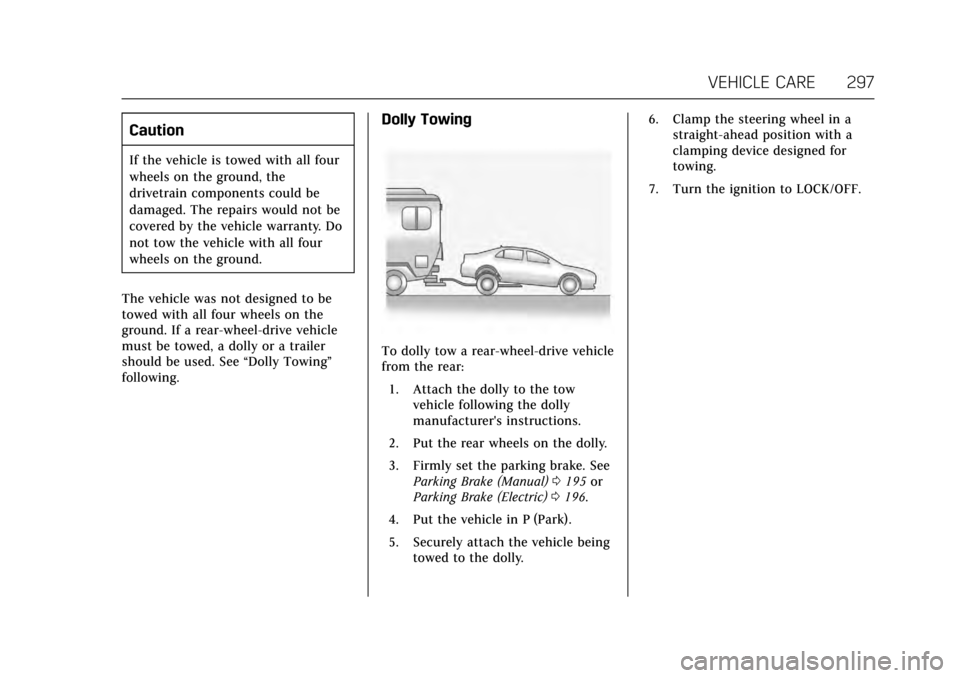
Dolly Towing
To dolly tow a rear-wheel-drive vehicle
from the rear:
1. Attach the dolly to the tow vehicle following the dolly
manufacturer's instructions.
2. Put the rear wheels on the dolly.
3. Firmly set the parking brake. See Parking Brake (Manual) 0195 or
Parking Brake (Electric) 0196.
4. Put the vehicle in P (Park).
5. Securely attach the vehicle being towed to the dolly. 6. Clamp the steering wheel in a
straight-ahead position with a
clamping device designed for
towing.
7. Turn the ignition to LOCK/OFF.