2017 AUDI TT ROADSTER fuel
[x] Cancel search: fuelPage 259 of 314
a, a, ... N
" N ... 0
" V, a:,
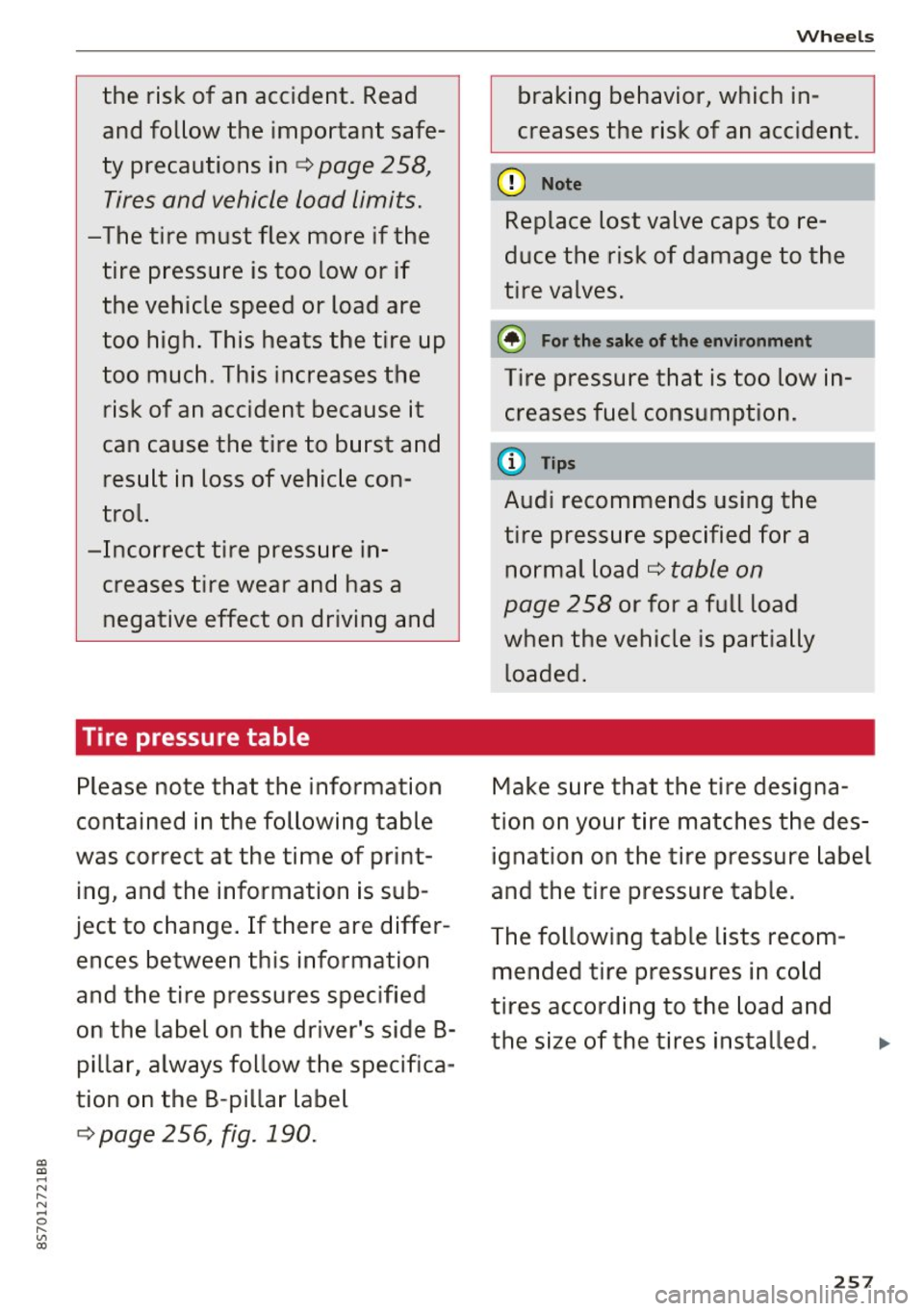
the risk of an accident. Read
and follow the important safe
ty precautions inc:::>
page 258 ,
Tires and vehicle load limits.
-The tire must flex more if the tire pressure is too low or if
the vehicle speed or load are
too high . This heats the tire up
too much . This increases the
risk of an accident because it
can cause the tire to burst and result in loss of vehicle con
trol.
- Incorrect tire pressure in
creases tire wear and has a negative effect on driving and
Tire pressure table
Please note that the information
contained in the following table
was correct at the time of print ing , and the information is sub
ject to change . If there are differ
ences between this information
and the tire pressures specified
on the label on the driver's side B
pillar, always follow the specifica
tion on the B-pillar label
~ page 256, fig. 190.
Wheels
braking behavior, which in
creases the risk of an accident.
Replace lost valve caps to re
duce the risk of damage to the
tire valves.
Tire pressure that is too low in creases fuel consumption.
Audi recommends using the
tire pressure specified for a
normal load c:::>
table on
page 258
or for a full load
when the vehicle is partially
loaded .
Make sure that the tire designa
tion on your tire matches the des
ignation on the tire pressure label
and the tire pressure table .
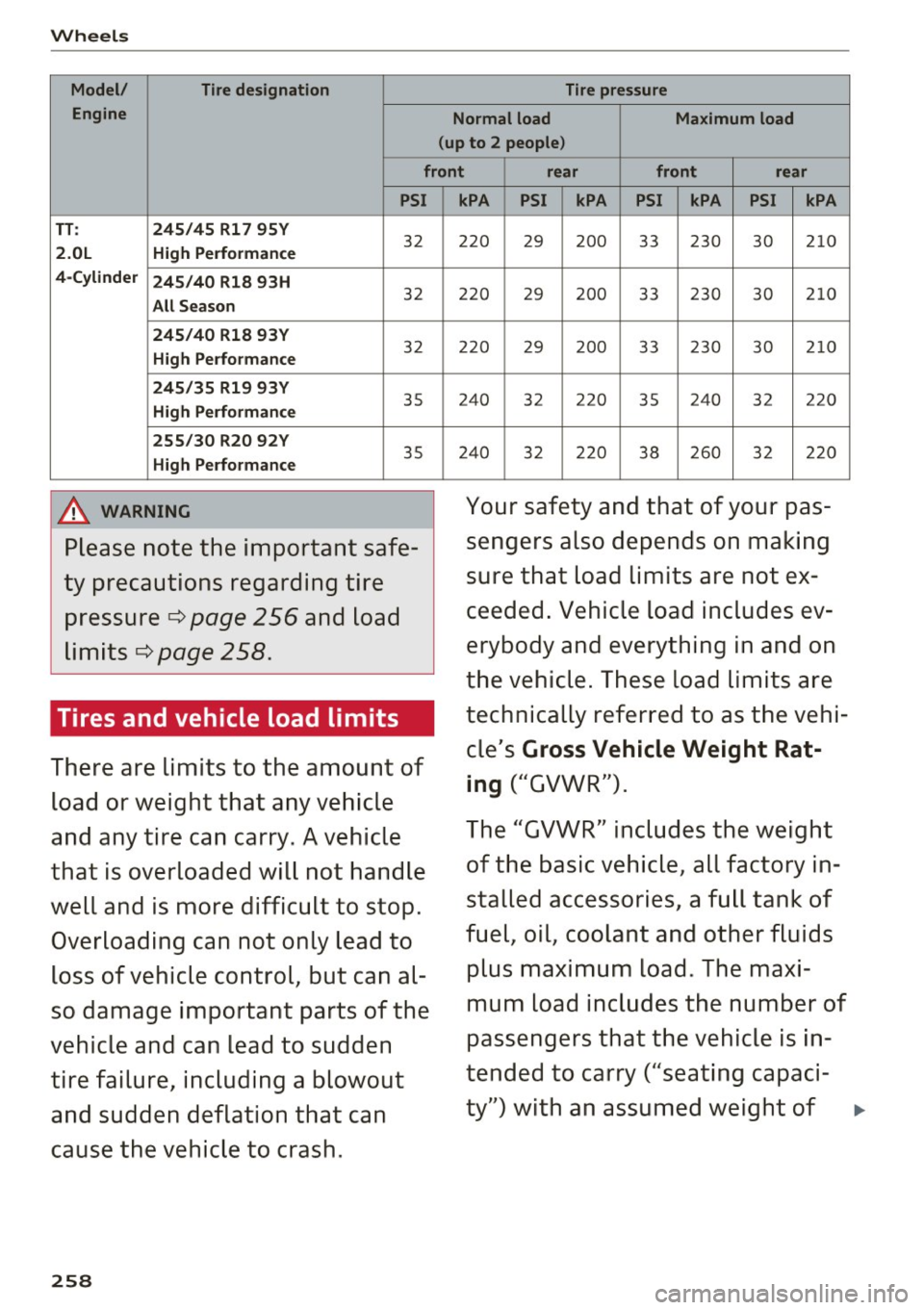
The following table lists recom
mended tire pressures in cold
tires according to the load and
the size of the tires installed .
257
Page 260 of 314
Wheels
Model/ Tire designation Tire pressure
Engine Normal load Maximum load
(up to 2 people)
front rear front rear
PSI
TT : 245/45 R17 95Y
2.0L High Performance
32
4-Cylinder 245/40 R18 93H
All Season
32
245/40 R18 93Y
High Performance 32
245/35 R19 93Y
High Performance
35
255/30 R20 92Y
High Performance
35
A WARNING
Please note the important safe
ty precautions regarding tire pressure ¢
page 256 and load
limits¢
page 258.
Tires and vehicle load limits
There are limits to the amount of
load or weight that any vehicle
and any tire can carry. A vehicle
that is overloaded will not handle
well and is more difficult to stop .
Overloading can not only lead to
loss of vehicle control, but can al
so damage important parts of the
vehicle and can lead to sudden
tire failure, including a blowout and sudden deflation that can
cause the vehicle to crash.
258
kPA PSI kPA
PSI kPA PSI kPA
220 29 200 33 230 30 210
220 29 200 33 230 30 210
220 29 200 33 230 30 210
240 32 220 35 240
32 220
240 32 220 38 260 32 220
Your safety and that of your pas
sengers also depends on making
sure that load limits are not ex
ceeded. Vehicle load includes ev
erybody and everything in and on
the vehicle. These load limits are
technically referred to as the vehi
cle's
Gross Vehicle Weight Rat
ing
("GVWR").
The "GVWR" includes the weight
of the basic vehicle, all factory in
stalled accessories, a full tank of
fuel, oil, coolant and other fluids plus maximum load. The maxi
mum load includes the number of
passengers that the vehicle is in
tended to carry ("seating capaci-
ty") with an assumed weight of ..,
Page 263 of 314
co
co
.... N
" N .... 0
" "' c:o
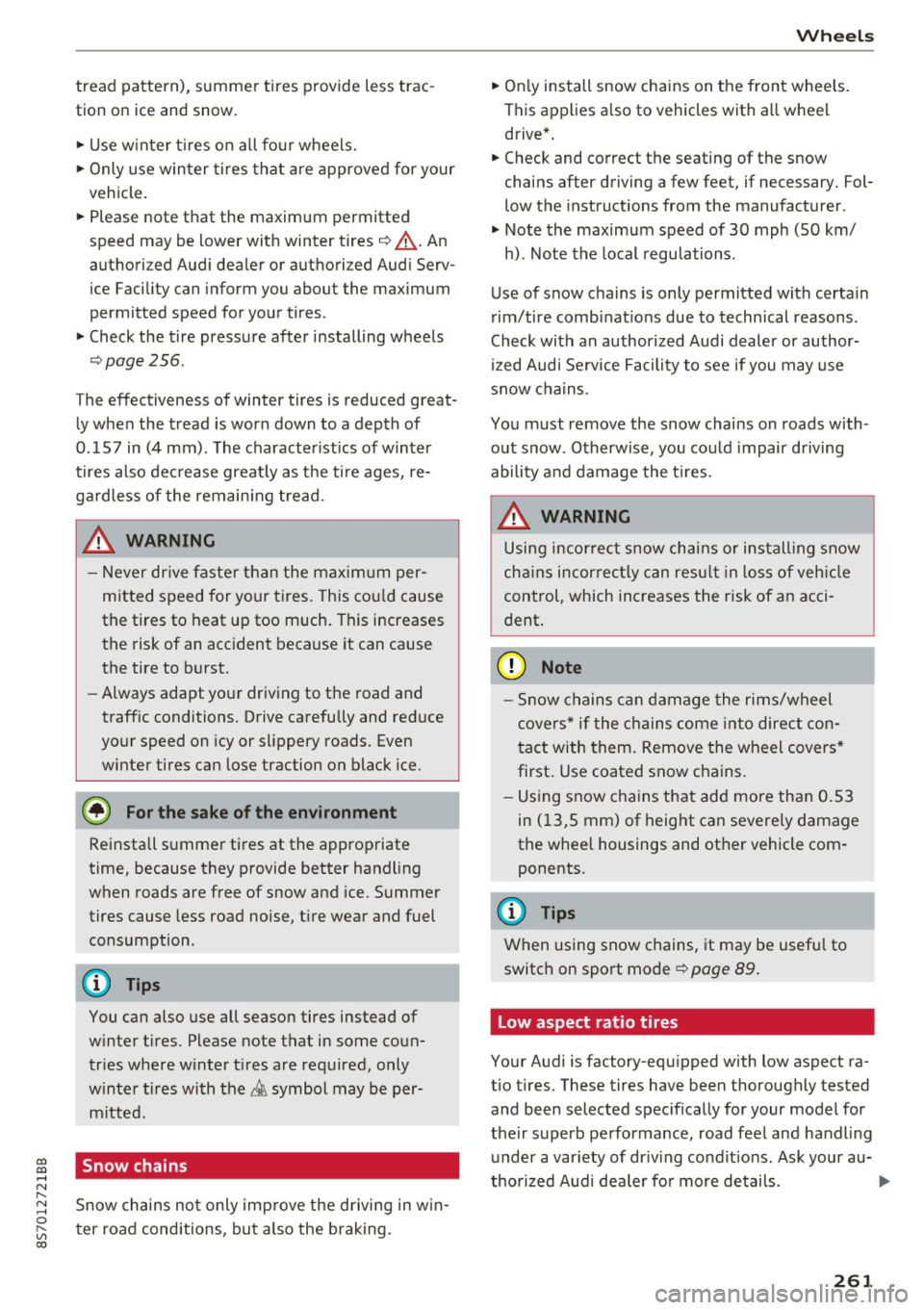
tread pattern), summer tires provide less trac
tion on ice and snow.
.,. Use w inter tires on a ll fo ur wheels.
.,. Only use win ter tires that are approved for your
vehicle.
... Please note that the maximum permitted
speed may be lower with winter tires ¢,& .An
authori zed Aud i dealer or authori zed Aud i Serv
ice F acility can inform you about the maximum
permitted speed for your tires .
... Check the tire pressure after installing wheels
¢ page 256 .
The effectiveness of winter tires is reduced great
ly when the tread is worn down to a depth of
0 .1 57 in (4 mm) . The character istics of winter
tires a lso decrease great ly as t he tire ages, re
ga rdless of the remaining tread .
_& WARNING
-Never dr ive faste r than the maxim um per
mitted speed for your t ires. This cou ld cause
the tires to heat up too much . Th is increases
the risk of an acc ident because it can cause
the tire to burst.
- Always adapt yo ur dr iv ing to the road and
traff ic conditions. Drive carefully and red uce
your speed on icy or slippery roads. Even
winter tires can lose traction on black ice.
@ For the sake of the environment
Reinstall summer ti res at the approp riate
time, because they provide better handling
when roads are free of snow and ice. Summer
tires cause less road noise, t ire wear and fuel
consumption .
You can also use all season tires instead of
w inter t ires . Please note that in some coun
tries where w inter t ires are required, only
w inter t ires with the
& symbol may be per
m itted.
Snow chains
-
Snow chains no t only imp rove the d riving in w in
ter road conditions, but also the braking.
Wh eel s
... On ly install snow chains on the front wheels.
This applies a lso to vehicles with a ll wheel
drive* .
... Check and correct the seating of the snow
chains after driving a few feet, if necessary. Fol
low the instructions from the manufacturer .
... Note the maximum speed of 30 mph (SO km/
h) . Note the local regulations .
Use of snow cha ins is only permitted with certa in
rim/tire comb inat ions due to technical reasons .
Check with an authorized Audi dealer or author
i zed Audi Se rvice Facility to see if you may use
snow c hains.
You must remove the snow chains on roads with out snow . O therwise, you co uld impair driving
ability a nd damage the t ires .
_& WARNING
Using incor rect snow chains or install ing snow
ch ains incor rec tly c an resu lt in loss of veh icle
control, which increases the risk of an acci
dent .
(D Note
-Snow chains can damage the rims/wheel
cove rs* if the chains come into direct con
tact with them . Remove the wheel covers*
first. Use coated snow chains.
- Us ing snow chains that add more tha n O.S3
in (13,S mm) of height can severe ly damage
the whee l housings and other vehicle com
ponents.
(D Tips
When using snow chains, it may be usefu l to
switch on sport mode ¢
page 89.
Low aspect ratio tires
Your Audi is factory-equ ipped with low aspect ra
tio t ires . These tires have been thoroughly tested
and been selected spec ifically for your model for
the ir superb performance, road feel and handl ing
under a var iety of dr iv ing condit ions. Ask your au-
thorized Audi dea le r fo r more details . .,.
261
Page 265 of 314

co
co
.... N
" N .... 0
" "' c:o
Traction
The traction grades, from highest to lowest, are
AA, A, B and
C. Those grades represent the tire's
ability to stop on wet pavement as measured un
der controlled conditions on specified govern
ment test surfaces of asphalt and concrete . A tire
marked C may have poor traction performance
¢ _& .
Temperature
The temperature grades are A (the highest), B ,
and
C, representing the tire's resistance to the
generation of heat and its ability to dissipate
heat when tested under controlled conditions on
a specified indoor laboratory test wheel.
Sustained high temperature can cause the mate rial of the tire to degenerate and reduce tire life,
and excessive temperature can lead to sudden
tire failure
c:> .& .
The grade C corresponds to a level of perform
ance which all passenger car tires must meet un
der the Federal Motor Vehicle Safety Standard No.
109 . Grades Band A represent higher levels
of performance on the laboratory test wheel than
the minimum required by law.
A WARNING
The traction grade assigned to this tire is
based on straight -ahead braking traction
tests, and does not include acceleration, cor
nering, hydroplaning or peak traction charac
teristics.
A WARNING
The temperature grade for this tire is estab
lished for a tire that is properly inflated and
not overloaded . Excessive speed, underinfla
tion, or excessive loading, either separately or
in combination, can cause heat buildup and
possible tire failure.
A WARNING
Temperature grades apply to tires that are properly inflated and not over or underinflat
ed.
Wheels
Tire pressure monitoring system
ill General notes
Each tire, including the spare (if provided),
should be checked monthly when cold and inflat
ed to the inflation pressure recommended by the
vehicle manufacturer on the vehicle placard or
tire inflation pressure label. (If your vehicle has
tires of a different size than the size ind icated on
the vehicle placard or tire inflation pressure la bel, you should determine the proper tire infla
tion pressure for those tires).
As an added safety feature, your vehicle has been equipped with a tire pressure monitoring system
(TPMS) that illuminates a low tire pressure tell
tale when one or more of your tires is significant
ly under-inflated. Accordingly, when the low tire
pressure telltale illuminates, you should stop and
check your tires as soon as possible, and inflate
them to the proper pressure . Driving on a signifi
cantly under-inflated tire causes the tire to over
heat and can lead to tire failure . Under-inflation
also reduces fuel efficiency and tire tread life,
and may affect the vehicle's handling and stop
ping ability .
Please note that the TPMS is not a substitute for
proper tire maintenance, and it is the driver's re
sponsibility to maintain correct tire pressure, even if under-inflation has not reached the level
to trigger illumination of the TPMS low tire pres
sure telltale .
Your vehicle has also been equipped with a TPMS malfunction indicator to indicate when the sys
tem is not operating properly . The TPMS mal
function indicator is combined with the low tire
pressure telltale. When the system detects a
malfunction, the telltale will flash for approxi
mately one minute and then remain continuously
illuminated. This sequence will continue upon
subsequent vehicle start-ups as long as the mal
function exists.
When the malfunction indicator is illuminated,
the system may not be able to detect or signal low tire pressure as intended. TPMS malfunctions
may occur for a variety of reasons, including the .,.
263
Page 270 of 314
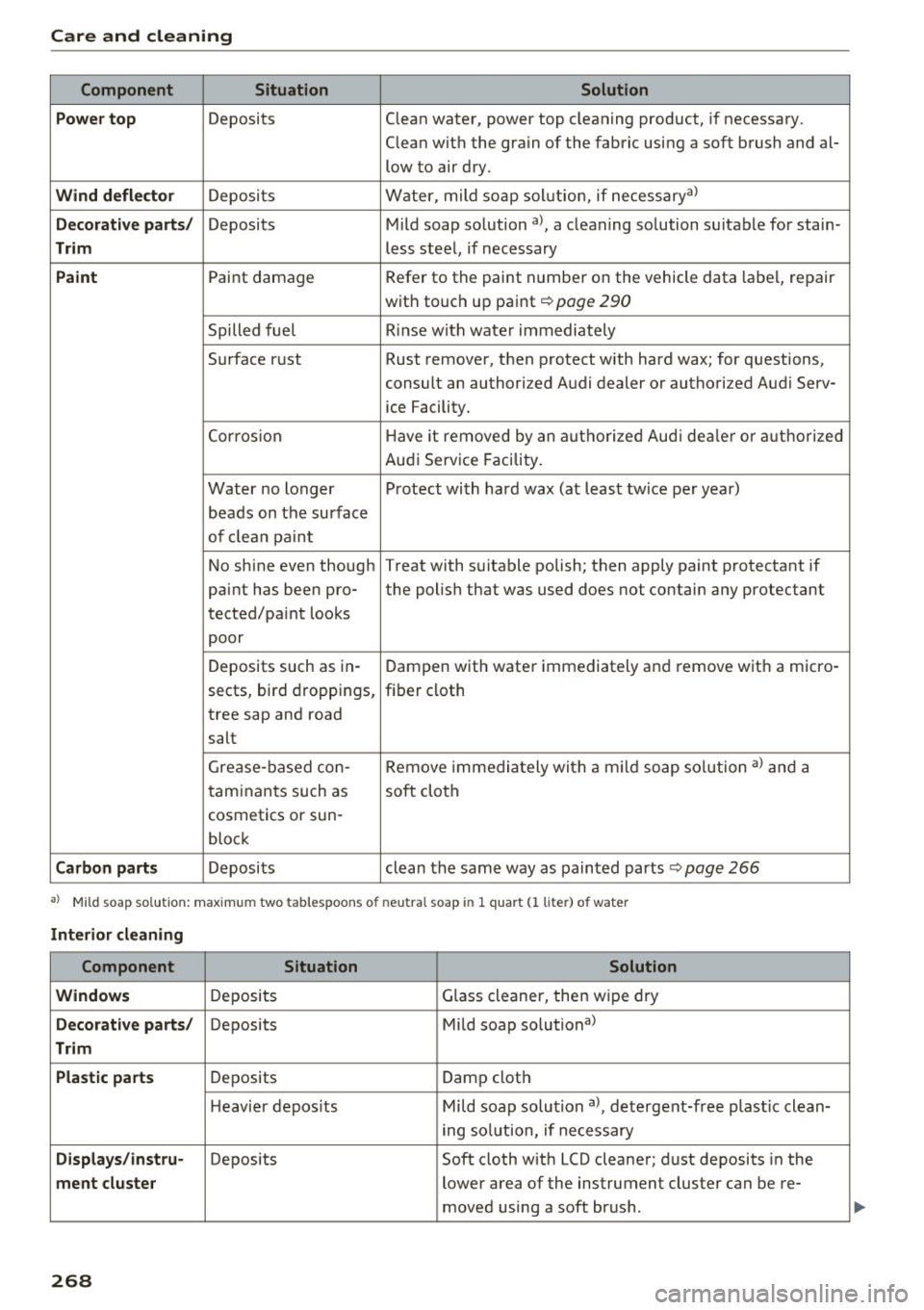
Care and cleaning Component Situation Solution
Power top
Deposits Clean water, power top cleaning product, if necessary.
Clean with the grain of the fabric using a soft brush and al-
low to air dry.
Wind deflector Deposits Water,
mild soap sol ution, if necessaryal
Decorative parts/ Deposits Mild soap solution al, a cleaning solution suitable for stain-
Trim less steel, if necessary
Paint Paint damage Refer to the paint number on the vehicle data label, repair
with touch up paint
¢page 290
Spilled fuel Rin se with wate r immediately
Surface r ust Rust remover, then protect with hard wax; for questions,
consult an 1 authorized Audi dealer or authorized Audi Serv-
ice Facility.
Corrosion Have it removed by an autho rized Aud i dea le r o r authorized
Audi Service Facility.
Water no longer Protect with hard wax (at least twice per year)
beads on the surface
of clean paint
No shine even though Treat with suitable polish; then apply paint protectant if
paint has been pro- the polish that was used does not contain any protectant
tected/pa int looks
poor
Deposits such as in- Dampen with water immediately and remove with a micro-
sects, bird droppings,
fiber cloth
tree sap and road
salt
Grease-based con- Remove immedia tely with a mild soap solution a) and a
taminants such as
soft cloth
cosmetics or sun-
block
Carbon parts Deposits clean the same way as painted parts¢ page 266
a) Mi ld soap so lution: maxim um two tablespoo ns of neut ra l soap i n 1 quart (l lite r) of water
Interior cleaning
Component Situation Solution
Windows
Deposits Glass
cleaner, then wipe dry
Decorative parts/ Deposits Mild soap solutional
Trim
Plastic parts
Deposits Damp cloth
Heavier deposits Mild soap solution al, detergent-free plast ic clean-
ing so lution, if necessary
Displays/instru-Deposits Soft cloth with LCD cleaner; dust deposits in the
ment cluster lower area of the instrument cluster can be re-
moved using a soft brush.
268
Page 285 of 314

CD
CD
.... N
" N .... 0 r--. V, co
Left engine compartment fuse assignment
Fig. 209 Engine compartment: fuse ass ignment
No. Equipment
Fl ESC control module
F2 ESC control module
F3 Engine control module
Engine cooling, engine components, auxili -
F4 ary heater coil re lay ( 1+2), secondary air
injection pump relay
FS E
ngine components, tank system
F6 Brake light sensor
F7 Engine components
F8 Oxygen sensor
F9 Engine components, exhaust door, glow
time control module
FlO Fuel injectors, fuel control module
Fll Auxiliary heater heating element 2
F 12 Auxiliary heater heating e
lement 3
F13 Automatic transmission cont rol module
FlS Horn
F16 Ignition coil
F17 ESC control module
, engine control mod-
ule
F18 Term inal 30 (reference voltage)
Fuses and bulbs
No . Equipment
Fl9 Windshield wipers
F20 Horn
F22 Terminal SO diagnos
is
F23 Starter
F24 Auxiliary heater heating element 1
F3 2 LED headlights
Bulbs
Message
Your vehicle is equ ipped with maintenance-free
headlights and tail lights . However, if a light bulb
needs to be replaced, p lease contact yo ur author
ized Audi dea ler or authorized Audi Service Facili
ty.
283
Page 292 of 314

Technical data
Technical data
Vehicle specifications
Fig. 219 Windshiel d (fro nt left s ide): V IN
XXXXX XX -X -XXX X XX X xx
®--+ f AHRZC . - ll)[jj f -Nil . Vlll[l£ • OOIT • NO. XX XXXXXX XX X XX XX XXX X
1YP /rtl'! XXX XXX
xx xxxxxxx
xx xx xx
XXX KW XXX
OC. OOll / lll AMS . lllO! xxxx XXX XXX ®-t Ml) TORKB./ CETll kS.
©+ IACl( flR./ INNENAIJSS t
XXXX I XXXX XXX I XX PAI NT NO. / WlllllOfl
II. -AUSST . / OPTIO NS
E 0 A 7D 5 4U B 6XM 5SG 5RW
2 EH JO Z l lB lA S lBA
3 FC 5M U 7X1
F0A 9G3 0G7 0 YH 0JF
TL 6 3 KA 8EH UlA X 9B OZ 7
lXW 8 0 3 908 8Z4 020
7T6 C V7
7K0 4
X3 2 K2
3 L4 4 KC 3 Y0 413 5 02
1 SA 7GB 0 1A 4GO
XX X XX X X X X xxxx
F ig . 220 Vehicle id entifica tion labe l
Vehicle Identification Number (VIN) in the
Infotainment system
0
0
0:, 0 ' J: .. a:,
~ Select in the Infotainment system: the I MENU I
button > left control button > Service & checks
> Vehicle information .
Vehicle Identification Number (VIN)
The VIN can be found in the Infotainment sys
tem, on the vehicle data label and under the
windshield on the driver's side*
¢ fig. 219.
290
Vehicle identification label
The vehicle identification label¢
fig. 220 is locat
ed in the luggage compartment under the cargo
floor cover.
The information of the vehicle identification label
can also be found in your Warranty
& Mainte
nance booklet.
The st icker contains the follow ing vehicle data:
(D Vehicle Identifica tion Number (VIN)
@ Vehicle type, eng ine output, transmission
® Engine and transmission cod es
@ Paint and interior codes
® Optional equipment numbers
Safety compliance sticker
The safety compliance sticker is your assurance
that your new veh icle complies with all applicable
Federal Motor Vehicle Safety Standards which
were in effect at the time the vehicle was manu
factured. You can find this sticker on the door
jamb on the driver's side. It shows the month and
year of production and the vehicle identification
number of your vehicle (perforation) as well as
the Gross Vehicle Weight Rating (GVWR) and the Gro ss Axle We ight Rating (GAWR).
High voltage warning label
The high voltage warn ing label is located in the
engine compartment next to the engine hood re
lease. The spark ignition system complies w ith
the Canadian standard IC ES-002.
Weights
Gross Vehicle Weight Rating
The Gross Vehicle Weight Rating (GVWR), and
the Gross Axle Weight Rat ing (GAWR) for front
and rear are li sted on a sticker on the door jamb
on the driver 's side.
The Gross Vehicle Weight Rating includes the
weight of the basic vehicle plus full fuel tank, oil
and coolant, plus maximum load, which includes
passenger weigh t (150 lbs/68 kg per designated
seat ing position) and luggage weight
c::> ,&.. ..,.
Page 294 of 314
Tech nical data
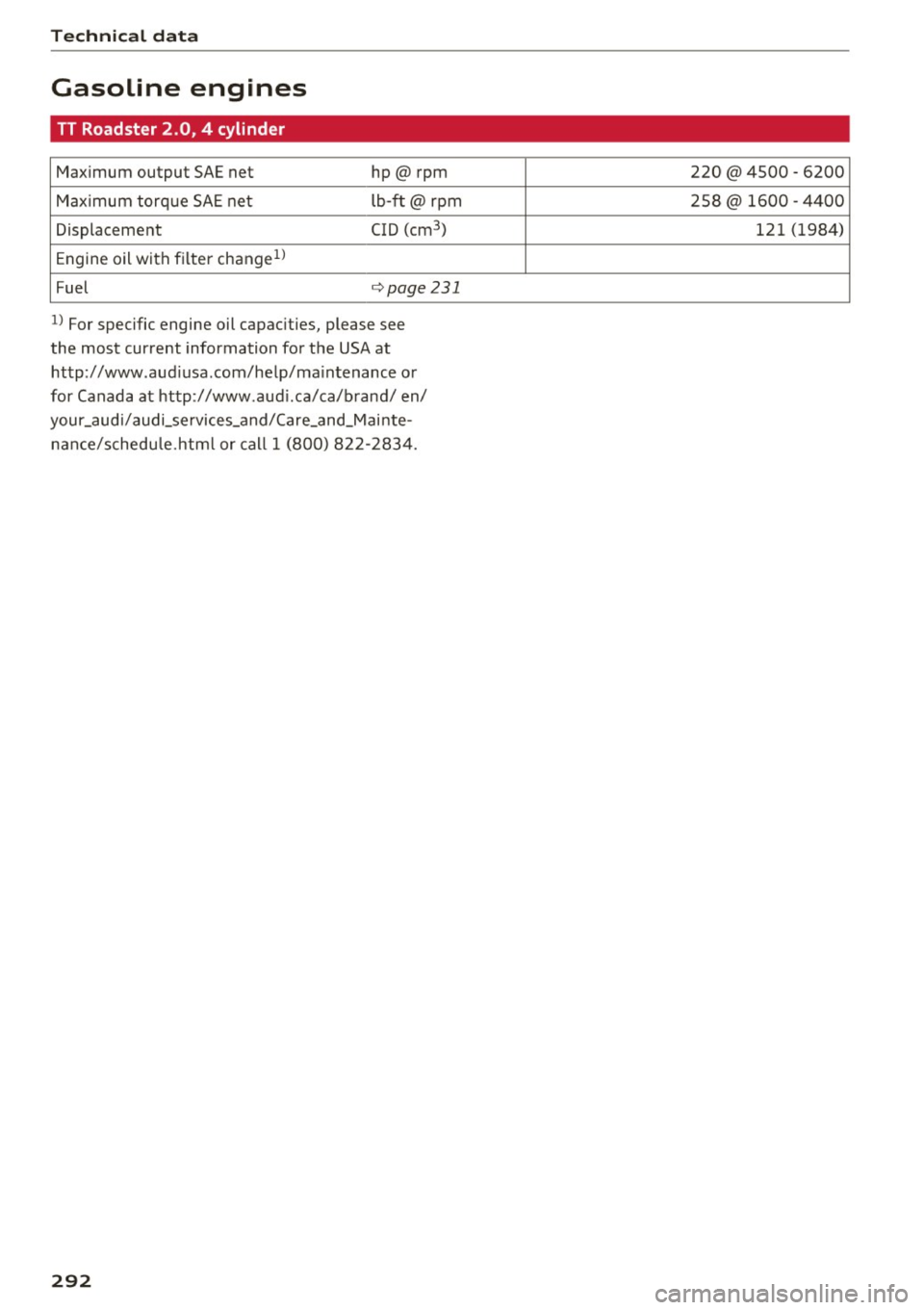
Gasoline engines
TT Roadster 2.0 , 4 cylinder
Maximum output SAE net hp@ rpm
Max imum torq ue SAE net lb-ft@ rpm
Displacement CID (cm
3
)
Engine oil with filter change1>
Fuel ¢ page231
ll For specific engine oil capac ities, please see
the most current information for the USA at http :/ /www .aud iusa.com/help/ma intenance or
for Canada at http ://www .aud i.ca/ca/b rand/ en/
your _aud i/ aud i_services_a nd/Ca re_and_M a i nte
na n ce/ schedu le.htm l or call 1 (80 0) 82 2-2834.
292
220 @ 4500 -6200
258@ 1600 - 4400
121 (1984)