2017 AUDI TT ROADSTER engine oil
[x] Cancel search: engine oilPage 241 of 314
CD
CD
.... N
" N .... 0
" V, co
accurate measurement of oil consumption requires great care and may take some
time. An authorized Audi dealer has instruc
tions about how to measure oil consump
tion accurately.
Checking the engine oil level and adding
engine oil
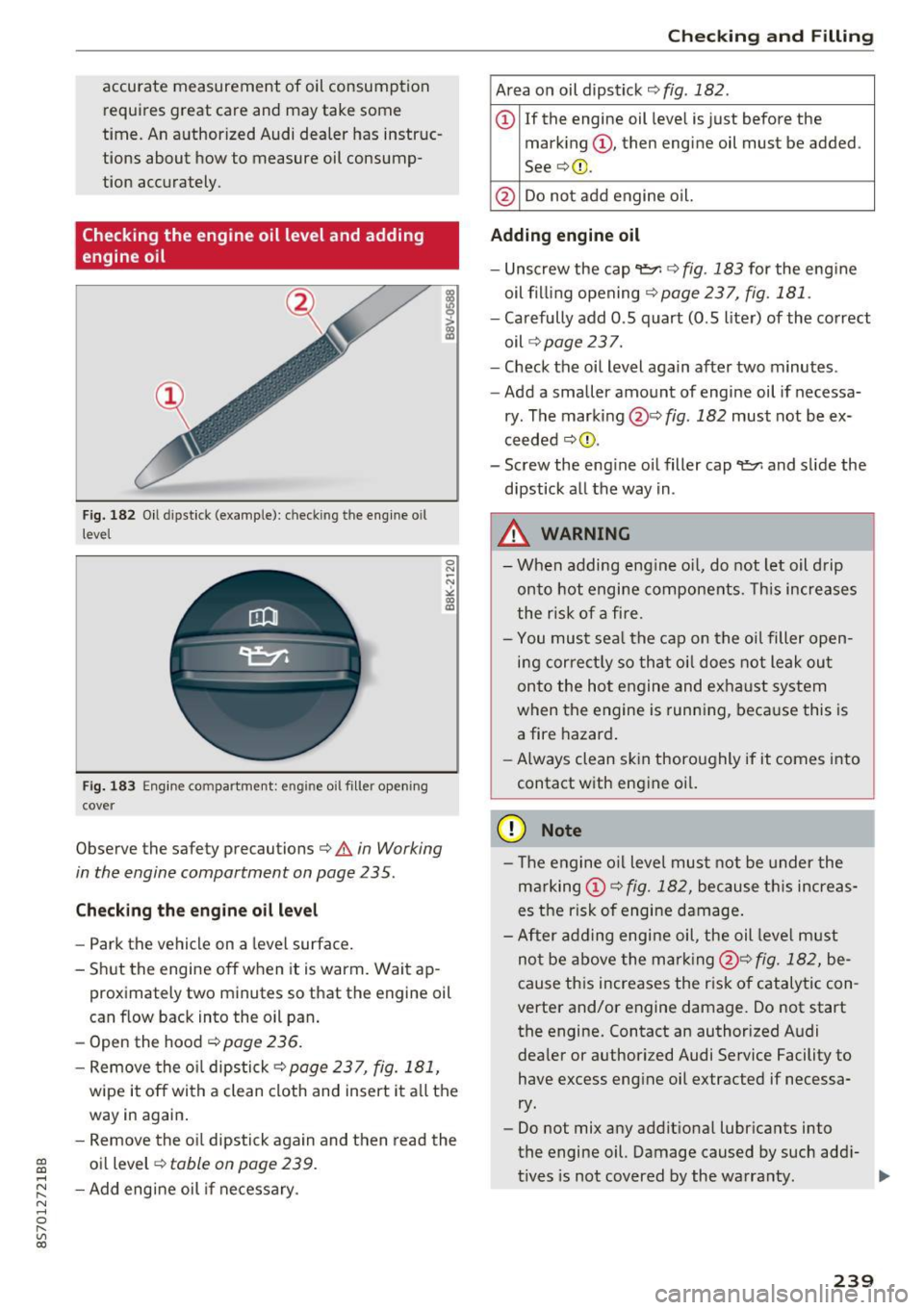
Fig. 182 Oil dips tick (exa mple): check ing the engine o il
level
Fig. 183 Engine compartment: engine oil filler opening
cover
Observe the safety precautions c> A:. in Working
in the engine compartment on page 235.
Checking the engine oil level
- Park the vehicle on a level surface.
- Shut the engine off when it is warm. Wait ap-
0
"' -"'
"' a, IX)
proximately two minutes so that the engine oil
can flow back into the oil pan.
- Open the hood c>
page 236.
-Remove the oil dipstick c> page 237, fig. 181,
wipe it off with a clean cloth and insert it all the
way in again.
- Remove the oil dipstick again and then read the
oil level ¢
table on page 239.
-Add engine oil if necessary.
Checking and Filling
Area on oil dipstick<=> fig. 182.
(D If the engine oil level is just before the
marking
(D , then engine oil must be added .
See c>@.
@ Do not add engine oil.
Adding engine oil
- Unscrew the cap~ c>
fig. 183 for the engine
oil filling opening
¢page 237, fig. 181.
-Carefully add 0.5 quart (0.S liter) of the correct
oil ¢
page 23 7.
- Check the oil level again after two minutes .
- Add a smaller amount of engine oil if necessa-
ry . The marking @¢ fig . 182 must not be ex
ceeded ¢Cl) :
- Screw the eng ine oil filler cap~ and slide the
dipstick all the way in.
,&. WARNING
i=
- When adding eng ine oi l, do not let oil drip
onto hot engine components. This increases
the risk of a fire.
- You must seal the cap on the oil filler open
ing correctly so that oil does not leak out
onto the hot engine and exhaust system
when the engine is running, because this is
a fire hazard.
-Always clean skin thoroughly if it comes into
contact with eng ine oil.
(D Note
- The engine oil level must not be under the
ma rking
(D ¢ fig. 182, because th is increas
es the risk of engine damage .
- After adding engine oil, the oil level must
not be above the marking @c>
fig. 182, be
cause this increases the risk of catalytic con
verter and/or engine damage. Do not start the engine. Contact an authorized Audi
dea ler or authorized Audi Service Facility to
have excess engine oil extracted if necessa
ry.
- Do not mix any additional lubricants into
the engine oil. Damage caused by such addi-
tives is not covered by the warranty. .,.
239
Page 242 of 314
Checking and Filling
@ For the sake of the environment
-Engine oil should never enter the sewer sys
tem or come into contact with the ground
under any circumstances.
- Pay attention to legal requirements when
disposing of empty oil containers.
(D Tips
The engine oil consumption may be up to 0.5 quart/600 miles (0.5 liter/1,000 km), de
pending on driving style and operating condi
tions. Consumption may be higher during the
first 3,000 miles (5,000 km). Because of this,
the engine oil level must be checked regular
ly .
It would be best to check each time you re
fuel your vehicle and before long drives.
Changing the engine oil
We recommend that have your oil changed by an
authorized Audi dealer or a qualified service sta
tion.
Before you check anything in the engine compart
ment, always read and heed all WARNINGS
q .&.
in Working in the engine compartment on
page 235.
The engine oil must be changed according to the
intervals specified in your Warranty
& Mainte
nance booklet. This is very important because the
lubricating properties of oil diminish gradually
during normal vehicle use.
Under some circumstances the engine oil should
be changed more frequently . Change oil more of
ten if you drive mostly short distances, operate
the vehicle in dusty areas or under predominantly
stop-and-go traffic conditions, or have your vehi
cle where temperatures remain below freezing
for extended periods.
Detergent additives in the oil will make fresh oil
look dark after the engine has been running for a
short time. This is normal and is not a reason to
change the oil more often than recommended.
Because of the problem of proper disposal, along
with the special tools and necessary expertise re
quired, we strongly recommend that you have
240
your oil changed by an authorized Audi dealer or
a qualified service station.
If you choose to change your oil yourself , please
note the following important information:
& WARNING
To reduce the risk of personal injury if you
must change the engine oil in your vehicle
yourself:
- Wear eye protection.
-
-To reduce the risk of burns from hot engine
oil, let the engine cool down to the touch.
- When removing the oil drain plug with your
fingers, stay as far away as possible. Always
keep your forearm parallel to the ground to
help prevent hot oil from running down your
arm.
- Drain the oil into a container designed for
this purpose, one large enough to hold at
least the total amount of oil in your engine.
- Engine oil is poisonous. Keep it well out of
the reach of children.
- Continuous contact with used engine oil is
harmful to your skin. Always protect your
skin by washing oil off thoroughly with soap
and water .
(D Note
Never mix oil additives with your engine oil.
These additives can damage your engine and adversely affect your Audi Limited New Vehi
cle Warranty.
@I For the sake of the environment
- Before changing your oil, first make sure
you know where you can properly dispose of
the used oil.
- Always dispose of used engine oil properly.
Do not dump it on garden soil, wooded
areas, into open streams or down sewage
drains.
- Recycle used engine oil by taking it to a used
engine oil collection facility in your area, or
contact a service station .
Page 244 of 314

Checking and Filling
Audi dealer or authorized Audi Service Facility
and have the cooling system inspected. If the
cooling system is not leaking, a loss can come
from the coolant boiling through overheating
and being pushed out of the cooling system.
A WARNING
The cooling system is pressurized and can be
come very hot. To reduce the r isk of burns
from hot coolant:
- Do not open the coolant expansion tank cap when the eng ine is hot. This increases the
risk of burns.
- Stop the engine and allow it to cool.
- Protect your face, hands and arms from es-
caping coolant and steam by covering the
coolant tank cap with a large, thick cloth.
- Turn the coolant tank cap counterclockwise
slowly and keep light pressure o n the cap.
- To reduce the risk of burns, do not allow any
antifreeze or coolant to drip onto the ex haust system or hot eng ine components .
T he ethylene glycol in eng ine coolant can
catch fire under certa in circumstances.
- The coo lant add itive and the coolant can be
dange rous to your health. For this reason,
keep the coolan t in the origina l container
and away from children. There is a risk of
poisoning.
- When working in the engine compartmen t,
remember that the radiator fan can switch
on even if the ignition is switched off, which
increases the risk of inj ury.
(D Note
Do not add coolant if the exp ansion tank is
empty . Air could enter the cooling system and
damage the engine . If this is the case, do not
continue driving. See an authorized Audi deal
er or authorized Audi Service Facility for assis
tance.
242
Brake fluid
Fig. 1 85 Eng ine compa rtment: cover o n the brake fluid
reservo ir
Observe the safety precautions ¢ A in Working
in the engine compartment on page 235.
Check ing the brake fluid level
... Read the bra ke fluid level o n the bra ke flu id
reservoir
¢ page 237, fig . 181. The brake f luid
level must be between the MIN and MAX mark
ings ¢&_ .
The brake f lu id leve l is monito red au toma tically.
Changing the brake fluid
Have the brake fluid changed regularly by an au
thorized Audi dea ler or authorized Audi Service
Fac ility.
A WARNING
- I f the brake fl uid leve l is below the MIN
marking, it can impair the bra king effec t
and driving safety, which increase the risk o f
an accident . Do not continue driv ing. See a n
author ized Audi dealer or authorized A udi
Serv ice Facility for assistance.
- If the brake fl uid is old, b ubbles may form
in the brake system during heavy braking.
This would impair braking performance and
driving safety, which increases the r isk of an
accident.
- To ensure the brake system functions cor
rectly, only use brake fluids that comply
w it h VW standard SO l 14 or
FMVSS- 116 DO T 4.
Page 247 of 314
co
co
.... N
" N .... 0
" "' c:o
-Do not use a glass cleaner that contains
paint solvents, because this could damage
the pa int.
Service interval display
The service interval display detects when your ve
hicle is due for service.
The service interval display works in two stages:
- Inspection or oil change reminder: after a cer-
tain distance driven, a message appears in the
Infotainment system display each time the ig
nition is switched on or off. The remaining dis
tance or time is displayed briefly.
- Inspection or oil change due: if your vehicle
has reached an inspection or oil change interval
or both intervals at the same time, the mes
sage
Inspection due! or Oil change due! or Oil
change and inspection duel
appears briefly af
ter switching the ignition on/off .
Checking service intervals
You can check the remaining distance or time un
til the next oil change or next inspection. Select
in the Infotainment system: the !MENU ! button>
Vehicle > left control button > Service & checks >
Service intervals .
(D Note
-Following the service intervals is critical to
maintain ing the service life and value of
your vehicle, especially the engine. Even if
the mileage on the vehicle is low, do not ex
ceed the time for the next service.
- Calcu lating the time to the next oil change
i s interrupted when the vehicle battery is
disconnected~
page 271.
Checking and Filling
245
Page 260 of 314
Wheels
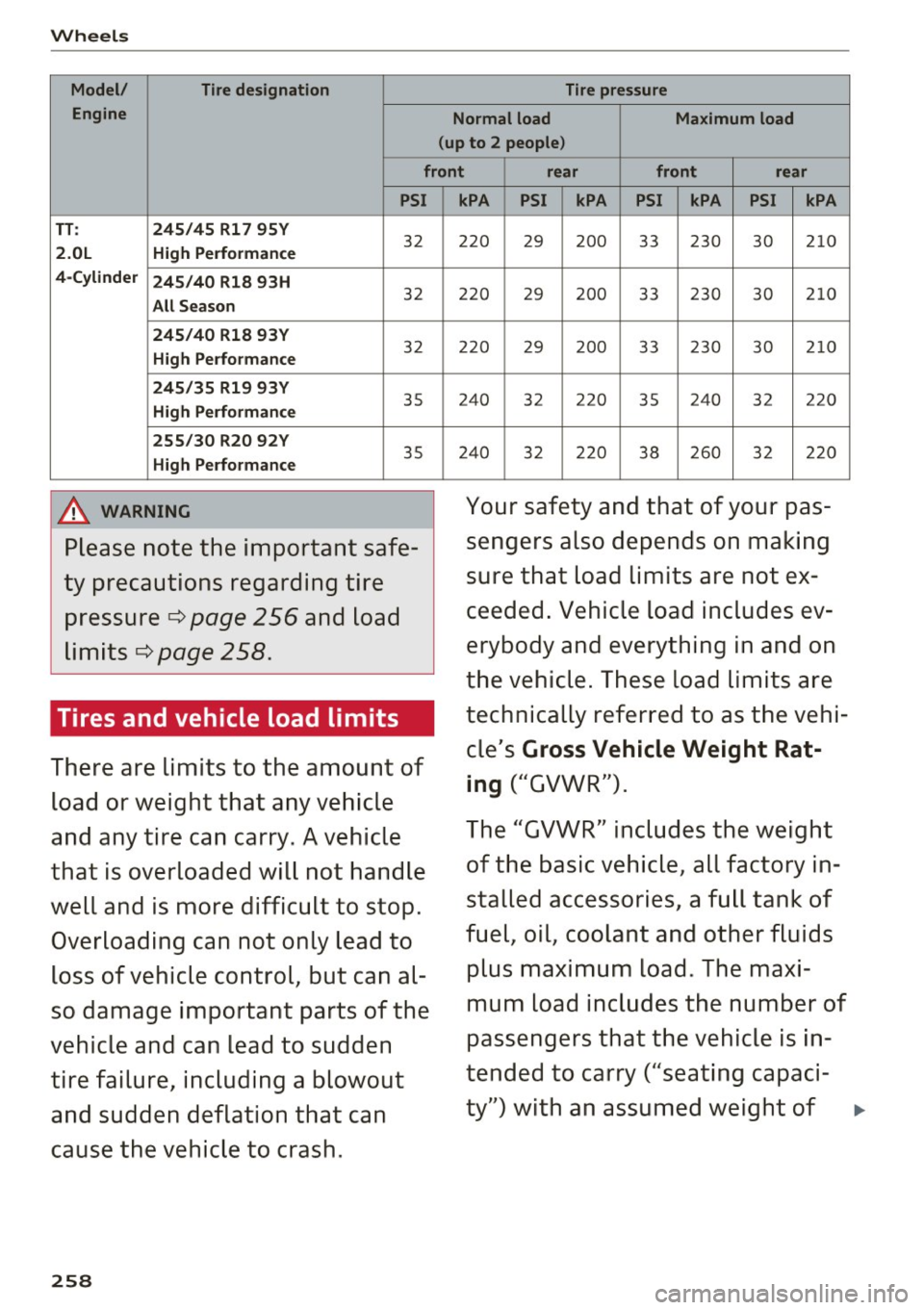
Model/ Tire designation Tire pressure
Engine Normal load Maximum load
(up to 2 people)
front rear front rear
PSI
TT : 245/45 R17 95Y
2.0L High Performance
32
4-Cylinder 245/40 R18 93H
All Season
32
245/40 R18 93Y
High Performance 32
245/35 R19 93Y
High Performance
35
255/30 R20 92Y
High Performance
35
A WARNING
Please note the important safe
ty precautions regarding tire pressure ¢
page 256 and load
limits¢
page 258.
Tires and vehicle load limits
There are limits to the amount of
load or weight that any vehicle
and any tire can carry. A vehicle
that is overloaded will not handle
well and is more difficult to stop .
Overloading can not only lead to
loss of vehicle control, but can al
so damage important parts of the
vehicle and can lead to sudden
tire failure, including a blowout and sudden deflation that can
cause the vehicle to crash.
258
kPA PSI kPA
PSI kPA PSI kPA
220 29 200 33 230 30 210
220 29 200 33 230 30 210
220 29 200 33 230 30 210
240 32 220 35 240
32 220
240 32 220 38 260 32 220
Your safety and that of your pas
sengers also depends on making
sure that load limits are not ex
ceeded. Vehicle load includes ev
erybody and everything in and on
the vehicle. These load limits are
technically referred to as the vehi
cle's
Gross Vehicle Weight Rat
ing
("GVWR").
The "GVWR" includes the weight
of the basic vehicle, all factory in
stalled accessories, a full tank of
fuel, oil, coolant and other fluids plus maximum load. The maxi
mum load includes the number of
passengers that the vehicle is in
tended to carry ("seating capaci-
ty") with an assumed weight of ..,
Page 285 of 314

CD
CD
.... N
" N .... 0 r--. V, co
Left engine compartment fuse assignment
Fig. 209 Engine compartment: fuse ass ignment
No. Equipment
Fl ESC control module
F2 ESC control module
F3 Engine control module
Engine cooling, engine components, auxili -
F4 ary heater coil re lay ( 1+2), secondary air
injection pump relay
FS E
ngine components, tank system
F6 Brake light sensor
F7 Engine components
F8 Oxygen sensor
F9 Engine components, exhaust door, glow
time control module
FlO Fuel injectors, fuel control module
Fll Auxiliary heater heating element 2
F 12 Auxiliary heater heating e
lement 3
F13 Automatic transmission cont rol module
FlS Horn
F16 Ignition coil
F17 ESC control module
, engine control mod-
ule
F18 Term inal 30 (reference voltage)
Fuses and bulbs
No . Equipment
Fl9 Windshield wipers
F20 Horn
F22 Terminal SO diagnos
is
F23 Starter
F24 Auxiliary heater heating element 1
F3 2 LED headlights
Bulbs
Message
Your vehicle is equ ipped with maintenance-free
headlights and tail lights . However, if a light bulb
needs to be replaced, p lease contact yo ur author
ized Audi dea ler or authorized Audi Service Facili
ty.
283
Page 290 of 314
Emergency situations
Raising the vehicle
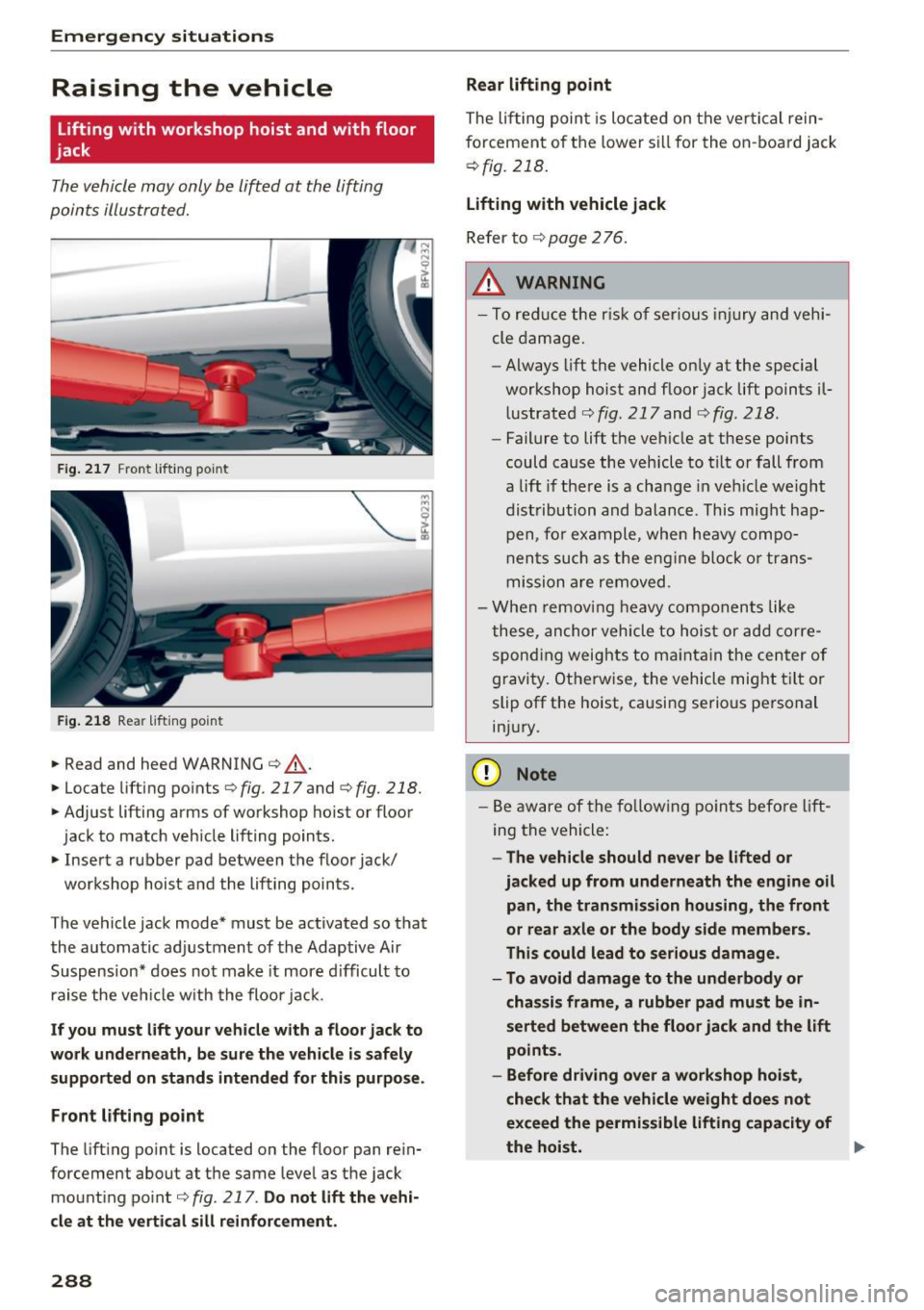
Lifting with workshop hoist and with floor
jack
Th e vehicle may only b e lift ed at the lifting
poin ts illust rated.
F ig .. 217 F ro nt lift ing po int
F ig. 218 Rea r lifti ng po int
.,. Read and heed WARNING ¢ A-
.,. Locate lifti ng po ints ¢ fig. 217 and ¢ fig. 218 .
.,. Adjust lifting arms of wo rkshop hoist or floor
jack to match veh icle lifting points.
.,. In se rt a rubb er pad between t he floor jack/
wor kshop hoist a nd the lif ting poin ts .
The vehicle jack mode * must be activated so that
the au tomatic ad justment of the Adaptive Air
Suspens ion * d oes no t mak e it more difficult to
raise the ve hicl e with the floo r jack.
If you must lift your vehicle with a floor jack to
work underneath, be sure the vehicle is safely
supported on stands intended for this purpose .
F ront lifting point
The lift ing po int is located on the floor pan re in
forcement about at the same leve l as the jack
mo unt ing point ¢
fig. 217 . Do not lift the vehi
cle at the vertical sill reinforcement.
288
Rear lifting point
The li fting poin t is lo cated on the ve rtic al rein
f orcement o f th e lower s ill for the on -boar d ja ck
¢fig. 218 .
Lifting with vehicle jack
Refer to ¢ page 2 76.
Ln., WARNING
- To reduc e the r isk of s erious in ju ry and vehi
cle dam age.
- Always lift the vehicle on ly at the special
wor ksh op hoist an d flo or jack lift points il
l ustrated
¢ fig. 217 and ¢fig . 218.
- Failur e to lift t he ve hicle at these points
could cause th e veh icle to tilt o r fall from
a lift if t he re is a cha nge in vehi cle w eight
dist ribution and balanc e. This mi ght hap
p en, fo r exa mple , whe n he avy co mpo
n en ts s uch as the e ngine blo ck or t ra n s
mis sion a re removed .
- Wh en r em ov ing heavy com ponen ts like
t hese, an ch or veh icle t o hoi st or add corre
s p ond ing weights t o maintain the ce n ter of
gravi ty. Oth e rw ise, the vehicle mig ht til t o r
slip off t he hoist, causi ng serious pe rsona l
in jur y .
(D Note
- B e aw are of the fo llow ing poin ts bef ore lif t
ing the vehicle:
- The vehicle should never be lifted or
jacked up from underneath the engine oil
pan, the transmission housing, the front
or rear axle or the body side members .
This could lead to serious damage .
- To avoid damage to the underbody or
chassis frame, a rubber pad must be in
serted between the floor jack and the lift
points .
- Before driving over a workshop hoist ,
check that the vehicle weight does not
exceed the permissible lifting capacity of
the hoist. ..,.
Page 292 of 314

Technical data
Technical data
Vehicle specifications
Fig. 219 Windshiel d (fro nt left s ide): V IN
XXXXX XX -X -XXX X XX X xx
®--+ f AHRZC . - ll)[jj f -Nil . Vlll[l£ • OOIT • NO. XX XXXXXX XX X XX XX XXX X
1YP /rtl'! XXX XXX
xx xxxxxxx
xx xx xx
XXX KW XXX
OC. OOll / lll AMS . lllO! xxxx XXX XXX ®-t Ml) TORKB./ CETll kS.
©+ IACl( flR./ INNENAIJSS t
XXXX I XXXX XXX I XX PAI NT NO. / WlllllOfl
II. -AUSST . / OPTIO NS
E 0 A 7D 5 4U B 6XM 5SG 5RW
2 EH JO Z l lB lA S lBA
3 FC 5M U 7X1
F0A 9G3 0G7 0 YH 0JF
TL 6 3 KA 8EH UlA X 9B OZ 7
lXW 8 0 3 908 8Z4 020
7T6 C V7
7K0 4
X3 2 K2
3 L4 4 KC 3 Y0 413 5 02
1 SA 7GB 0 1A 4GO
XX X XX X X X X xxxx
F ig . 220 Vehicle id entifica tion labe l
Vehicle Identification Number (VIN) in the
Infotainment system
0
0
0:, 0 ' J: .. a:,
~ Select in the Infotainment system: the I MENU I
button > left control button > Service & checks
> Vehicle information .
Vehicle Identification Number (VIN)
The VIN can be found in the Infotainment sys
tem, on the vehicle data label and under the
windshield on the driver's side*
¢ fig. 219.
290
Vehicle identification label
The vehicle identification label¢
fig. 220 is locat
ed in the luggage compartment under the cargo
floor cover.
The information of the vehicle identification label
can also be found in your Warranty
& Mainte
nance booklet.
The st icker contains the follow ing vehicle data:
(D Vehicle Identifica tion Number (VIN)
@ Vehicle type, eng ine output, transmission
® Engine and transmission cod es
@ Paint and interior codes
® Optional equipment numbers
Safety compliance sticker
The safety compliance sticker is your assurance
that your new veh icle complies with all applicable
Federal Motor Vehicle Safety Standards which
were in effect at the time the vehicle was manu
factured. You can find this sticker on the door
jamb on the driver's side. It shows the month and
year of production and the vehicle identification
number of your vehicle (perforation) as well as
the Gross Vehicle Weight Rating (GVWR) and the Gro ss Axle We ight Rating (GAWR).
High voltage warning label
The high voltage warn ing label is located in the
engine compartment next to the engine hood re
lease. The spark ignition system complies w ith
the Canadian standard IC ES-002.
Weights
Gross Vehicle Weight Rating
The Gross Vehicle Weight Rating (GVWR), and
the Gross Axle Weight Rat ing (GAWR) for front
and rear are li sted on a sticker on the door jamb
on the driver 's side.
The Gross Vehicle Weight Rating includes the
weight of the basic vehicle plus full fuel tank, oil
and coolant, plus maximum load, which includes
passenger weigh t (150 lbs/68 kg per designated
seat ing position) and luggage weight
c::> ,&.. ..,.