2017 AUDI S3 SEDAN service
[x] Cancel search: servicePage 326 of 400

Checking and Filling
When the engine is warm it can be slightly above the upper marking.
Adding coolant
Plug-in hybrid drive* : Your vehicle has two cool
ant expansion tanks that are separate from each
other. The smaller of the two expansion tanks
must not be opened
¢ page 104. Read and fol
low the important safety precautions ¢
A in
Coolant on page 105 .
Requirement: there must be a residual amount of
coolant in the expansion tank
¢ (D .
~ Let the engine cool down.
~ Place a cloth over the coolant expansion tank
cap and unscrew the cap counterclockwise
¢_&. .
~ Add coolant mixed in the correct ratio
¢page 323 up to the upper marking.
~ Make sure that the fluid level remains stable.
Add more coolant if necessary.
~ Close the cap securely.
Coolant loss usually indicates there is a leak . Im
mediately drive your vehicle to an authorized
Audi dealer or authorized Audi Service Facility
and have the cooling system inspected.
If the
cooling system is not leaking, a loss can come
from the coolant boiling through overheating
and being pushed out of the cooling system.
.,&. WARNING
The cooling system is pressurized and can be
come very hot. To reduce the risk of burns
from hot coolant:
- Do not open the coolant expansion tank cap
when the engine is hot. This increases the
risk of burns.
- Stop the engine and allow it to cool.
- Protect your face, hands and arms from es-
caping coolant and steam by covering the
coolant tank cap with a large, thick cloth.
- Turn the coolant tank cap counterclockwise
slowly and keep light pressure on the cap.
- To reduce the risk of burns, do not allow any
antifreeze or coolant to drip onto the ex
haust system or hot engine components.
324
The ethylene glycol in engine coolant can
catch fire under certain circumstances.
- The coolant additive and the coolant can be
dangerous to your health. For this reason,
keep the coolant in the original container
and away from children . There is a risk of
poisoning.
- When working in the engine compartment,
remember that the radiator fan can switch
on even if the ignition is switched off, which
increases the risk of injury.
(D Note
Do not add coolant if the expansion tank is
empty . Air could enter the cooling system and
damage the engine . If this is the case, do not
continue driving . See an authorized Audi deal
er or authorized Audi Service Facility for assis
tance.
- Before the start of winter, have an author
ized Audi dealer or authorized Audi Service
Facility check if the coolant additive in your
vehicle matches the percentage appropriate
for the climate. This is especially important
when driving in colder climates.
- If the appropriate coolant additive is not
available in an emergency, do not add any
other additive. You could damage the en
gine. If this happens, only use water and re
store the correct mixture ratio with the
specified coolant additive as soon as possi
ble .
- Only refill with new coolant.
- Radiator sealant must not be mixed with the coolant.
· Radiator fan
The radiator fan switches on automatically by it
self
An auxiliary electric radiator fan switches on and
off depending on coolant temperature and other
vehicle operating conditions.
After you switch the engine off, the auxiliary fan
can continue running for up to 10 minutes
-even
with the ignition off.
It can even switch on again
later by
itself ¢.& , if .,..
Page 327 of 400
a, a, ..... N
" N ..... 0 N > 00
- the temperature of the engine coolant r ises due
to the heat bui ld-up from the engine in the en
gine compartment , or
- the engine compartment heats up because the
vehicle is parked in intense su nlight .
_& WARNING
- To reduce the risk of personal injury never
touch the radiator fan .
- The auxiliary elect ric fan is temperature
contro lled and can switch on suddenly even
w hen the eng ine is not running.
- The auxiliary radiator fan switches on auto matically when the engine coo lant reaches a
certain temperature and will cont inue to run
until the coolant temperat ure drops.
Brake fluid
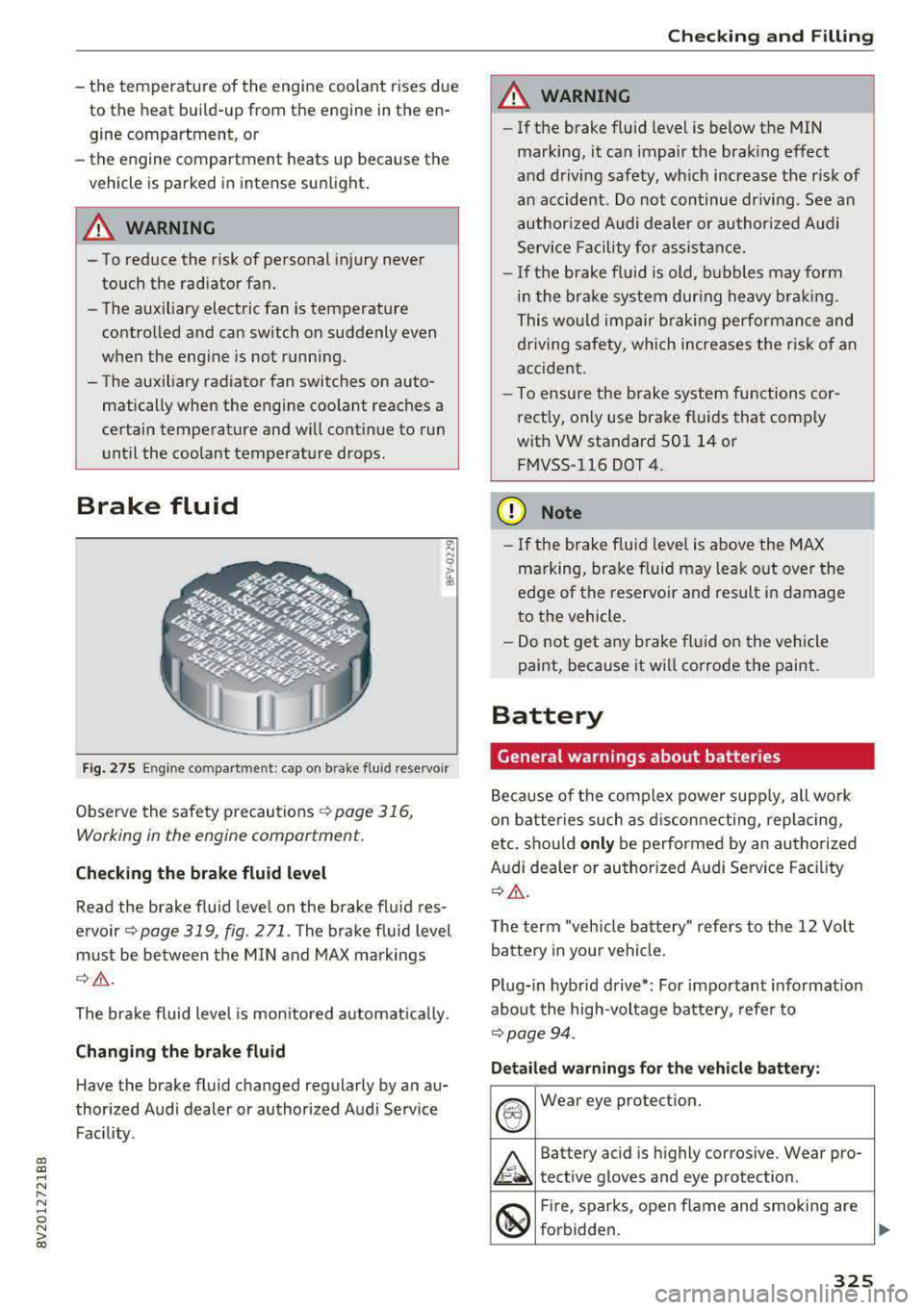
Fi g. 27 5 Engine co mpartment: cap on b rake f lu id reservoir
Observe the safety p recau tions ¢ page 316,
Working in the engine compartment .
Checking the brake fluid level
Read the brake f lu id leve l on the brake fl uid res
e rvo ir
Q page 319 , fig. 271. The bra ke fluid level
must be be tween the M IN and MAX m ark ings
¢ _& .
The brake fluid level is mon itored a utomat ica lly .
Changing the brake fluid H ave the brake fluid changed regularly by an au
thor ized Audi dealer or authorized Audi Service
Facility .
-
Checking and Filling
A WARNING
=
-If the brake fluid level is below the MIN
marking, it can impair the brak ing effect
and d riving safety, wh ich increase the risk of
a n accident . Do no t continue dr iving . See a n
a uthor ized Audi dealer or author ized A udi
Serv ice F acility for a ssistance.
- I f the b rake fl uid is old, b ubbles may form
i n t he bra ke sys tem dur ing heavy bra king.
This wo uld impair braking per formance an d
d riving safety, which increases the r is k of an
accident.
- T o ensu re the brake system fu nctions cor
rectly, only use brake fluids that comp ly
with VW standard 501 14 or F M VSS -116 DOT 4.
(D Note
- If the brake flu id leve l is above the MAX
marking, bra ke f luid may leak o ut over the
edge of the reservo ir and result in damage
to the vehicle.
- Do not get any b rake fl uid on the vehicle
paint, because it wi ll corrode the paint.
Battery
General warnings about batteries
B ecause of the complex power supp ly, all work
o n batter ies such as d iscon necti ng, replac ing,
etc. should only be performed by an authori ze d
Audi dealer or au thor ized A udi Service Fac ility
Q _& .
The term "veh icle batte ry" refe rs to the 1 2 Vol t
battery in your vehicle .
P lug- in hybr id driv e*: For important informat ion
abou t the high-vol tage batte ry, refe r to
Qpage 94.
Detail ed warnings fo r the vehicle battery :
®
Wear eye protect ion.
A
Battery acid is h ighly corros ive. Wear pro-
tect ive gloves and eye protection.
@
F ir e, sparks, open flame and smoking are
forbidden .
325
Page 328 of 400

Checking and Filling
A
A highly explosive mixture of gases can
form when charging batteries.
®
Keep children away from battery acid and
batteries.
A WARNING
All wo rk on the battery or electrical system in
your vehicle can result in injuries, chemical burns, accidents o r burns. Because of this, a ll
work m ust be performed
only by an author
ized Aud i dea ler or a uthorized Audi Service
Facility.
A WARNING
California Proposition 65 Warning:
- Battery posts, termina ls and re lated acces
sories contain lead and lead compounds,
chemicals known to the State of California
to cause cancer and reproduct ive p roblems.
Wash hands after handling.
(D Note
Protect the vehicle battery against freezing if
the vehicle will be parked for long periods of
time so that it is not destroyed by "freezing"
¢ page 326, Charging the vehicle battery.
Charging the vehicle battery
F ig. 276 Eng ine compartment: connectors for a charger
and jump start cables
Observe the safety precautions c:;;, page 316,
Working in the engin e compartment.
Plug-in hybrid drive*: ¢ page 104.
Req uirement: on ly use chargers with a maximum
charg ing current of 30 amps /14 .8 Volts .
The ve
hicle battery cables rema in connected.
326
The battery is located in the engine compart
ment. The ground point
0 is always located on
the ve hicle body.
.. Read the wa rnings¢ A in General warnings
about batteries on page 326
and ¢ _& .
.. Switch off the ignition and all electrica l equip-
ment .
.. Open the hood ¢page 318.
.. Fold the battery cover upward.
.. Clamp the charger terminal clamps as instruct
ed on the
battery terminal (+ ) and only on t he
bod y ground point (· ).
.,. Insert the power cable fo r th e cha rging dev ice
into the socket and switch t he device on .
.. At the end of the cha rging p rocess, switch the
charger off and pull the power cable out of the
socket.
.. Remove the charger terminal clamps.
.. Fold the cover back on the battery correctly.
.. Close the hood¢ page 318.
A WARNING
-A high ly explosive m ixture of gases can form
when charg ing batte ries. Only cha rge the
veh icle ba ttery in well-ven tila ted a reas.
- A dra ined vehicle battery can free ze at tem
pe ratures arou nd
32 QF (0 QC). A frozen or
thawed vehicle bat tery must no t be cha rged
and must no t be used anymo re. The b attery
housing can crack and battery ac id can leak
out if ice forms, which increases the risk of
an explosion and chemical burns. Contact an
authorized Audi dealer or authorized A udi
Serv ice Facility fo r more info rmation.
- Do not connect or disconnect the charging
cable wh ile charging because this increases
the risk of an explos ion.
@ Tips
- Only charge the vehicle battery t hrough the
connect ions in the engine compartment.
- Read all of the manufacturer's instructions
for the c harger before charging the vehicle
battery.
Page 329 of 400

CXl CXl .... N ,.__
N .... 0 N > 00
Windshield washer system
Fig. 277 Engine co mpa rtment: washer fluid reservoir cap
Observe the safety precautions ¢ page 316,
Working in the engine compartment.
M N
-N ~
"' a,
The windshield washer f luid reservoir~ contains
the cleaning solution for the windshield and the
headlight washer
system* ¢ page 319, fig. 2 71 .
The reservoir capacity can be found in
¢page 375 .
To reduce the risk of lime scale deposits on the
spray nozzles, use clean water with low amounts
of calc ium . Always add window cleaner to the wa
ter. When the outside temperatures are co ld, an
anti-freezing agent should be added to the water
so that it does not freeze.
CD Note
-The concentration of anti-freezing agent
must be adjusted to the vehicle operating
conditions in the respective climate. A con
centration that is too high can lead to veh i
cle damage.
- Never add radiator anti-freeze or other addi
tives to the washer fluid.
- Do not use a glass cleaner that contains
paint solvents, because this could damage
the paint .
Service interval display
The service interval display detects when your ve
hicle is due for service .
The service interva l display works in two stages:
- Inspection or oil change reminder: after a cer-
ta in distance driven, a message appea rs in the
Checking and Filling
instrument cluster display each time the igni
tion is switched on or off. The remaining dis
tance or time is disp layed briefly.
- Inspection or oil change due: if your vehicle
has reached an inspection or oil change interval
or both intervals at the same time, the mes
sage
Inspection due! or Oil change due! or Oil
change and inspection due!
appears briefly af
ter sw itching the ignition on/off.
Checking service intervals
You can check the remaining distance or time un
til the next oi l change or next inspection in the
Infotainment system. Select in the Infotainment
system: the
! MENUI button> Vehicle> left con
trol button
> Service & checks > Service inter
vals.
Resetting the indicator
An authorized Audi dealer or authorized Audi Service Facility will reset the service interval dis
play after performing service .
If you have changed the oi l yourself, you must re
set the oil change interval.
T o reset the disp lay, select in the Infotainment
system: the
! MENUI button> Vehicle> left con
tro l button
> Service & checks > Service intervals
> Reset oil change interval.
CD Note
-Only reset the oil change indicator if the oi l
was changed.
- Following the service intervals is critical to
maintaining the function, service life, and
value of your vehicle, especially the engine.
Even if the mileage on the vehicle is low, do
not exceed the time for the next service.
327
Page 338 of 400
Wheels
-Inflation pressure that is too low or high can in
crease tire wear considerab ly.
-Driving quickly through curves, rap id accelera
tion and heavy b raking increase tire wear .
-Have an authorized A udi dealer or au thorized
Audi Se rvice Facility check the wheel alignment
if there is unusual wear.
-Have the whee ls rebalanced i f an imbalance is
causing noticeab le vib ration in the steering
whee l. If you do not, the tires and other veh icle
components could wear more quickly.
Treadwear indicator
O rigina l equ ipment t ires conta in treadwe ar indi
cators in the tread pattern, which are b ars that
are 1/16 in. (1.6 mm) h igh and are spaced evenly
aro und the tire perpendic ular to the runn ing d i
rection¢ fig. 279. The letters "TWI" or triangles
on the tire sidewall indicate the locat ion of the
treadwear indicators.
The tires have reached the mi nimum tread
dept h
ll when they have worn down to the tread
wear ind icators. Replace the tires with new ones
¢ .&, .
Tire rotation
Rotating t he tires regular ly is recommended to
ensure the tires wear even ly. To rotate the tires,
install the tires from the rear ax le on the front
axle and v ice versa. This will allow the tires to
have approx imately the same length of service
life.
For unidirectional tires, make sure the tires are
installed according to the running direction indi
cated on the tire
sidewall¢ page 361 .
Hidden damage
Damage to tires and r ims can often occur i n loca
tions that are hidden . Unus ua l vibrations in the
veh icle or pulling to one s ide may indicate that
there is tire damage. Reduce your speed immedi
ately. Check the t ires for damage .
If no damage
is visible from the outside, drive s lowly and care
fully to the nearest authorized Aud i dealer or au-
l) Obey any applicable reg ulations in you r country.
336
thorized Audi Service Facility to have t he ve hicle
inspected.
A WARNING
Tread that has worn too low or different tread depths on the tires can reduce driving safety.
This can increase the risk of an accident be
cause it has a negative effect on handling,
d riving through curves, and b raking, and be
cause it increases the r isk of hydroplaning
when dr iving th rough dee p puddles.
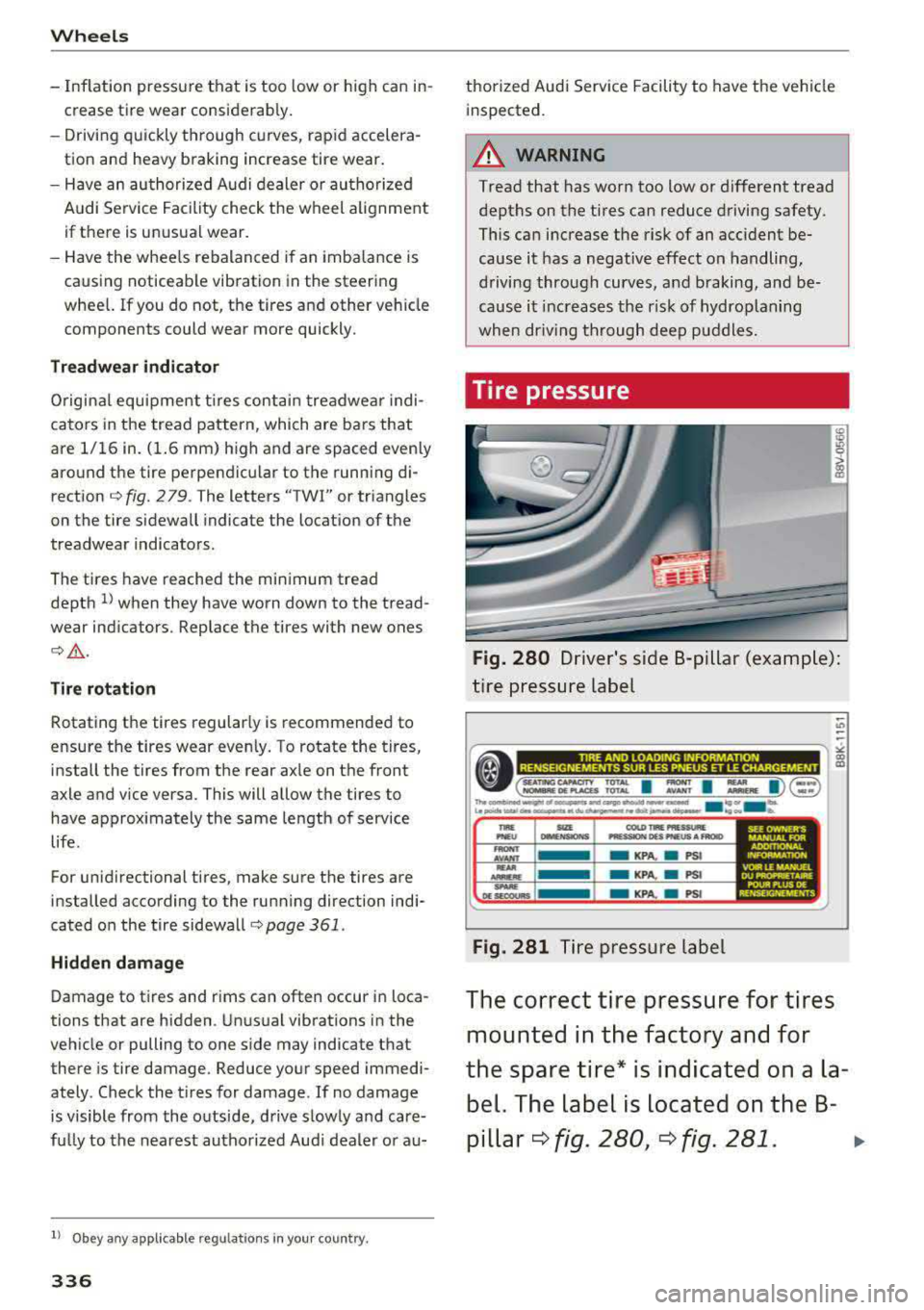
Tire pressure
Fig. 280 Driver's side B-pi llar (e xamp le) :
t ire p ress ure label
;; ~ ~ ~-----------------,:,
• (=~ ~~I: I:. I)@ ::g
»-OOIMING...-ol~..SAflO.....,....,--.d . ... _k Le«-h,...a .. ~etdudw,.uWl>l!tdollil,.._~ 'eou lb.
tw: SIU COI.O TR PRESSURE PNE U lailEHSl0HS "'lSSION OU PNEUS AFRQID
-AVANT -KPA. • PS I
Fig. 281 Tire pressure label
SEE OWNER"S MANUAL FOR ADOrTlONAL INFORMATK>N
VOIR L£ MANUa DU PROPRIETAIRE POUR PLUS DE RENSEIGNEMENTS
The correct tire pr essure for tires
mounted in the fa ctory and for
th e s pare tire * is ind icated on a la
bel. The label i s located on th e B-
pillar
¢ f ig . 280, ¢ fig. 2 81 . ..,
Page 344 of 400

Wheels
Wheel bolts and rims
Wheel bolts
Wheel bolts must be clean and loosen/tighten
easily .
Rims
Rim s with a bolted r im ring * or with bolted wheel
covers* consist of multiple pieces. These compo
nents were bolted together using special bolts
and a special procedure . You must not repair or
disassemble
them ¢_&. .
..&, WARNING
Wheel bolts that are tightened or repaired in
correctly can become loose and result in loss
of vehicle control , which increases the risk of
an accident. For the correct tightening specifi
cation, see
¢ page 35 7, After changing a
wheel.
- Always keep the wheel bolts and the
threads in the wheel hub clean and free of
grease.
- Only use wheel bolts that fit the rim.
- Always have damaged rims repaired by an
authorized Audi dealer or authorized Audi
Service Facility. Never repair or disassemble
rims yourself, because this increases the risk
of an accident .
Winter tires
Winter tires significantly improve the vehicle 's
handling when driving in winter conditions. Be
cause of their construction (width, compound,
tread pattern) , summer tires provide less trac
tion on ice and snow.
.,. Use winter tires on all four wheels .
.,. Only use winter tires that are approved for your
vehicle.
.,. Please note that the maximum permitted
speed may be lower with winter tires
¢ _&. .An
authorized Audi dealer or authorized Audi Serv
ice Facility can inform you about the maximum
permitted speed for your tires.
.. Check the tire pressure after installing wheels
¢ page 336.
342
The effectiveness of winter tires is reduced great
ly when th e tread is worn down to a depth of
0.157 inch (4 mm). The characteristics of winter
tires also decrease greatly as the tire ages, re
gardless of the remaining tread.
'
..&, WARNING
- Never drive faster than the maximum per
mitted speed for your tires. This could cause
the tires to heat up too much. This increases
the risk of an accident because it can cause
the tire to burst .
- Always adapt your driving to the road and
traffic conditions . Drive carefully and reduce
your speed on icy or slippery roads . Even
winter tires can lose traction on black ice.
{® For the sake of the environment
Reinstall summer tires at the appropriate
time, because they provide better handling
when roads are free of snow and ice. Summer
tires cause less road noise, tire wear and fuel
consumption.
(D Tips
You can also use all season tires instead of
winter tires. Please note that in some coun
tries where winter tires are required, only
winter tires with the
& symbol may be per
mitted.
Snow chains
-
Snow chains not only improve the driving in win
ter road conditions, but also the braking.
.. Only install snow chains on the front wheels.
This applies also to vehicles with all wheel drive* .
.. Check and correct the seating of the snow
chains after driving a few feet, if necessary . Fol
low the instructions from the manufacturer .
.,. Note the maximum speed of 30 mph (SO km/
h). Note the local regulations.
Use of snow chains is only permitted with certain
rim/tire combinations due to technical reasons.
.,.
Page 345 of 400

CXl CXl .... N ,.__
N .... 0 N > 00
Check with an authorized Audi dealer or author
ized Audi Service Facility to see if you may use
snow chains .
Use
fine-mesh snow chains . They must not add
more than 0.53 inch (13 .5 mm) in height, includ
ing the chain lock.
You must remove the snow chains on roads with
out snow. Otherw ise, you could impair driving
ability and damage the tires.
~ WARNING
Using incorrect snow chains or installing snow
chains incorrectly can result in loss of vehicle
control, which increases the risk of an acc i
dent.
0 Note
Snow chains can damage the rims/wheel cov
ers * if the chains come into direct contact
w ith them. Remove the wheel covers * first.
Use coated snow chains.
(D Tips
When using snow cha ins, it may be useful to
sw itch on sport mode
¢page 152.
Low aspect ratio tires
Your Aud i is factory-equipped with low aspect ra
tio tires. These t ires have been thoroughly tested
and been selected specifically for you r model for
their superb performance, road feel and handling
under a va riety of driving conditions. As k your au
thorized Audi dealer for mo re de tails.
The low aspect ratio of these tires is indicated by
a numera l of
55 or less in the tire's size designa
tion . The numeral represents the ratio of the
tire's sidewall height in relation to its tread width
expressed in percentage. Conventional tires have
a height/w idth rat io of 60 or more .
The performance of low-aspect-ratio tires is par
ticularly sensitive to improper inflation pres
sure. It is therefore important that low aspect
ratio tires are inflated to the specified pressure
and that the inflation pressure is regularly
checked and maintained. Tire pressures should
Wheels
be checked at least once a month and always
before a long trip
¢ page 336 .
What you can do to avoid tire and rim
damage
Low aspect ratio tires can be damaged more easi
ly by impact w ith potholes, curbs, gullies or
ridges on the road, particularly if the tire is un
der inflated.
In order to minimize the occurrence o f impact
damage to the tires of your vehicle, we recom
mend that you observe the following precau
t ions:
-Always maintain recommended inflation pres
sures . Check your tire pressure every
2,000 miles (3,000 km) and add air if necessa
ry.
-Drive carefully on roads with potholes, deep
gullies or ridges. The impact from driving
through or over such obstacles can damage
your tires. Impact with a curb may also cause damage to your tires.
-After any impact, immediate ly inspect your
tires or have them inspected by the nearest au
thorized Audi dealer . Replace a damaged tire as
soon as possible .
-Inspect your tires every 2,000 m iles (3,000 km)
for damage and wear . Damage is not a lways
easy to see. Damage can lead to loss of air and
unde rinflation, w hich could even tually cause
t ire fa ilure.
If yo u bel ieve that a tire may have
been damaged, replace the tire as soon as pos
sible.
-These tires may wear more quickly than others.
-Please also remember that, while these tires
deliver responsive handlin g, they may ride less
comfortably and make more noise than other
choices.
Reduced performance in winter/cold season
conditions
All tires are designed for certain purposes. The
low aspect ratio, ultra high performance tires
origina lly installed on your vehicle are intended
for maximum dry and wet road performance and
handling. They are not suitable for cold, snowy or
icy weather conditions. If you drive under those
c ir cumstances, you should equip your vehicle
..,.
343
Page 346 of 400

Wheels
with all-season or winter tires, which offer better
traction under those cond itions. We suggest you
use the recommended snow or all-season tires
specified for your vehicle, or their equivalent.
Refer to
q page 342 for more detailed informa
tion regarding winter tires.
Uniform tire quality grading
-Tread wear
- Traction AA A B C
- Temperature ABC
Quality grades can be found where applicable on
the tire side wall between tread shoulder and
maximum sect ion w idth
q page 328, fig. 278.
For example: Tread wear 200 , Traction AA, Tem
perature
A .
All passenger car tires must conform to Federal
Safety Requirements in addition to these grades.
Tread wear
The tread wear grade is a comparative rating
based on the wear rate of the tire when tested
under controlled conditions on a specified gov
ernment test course .
For examp le, a tire graded 150 would wear one
and one half
(1 1/2) times as well on the govern
ment course as a tire graded 100.
The relative performance of tires depends upon
the actual conditions of their use, however, and
may depart significantly from the norm due to
variations in driving habits, service practices and
differences in road characteristics and climate.
Traction
The traction grades, from highest to lowest, are
AA, A, Band
C. Those grades represent the tire 's
ability to stop on wet pavement as measured un
der controlled conditions on specified govern
ment test surfaces of asphalt and concrete . A tire
marked C may have poor traction performance
q .,&..
Temperature
The temperature grades are A (the highest), B,
and C, representing the tire's resistance to the
344
generation of heat and its ability to dissipate
heat when tested under controlled conditions on
a specified indoor laboratory test wheel.
Sustained high temperature can cause the mate
rial of the tire to degenerate and reduce tire life,
and excessive temperature can lead to sudden
tire
failure ¢.&. .
The grade C corresponds to a level of perform
ance which all passenger car tires must meet un
der the Federal Motor Vehicle Safety Standard
No. 109. Grades Band A represent higher levels
of performance on the laboratory test wheel than
the minimum required by law.
A WARNING
-
The tract ion grade assigned to this tire is
based on straight-ahead braking traction
tests, and does not include acceleration, cor
nering, hydroplaning or peak traction charac
teristics.
A WARNING
The temperature grade for th is tire is estab
lished for a tire that is properly inflated and
not overloaded. Excessive speed, underinfla
tion, or excessive loading, either separately or
in combination, can cause heat bui ldup and
possible tire failure.
A WARNING
Temperature grades apply to tires that are properly inflated and not over or underinflat
ed .
Tire pressure monitoring
system
(1) General notes
App lies to : vehicles with tire pressure mo nitori ng syste m
.
Each tire, including the spare (if provided),
should be checked monthly when cold and inflat
ed to the inflation pressure recommended by the
vehicle manufacturer on the vehicle placard or
tire inflation pressure label. (If your veh icle has
tires of a different size than the size ind icated on
the veh icle placard or tire inflat ion pressure
..,.