2017 AUDI Q5 fuel cap
[x] Cancel search: fuel capPage 217 of 296

a,
a,
..... N r-N ..... 0 0
0:
co
Filling AdBlue
Applies to: vehicles with selective catalytic reduction
Fig. 192 Right rear side of the vehicle : remov ing the AdBl
ue cap
The Ad Blue tank opening is located nea r the die
sel tank open ing. Add at least 1 gallon (3.8 lit
e rs) of Ad Blue. This is the minimum amount re
quired to ensure the system detects the refilling
and to start the engine. You can fill a maximum
of 6 gallons (23 liters) .
Requirement: the request to add Ad Blue must
appear in the instrument cluster display.
• Switch the ignition off.
• Open the tank fi ller door ¢
page 212.
• Turn the cap on the filler neck counter-clock
wise using the whee l wrench from the vehicle
tool kit to remove it¢
fig . 192.
• Fill the Ad Blue using a bottle¢ page 215 or a
canister
c> page 216.
A WARNING
Ad Blue can irr itate the skin, eyes and resp ira
tory system. If there is contact with the fluid,
flush immediately with plen ty of wate r. Con
sult a physician if necessary.
CD Note
- Only use Ad Blue that conforms to the
standard ISO 22241-1. Do not mix any addi
tives w ith the Ad Blue and do not d ilute it
with water.
- Do not add Ad B lue to the diesel tank or add
diesel fuel to the Ad Blue tank. Do not start
the engine under any circumstances if the
wrong fuel is filled in the tank. There is a
risk of damaging the fuel tank system and
Fue l an d Re fuelin g
the engine . See an authorized Audi dea ler or
authorized Audi Service Facility for assis
tance.
- Ad Blue attacks surfaces such as painted ve
hicle components, p lastic and carpet. Re
move the fluid as quickly as possible with a
damp cloth and plenty of cold water . If the
Ad Blue has already crystallized, use warm
water and a sponge. Ad Blue residue that is not removed w ill crystallize and can damage
the affected surface.
- Do not store refill bottles or canisters per
manently in the vehicle . If the container
leaks, the escaping Ad Blue could damage
the vehicle interior.
- Do not al low Ad Blue to come into contact
w ith clothing.
If there is contact with the
fluid, flush immediately with plenty of wa
ter.
© Tips
Fo llow the AdBl ue manufacturer's instruc
tions for use and storage.
Refilling AdBlue with a bottle
Applies to: vehicles wit h selective catalytic reduction
• Remove the cap from the refill bott le ¢ A in
Filling AdBlue on page 215,
c> (D in Filling
AdBlue on page 215.
• Position the bottle on the filler tube and turn
the bottle clockwise until it stops turning.
• Press lightly against the bottom of the bottle
to empty it . Cont inue pressing the bottom of
the bottle until it is empty or until fluid stops
f low ing into the tank.
• Remove the bott le and seal the f iller neck
¢ page 216, Completing AdBlue refill .
CD Note
Only use refill bottles that are approved for
your vehicle. Using other systems can cause AdB lue to leak.
(0 Tips
- You can obtain refill bo ttles from an author
ized Aud i dea le r or authorized Audi Serv ice
Facility.
215
Page 218 of 296

Fuel and Refueling
-A permitted refill bott le contains approxi
mately 0 .5 gallons (1.9 liters) of Ad Blue.
Refilling Ad Blue with a canister
A ppl ies to: ve hicles w ith select ive ca talyt ic reduction
®
+®
F ig. 193 Canister wit h attac hab le hose
N
~ 0 :::, a:, m
.., Remove the cover from the refill canister~ A
in Filling AdBlue on page 215, c>(D in Filling
AdBlue on page 215 .
... Secure the end of the hose (Don the opening in
the canister @ by turning the hose to the right.
... Remove the cap @from the other end of the
hose @.
"' Pos ition the end of the hose@ on the f iller
neck in the vehicle and turn the hose to the
right to tighten it.
.., Lift the canister up and then tip it. Continue
holding the can ister in a tipped position unti l it
is empty or until no mo re fluid flows into the
tank .
... Remove the canister and close the fi ller tube
c> page 216 , Completing AdBlue refill .
(D Note
Only use refill canisters that are approved for
your vehicle. Using other systems can cause
Ad Blue to leak.
@ Tips
- An authorized Audi dealer or authorized
Audi repair facility can tell you which refill
can isters are approved for your vehicle.
- A permitted refill canister contains approxi
mately 1.3 gallons (5 liters) of Ad B lue.
216
· Completing AdBlue refill
App lies to : vehicles with selective cata lyt ic re du ction
Closing the filler neck
... Turn the cap on the filler neck to the right w ith
the wheel w rench until the cap clicks into place .
This tightens the cap to the specification ~
A
in Filling AdBlue on page 215, c>(D in Filling
AdBlue on page 215 .
... Then press on the left side of the tank door un-
til it latches.
After filling
The vehicle must be driven so that the system
recognizes that the Ad Blue was refilled. This can
take several minutes .
.., If there was no AdB lue left in the tank and a
range of
O mi (0 km ) was shown in the display,
sw itch the ignition on for about 30 seconds be
fore starting the engine .
(D Tips
Ad Blue can freeze at very low temperatures.
If this happens, the system will not detect
that the Ad B lue was refilled and it will contin
ue to inform you of the low Ad Blue level. The
message turns off as soon as the tank thaws
out again.
Page 220 of 296

Checking and Filling
-Always let the engine cool down. Hot com
ponents will burn skin on contact .
- To reduce the risk of being burned, never
open the hood if you see or hear steam or
coolant escaping from the engine compart
ment. Wait until no steam or coolant can be
seen or heard before carefully opening the
hood.
- Keep children away from the engine com
partment.
- Never spill fluids on hot engine compo
nents . They can cause a fire.
- Never touch the radiator fan. The auxiliary
electric fan is temperature controlled and
can switch on suddenly.
- Never open the coolant reservoir cap when
the engine is still warm. The coolant system
is pressurized and hot coolant could spray
out .
- Protect your face, hands and arm from steam or hot engine coolant by placing a
thick rag over the cap when you open the coolant reservoir.
- Do not remove the engine cover under any
circumstances . This increases the risk of
burns.
- If work on the fuel system or the electrical
system is necessary:
- Always disconnect the battery.
- Never smoke or work near heaters or open flames. Fluids in the engine compartment
could start a fire.
- Keep an approved fire extinguisher imme
diately available.
- To avoid electrical shock and personal injury
while the engine is running or being started, never touch:
- Ignition cables
- Other components of the high voltage
electronic ignition system .
- If you must perform a check or repair with
the engine running:
- First, fully apply the parking brake, move
selector lever of automatic transmission
to P (Park).
218
- Always use extreme caution to prevent
clothing, jewelry, or long hair from get
ting caught in the radiator fan, V-belts or
other moving parts, or from contacting hot parts . Tie back hair before starting,
and do not wear clothing that will hang or
droop into the engine.
- Minimize exposure to emission and chemi
cal hazards
~ &.
&, WARNING
California Proposition 65 Warning:
- Engine exhaust, some of its constituents,
and certain vehicle components contain or
emit chemicals known to the State of Cali
fornia to cause cancer and birth defects and
reproductive harm. In addition, certain flu
ids contained in vehicles and certain prod
ucts of component wear contain or em it
chemicals known to the State of California
to cause cancer and birth defects or other
reproductive harm .
- Battery posts, terminals and related acces sories contain lead and lead compounds,
chemicals known to the State of California
to cause cancer and reproductive harms .
Wash hands after handling.
('.!) Note
When adding fluids, always make sure that
they are poured into the proper container or
filler opening, otherwise serious damage to
vehicle systems will occur.
@ For the sake of the environment
To detect leaks in time, inspect the vehicle
floor pan from underneath regularly . If you
see spots from oil or other vehicle fluids, have
your vehicle inspected by an authorized Audi dealer.
Page 223 of 296

CD
CD
.... N ,-... N .... 0 0 C<'. 00
(D Note
Driving with an insufficient oil leve l is likely to
cause severe damage to the engine .
@ Tips
-The oil pressure warning display. is not
an indicator of the oil level. Do not rely on
it. Instead , check the oil level in your en
gine at regular intervals, preferably each
time you refuel, and always before going
on a long trip.
- If yo u have the impression your engine con
sumes excessive amounts of oil, we recom
men d that you cons ult an autho riz ed Au di
dealer to hav e the ca use of your conce rn
properly diagnosed. Keep in mind that the
a ccu ra te measurement of oil consump tion
r equi re s gre at care and m ay ta ke some
time. An a uthorized Audi de aler has instr uc
tions about how to measure oil consump
tion acc urately.
Checking the engine oil level
Read oil level
"' Park your vehicle so that it is hor izonta lly level.
"' Shu t the engine off when it is at operat ing tem-
perature.
"' Switch only the ignition back on .
"' Wai t approx. two mi nutes .
"' Se lect:
I CARI funct ion button > Oil lev el. Or
"' Se le ct:
ICARI f u n ct ion butto n> Car sy stem s*
contro l button > Servicing & checks > Oil level.
"' Read the oil level in the r adio or M MI* Disp lay.
Add engine oil if the ba r of the o il level indica
tor is near "Min"
¢ page 221.
The o il level needs to be c heck ed at reg ular i nter
va ls. The bes t times to do this are w henever you
refuel and pr io r to long trips .
D epending on t he way t he ve hicle is dr iven and
the operat ing cond itions, o il cons umption can be
up to a 1 /2 q uart per 600 m iles ( O.S li ter per
1,000 km) . Cons umption may be hig he r within
the first 3,000 miles (5,000 km).
Checking and Filling
{!) Tips
The oil leve l indicator in t he radio o r MMI*
D isp lay is only an i nfo rmation disp lay. If the
oi l level is too low, a minimum o il wa rning ap
pears in the instrument cl uster. Add oil
¢ page 221. If the hood has been o pened ,
t he cur rent oi l level is show n in the inst ru
ment clust er the n ext time t he igni tion is
swi tched o n.
Adding engine oil~
Fig. 197 En gin e co mpa rt m ent: cove r o n th e eng ine o il fill
e r neck
Befo re yo u check any thing in the engine compa rt
ment,
always read and heed all WARNINGS
¢ A in Working in the engine compartment on
page 217.
"' Shu t the eng ine off .
"' Unscrew the cap
9=;1: to the engine oil f illing
hole
¢ fig.197, ¢page 219, fig.196 .
"'Carefully top off with 0.5 quarts (0. 5 liters) of
the appropriate oil¢
page 219.
"' Check the oil level again after two minutes
~ page 221, Checking the engine oil level .
"'Top off th e oil, if nec essary.
"' Scr ew the cap ba ck on the fi lling hole.
_&. WARNING
- Whi le toppin g off , the o il mus t no t come in
con tact w ith ho t en gine parts -fir e hazard !
- Th e oi l filler c ap must b e pr oper ly sec ure d
t o p reve nt o il from being spraye d on t he ho t
e ngine an d exha ust system whe n the engi ne
-
is run ning -fi re hazard ! Ill>-
221
Page 235 of 296

Bead separa tion
means a breakdown of the bond
between components in the bead.
Cord
means the strands forming the
plies in the tire .
Cold tire inflation pressure
means the tire pressure recom
mended by the vehicle manufac
turer for a tire of a designated size that has not been driven for
more than a couple of miles (kilo
meters) at low speeds in the
three hour period before the tire
pressure is measured or adjusted .
Curb weight
means the weight of a motor ve
hicle with standard equipment in
cluding the maximum capac ity of
fuel, oi l, and coolant, a ir condi
tioning and add itional weight of
optional equipment.
E xtra load tire
means a tire designed to operate
at higher loads and at h igher in
flation pressures than the corre sponding standard tire. Extra load
tires may be identified as "XL",
g; "xl", "E XTRA LOAD" , or "RF" on
-~ the sidewal l.
-0 0 0: a:,
Wheels
Gross Axle Weight Rating
(" GAWR")
means the load-carrying capacity
of a single axle system, measured
at the tire -ground interfaces.
Gross Vehicle Weight Rating
(" GVWR ")
means the max imum total loaded
weight of the vehicle.
Groove
means the space between two ad
jacent tread ribs .
Load rating (code)
means the maxim um load that a
tire is rated to carry for a given in
flat ion pressure . You may not f ind
this informat ion on all tires be
cause it is not required by law.
Maximum load rating
means the load rating for a tire at
the maximum permissible infla
tion pressure for that tire .
Maximum loaded vehicle
weight
means the sum of:
(a) Curb weight
(b) Accessory weight
(c) Vehicle capacity we ight , and
(d) Production options we ight
233
Page 243 of 296

a,
a,
-N r-N
-0 0 0: a:,
and follow the important safe
ty precautions inc:::>
page 242,
Tires and vehicle load limits .
-The tire must flex more if the
tire pressure is too low or if
the vehicle speed or load are
too high . This heats the tire up
too much. This increases the risk of an accident because it
can cause the tire to burst and result in loss of vehicle con
trol.
- Incorrect tire pressure in
creases tire wear and has a negative effect on driving and
Tire pressure table
Please note that the information
contained in the following table
was correct at the time of print ing, and the information is sub
ject to change . If there are differ
ences between this information
and the tire pressures specified
on the label on the driver's side B
pillar, always follow the specifica
tion on the B-pillar label
c:::> page 240, fig. 204.
Wheels
braking behavior, which in
creases the risk of an accident.
Replace lost valve caps to re
duce the risk of damage to the
tire valves.
Tire pressure that is too low in creases fuel consumption.
Audi recommends using the
tire pressure specified for a
normal load
c:::> table on
page 242
or for a full load
when the vehicle is partially
loaded .
Make sure that the tire designa
tion on your tire matches the des
ignation on the tire pressure label
and the tire pressure table .
The following table lists recom
mended tire pressures in cold
tires according to the load and
the size of the tires installed .
241
Page 275 of 296

CD
CD
.... N ,-... N ..... 0 0 C<'. 00
Gross Axle Weight Rating
The G ross Axle We igh t Rating is the max imum
l oad that can be applied at each axle of the vehi
cle ~.& .
Vehicle capacity weight
The vehicle capac ity we ight (max. load) is listed
on the drive r's side 8-p illar.
_& WARNING
- T he ac tual Gross Ax le Weight Ra ting a t the
front and rear axles sho uld not exceed the
permissible weights, and their combination
must not exceed the Gross Ve hicle We ight
Rating.
Dimensions
Leng th i
n (mm)
Width in (mm)
Width (a cross mirro rs) in (mm)
He ight (un loaded)al in (mm)
Technical data
- Exceeding permissible weight ratings can
res ult in vehicle damage, accidents and per
sonal injury.
(D Note
- The vehi cle capacity weig ht figures apply
when the load is d istributed evenly in the
vehicle (passengers and luggage) . When
transport ing a heavy load in the luggage
compartment, carry the load as near to the
rear axle as possib le so that the veh icle's
hand ling is not impaired .
- Do not exceed the maximum perm iss ible
ax le loads or the maximum gross vehicle
we igh t. Always remember that the veh icle's
han dling will be affe cted by the extra load.
Th erefore, adjust your spee d accordingly.
- Always observe local regulations.
QS /QS hybrid SQS
18 2.6 (4639) 183 .0 (464 7)
74.7 (1898) 75.2 (1911)
8 2.2 ( 2089) 82 .2 (2089)
65.2 (1655) 65 .3 (1658)
a ) T he heig h t of t he ve hicl e de pe nds on th e tir es and the suspen sio n.
When driving up steep ramps, on rough roads,
over curbs, etc . it is important to remember that
some pa rts of your vehicle, such as spo ile rs or ex- haust system components, may be close to the
ground. Be carefu
l not to damage them.
Capacities
QS /SQS QS hybrid
Fuel tank: tota l capacity gal (liters) approx. 19.8 (75) approx . 19 .0 (72)
Windsh ield and h eadlight* quarts (liters) approx . 4 .9 (4 .6) approx . 4 .9 (4 .6)
washer fluid container
273
Page 277 of 296
CD
CD
.... N ,-... N ..... 0 0 C<'. 00
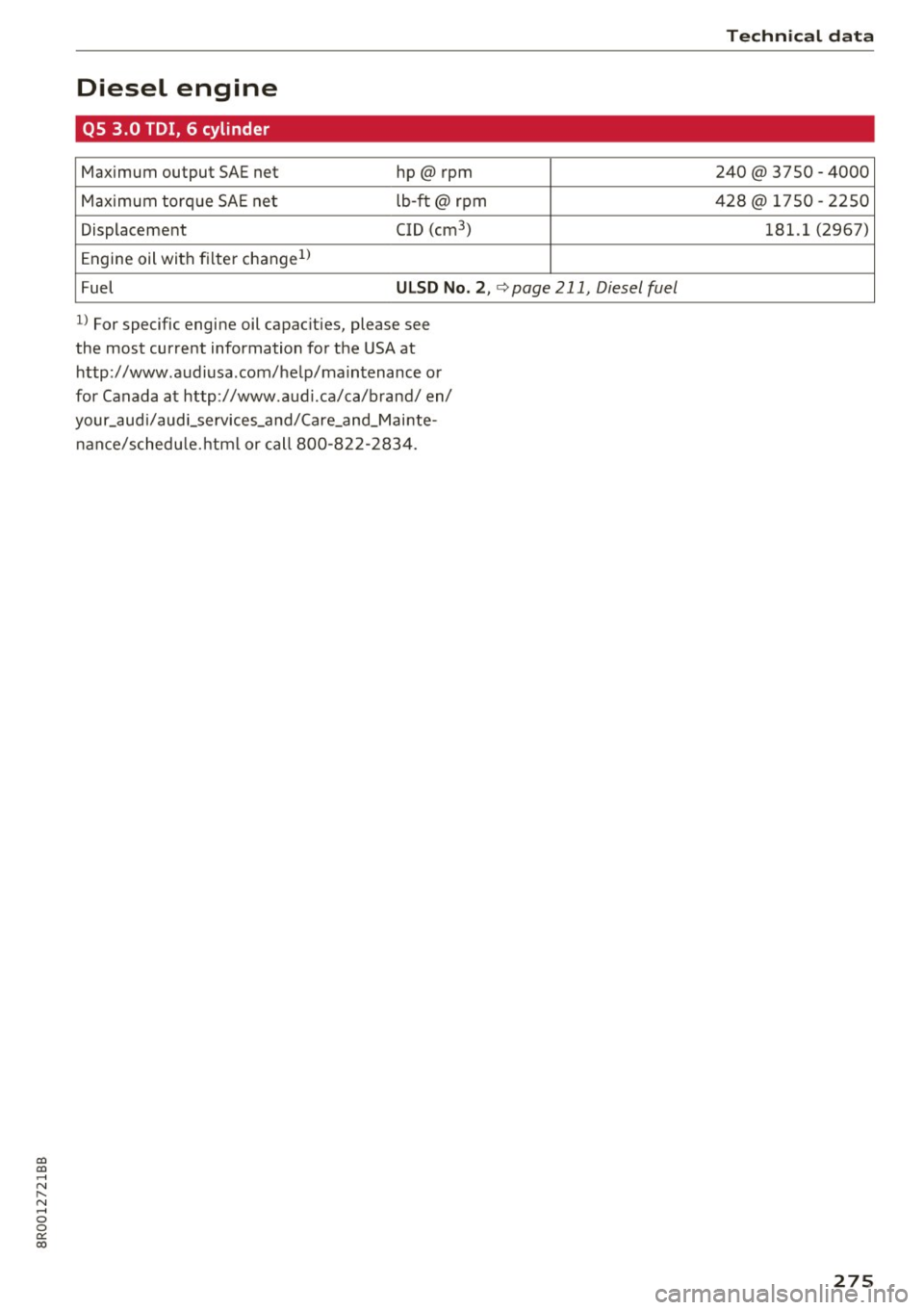
Diesel engine
QS 3.0 TOI, 6 cylinder
Maximum output SAE net hp@rpnn
Maximum torque SAE net lb-ft@ rpm
Displacement CID (cm
3
)
Engine oil with filter change1>
Fuel U LS D No . 2, c::> page 211, Diesel fuel
ll For specific engine oil capacities, please see
the most current information for the USA at
http:/ /www.audiusa.com/help/maintenance or
for Canada at http:/ /www.audi.ca/ca/brand/ en/
your _aud i/ aud i_services_a nd/Care_and_M a i nte
n a nce/ schedu le.html or call 800-822-2834.
Techn ical dat a
240@ 3750 -4000
428@ 1750 -2250
181.1 (2967)
275