2017 AUDI Q5 brake fluid
[x] Cancel search: brake fluidPage 203 of 296
CD
CD
.... N ,-... N ..... 0 0 C<'. 00
Operating instructions
6" r-2
~·~
1/2"
1·1/2"
ill
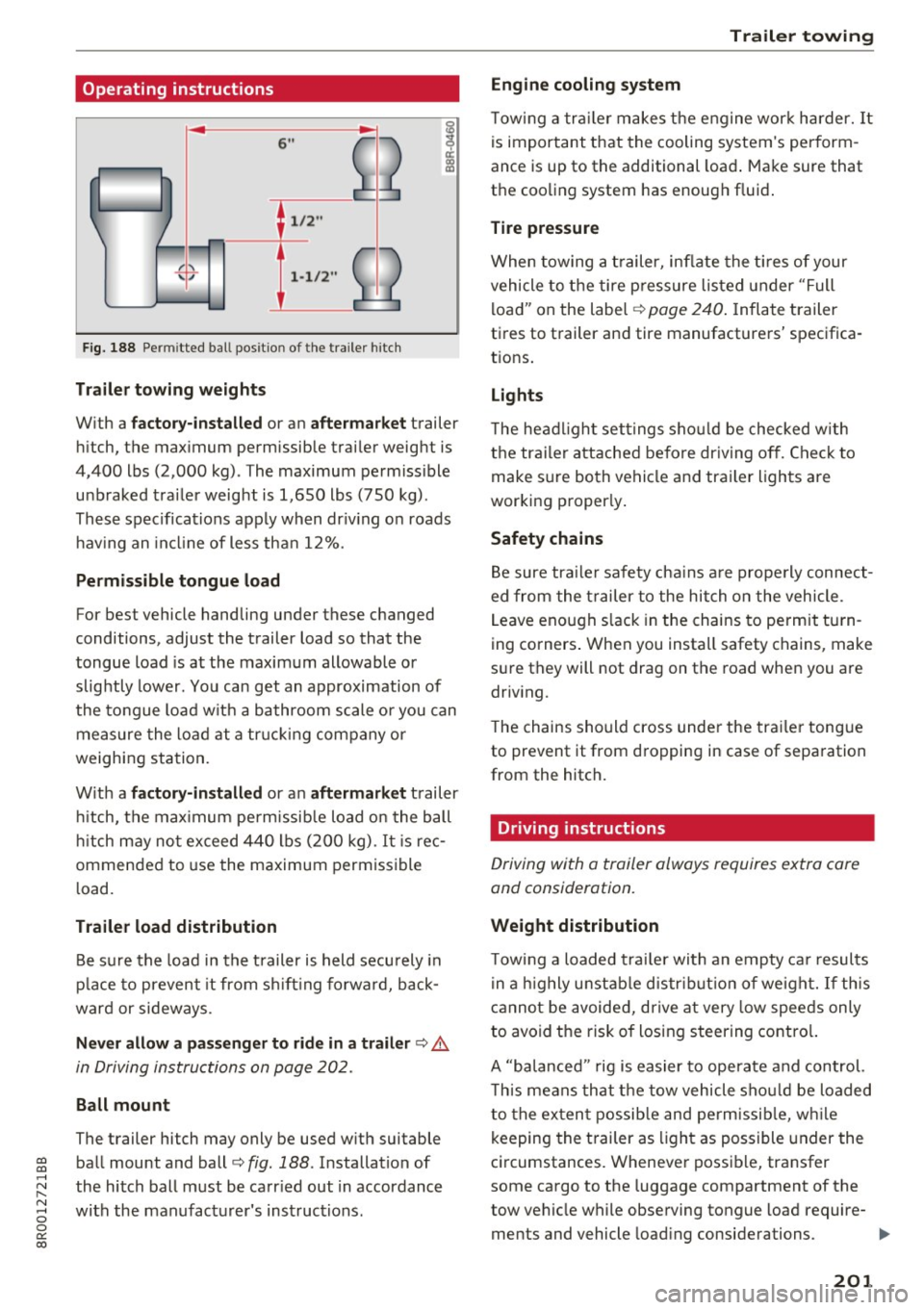
Fig. 188 Permi tted ba ll pos it io n of the trailer h itch
Trailer towing weights
With a
factory-installed or an aftermarket trailer
hitch, the maximum permissible trailer weight is
4,400 lbs (2,000 kg) . The maximum permissible
unbraked trailer weight is 1,650 lbs (750 kg).
These specifications apply when driving on roads having an incline of less than 12%.
Permissible tongue load
For best vehicle handling under these changed
conditions, adjust the trailer load so that the
tongue load is at the maximum allowable or
slightly lower. You can get an approximation of
the tongue load with a bathroom scale or you can
measure the load at a trucking company or
weighing station.
With a
factory-installed or an aftermarket trailer
hitch, the maximum permissible load on the ball
hitch may not exceed 440 lbs (200 kg) .
It is rec
ommended to use the maximum permissible
load.
Trailer load distribution Be sure the load in the trailer is held securely in
place to prevent it from shifting forward, back
ward or sideways.
Never allow a passenger to ride in a trailer ¢.&.
in Driving instructions on page 202.
Ball mount
The trailer hitch may only be used with suitable ball mount and ball¢
fig. 188 . Installation of
the hitch ball must be carried out in accordance
with the manufacturer's instructions .
Trailer towing
Engine cooling system
Towing a trailer makes the engine work harder. It
is important that the cooling system's perform
ance is up to the additional load. Make sure that
the cooling system has enough fluid.
Tire pressure
When towing a trailer, inflate the tires of your
vehicle to the tire pressure listed under "Full
load" on the label¢
page 240. Inflate trailer
tires to trailer and tire manufacturers' specifica
tions.
Lights
The headlight settings should be checked with
the trailer attached before driving off. Check to
make sure both vehicle and trailer lights are
working properly.
Safety chains
Be sure trailer safety chains are properly connect
ed from the trailer to the hitch on the vehicle .
Leave enough slack in the chains to permit turn
ing corners. When you install safety chains, make
sure they will not drag on the road when you are
driving.
The chains should cross under the trailer tongue
to prevent it from dropping in case of separation
from the hitch.
· Driving instructions
Driving with a trailer always requires extra care
and consideration.
Weight distribution
Towing a loaded trailer with an empty car results
in a highly unstable distribution of weight. If this
cannot be avoided, drive at very low speeds only
to avoid the risk of losing steering control.
A "balanced " rig is easier to operate and control.
This means that the tow vehicle should be loaded
to the extent possible and permissible, while
keeping the trailer as light as possible under the
circumstances. Whenever possible, transfer
some cargo to the luggage compartment of the
tow vehicle while observing tongue load require-
ments and vehicle loading considerations. .,.
201
Page 219 of 296

Checking and Filling Hood
Releasing the engine hood
The engine hood is released from inside the vehi
cle .
Fig. 194 Drive r's side footwell: e ng ine hood re lease lever
"' Wi th the driver's door open, pu ll th e leve r un
der the instrument panel in the direction of the
arrow ¢fig.194 .
The hood pops up s light ly unde r spri ng p ressure.
Opening the engine hood
Fi g. 19 5 Release lever under t he eng ine hood
Before opening the engine hood, make sure tha t
the w indshield wipe rs are fla t against the w ind
shie ld. Otherwise, they could d amage t he paint
on the hood .
"' Pull up on the release under the hood
~fig . 195. Th is releases the cat ch.
"' Open the hood all the way¢&,, .
a,
~ ,&. WARNING
r--
~ Hot engine coo lant can burn you. 0 0
0:
co
Checking and Filling
- To reduce the r isk of being burned, never
open the hood if you see or hear steam or
coo lant escaping from the engine compart
ment. Wa it until no steam or coolant can be
seen or hea rd before carefully ope ning t he
hood.
Closing the engine hood
"' Pull the hood down until the press ure from the
s truts is red uced.
"' Le t the hood
drop down and latch in p lace. Do
not try to push it shut ;
it may fail to engage
¢ &,, .
A WARNING
- -
A hood that is not completely latched co uld
f ly up and block your view while dr iv ing.
- When you close the engine hood, c heck it to
make sure the safety catch has prope rly en
gaged . The hood should be flush with the
sur rounding vehicle body parts .
- If you notice while driv ing that the hood is
not secured prope rly , stop at once and close
it .
Working in the engine compartment
Be especially careful whenever you work in the
engine compartment.
Whenever you must pe rfo rm any work in the
eng ine compa rtment , for e xample check ing and
fill ing diffe rent fluids, the re is a ris k of injury,
burns and acciden ts. To pre vent personal injur y
always ob serve the fo llowing WARNINGS . The
eng ine compartment of any vehicle is a hazard
ou s area
~ .&, .
A WARNING
To he lp avoid injury, befo re yo u check any
t h ing u nder the hood:
- Tur n off the engine.
- Remove the ig nitio n key .
- Apply the parking brake.
-
- Move selector lever of automatic t ransm is-
sion to P (Park).
217
Page 220 of 296

Checking and Filling
-Always let the engine cool down. Hot com
ponents will burn skin on contact .
- To reduce the risk of being burned, never
open the hood if you see or hear steam or
coolant escaping from the engine compart
ment. Wait until no steam or coolant can be
seen or heard before carefully opening the
hood.
- Keep children away from the engine com
partment.
- Never spill fluids on hot engine compo
nents . They can cause a fire.
- Never touch the radiator fan. The auxiliary
electric fan is temperature controlled and
can switch on suddenly.
- Never open the coolant reservoir cap when
the engine is still warm. The coolant system
is pressurized and hot coolant could spray
out .
- Protect your face, hands and arm from steam or hot engine coolant by placing a
thick rag over the cap when you open the coolant reservoir.
- Do not remove the engine cover under any
circumstances . This increases the risk of
burns.
- If work on the fuel system or the electrical
system is necessary:
- Always disconnect the battery.
- Never smoke or work near heaters or open flames. Fluids in the engine compartment
could start a fire.
- Keep an approved fire extinguisher imme
diately available.
- To avoid electrical shock and personal injury
while the engine is running or being started, never touch:
- Ignition cables
- Other components of the high voltage
electronic ignition system .
- If you must perform a check or repair with
the engine running:
- First, fully apply the parking brake, move
selector lever of automatic transmission
to P (Park).
218
- Always use extreme caution to prevent
clothing, jewelry, or long hair from get
ting caught in the radiator fan, V-belts or
other moving parts, or from contacting hot parts . Tie back hair before starting,
and do not wear clothing that will hang or
droop into the engine.
- Minimize exposure to emission and chemi
cal hazards
~ &.
&, WARNING
California Proposition 65 Warning:
- Engine exhaust, some of its constituents,
and certain vehicle components contain or
emit chemicals known to the State of Cali
fornia to cause cancer and birth defects and
reproductive harm. In addition, certain flu
ids contained in vehicles and certain prod
ucts of component wear contain or em it
chemicals known to the State of California
to cause cancer and birth defects or other
reproductive harm .
- Battery posts, terminals and related acces sories contain lead and lead compounds,
chemicals known to the State of California
to cause cancer and reproductive harms .
Wash hands after handling.
('.!) Note
When adding fluids, always make sure that
they are poured into the proper container or
filler opening, otherwise serious damage to
vehicle systems will occur.
@ For the sake of the environment
To detect leaks in time, inspect the vehicle
floor pan from underneath regularly . If you
see spots from oil or other vehicle fluids, have
your vehicle inspected by an authorized Audi dealer.
Page 221 of 296

a,
a,
..... N r-N ..... 0 0
0:
co
Checking and Filling
Engine compartment
Engine compartment
These are the most important items that you can check.
Fig. 196 Typical layout for containers and e ngin e oil fille r cap
(D Jump start po int(+) under a cover 227,267
@ Brake fluid reservoir (CO)) . . . . . . . 224
@ Engine oil filler cap(~) . . . . . . . 221
@ Coolant expansion tank (- L) . . . . . 223
® Jump start point( -) with hex head
screw . . . . . . . . . . . . . . . . . . . . . . . 227, 267
@ Windshield/headlight washer con -
tainer
(W) . . . . . . . . . . . . . . . . . . . 229
The position of the engine oil filling hole
c:> fig. 196 (item@) can differ depending on the
engine design .
A WARNING
Before you check anything in the engine com
partment, always read and heed a ll WARN
INGS
c:> &. in Working in the engine compart
ment on page 217.
Engine oil
Engine oil specifications
The engine oil used must conform to exact speci
fications.
T he serv ice interval display in the instrument
cluster of your vehicle will inform you when it is
time for an oi l change . We recommend that you
have your oi l changed by an authorized Audi Serv
ice Advisor.
If you have to top off the oil between oil changes,
use the Audi oil quality standard specified in the
tab~ .
~
219
Page 226 of 296

Checking and Filling
cooling system is not leakin g, a loss can come
from t he coolant boiling through overheat ing
an d be ing pushed out o f the coo ling system .
A WARNING
-
-The cooling system is under pressure. Do
not open t he coolant expansion tank ca p
when the eng ine is hot. This inc reases the
risk of bu rns .
- The coolant add itive and the coolant can be
dangerous to your health. For this reason,
keep the coolant in the o rigina l container
and away from children. There is a risk of
po isoning .
- When working in the eng ine compartmen t,
r emembe r that the rad iator fan ca n switch
on even if the ign ition is swi tc h ed off, which
in creases the risk of in jury.
(D Note
Do not add coolant if the expansion tank is
empty. Air could enter the cooling system and
damage the engine. If this is the case , do no t
cont inue driv ing. See an authorized Audi deal
er or author ized Audi Se rvice Facility for assis
tance .
Brake fluid
Checking brake fluid level
The brake fluid level can be checked with a quick
glance.
F ig. 19 9 En gi ne co mpa rtme nt: cove r on the brak e fluid
r ese rvoi r
N N
-N
" "' IX)
Before you check anyth ing in the eng ine compart
ment,
a lways read and h eed all WARNING S
224
¢.&. in Working in the engine compartment on
page 217.
.,. Read the bra ke fluid level from the brake f lu id
reservoir ¢
fig. 199, ~ page 219, fig. 196. The
brake fluid leve l must be between the "M IN"
and "MAX" markings.
The brake flu id reservoir is located a t the rear
partition of the engine compartment on the left
side
¢ page 219.
The fluid level may drop slightly afte r some t ime
due to t he automatic adjustme nt of the brake
pads. This is not ca use for a larm.
If the brake fluid level falls considerably below
the
" M IN " mark, the bra ke warn ing/ indica tor
li gh t (U.S. models:
11111 . Canadian models: .
will come on ¢
page 15 and¢ page 25. Do not
continue to ope rate the veh icle. The comp lete
brake system shou ld be thoroughly checked by an
a uthor ized Audi dealer or qualified workshop and
the cause corrected. If the brake fluid level is too l ow, the brake warn ing/ indicator light w ill illumi
nate. Contact a n author ized Audi dealer
immedi
ately .
Chang ing brake fluid
Have the brake fluid changed by an experienced
technician .
Brake fluid absorbs moisture from the air. If the
water content in the brake fluid is too high, cor
rosion in the brake system may result after ape
riod of time . The boiling po int of the brake fluid
will a lso decrease considerably and decrease
bra king pe rformance.
Therefore, the brake fluid must be changed
every
two years .
Always use new brake f lu id which con
fo rms to Federa l Moto r Vehicle S tandard " FMVSS
116 DO T 4".
The brake fluid reservoir can be diff icult to reach,
therefore, we recommend that you have the
brake fluid changed by your author ized
Audi
dealer .
Your dealer has the correct tools, the
right brake fluid a nd the know -how to do t his for
you . ..,.
Page 227 of 296

CD
CD
.... N ,-... N ..... 0 0 C<'. 00
& WARNING
-Brake fluid is poisonous. It must be stored
only in the closed original container out of
the reach of children!
- Brake failure can resu lt from old or inappro
priate brake fluid. Observe these precau
t ions:
- Use only brake flu id that meets SAE speci
fication
J 1 703 and confo rms to Fede ral
Motor Vehicle Standard 116. Always check
with your author ized Audi dealer to make
sure you are using the correct brake fluid.
The correct type of brake fluid is a lso indi
cated on the brake flu id reservoir.
- The brake fluid must be new. Heavy use o f
the brakes can cause a vapor lock if the
brake fl uid is left in the system too long.
This can serious ly affect the efficiency of
the brakes as well as your safety. This
could result in an acc ident.
Brake fluid w ill damage the pa int of yo ur vehi
cle.
@) For the sake of the environment
Because of the prob lem of proper disposal of
brake flu id as we ll as the special tools re
qui red and the necessary expertise, we rec
ommend that you have the brake fluid
changed by your author ized Audi dealer.
Battery
General information
Under normal operating conditions, the battery
in your Audi does not need any maintenance.
W ith
high outside temperatures or long da ily
drives we recommend that you have the electro lyte level checked by an authorized Audi dea ler or
qua lified workshop. The e lectrolyte level should
a lso be checked each t ime the batte ry is charged
¢ page 22 7.
H ave the battery checked when you take your ve
hi cle in for serv ice. You a re well advised to re
p lace a batte ry that is o lde r than 5 years .
Check ing and Filling
Hybrid dr ive *: you can find important in format ion
about the high voltage battery under
¢ page 100.
Disconnecting the battery te rminals
Some vehi cle functions (power window regula
tors, for examp le) are lost if the batte ry te rm i
nals a re disconnected . These functions have to be
re learned after the battery terminals a re con
nected again. To prevent this, the battery should
only be disconnected from the vehicle electrical
system when absolutely necessary for repa irs.
Vehicles not dr iven for long p eriod s
If you do not drive your vehicle over a period of
severa l days or weeks, electrical compone nts are
gradually cut back or switched off. This reduces
energy consumpt ion and maintains starting ca
pability over a longer per iod
¢ page 192.
T ake into consideratio n that when you unlock
your vehicle, some convenience functions, suc h
as the inter ior lights or the power seat adjust
ment, may not be ava ilab le. The conve nience
funct ions will be available again when you turn
on the ignition and sta rt the eng ine.
Winter operation
D uring the winter months, battery capacity tends
to decrease as temperatures drop. This is be
cause more power is also consumed while start
i ng, and the headlights, rear w indow defogger,
etc., are used more ofte n.
Avo id unnecessary power consumption, pa rtic u
larly in city traff ic or when traveling only short
distances . Let your author ized Audi dealer check
the capacity of the veh icle batte ry before winter
sets in
¢ page 22 7. A we ll charged batte ry will
not only p reve nt start ing prob lems when the
wea the r is co ld, but will also last longer.
Working on the battery
Be especially careful when working on or near
the battery.
T he battery is loca ted in t he luggage compart
ment unde r the floo r. B efo re yo u check any thing .,..
225
Page 282 of 296

Index
A
A/C (climate control) . . . . . . . . . . . . . . . . . . . 78
Accessories . . . . . . . . . . . . . . . . . . . . . . . . . . 278
Active lane assist
Cleaning the camera area . . . . . . . . . . . . . 205
Adaptive cruise control. . . . . . . . . . . . . . . . . 109
Cleaning the sensor . . . . . . . . . . . . . . . . . . 205
Indicator lamp . . . . . . . . . . . . . . . . . . . . . . 111
M essages . . . . . . . . . . . . . . . . . . . . . . . . . . 116
Request for driver intervention . . . . . . . . . 114
Setting the distance............... ... 113
Setting the driving program . . . . . . . . . . . 114
Adaptive dampers . . . . . . . . . . . . . . . . . . . . . 122
Adaptive light .. .. ............. .... .. .. 51
Defective . . . . . . . . . . . . . . . . . . . . . . . . . . . 31
AdBlue .... .. .. .... ........... ....... 214
Messages . . . . . . . . . . . . . . . . . . . . . . . . . . 214
Opening the tank door ............... . 215
Refilling . .. .. .... ........... .... ... 215
Adding Engine oil .......................... 221
Windshield washer fluid . . . . . . . . . . . . . . 229
Additional accessories
Additives 278
Engine oil . . . . . . . . . . . . . . . . . . . . . . . . . . 221
Adjusting Air distribution (climate control) . . . . . . . . 78
Instrument illumination . . . . . . . . . . . . . . . 53
Steering column manually . . . . . . . . . . . . . 81
Temperature (climate control) . . . . . . . . . . 78
Airbag . . . . . . . . . . . . . . . . . . . . . . . . . . . . . . 148
Airbag system . . . . . . . . . . . . . . . . . . . . . . . . 164
Advanced Airbag-System . . . . . . . . . . . . . . 152
Advanced Airbag System components . . . 154
Care . . . . . . . . . . . . . . . . . . . . . . . . . . . . . . 161
Children . . . . . . . . . . . . . . . . . . . . . . . . . . . 169
Child restraints . . . . . . . . . . . . . . . . . . . . . 170
Components (front airbags) . . . . . . . . . . . 154
Danger of fitting a child safety seat on the
front passenger seat . . . . . . . . . . . . . . . . . 149
Disposal . . . . . . . . . . . . . . . . . . . . . . . . . . . 161
Front airbags . . . . . . . . . . . . . . . . . . . 152, 153
How do the front airbags work? . . . . . . . . 156
How many airbags does my vehicle have? 154
How the Advanced Airbag System compo-
nents work together . . . . . . . . . . . . . . . . . 156
280
Important information . . . . . . . . . . . . . . . 148
Monitoring . . . . . . . . . . . . . . . . . . . . . . . . . 158
PASSENGER AIR BAG OFF light . . . . . . . . . 159
Repairs . . . . . . . . . . . . . . . . . . . . . . . . . . . . 161
Safety instructions . . . . . . . . . . . . . . . . . . . 160
Side airbags . . . . . . . . . . . . . . . . . . . . . . . . 162
Side curtain airbags . . . . . . . . . . . . . . . . . . 165
Warning/indicator lights . . . . . . . . . . . . . . . 13
Warning/Indicator lights . . . . . . . . . . . . . 158
Weight-sensing mat . . . . . . . . . . . . . . . . . 170
When must the system be inspected? . . . 158
Air transport . . . . . . . . . . . . . . . . . . . . . . . . . 108
All-wheel drive ....................... 192
Selective wheel torque control . . . . . . . . . 186
All season tires
Alternator 245
Malfunction . . . . . . . . . . . . . . . . . . . . . . . . . 25
Anti-lock brake system Warning/indicator lights . . . . . . . . . . . . 13, 14
Anti-Lock Braking System . . . . . . . . . . . . . . 186
Anti-slip regulation Warning/indicator lights . . . . . . . . . . . . . . . 13
Anti-Slip Regulation . . . . . . . . . . . . . . . . . . . 186
Anti-theft alarm warning system . . . . . . . . . 35
Electronic immobilizer . . . . . . . . . . . . . . . . . 35
Approach/departure angle....... ..... .. 198
Ashtray . . . . . . . . . . . . . . . . . . . . . . . . . . . . . . 73
Audi braking guard
refer to Braking guard 115
Audi drive select Indicator light . . . . . . . . . . . . . . . . . . . . . . 191
also refer to Drive select . . . . . . . . . . . . . . 122
Audi parking system plus with rearview cam-
era . . . . . . . . . . . . . . . . . . . . . . . . . . . . . . . . . 125
Adjusting the display . . . . . . . . . . . . . . . . . 130
Adjusting the warning tones . . . . . . . . . . . 130
Rearview camera -parking mode 1 . . . . . . 128
Rearview camera -parking mode 2 . . . . . . 129
Safety precautions . . . . . . . . . . . . . . . . . . . 125
Switching on and off . . . . . . . . . . . . . . . . . 127
Trailer hitch . . . . . . . . . . . . . . . . . . . . . . . . 130
Audi Service Repair Manuals and Literature 276
Auto-Check Control . . . . . . . . . . . . . . . . . . . . 24
Auto locking . . . . . . . . . . . . . . . . . . . . . . . . . . 35
Automatic belt retractor . . . . . . . . . . . . . . . 143
Automatic driving light control . . . . . . . . . . . 49
Automatic Shift Lock (ASL) . . . . . . . . . . . . . . 95
Page 283 of 296

Automatic transmission . . . . . . . . . . . . . . . . . 94
Automatic Shift Lock (ASL) . . . . . . . . . . . . . 95
Driving . . . . . . . . . . . . . . . . . . . . . . . . . . . . . 96
Emergency mode . . . . . . . . . . . . . . . . . . . . . 98
Emergency release . . . . . . . . . . . . . . . . . . . . 99
H ill descent control . . . . . . . . . . . . . . . . . . . 97
Kick-down . . . . . . . . . . . . . . . . . . . . . . . . . . . 98
Manual shift program . . . . . . . . . . . . . . . . . 98
Removal lock (ignit ion key) . . . . . . . . . . . . . 81
Selector lever . . . . . . . . . . . . . . . . . . . . . . . . 94
Shift paddles . . . . . . . . . . . . . . . . . . . . . . . . 98
Automatic wipe/wash system . . . . . . . . . . . . 54
Auto Safety Hotline . . . . . . . . . . . . . . . . . . . 138
AUTO (climate control) . . . . . . . . . . . . . . . . . . 78
Average speed . . . . . . . . . . . . . . . . . . . . . . . . 19
Avoid damaging the vehicle . . . . . . . . . . . . . 195
B
Bass box . . . . . . . . . . . . . . . . . . . . . . . . . . . . 251
Battery . . . . . . . . . . . . . . . . . . . . . . . . . . . . . 225
Battery location inside the luggage compart
ment .. .. .. .. ...... ......... .. .. .. . 225
Charge level . . . . . . . . . . . . . . . . . . . . . . . . 192
Charging . .. .. ............... .. . 107,227
Energy management . . . . . . . . . . . . . . . . . 192
Impor tant warnings when working on the
battery . . . . . . . . . . . . . . . . . . . . . . . . . . . . 225
Jump starting . . . . . . . . . . . . . . . . . . . . . . . 266
Replacing the battery . . . . . . . . . . . . . . . . 228
Voltage . . . . . . . . . . . . . . . . . . . . . . . . . . . . . 30
Winter operation . . . . . . . . . . . . . . . . . . . . 225
Working on the battery . . . . . . . . . . . . . . . 225
Before driving . . . . . . . . . . . . . . . . . . . . . . . . 131
Belt tensioners . . . . . . . . . . . . . . . . . . . . . . . 146
Bio-ethanol (Fuel)....... ..... ... ... .. . 210
Blended gasoline . . . . . . . . . . . . . . . . . . . . . 209
Blower (climate control) . . . . . . . . . . . . . . . . 78
Booster seats . . . . . . . . . . . . . . . . . . . . . . . . 176
B ra ke fluid
Changing the brake fluid . . . . . . . . . . . . . . 224
Checking the brake fluid l evel . . . . . . . . . . 224
Brake system
Anti-lock brake system . . . . . . . . . . . . . . . . 14
~ Brak e booster . . . . . . . . . . . . . . . . . . . . . . . 190 ....
~ Brake fluid . . . . . . . . . . . . . . . . . . . . . . . . . 224
8 Brake fluid specifications for refill and re-
~ placement . . . . . . . . . . . . . . . . . . . . . . . . . 224 00
Index
Brake light defective . . . . . . . . . . . . . . . . . . 29
Brakes . . . . . . . . . . . . . . . . . . . . . . . . . . . . . 190
Electromechanical parking brake . . . . . . . . 86
Fluid reservo ir . . . . . . . . . . . . . . . . . . . . . . 224
Malfunction . . . . . . . . . . . . . . . . . . . . . . . . . 25
Warning/indicator lights . . . . . . . . . . . . . . . 15
Worn brake pads symbol . . . . . . . . . . . . . . . 29
Braking Brake assist . . . . . . . . . . . . . . . . . . . . . . . . 186
Braking guard . .. . ... ............. 109, 115
Messages . . . . . . . . . . . . . . . . . . . . . . . . . . 116
Settings . . . . . . . . . . . . . . . . . . . . . . . . . . . 116
Switching on and off . . . . . . . . . . . . . . . . . 116
Break -in per iod
Brake pads . . . . . . . . . . . . . . . . . . . . . . . . . 190
Ti res . . . . . . . . . . . . . . . . . . . . . . . . . . . . . . 194
Breaking in . . . . . . . . . . . . . . . . . . . . . . . . . . 194
New tires . . . . . . . . . . . . . . . . . . . . . . . . . . 237
Breakover angle . . . . . . . . . . . . . . . . . . . . . . 198
Bulbs . . . . . . . . . . . . . . . . . . . . . . . . . . . . . . . 264
C
Californ ia Proposition 65 Warning 218
Battery specific . . . . . . . . . . . . . . . . . . . . . 227
Capacities . . . . . . . . . . . . . . . . . . . . . . . . . . . 273
AdBlue . . . . . . . . . . . . . . . . . . . . . . . . . . . . 214
Engine oil ....... .. ................. 219
Care . . . . . . . . . . . . . . . . . . . . . . . . . . . . . . . . 204
Cargo area
refer to Loading the luggage compart-
ment...... ... . ... ................. 136
Cargo floor . . . . . . . . . . . . . . . . . . . . . . . . . . . 68
Catalytic converter . . . . . . . . . . . . . . . . . . . . 194
Cente r armrest
Adjusting . . . . . . . . . . . . . . . . . . . . . . . . . . . 65
Storage compartment . . . . . . . . . . . . . . . . . 65
Centra l locking . . . . . . . . . . . . . . . . . . . . . . . . 35
Certification . . . . . . . . . . . . . . . . . . . . . . . . . 279
Changing Engine oil . . . . . . . . . . . . . . . . . . . . . . . . . . 222
Child restraints
Danger of using child restra ints in the front
seat...... .... .. .. ............... .. 149
System anchors . . . . . . . . . . . . . . . . . . . . . 181
Where can I get additional information
about child restraints and their use? . . . . 185
281