2017 AUDI A5 CABRIOLET brake
[x] Cancel search: brakePage 97 of 266

a:,
a:,
...... N r--. N ...... 0
0
LL 00
Audi adapt ive cruis e control and braking gua rd
promptly detected or may not be detected
at all.
- Reflective surfaces including crash barriers
or tunnel entrances may impair the function
of the radar sensor.
(D Tips
- You can cancel the braking that is initiated
by the system by braking yourse lf, by accel
erating noticeably or by swerving.
- Braking guard error messages ¢
page 95.
-Keep in mind that braking guard can brake
unexpected ly. Always secure any cargo or
objects that you are transporting to reduce
the risk of damage or injury.
Settings in the radio/MM!
A ppl ies to: vehicl es with Audi adaptive cruise co ntro l
... Se lect : I CARI funct ion button > C ar s ystem s*
control button > Driver a ssi st > Audi brak ing
guard .
Or
... Select:
~I C-A-R~I funct ion button > A udi braking
g uard .
S ystem -
Switch Audi braking guard On and Off.
When you sw itch the ignition on, the message
Audi bra king gua rd off appears if the system is
switched off.
Ea rly warn ing -The distance and approach warn
ings in the display can be switched
On/ Off.
(D Tips
-Your settings are automatically stored and
ass igned to the remote control key being
used at the times the sett ings are made.
- If you restrict or sw itch off the ESC, the
braking guard also sw itches itself off
¢ page 168 .
- Switch braking guard off when you are load
ing the veh icle onto a vehicle ca rr ier, train,
sh ip or other type of transportation . This
can p revent undesired warnings from the
braking gua rd system.
Messages
Applies to: vehicles wi th Aud i adapt ive c ruise control
Braking guard : Off
This dr iver message appears if the system is
tu rned off via the radio/MM I*. O therwise, if the
system is turne d off, the information appears ev
ery time shortly after t he start o f the trip .
T he driver message a lso appea rs if the system is
not avai lab le due to a ma lfunction o r if the ES C i s
not switched on
¢ page 168 . If th is is the case,
the system wi ll not provide warnings about a
possib le collision .
Braking guard : Ac tivated
This dr iver message appears if sharp brake pres
su re was applied due to an acute warning .
•••
Three white dots appear if a setting cannot be se
l ected with the operating lever. For example, this
happens if you want to raise/lower the speed
even though there was no previously saved
speed .
ACC: Sen sor bloc ked
T his message appears if the senso r view is ob
structed, for examp le by leaves, snow, heavy
spray or dirt. Clean the sensor ¢
page 88,
fig. 102.
ACC : not avail able
The dr iver message appears if there is a malfunc
t ion. The adaptive cruise control tu rns off. A
c hi me so unds as a reminde r. Have the system
c h ecke d by an author ized Audi dealer or au thor
ized Audi Se rvice Facility .
ACC: unavailable
The driver message appears if, for examp le, the
brake temperature is too high . The adapt ive
c ruise co ntro l is temporarily u navailable . A chime
sou nds as a reminder.
Shift lever posi tion!
The driver message appears if the se lector lever
is shifted to the N position. The adapt ive cru ise
contro l is not available wh ile in this position.
Ill>
95
Page 98 of 266

Audi adaptive cruise control and braking guard
Stabilization control (ESC )
This message appea rs if the elect ronic stab iliza
tion con tro l (E 5C) is t akin g action to st abiliz e t he
ve hicl e. The a dap tive cr uise control tu rns o ff. A
chime soun ds as a rem inder .
Speed too low
This message appea rs if the current speed is too
low
to set or to maintain the des ired speed.
The speed being saved m ust be at least 20 mph
(3 0 km/h). The cru ise cont rol is turned off for
speeds lowe r than 12 mph (20 km/h) . The adap
tive cruise contro l remai ns tu rned on for speeds
above 95 mph (150 km/ h) (over ride) .
It will sta
b iliz e again at 95 mph (150 km/ h) w hen t he d riv
e r ta kes hi s fo ot off of the gas ped al.
Parking brake!
The drive r message appea rs when the park ing
brake is activated. Adaptive c ruise contro l is
turned off. A chime sounds as a remi nder .
96
Page 118 of 266
Driving sa fe ty
the a irbag dep loys and injure you or yo ur
passengers.
Pedal area
Pedals
The pedals must always be free to move and
must never be interfered with by a floor mat or
any other object.
Make sure that all pedals move freely without in
terference and that noth ing prevents them from
retu rni ng to the ir origi nal positions.
Only use floor mats that leave the pedal area free
and can be secured with floor mat fasteners.
If a brake circuit fails, increased brake pedal trav
el is required to br ing the veh icle to a full stop.
_&. WARNING
Peda ls that cannot move free ly can cause loss
of vehicle control and increase the risk of seri
ous inj ury.
- Never place any objects in the driver's foot
well. An object could get into the pedal area
and interfere w ith pedal function . In case of
s u dden brak ing o r an accident, you would
not be ab le to bra ke or accelerate!
- Always make sure that nothing can fa ll or
move into the dr ive r's footwell.
Floor mats on the driver side
Always use floor mats that can be securely at
tached to the floor mat fasteners and do not in
terfere with the fre e movement of the pedals .
... Make sure that the floor mats are properly se
cured and cannot move and interfere with the
peda ls ~ .&_ .
Use on ly floor mats that leave the pedal area un
obstructed and that are firmly secured so that
they cannot slip o ut of pos ition . Yo u ca n obtain
suitable floo r mats from you r authorized Aud i
dea le r.
F loor mat fasteners are insta lled in your Audi.
116
Floor mats used in your vehicle must be attached
to these fasteners. Properly securing the floor
mats will prevent them from slid ing into posi
tions that could interfere with the pedals or im
pair safe operat ion of your vehicle in other ways.
_&. WARNING
Pedals that ca nnot move freely can res ult in a
loss of vehicle co ntro l and increase the r isk of
serious pe rsonal injury.
-Always make sure that floo r mats a re prop
erly secured.
- Never p lace or install floor mats o r other
floor coverings in the vehicle that cannot be
proper ly sec ured in place to prevent them
from s lipping and interfer ing wi th t he ped
al s or the ab ili ty to cont ro l t he vehicle.
- Never p lace or ins tall floor mats o r other
floor coverings on top of a lready installed
floor m ats. Addi tional floor ma ts and o ther
cover ings will reduce the size o f th e pedal
area and interfere with the pedals.
- Always proper ly re insta ll and se cure floo r
mats tha t have been taken ou t for cleaning.
- Alway s make sure th at o bje cts canno t fall
into the driver foo twell whi le the vehicle is
mov ing. Objects can become trapped under
the brake pedal a nd accelerator pedal caus
ing a loss o f vehicle control.
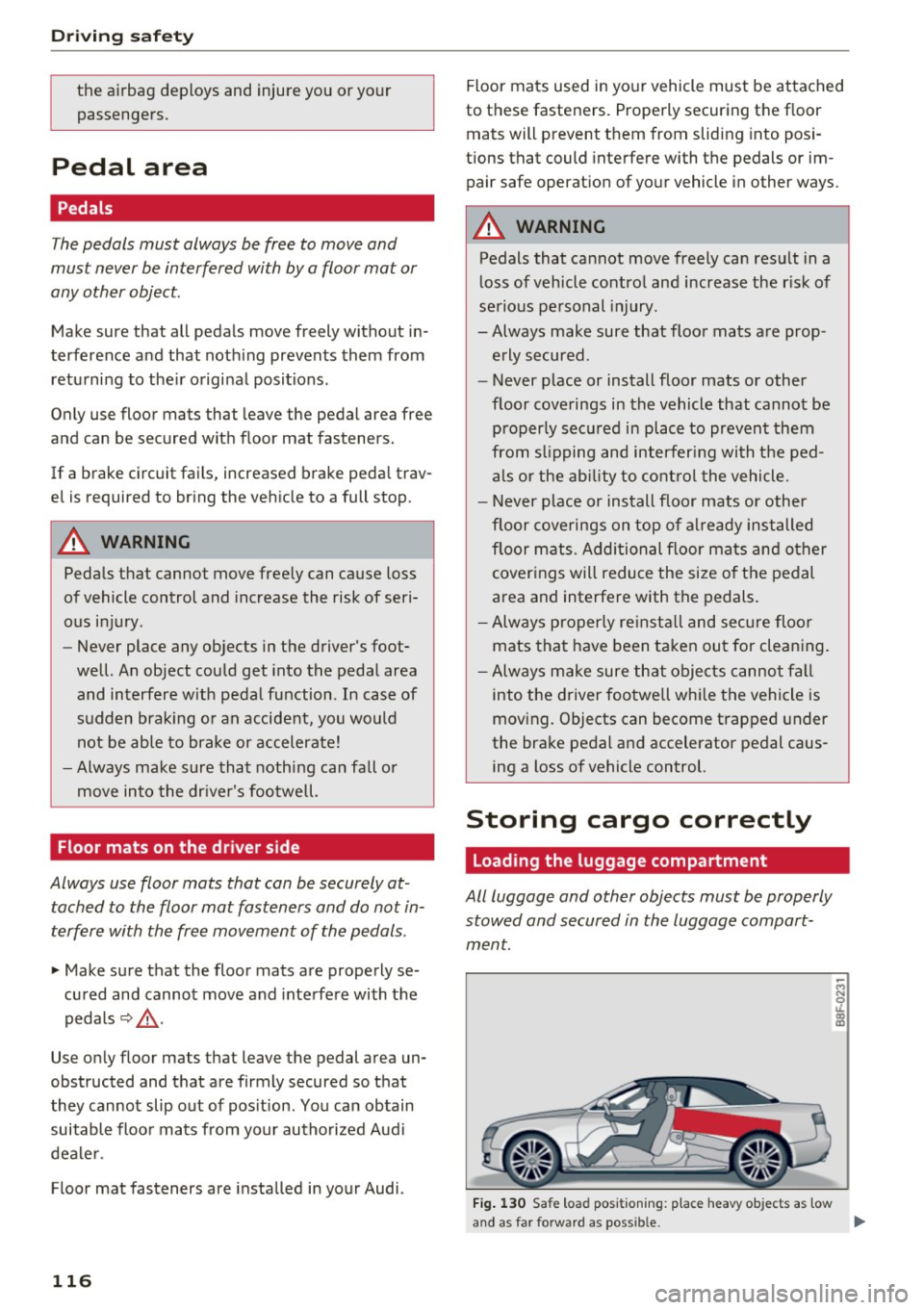
Storing cargo correctly
Loading the luggage compartment
All luggage and other objects must be properly
stowed and secured in the luggage compart
ment .
Fig. 13 0 Safe load pos it ion ing: p lace heavy objects as low
-M N 0 oL CD m
an d as far forwa rd as possible. .,.
Page 169 of 266

Intelligent Technology Electronic Stabilization
Control (ESC)
Description
ESC helps to improve road ho lding and vehicle
dynamics to help reduce the probability of skid
ding and loss of vehicle control. It works only
when the engine is runn ing . ESC detects certain
d ifficult driving situat ions, including when the
vehicle is beginn ing to spin (yaw) out of control
and helps you to get the veh icle back under con
tro l by selectively braking the wheels , and/or re
ducing engine powe r and provid ing steering as
sistance to help ho ld the veh icle on the driver 's
intended course. The indicator light
bJ in the in
strument cluster blinks when ESC is taking action
to help you contro l th e vehicl e.
The follow ing systems a re integr ated in the ESC:
Anti -lock braking system (ABS )
ABS preve nts the wheels from lock ing up when
b raking . The ve hicle can still be stee red even dur
in g ha rd brak ing . Apply steady pressure to the
b rake pedal. Do not p ump the pedal. A pu lsing in
the brake pedal indicates tha t the system is help
ing you to brake the vehicle .
Brake assist system
The brake assist sys tem can dec rease braking dis
tance .
It increases brak ing power when the d rive r
pr esses the brake pedal q uickly in eme rge ncy sit
uations . You m ust press and hold the b rake pedal
unti l the situation is over . In vehicles with adap
tive cruise control* , the brake assist system is
mo re sensitive if the distance det ected to the ve
h icle ahead is too small.
Anti -slip regulation (ASR)
ASR red uces eng ine power when the drive wheels
begin to spin and adapts the force to the road
conditions. This makes it easier to start, acceler
ate and dr ive up h ills.
gi Electronic differential lock (EDL ) ...... N
~ The ED L br ak es w heels that a re spi nnin g and
8 trans fers the drive power to the othe r drive LL 00
Intellig ent Technology
whee l or wheels if the vehicle is equ ipped with
all-wheel drive*. This function is not avai lable at
highe r speeds.
In extreme cases , EDL automat ic all y swi tches off
to help keep t he b rake on the braked wheel from
overheating . EDL will switch on again automati
ca lly when cond itions have returned to normal.
Steering recommendation
T he ES C helps to s tabilize the vehicle by changing
the s teering torque.
In veh icles with dynamic steer ing*, ESC a lso
helps to stab ilize the steer ing in crit ica l sit ua
tions.
Electronic interaxle differenti al lock */
selective wheel torque control*
T he elect ronic inte raxle d iffere ntial lo ck (front
whee l dr ive) o r the sele ct ive whee l torque co ntro l
(a ll w heel d rive) operates when driving thro ugh
cu rves. The front wheel on the inside of the curve
o r both wheels on the inside of the curve are
braked selectively as needed. This allows more
precise driving in curves . The applicab le system
may not activate when driving in wet or snowy
condit ions .
A WARNING
--The ESC and i ts integrated systems ca nnot
overcome the laws of physics. This is espe
cially importa nt on slippery or wet roads. If
the systems begin act ing to sta biliz e your
veh icle, you shou ld immedi ate ly change
your speed to match the road and traffic conditions. Do not let the increased safety
provided by these systems tempt yo u to
take risks. Doing so will increase the risk of
a loss of vehicle control, collision and seri
ous personal injur ies .
- Always adapt your speed to road, traffic and
weather conditions . The risk of losing con
trol of the vehicle increases when driv ing
too fast, especially through curves and o n
slippe ry o r wet roads , and whe n driving too
close to ve hicl es up ahea d. The ESC and its
integ ra t ed systems cannot always preven t
collis ions -the re is s till a risk o f accidents!
167
Page 172 of 266

Intelligent Technology
These electronic control modules record data
dur ing normal vehicle operation that may be
needed by trained technicians for diagnostic and
repair purposes. The recording capability of these
modules is l imited to data (no sound is record
ed). Only a small amount of data is actually re
corded over a very limited per iod of time, or stor
ed when a system fau lt is detected by a control
mod ule. Some of the data stored may re late to
ve hicl e speed, dire ct ion, or brak ing, as well as re
stra int system use and performance in the event
of a crash. Stored data can also only be read and
downloaded with special equipment that is di rectly connected to the veh icle.
@ Tips
Your vehicle may be equipped with Audi con
nect. Your use of certain Audi connect fea
tures requires wireless services that are pro
vided by a third party wire less te lecommuni
cations provider. For detai ls regarding how in
formation obtained through Audi connect is collected, processed, t ransmitted, used, and
shared, please see your contract with the
w ireless te lecommunica tions p rovider and the
"About Aud i connec t" tab in your vehi cle's
M M I:
!MENUI b utton> Audi connect > About
Audi conne ct.
Braking
What affects broking efficiency?
New brake pads
During the fi rs t 250 miles (400 km), new b rake
pads do not possess the ir full braking effect, they
have to be "broken in" first ¢.& . You can com
pensate for this s light ly reduced bra king power
by pushing harde r on the brake pedal. Avoid
heavy braking loads during the break-in period .
Operating conditions and driving habits
The brakes on today's automobiles a re st ill s ub
ject to wea r, depending la rgely on ope rating con
ditions and driving habits¢.&, . On vehicles that
are either dr iven most ly in stop-and-go city traf
f ic or are driven hard, the brake pads should be
checked by your authorized Aud i dea ler more of
ten than specified in the
War ranty & Mainte-
170
nance booklet . Failure to have your brake pads
inspected can result in reduced brake perform
ance.
On steep slopes, you should use the bra king ef
fect o f the engine. This way, you prevent unnec
essary wear on the brake system. If you must use
your brakes, do not ho ld the brakes down contin
uously. Pump the brakes at intervals.
Ope rating nois e
Noises may occu r when braking depen ding on the
speed, braking force and outside conditions such
as temperature and h umidity.
Effect of water and road salt
In certain si tuations, for examp le after d riving
t hr ough water, in heavy rain, after over nigh t con
densa tion or after washing your car, the brak ing
effect can be reduced by moisture or ice on the
brake rotors and brake pads . The brakes must be
dried f irst with a few careful brake app lications.
At higher speeds and w ith the windshield wipe rs
turned on, the brake pads press against the brake rotors for a short amount of time . This occurs at
regu lar intervals without the dr iver not icing and
provides for better brake response t ime under
wet cond itions .
The effectiveness of the brakes can be reduced
when the vehicle is driven on a salt-covered road
and the brakes are not used. Likewise, you clean
off accumulated salt coating from brake discs
and pads with a few caut ious applications of the
brake ¢.& .
Corrosion
There may be a tendency for dirt to build up on
the brake pads and corrosion to form on the discs
i f the car is not driven regularly or only for short
trips with little use of the brakes .
If the brakes are not used frequently, or if corro
s io n has formed on the discs, it is advisable to
clean off the pads and discs by braking firmly a
few times from a moderately high speed ¢ .& .
Page 173 of 266

a:,
a:,
...... N r--. N ...... 0
0
LL 00
Fa ults in the brake system
If yo u should notice a sudden increase i n brake
pedal travel, then one of the two brake circuits
may have failed
¢ .&. .
Low brake fluid level
Malf unct ions can occur in the bra ke system if the
b rake fl uid leve l is too low. The brake fluid level
i s monitored e lectronica lly .
Bra ke booste r
The brake booster increases the pressure that
you generate with the brake pedal.
It works on ly
when the engine is run ning
.¢ .&.
Bra ke lining we ar status
Brake lining wear may be checked by visual in
spection of the condition of the brake pads
through the open ings in the wheel. If necessary,
the wheel may be removed for this inspection
¢ page 228, Replacing wheels.
A WARNING
- New bra ke pads don't have the best stop
ping power and must be "bro ken- in" dur ing
the init ia l 250 m iles (400 kilometers). Yo u
can compensate for th is by press ing the
brake pedal more firmly. This a lso applies
later when new pads are installed.
- Yo u should perfo rm braking maneuvers for
the p urpose of clean ing the brake system
only if road conditions permit. Other road
users must not be put at risk -you may
cause an accident!
- Before descending a steep grade, reduce
speed and shift t ransm iss ion into a lower
gear or lowe r driving range. Do not ride the
brakes or hold the pedal down too long or
too often. This could ca use the brakes to get
hot and diminish brak ing efficie ncy.
- Do not "r ide t he b rakes" by resting your foot
on the pe dal when yo u do not inten d to
bra ke. This may cause the bra kes to over
heat, premat ure wear and increased stop
ping distance.
- Under certa in climatic and operating condi
tio ns such as passing thro ugh water, driving
in heavy rain or after washing the vehicle,
Intellig ent Technology
the effectiveness o f the brakes can be re
duced. In winter, ice can accum ulate on the
brake pads, lin ings, d iscs and drums . Care
fu lly apply brakes for a test . Brakes will dry
and ice coat ings will be cleaned off after a
few ca refu l brake applications .
- Driving for an extended period of t ime on
salt-covered roads without usi ng your
b rakes can also affect braking eff iciency.
Clea n off acc umul ated salt coat ing from
b rake discs an d pa ds w ith a few careful
b rake appli cat ions .
- I f you d amage the front spoile r, or if you in
s t all a different spoiler, be s ure the a ir flow
to the front brakes is not obstruc ted. Other
wise the brake system could overheat reduc ing the effectiveness of t he ent ire bra ke sys
tem.
- Fai lure of one brake circuit w ill impa ir the
braking capability resulting in an increased
stopping distance . Avoid driving the vehicle
and have it towed to the nearest authorized
Aud i dealer or qualified workshop.
- Never let the vehicle roll to a stop with the
engine shut off.
- If the brake booster is not working, the
brake pedal must be pressed cons iderab ly
ha rder to make up fo r the lack of booste r
assis tance .
Electro-mechanical
power assist, dynamic
steering
The electro-mechanical power assist helps the
driver when steering.
Power steer ing adapts electronically based on
the vehicle speed.
Indicator lights and messages
• Steering defe ctive! Do not drive vehicle!
If this indicato r light turns on and stays on and
t hi s message appears, the powe r steering may
have failed.
171
Page 177 of 266

a:,
a:,
...... N r--. N ...... 0
0
LL 00
Driving and the
environment
Breaking in
New engine
The engine needs to be run-in during the first
1,000 miles (1,500 km).
For the first 600 miles (1 ,000 kilometer s):
"' Do not use full throttle .
"' Do not drive at engine speeds that are more
than
2/3 of the max imum permitted RPM .
From 600 to 1,000 miles (1 ,000 to 1 ,500
kilometers):
"' Speeds can gradually be increased to the maxi
mum pe rm issib le road or engine speed .
During and after break-in pe riod
"' Do not rev the engine up to high speeds when it
is cold. This applies whether the transmission is
in N (Neutral) or in gear .
After the break-in period
"'Do not exceed maximum engine speed under
any c ircumstances.
"'U pshift into the next higher gear
before reach
ing the red area at the end of the tachometer
sca le
c=>page 8.
During the first few hours of driving, the eng ine's
internal friction is higher than later when all the
mov ing parts have been broken in . How well this
b reak-in process is done depends to a considera
b le exte nt on the way the veh icle is d rive n during
t he first 1,000 miles (1,500 kilometers).
(D Note
Extremely high eng ine speeds a re au toma ti
cally reduced. However, these rpm limits are
programme d for a n engine well run-in, not a
new engine.
@) For the sake of the environment
D o not dr ive with u nnecessari ly high eng in e
spee ds -ups hifting ea rly saves fuel, reduces
noise and pro tec ts the envi ronme nt .
Driving and the envir onment
New tires
If your vehicle is runn ing on new tires, d rive very
car efu lly fo r the firs t 35 0 miles (500 kilometers)
a ft er fit ting.
New tires tend to be slippe ry and must a lso
be "bro ken-in". Be sure to remembe r th is dur
i ng the fi rst 350 m iles (500 kilometers).
Brake gent ly. Avoid following closely behind
other vehicles or other s ituations that m ight
r equire sudden, hard b raking.
Avoid damaging the
vehicle
When yo u are dr iv ing o n poor roa ds, or over
cur bs, stee p ramps, e tc., ma ke cert ain that low
ly ing parts s uch a s spo ile rs a nd exh aust sy stem
parts do no t bottom o ut and get dama ged.
T his is espec ially true for ve hicles with low-s lung
c h ass is (sports c hass is) * and fully loaded
vehicles.
Driving through water on
roads
Note t he following to avoi d ve hicle damage w hen
driv ing through water, for examp le on flooded
roads:
- The water must not be any hig her t han the bot
tom of the vehicle body.
- Do not dr ive faste r than walk ing speed.
A WARNING
= -
Afte r driv ing th ro ugh water, m ud, slush, etc .,
the brakes may be slow to take effect beca use
of wet brake rotors and pa ds. Dry the brakes
f irst by braking carefully to restore the full
b raking effect.
(D Note
Ve hicle compone nts such as the engine,
transmission, suspension o r electrica l system
can be severely damaged by driving throug h
water.
Iii>
175
Page 179 of 266

a:,
a:,
...... N r--. N ...... 0
0
LL 00
on necessary precautions e.g. co rrosion preven
tion, maintenance and storage . Pay attention to
addit ional information concerning the battery .
Refer to
¢ page 203 .
Economical and environ
mentally-friendly driving
General
Your personal style of driving will determine the
economy of your vehicle, as well as exhaust and
noise levels.
F ue l economy, environmenta l impact, and we ar
on your engine, brakes and tires la rgely depend
on three factors :
- you r persona l dr iving sty le
- operating conditions
- technical lim itations
If you anticipate what you need to do next and
drive economically, you can eas ily cut your fue l
consumption by
10-15 percen t. This section will
g ive you some tips on how you can help the envi
ronment and yo ur pocketbook .
(!) Tips
The consumpt ion estimates as published by
ENVIRONMENTAL PROTECTION AGENCY (EPA) and Transport Canada may not cor re
spond to your actual consumption on the
road, which will va ry depending upon vehicle
load and speed, road and wea ther condi tions,
t rip length, etc.
Drive smoothly and keep a lookout ahead
Vehicles use the most fuel when they are acceler
ating.
" Avoid unnecessary accelerating a nd braking .
Veh icles use the most fuel when they are acceler
ating . If you anticipate what is going to happen
next , you will need to brake less and, thus, accel
e rate less . let the vehicle coast wheneve r possi
b le -fo r example when yo u see that the next traf
fic light is red.
Driving and the envir onment
Avoid full throttle
Driving at moderate speeds saves fuel and im
proves your mileage .
"Try and keep well below your car 's maximum
speed.
Acce lerating gently reduces fuel consumption,
engine wear, and does not disturb the environ
ment.
Fuel consumption, exhaust emissions and engine
noise increase disproport ionately at high speeds.
If you drive at approximately three quarters of
top speed, fuel consumption will be reduced by
one half. Never drive faster than the posted
speed limit and weather cond itions permit .
Reducing unnecessary idling
Even when your car is jus t idling it burns up fuel.
" Shut the eng ine off when you are not driving
the vehicle.
" Do not warm up the vehicle by lett ing the en-
gine run at idle.
It makes sense to shut off the engine in traffic
jams, when waiting for trains to pass at railroad cross ings, or at traff ic lights that have long waits
on red . Turning the engine off for just
30 -40 sec
onds saves more f uel than is burned starting the
. . engine again.
It takes a long time for the eng ine to warm up
fully when it is running at idle . However, wear
and noxious emissions are especially h igh when
the engine is warming up . So yo u should dr ive
away as soon as you start the eng ine and avoid
runn ing at high rpms w hile the engine is st ill
warming up .
(D Note
Do not leave eng ine idling unattended after
s tart ing. If wa rning lights sho uld come on to
i ndicate improper operation, they would go
unheeded . Extended idling also prod uces
heat, which could resu lt in overheating or
other damage to the vehicle or other proper
ty .
177