2017 AUDI A3 SEDAN lock
[x] Cancel search: lockPage 64 of 400

Sea ts and stor age
_& WARNING
- Only adjust the front seat with when the ve
hicle is stat ionary . Otherwise, this increases
the risk of an acc ident
- The power adjustment for the front seats al
so works with the ignition switched off or
with the ignition key removed . For this rea
so n, children should never be left unattend
ed in the veh icle
-they co uld be inj ured!
- Exercise caution when adjusting the seat
height. Uns upervised or careless seat ad
justment can p inch fingers or hands causing
injur ies .
- T he front seat backrests m ust not be re
cl ined too far back when driving, because
this impairs the effectiveness of the safety
belts and airbag system, which increases
the risk of injury .
(Di Tips
The massage function* switches off a utomat i
cally after approximately 10 mi nutes.
Entry assistance
Applies to: vehicles with entry ass istance
E asy seat entry makes it easier to get into the
back seats .
Fig. 67 Dr ive r's seat : easy se at ent ry controls (ex ample )
62
'° ::: 0 ::l-a) 113
F ig. 6 8 Easy sea t en try ope rat io n (examp le) , seat ret urnin g
t o t he origina l pos ition w it h se at mem ory
Fold ing th e front seat backrests forward
.,. Pull the handle (!)¢ fig. 67 forward.
.,. Fold the backrest forward unti l it locks into
place and then slide the seat a ll the way for
ward using the backrest @.
Fold ing the front seat back rests back
.,. Slide the seat all the way back using the back
rest ®~ fig. 68 .
.,. Fold the backrest back until it locks into
place @.
The seat will ret urn to its original posit ion after
u sing easy seat entry.
A WARNING
-The front seat backrests must a lways be
l ocked in lace wh ile driving for safety reasons.
- When using easy seat entry, t he seat must
always slide all the way back when returning
it to its orig inal position . Otherwise, the set
w ill not be ab le to lock in place. Only drive
once the seat is locked into place .
(D Tips
If the seat w ill not lock in place after using
easy seat entry, slide the seat all the way back
unt il it stops. Then adjust the seat to the de
sired posit ion.
Page 65 of 400
a, a, ..... N
" N ..... 0 N > 00
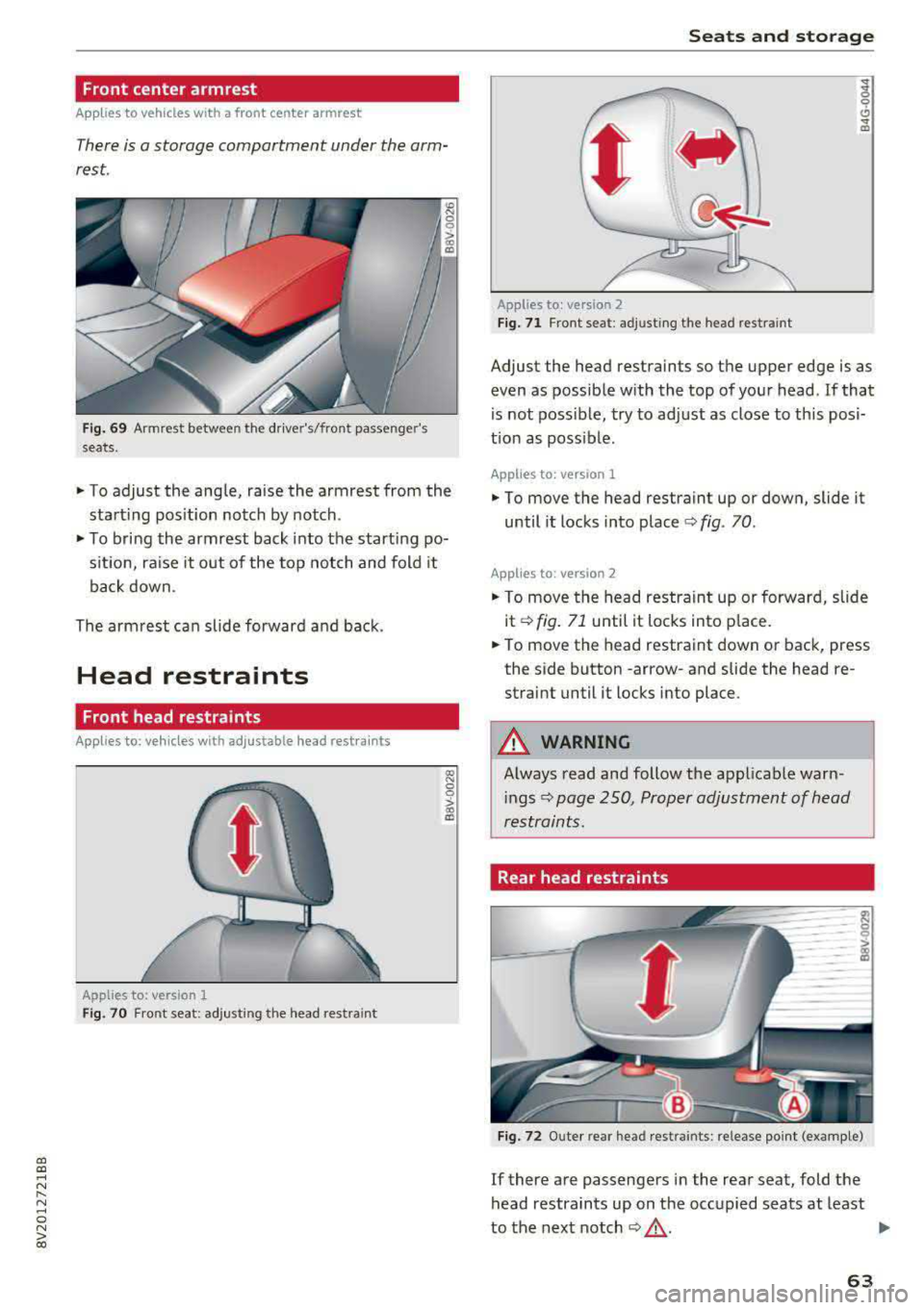
Front center armrest
Applies to vehicles with a front center armrest
There is a storage compartment under the arm
rest.
Fi g. 69 Armrest between the driver's/front passenge r's
seats.
.. To adjust the angle, raise the armrest from the
start ing pos ition notch by notch.
.. To bring the armrest back into the starting po
s it ion, ra ise it out of the top notch and fold it
back down .
The armrest can slide forward and back.
Head restraints
Front head restraints
Applies to: ve hicles with ad justable head rest ra in ts
Applies to: version 1
Fig. 70 Fr ont seat: adjusting the head restraint
Seats and storag e
Applies to: vers ion 2
F ig . 71 Front seat: adjusting the head restra int
Adjust the head restraints so the upper edge is as
even as possible with the top of you r head . If that
is not possible, try to adjust as close to th is posi
t ion as poss ible .
Applies to: version 1
.. To move the head restraint up or down, slide it
until it locks into place
c:> fig. 70 .
Applies to : version 2
.. To move the head restraint up or forward, slide
it
c:>fig . 71 until it locks into p lace.
.. To move the head restraint down or back, press
the side button
-arrow-and slide the head re
straint until it locks into place.
_& WARNING
-A lways read and follow the applicable warn-
i ngs
c:> page 250, Proper adjustment of head
restraints.
Rear head restraints
F ig . 72 O ute r rear head rest rain ts: release point (exam ple)
If there are passengers in the rear seat, fold the
head restraints up on the occupied seats at least
-
to the next notch c:> _& . Iii-
63
Page 67 of 400

a, a, ..... N
" N ..... 0 N > 00
Storing
Cup holders
Fig. 74 Sectio n of the rear bench seat : rea r cup ho lders•
Your vehicle has cup holders in the front center
console, in the door pockets, in the rear bench
seat* or in the rear center console*.
Re ar cup ho lders*
Applies to: ve hicles with rear center arm rest
.,. Tilt the rear center armrest all the way down.
.,. To open the cup holders, tap on the rim @
r:=>fig . 74.
.,. To place the beverage co nta iner in the cup
holder , push the arm @ outward .
.,. Then push the arm against the beve rage con
ta iner so that the a rm lies closely against it .
.,. To close the cup holders, push t hem back into
the slot .
A WARNING -
-Do not put any hot beverages in the cup
holder while the vehicle is moving. Hot bev
erages could spill, wh ic h can cause injury.
- Do not use any breakable beverage contai n
ers (for example, made out of glass or por
celain). You co uld be injured by them in the
event of a n accident .
(D Note
Beverage containers in the cup holders should
always have a lid. If not, beverages cou ld sp ill
and cause damage to vehicle equipment, such
electronics or seat covers .
Seats and storage
Other storage
Applies to: sedan
Fig. 75 Lu gga ge compar tm en t: bag hooks *
There are add itiona l storage compartments,
compartments and holders at other locations in
the vehicle:
- Glove compartment: the glove compa rtme nt
can be locked using the key* .
- Storage compartment under the front cen ter
armrest*
- Storage compartment o n the re ar side of the
front seat*. The com partment can hold a maxi
m um weight of 2 lbs (1 kg) .
- Garment hooks* on the B -pillar
r=> &.
- Garment hoo ks* above the rea r doo rs *
- Side bag hooks* in the luggage compartment
- Applies to: sedan : bag hooks* under the rear
she lf
r=> fig . 75
A WARNING
-Always leave the lid on the glove compa rt
men t cover closed while driv ing to red uce
t he risk of injury .
- Onl y use t he storage compa rtme nts in the
door trim panel s to sto re sm all obje cts th at
will not sti ck ou t of the compartmen t and
impair the range of the side air bags .
- Th e bag hoo ks c an ho ld a m aximum weight
of 6.6 lbs (3 kg) . Heavier objects are no t ad
equate ly secured . There is risk of pe rsonal
inj ury.
A WARNING
-App lies to: ve hicles with garment hooks
- Make sure that the view to the rear is not
obs tructed by hangi ng garments .
-
65
Page 68 of 400
Sea ts and stor age
-Hang only lightweight cloth ing and be s ure
that there are no heavy or sharp-edged ob
jects in the pockets.
-Do not use coat hangers to hang garments,
because th is could reduce the effectiveness
of the side curtain airbags.
Luggage compartment
General information
A WARNING
Read and follow the important safety p recau
tions in
¢ page 253, Storing cargo correctly.
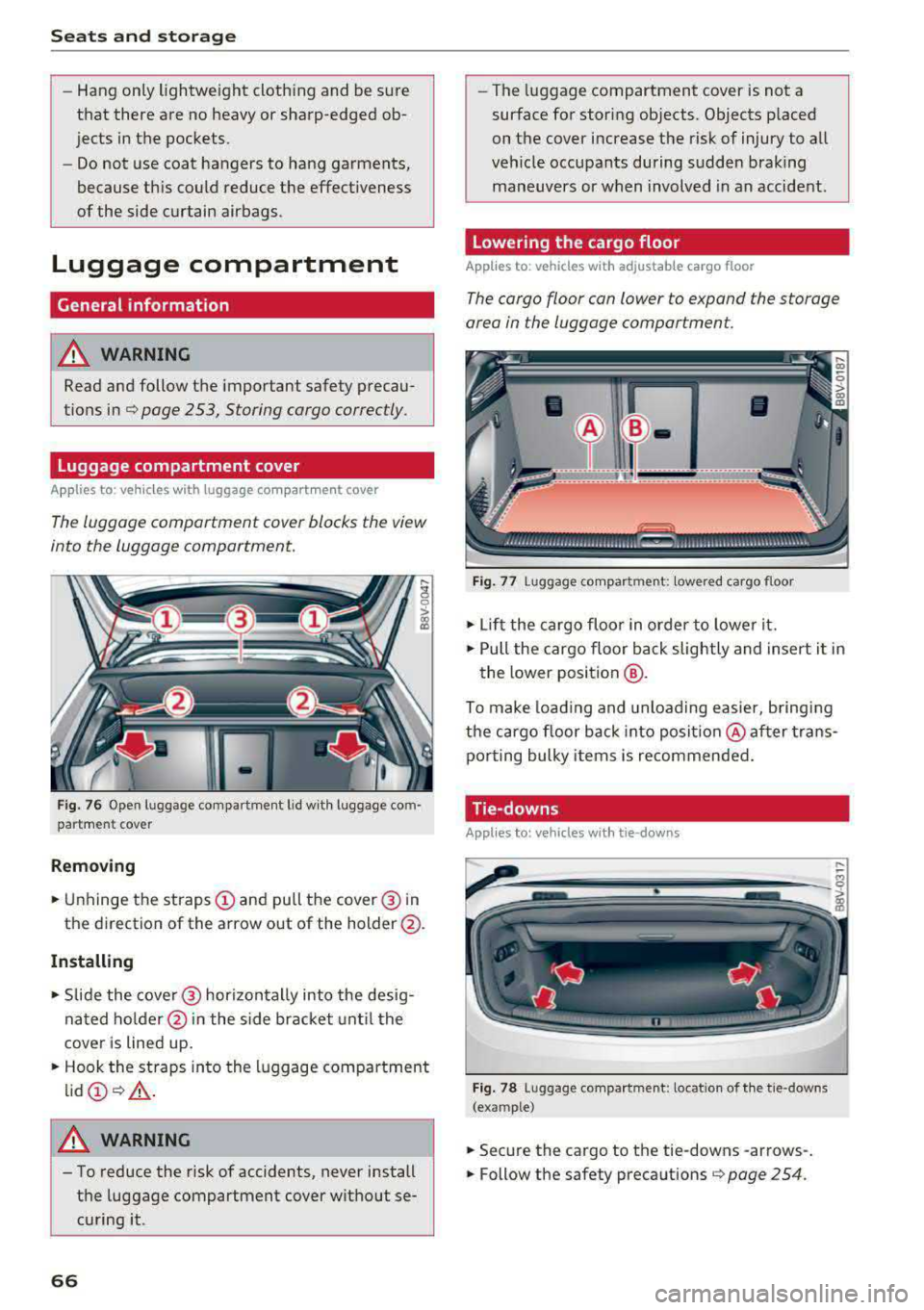
Luggage compartment cover
A pp lies to: ve hicles with luggage compart men t cover
The luggage comportment cover blocks the view
into the luggage comportment.
F ig . 76 Open luggage com pa rtment l id w ith luggage com
partment cover
Remov ing
... U nhinge the straps (D and pull the cover @ in
the d irection of the arrow out of the holder @.
Installing
... Slide the cove r@ horizontally into the desig
nated ho lder @in the s ide bracket until t he
cove r is lined up .
... Hook the st raps into the luggage compartment
lid @ ¢,& .
A WARNING
-To reduce the risk of accidents, never install
t h e luggage compartment c over wit hout se
cu ring it.
66
-The luggage compartment cover is not a
surface for storing objects. Objects p laced
on the cover increase the risk of injury to all
veh icle occupants during sudden braking
maneuvers or when involved in an accident.
Lowering the cargo floor
App lies to: vehicles with adjustable cargo floor
The cargo floor con lower to expand the storage
area in the luggage comportment.
Fi g. 7 7 Luggage co mpa rt ment: lowe re d cargo floor
... Lif t the cargo floo r in o rder to lowe r it .
... Pull the cargo floor ba ck slightly and insert i t in
the lower position
@ .
To make load ing and unloading easier, b ringi ng
the cargo floor back into posit io n @ aft er trans
po rting bulky item s is recommended.
Tie-downs
Appl ies to: vehicles with tie-downs
- ------- --
Fig. 7 8 Luggage compa rtment: locat io n of t he t ie-downs
(example)
... Secure the cargo to the tie-downs -arrows-.
... Follow the safety preca utions ¢ page 254.
Page 69 of 400
a, a, ..... N
" N ..... 0 N > 00
Cargo net/cargo bag
Applies to: vehicles with luggage compartment cargo net/car
go bag
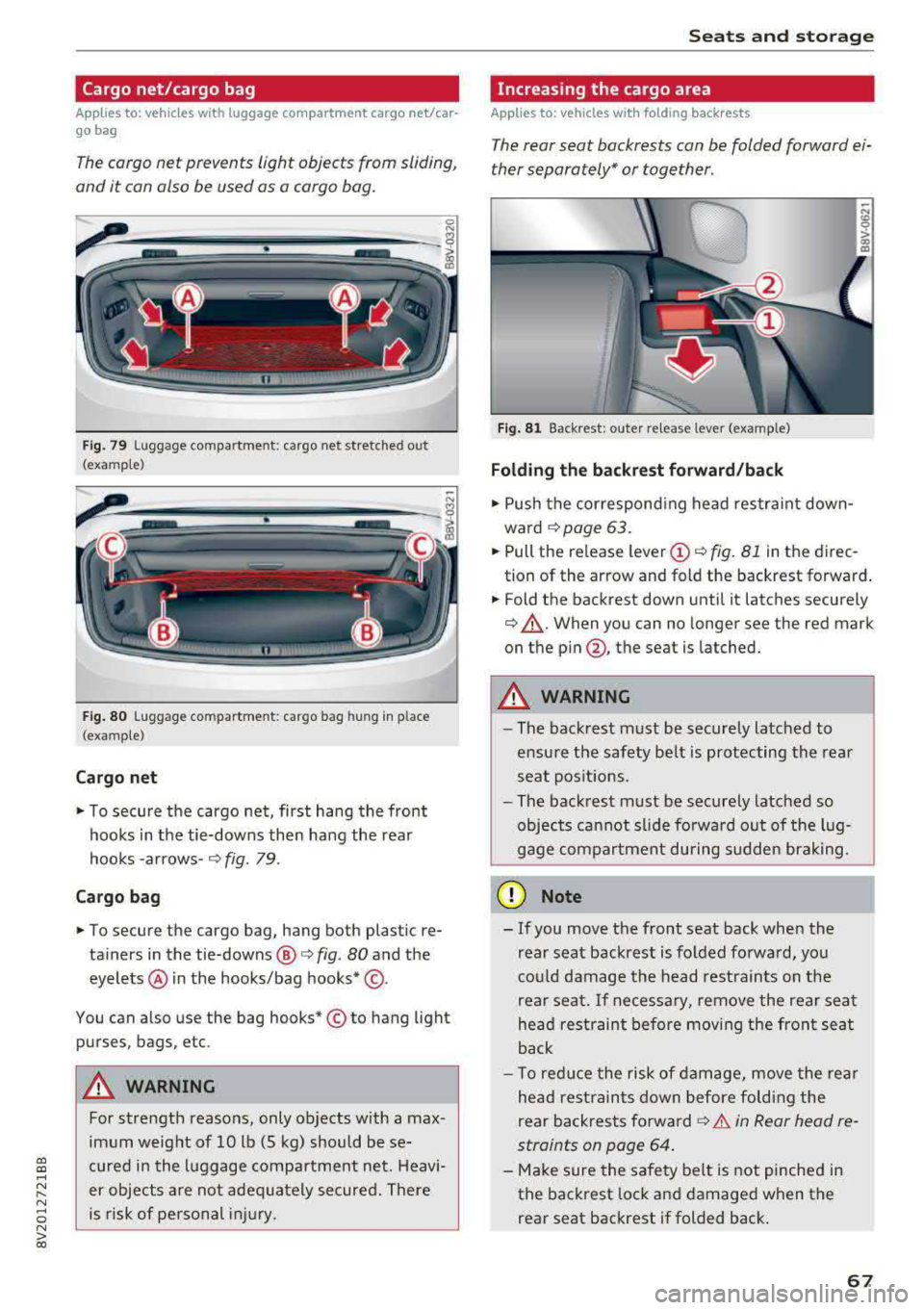
The cargo net prevents light objects from sliding,
and it can also be used as a cargo bog.
Fig. 79 Luggage compartment: cargo net stretched out
(examp le)
F ig . 80 Luggage compartme nt: cargo bag hung in place
(examp le)
Cargo net
.. To secure the cargo net, first hang the front
hooks in the tie-downs then hang the rear
hooks
-arrows-¢ fig. 79.
Ca rgo b ag
.. To secure the cargo bag, hang both plastic re
tainers in the tie-downs @
c> fig. 80 and the
eyelets @ in the hooks/bag
hooks* @.
You can also use the bag hooks* © to hang light
purses, bags, etc .
&_ WARNING
For strength reasons, only objects with a max
imum weight of 10 lb (5 kg) should be se
cured in the l uggage compartment net. Heavi
er objects are not adeq uately secured. There
is risk of personal injury .
Seats and storag e
Increasing the cargo area
Applies to: vehicles with folding backrests
The rear seat backrests con be folded forward ei
ther separately" or together .
n
Fig. 81 Backrest: outer re lease lever (example)
Folding the b ackrest forward /back
.. Push the correspond ing head restraint down
ward
¢page 63 .
.. Pull the release lever (D ¢ fig. 81 in th e direc
tion of the arrow and fold the backrest forward .
.. Fold the backrest down until it latches securely
¢ .,&.. When you can no longer see the red mark
on the
pin @ , the seat is latched.
&_ WARNING
~ -
-The backrest must be sec urely latched to
ensu re the safety belt is protecting the rear
seat pos it ions.
- The back rest must be securely latched so
objects ca nnot slide fo rwa rd out of the lug
gage compartment during sudden brak ing.
(D Note
- If you move the front seat back when the
rear seat backrest is folded fo rwa rd, you
co uld damage the head restrain ts on t he
rear seat.
If ne cessary, remove the rea r seat
he ad restraint before mov ing the front seat
back
- T o red uce the risk of damage, move the rea r
he ad rest raints down before fo ldi ng the
rear backrests
forward¢ .&. in Rear head re
straints on page 64 .
-Make sure the safety belt is not pinched in
the back rest lock a nd damaged when the
rear seat backrest if folded back .
67
Page 70 of 400
Sea ts and stor age
Pass-through
Applies to: vehicles with pass-through
Applies to: version
1
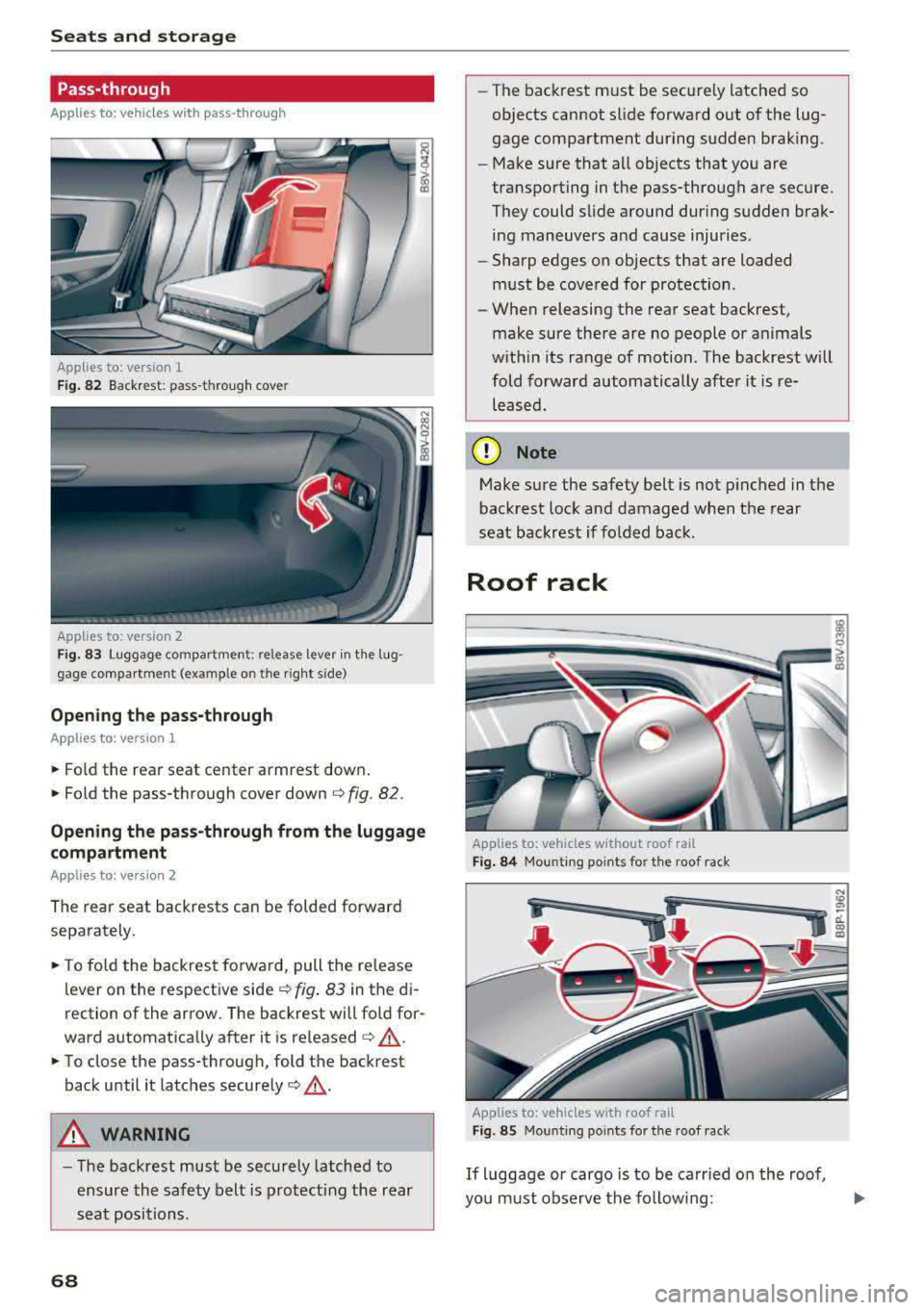
F ig . 82 Backrest : pass-throug h cover
App lies to: version 2
Fig. 83 Luggage compart ment: release lever in th e lug
gage compartme nt (ex am ple o n the r ight s ide)
Opening th e pass -through
Applies to : vers ion 1
.. Fo ld the rear seat center armrest down .
.. Fold the pass -through cover down¢ fig. 82 .
0 N
i (D
Opening the pas s-through from the luggage
compa rtment
Applies to : version 2
The rear seat backrests can be folded forward
separately .
.. To fo ld the backrest forward, pull the re lease
lever on the respective side
¢ fig . 83 in the di
rection of the arrow. The backrest will fo ld for
ward automatically after it is
released ¢,&. .
.. To close the pass-through, fold the backrest
back until it latches
securely ¢,&. .
A WARNING
-The backrest must be securely latched to
ensure the safety belt is protect ing the rear
seat positions.
68
- The backrest must be securely latched so
objects cannot slide forward o ut of the lug
gage compartment during sudden brak ing.
- Make sure that all objects that you are
transporting in the pass-through are secure.
They could slide around dur ing sudden brak
ing maneuvers and cause injuries .
- Sharp edges on objects that are loaded
must be covered for protection .
- When releasing the rear seat backrest,
make sure there are no people or animals
with in its range of motion . The backrest will
fold forward automatically after it is re leased.
(D Note
Make sure the safety be lt is not p inched in the
backrest lock and damaged when the rear
seat backrest if folded bac k.
Roof rack
Applies to: vehicles w ithout roof rail
F ig . 84 Mou nti ng po ints for the roof rack
Applies to: vehicles with roof rail
F ig. 85 Mou nting po ints fo r the roof rack
If luggage or cargo is to be carr ied on the roof,
you must observe the fo llow ing:
Page 78 of 400

Driving
other damage to the vehicle or other property .
-Have your vehicle maintained properly and
in accordance with the service recommenda
tions in your Warranty
& Maintenance book
let . Lack of proper maintenance as well as
improper use of the vehicle will impair the
function of the emission control system and
could lead to damage.
- Do not alter or remove any component of
the Emission Control System unless ap
proved by the manufacturer .
- Do not alter or remove any device, such as
heat shields, switches, ignition wires,
valves, which are designed to protect your
vehicle's Emission Control System and other
important vehicle components.
(I) Tips
The consumption estimates as published by
ENVIRONMENTAL PROTECTION AGENCY
(EPA) and Transport Canada may not corre
spond to your actual consumption on the
road, which will vary depending upon vehicle
load and speed, road and weather conditions,
trip length, etc .
Steering
Adjusting the steering wheel position
The steering wheel position is fully adjustable up
and down and forward and back .
Fig. 88 Steering column: steering col umn adjustment lever
.,. Tilt the lever c:::;, fig. 88 downward c:::;, ,& .
.,. Bring the steering wheel into the desired posi
tion.
76
.,. Push the lever against the steering column un
til it is secure.
A WARNING
Incorrect use of the steering wheel adjust ment and an incorrect seating position can
cause serious injuries.
- Only adjust the steering column when the
vehicle is stationary so that you do not lose control of the vehicle .
-
-Adjust the driver's seat or steering wheel so
that there is at least 10 inches (25 cm) dis
tance between your chest and the steering
wheel
c:::;, page 248, fig. 222 . If you do not
maintain this distance, the airbag system
will not be able to provide its full protec
tion .
c:::;,page248, fig. 222.
- If your physical characte ristics prevent you
from s itting at least 10 inches (25 cm) or
more away from the steering whee l, see if
an authorized Audi dealer or authorized
Audi Service Facility can provide adapters
that will help.
- If your face is level with the steering whee l,
the airbag does not provide as much protec
tion during a collision. Always make sure
that the steer ing wheel is level with your
chest.
- Always hold the steering wheel with your
hands in the 9 o'clock and 3 o'clock posi
tions to reduce the risk of injury if the airbag
deploys.
- Never hold the steering wheel in the 12
o'clock position or with both hands on the
rim or the center of the steering wheel.
Holding the steer ing wheel incorrect ly sig
nificant ly increases the r isk of injury to the
hands, arms and head if the airbag deploys.
Page 79 of 400

a, a, ..... N
" N ..... 0 N > 00
Starting and stopping
the engine (vehicles with
an ignition lock)
Starting the engine
Ap plies to: ve hicles with ign itio n lock
The ignition is switched on ond the engine start
ed with the key in the ignition.
Fig. 89 Ignit ion lock: posit ion of the ignitio n key
Switching the ignition on /off
~ To switch the ignition on, turn the ign ition key
to posit io n
(D . Vehicles w ithout the Start/Stop
system*: the needle in the tachomete r moves
into the
READY position .
~ To swi tch the ign ition off, turn the ignit io n key
to positio n@ . The need le in the tachometer
moves into the
OFF position.
Starting the engine
~ Press the b rake peda l and move the se lector
l ever to the P or N pos ition.
~ T urn the key br iefly to position @. The igni tion
key automatically returns to position
(D . Do not
press the accelerator pedal when doing this .
E qu ipment that uses a lot of elect ric ity is switch
ed off temporar ily when you sta rt the engine.
I f the engine does not sta rt immed iately, stop
the s ta rting proced ure by turning the ignition key
to position @ and repeat after 30 seconds.
Start /Stop system*
See the informat ion inc:> page 81, Start/Stop
system.
Driving
A WARNING
-- To reduce the r isk of po ison ing, never allow
the engine to run in confined spaces .
- Never remove the ignition key from the igni
tion lock while the vehicle is moving. Other
wise the steering lock will engage and you
w ill no t be ab le to s teer the vehicle.
(D Note
Avo id high engine speed, fu ll throttle, and
heavy engine load i f the engine has not
reached operat ing temperat ure yet. You could
damage the eng ine.
@ For the sake of the environment
Do not let the engine run w hile parked to
warm up . Beg in driving immed iately . T hi s re
duces unnecessa ry emissions .
@ Tips
-If it is d ifficult to tur n the key to pos ition
(D , turn the steer ing wheel back and fo rth
sligh tly to release the steering wheel lock.
- Some noise after starting the engine is nor
ma l and is no cause for conce rn .
Stopping the engine
Applies to: vehicles w ith ign ition lock
Stopping the engine
~ Br ing the veh icle to a full stop.
~ Tu rn the key to position @. The needle in the
tachometer moves into the
OFF pos ition.
Eng aging the steering lock
Requirement: the selector lever must be in P.
~ Remove the ignition key in position @
i:>page 78, fig. 90 c:> &,.
~ Tu rn the steering wheel until you hea r the
steer ing wheel lock.
The locked steer ing helps prevent vehicle theft.
""
77