Page 121 of 212
WARNING
117)The space-saver wheel is specific for
your car. Do not use it on cars of different
models. Do not use space-saver wheels of
different models on your car. The
space-saver wheel must only be used in the
event of an emergency. Never use it for more
than strictly necessary and never exceed
80 km/h. On the space-saver wheel there is
an orange label, summarising the main
warnings regarding space-saver wheel
usage restrictions. Never remove or cover
the label. Never apply any hub cap to the
space-saver wheel.118)Alert other drivers that the car is
stationary in compliance with local
regulations: hazard warning lights, warning
triangle, etc. Any passengers on board
should leave the car, especially if it is heavily
laden. Passengers should stay away from
on-coming traffic while the wheel is being
changed. On hills or uneven roads, use
chocks or appropriate objects to block the
wheels of the vehicle.
119)The vehicle's driving characteristics
will be modified with the space-saver wheel
fitted. Avoid violent acceleration and
braking, abrupt steering and fast cornering.
The overall duration of the space-saver
wheel is about 3000 km, after which the
relevant tyre must be replaced with another
one of the same type. Never install a
traditional tyre on a rim designed to be used
as a space-saver wheel. Have the wheel
repaired and refitted as soon as possible.
Using two or more space-saver wheels at the
same time is forbidden. Do not apply grease
to the bolt threads before fitting: they could
come unscrewed.
120)The jack may be used to replace
wheels only on the car that it comes with or
other cars of the same model. Never use the
jack for other purposes, such as lifting other
vehicle models. Never use it for repair
operations under the vehicle. Incorrect
positioning of the jack may cause the vehicle
to fall. Do not use the jack for loads higher
than the one shown on its label. Never install
snow chains on the space-saver wheel; if a
front tyre (driving wheel) is punctured and
you need to use snow chains, use a standard
wheel from the rear axle and install the
space-saver wheel on the rear axle. In this
way, with two normal front drive wheels, it is
possible to use snow chains.121)Incorrectly fitting the wheel cap may
cause it to fall off when the car is in motion.
Never tamper with the inflation valve. Never
introduce tools of any kind between rim and
tyre. Regularly check the inflation pressure
of the tyres and space-saver wheel (see
chapter "Technical specifications").
122)The jack is a tool developed and
designed only for changing a wheel, if a tyre
gets punctured or damaged, on the vehicle
with which it is supplied or on other vehicles
of the same model. Any other use, e.g. to jack
up other vehicle models or different things,
is strictly prohibited. Never use for
maintenance or repair activities under the
car or to exchange the summer/winter
wheels and vice versa. Never go under the
raised vehicle. Should it be necessary to
work under the vehicle, contact an Alfa
Romeo Dealership. Incorrect positioning of
the jack may cause the raised vehicle to fall:
use only in the positions indicated. Do not
use the jack for loads higher than the one
shown on its label. Never start the engine
with vehicle raised. If the vehicle is raised
more than necessary, everything can
become more unstable, with the risk of the
vehicle dropping violently. Thus, lift the
vehicle only as needed in order to access the
spare wheel.
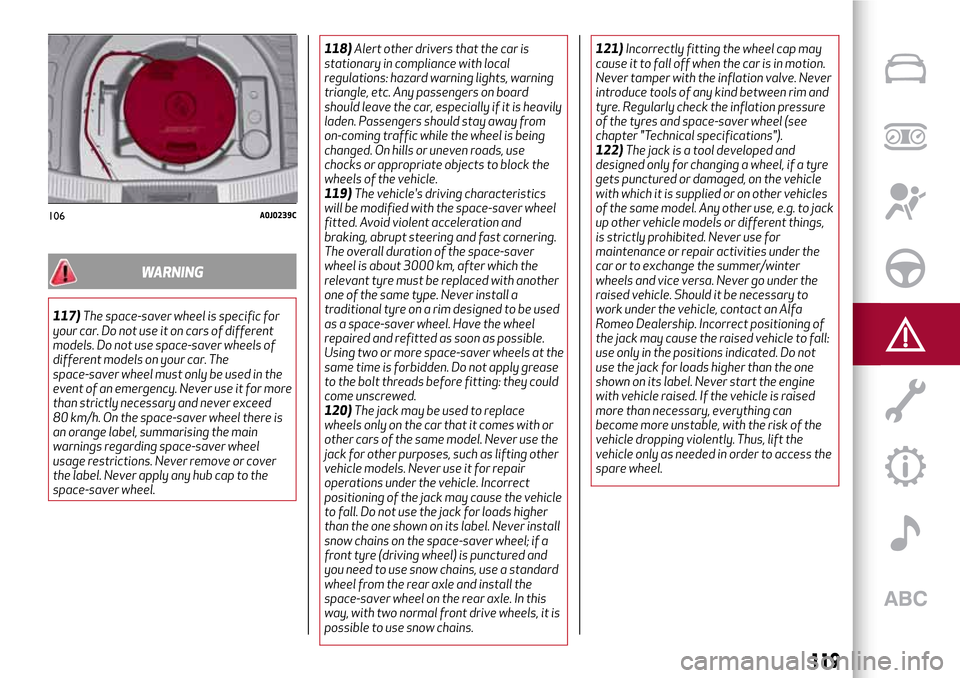
106A0J0239C
119
Page 129 of 212
Correct maintenance permits the performance of the car to be
maintained over time, as well as limited running costs and
safeguarding the efficiency of the safety systems.
This chapter explains how.
SERVICING AND MAINTENANCE
SCHEDULED SERVICING . . .......................128
SCHEDULED MAINTENANCE PLAN . . . . ..............129
PERIODIC CHECKS............................136
DEMANDING USE OF THE CAR . . . . . . ...............136
CHECKING LEVELS ............................137
BATTERY RECHARGING .........................143
WINDSCREEN / REAR WINDOW WIPERS . . . . . . . . .......144
BATTERY..................................146
LIFTING THE VEHICLE . .........................147
BODYWORK.................................147
INTERIOR . . . . ..............................149
Page 130 of 212
SCHEDULED SERVICING
Correct servicing is crucial for
guaranteeing a long life for the vehicle
under the best conditions.
For this reason, Alfa Romeo has planned
a series of checks and services at fixed
distance intervals and, where provided, at
fixed time intervals, as described in the
Scheduled Servicing Plan.
Regardless of the above, it is always
necessary to carefully follow the
instructions in the Scheduled Servicing
Plan (e.g. periodically check level of
liquids, tyre pressure, etc.).
Scheduled Servicing is offered by all Alfa
Romeo Dealerships according to fixed
time or kilometres/miles intervals. If,
during each operation, in addition to the
ones scheduled, the need arises for
further replacements or repairs, these
may be carried out with the owner's
explicit agreement only. If your vehicle is
used frequently for towing, the interval
between one service operation and the
next should be reduced.IMPORTANT NOTES
Scheduled Servicing interventions are
set out by the Manufacturer. Failure to
have them carried out may invalidate the
warranty.
It is advisable to inform the Alfa Romeo
Dealership of any small operating
irregularities without waiting for the next
service.
128
SERVICING AND MAINTENANCE
Page 131 of 212
SCHEDULED MAINTENANCE PLAN
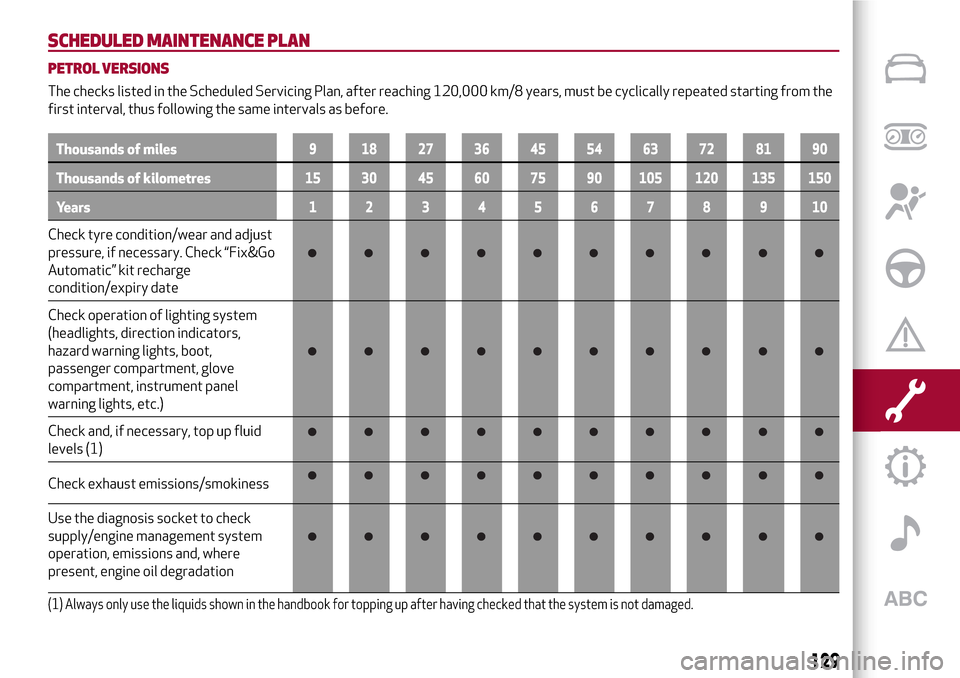
PETROL VERSIONS
The checks listed in the Scheduled Servicing Plan, after reaching 120,000 km/8 years, must be cyclically repeated starting from the
first interval, thus following the same intervals as before.
Thousands of miles9 182736455463728190
Thousands of kilometres15 30 45 60 75 90 105 120 135 150
Years12345678910
Check tyre condition/wear and adjust
pressure, if necessary. Check “Fix&Go
Automatic” kit recharge
condition/expiry date
Check operation of lighting system
(headlights, direction indicators,
hazard warning lights, boot,
passenger compartment, glove
compartment, instrument panel
warning lights, etc.)
Check and, if necessary, top up fluid
levels (1)
Check exhaust emissions/smokiness
Use the diagnosis socket to check
supply/engine management system
operation, emissions and, where
present, engine oil degradation
(1) Always only use the liquids shown in the handbook for topping up after having checked that the system is not damaged.
129
Page 132 of 212
Thousands of miles9 182736455463728190
Thousands of kilometres15 30 45 60 75 90 105 120 135 150
Years12345678910
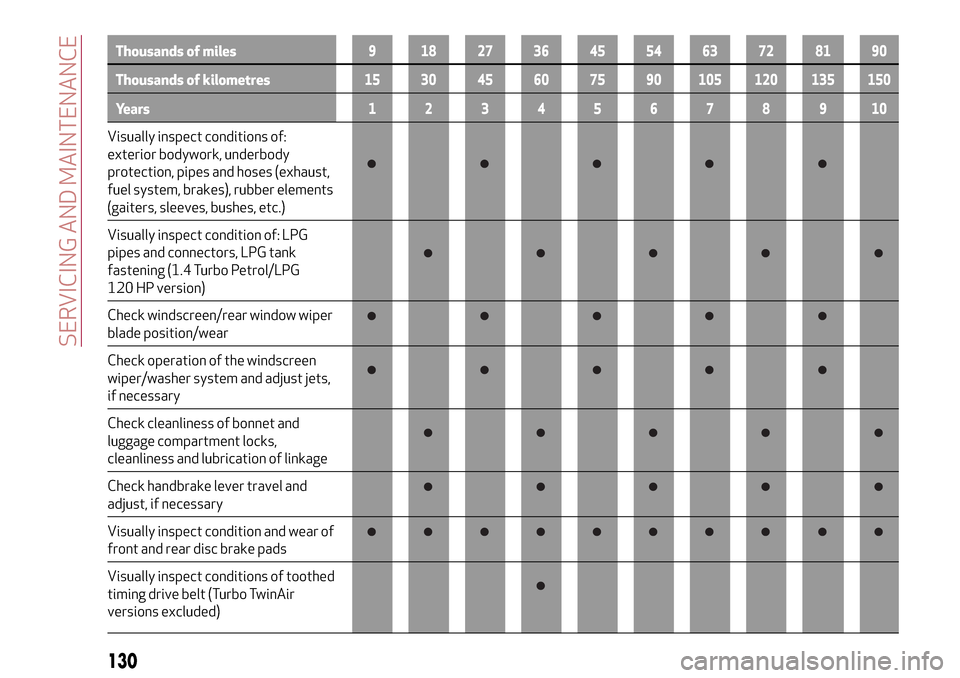
Visually inspect conditions of:
exterior bodywork, underbody
protection, pipes and hoses (exhaust,
fuel system, brakes), rubber elements
(gaiters, sleeves, bushes, etc.)
Visually inspect condition of: LPG
pipes and connectors, LPG tank
fastening (1.4 Turbo Petrol/LPG
120 HP version)
Check windscreen/rear window wiper
blade position/wear
Check operation of the windscreen
wiper/washer system and adjust jets,
if necessary
Check cleanliness of bonnet and
luggage compartment locks,
cleanliness and lubrication of linkage
Check handbrake lever travel and
adjust, if necessary
Visually inspect condition and wear of
front and rear disc brake pads
Visually inspect conditions of toothed
timing drive belt (Turbo TwinAir
versions excluded)
130
SERVICING AND MAINTENANCE
Page 134 of 212
Thousands of miles9 182736455463728190
Thousands of kilometres15 30 45 60 75 90 105 120 135 150
Years12345678910
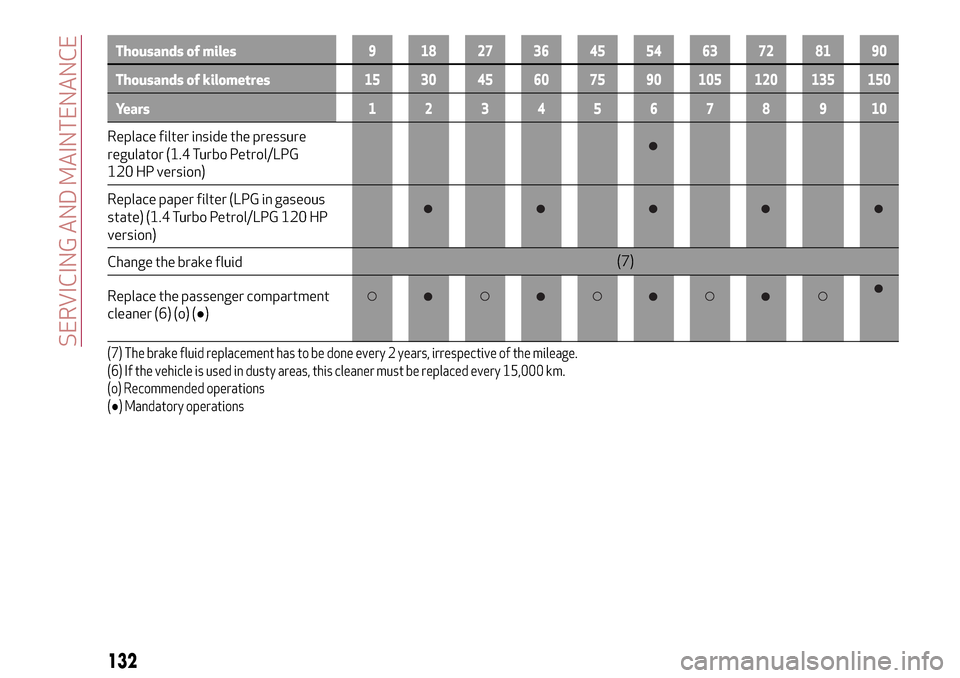
Replace filter inside the pressure
regulator (1.4 Turbo Petrol/LPG
120 HP version)
Replace paper filter (LPG in gaseous
state) (1.4 Turbo Petrol/LPG 120 HP
version)
Change the brake fluid(7)
Replace the passenger compartment
cleaner (6) (o) (●)
(7) The brake fluid replacement has to be done every 2 years, irrespective of the mileage.
(6) If the vehicle is used in dusty areas, this cleaner must be replaced every 15,000 km.
(o) Recommended operations
(●) Mandatory operations
132
SERVICING AND MAINTENANCE
Page 136 of 212
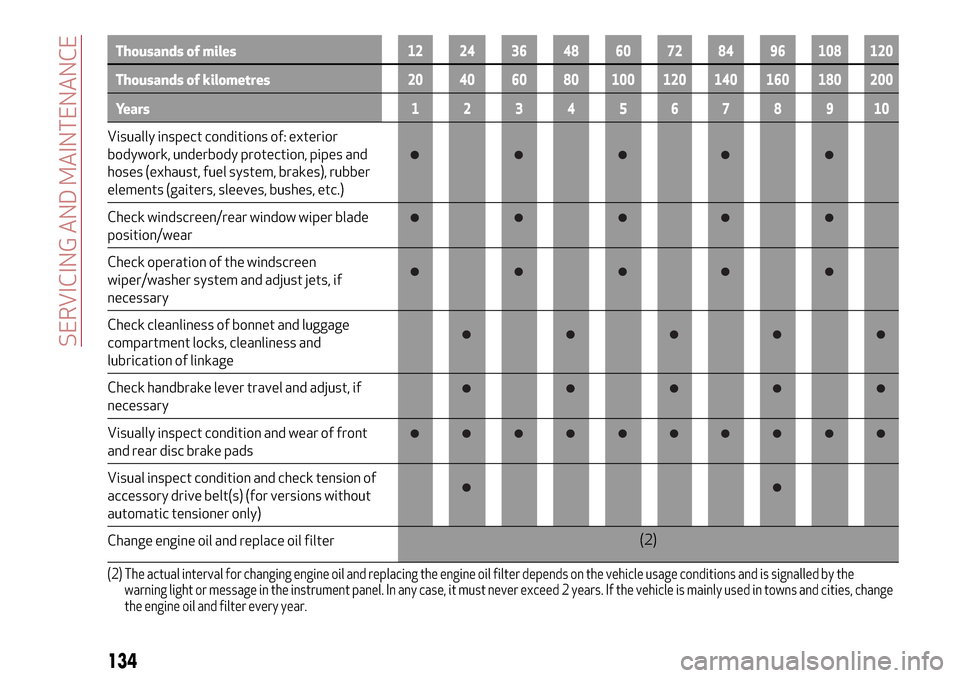
Thousands of miles12 24 36 48 60 72 84 96 108 120
Thousands of kilometres20 40 60 80 100 120 140 160 180 200
Years12345678910
Visually inspect conditions of: exterior
bodywork, underbody protection, pipes and
hoses (exhaust, fuel system, brakes), rubber
elements (gaiters, sleeves, bushes, etc.)
Check windscreen/rear window wiper blade
position/wear
Check operation of the windscreen
wiper/washer system and adjust jets, if
necessary
Check cleanliness of bonnet and luggage
compartment locks, cleanliness and
lubrication of linkage
Check handbrake lever travel and adjust, if
necessary
Visually inspect condition and wear of front
and rear disc brake pads
Visual inspect condition and check tension of
accessory drive belt(s) (for versions without
automatic tensioner only)
Change engine oil and replace oil filter(2)
(2) The actual interval for changing engine oil and replacing the engine oil filter depends on the vehicle usage conditions and is signalled by the
warning light or message in the instrument panel. In any case, it must never exceed 2 years. If the vehicle is mainly used in towns and cities, change
the engine oil and filter every year.
134
SERVICING AND MAINTENANCE
Page 138 of 212
PERIODIC CHECKS
Every 1,000 km or before long trips
check and, if necessary, top up:
engine coolant, brake fluid and
windscreen washer fluid level;
tyre inflation pressure and condition;
operation of lighting system
(headlights, direction indicators, hazard
warning lights, etc.);
operation of screen wash/wipe system
and positioning/wear of windscreen/
rearscreen wiper blades
Every 3,000 km check and top up if
required: engine oil level.
IMPORTANT To find out the correct oil
quantity, always check using the dipstick.
Carry out the check with the vehicle
parked on level ground.
DEMANDING USE OF THE CAR
If the vehicle is used mainly under one of
the following conditions:
towing a trailer or caravan;
dusty roads;
short, repeated journeys (less than
7-8 km) at sub-zero outside
temperatures;
engine often idling or driving long
distances at low speeds or long periods
of inactivity;
the following checks must be carried out
more often than indicated in the
Scheduled Servicing Plan:
check front disc brake pad condition
and wear;
check cleanliness of bonnet and
luggage compartment locks, cleanliness
and lubrication of linkage;
visually inspect condition of: engine,
gearbox, transmission, pipes and hoses
(exhaust - fuel system - brakes) and
rubber elements (boots - sleeves - bushes
- etc.);
check battery charge and battery fluid
level (electrolyte);
visually inspect conditions of the
accessory drive belts;
check and, if necessary, change engine
oil and replace oil filter;
check and, if necessary, replace pollen
filter;
check and, if necessary, replace air
cleaner.
136
SERVICING AND MAINTENANCE