2017 Alfa Romeo Giulietta lock
[x] Cancel search: lockPage 43 of 212

Daytime running lights
Activation/deactivation of Daytime
Running Lights (DRL).
AFS adaptive lights
(for versions/markets, where provided)
Activation/deactivation of AFS adaptive
lights (Adaptive Frontlight System).
Courtesy lights
This function turns on the internal
courtesy lights for approximately
25 seconds when the doors or luggage
compartment are opened using the
remote control. The courtesy lights are
turned off when the doors are closed or
locked using the remote control.
Exit Menu
Return to standard display screen.TRIP COMPUTER
The Trip computer is used to display
information on car operation when the
key is turned to MAR. This function is
characterised by two separate records,
called “Trip A” and “Trip B”, where the car’s
“complete missions” (journeys) are
recorded in a reciprocally independent
manner. Both memories can be reset: i.e.
start of a new journey.
"Trip A" can be used to display the values
relating to:
Range
Distance travelled A
Average consumption A
Instant consumption
Average speed A
Trip time (driving time) A
“Trip B” may be used to display the
figures relating to:
Distance travelled B
Average consumption B
Average speed B
Trip time B (driving time).
The "Trip B" function may be disabled
(see "Activating Trip B"). "Range" and
"Instant consumption" values cannot be
reset.
41
Page 45 of 212

Warning lights on
panelWhat it means What to do
EBD FAILURE
The simultaneous switching on of the
(red) and
(amber) warning lights with the engine on indicates
either an anomaly of the EBD system or that the system
is not available. In this case, the rear wheels may suddenly
lock and the vehicle may swerve when braking sharply.Drive very carefully to the nearest Alfa Romeo Dealership
to have the system inspected immediately.
AIRBAG FAILURE
The warning light switches on when the ignition key is
turned to MAR, but it should switch off after a few
seconds.
If the warning light switches on constantly, this indicates
a fault in the airbag system.
22) 23)
SEAT BELTS NOT FASTENED
(for versions/markets, where provided)
The warning light switches on constantly with the vehicle
stationary and the driver’s seat belt not fastened.
The warning light flashes and a buzzer sounds if the car is
in motion and the front seat belts are not correctly
fastened.For permanent deactivation of the acoustic signal
(buzzer) of the S.B.R. (Seat Belt Reminder) system
contact an Alfa Romeo Dealership. The system can be
reactivated using the Setup Menu.
43
Page 62 of 212

ACTIVE SAFETYSYSTEMS
ABS SYSTEM
This system, which is an integral part of
the braking system, prevents one or more
wheels from locking and slipping in all
road surface conditions, irrespective of
the intensity of the braking action,
ensuring that the vehicle can be
controlled even during emergency
braking and optimising stopping
distances.
System intervention
The driver can feel that the ABS system
has come into action because the brake
pedal pulsates slightly and the system
gets noisier: this is entirely normal with
the system operating.
33) 34) 35) 36) 37) 38) 39)
ASR (AntiSlip Regulation)SYSTEM
40) 41) 42)
This is an integral part of the ESC system
and automatically operates in the event
of one or both drive wheels slipping, loss
of grip on wet roads (aquaplaning) and
acceleration on slippery, snowy or icy
roads, etc.System intervention
The system operates on the engine
power and brakes.
This is indicated by the flashing of the
warning light
on the instrument panel,
to inform the driver that the car is in
critical stability and grip conditions.
MSR (Motor Schleppmoment
Regelung)SYSTEM
The system prevents the drive wheels
from possibly locking, which could
happen, for example, if the accelerator
pedal is released suddenly or in the case
of a sudden downshifting in conditions of
poor grip.
In this conditions, the engine braking
effect could cause the drive wheels to
slip, resulting in a loss of vehicle stability.
In these situations, the system
intervenes, restoring torque to the
engine in order to conserve vehicle
stability and increase vehicle safety.
HBA (Hydraulic Brake Assist)SYSTEM
43) 44) 45)
The HBA system is designed to improve
the car’s braking capacity during
emergency braking: the HBA system
therefore completes the ABS system.
Maximum assistance from the HBA
system is obtained by continuously
pressing the brake pedal very quickly.
DST SYSTEM (Dynamic Steering
Torque)
46)
The DST function uses the integration of
the ESC system with the electric power
steering to increase the safety level of
the whole vehicle.
In critical situations (braking on surfaces
with different grip conditions), through
the DST function the ESC system
controls the steering to implement an
additional torque contribution on the
steering wheel, to suggest the most
correct manoeuvre to the driver.
The coordinated action of the brakes and
steering increases the sensation of
safety and control of the vehicle.
EBD SYSTEM
The EBD system is an integral part of the
ESC system and intervenes during
braking, distributing the brake force
optimally between front and rear wheels.
This guarantees greater braking stability
for the car, preventing sudden locking of
the rear wheels and the consequent
instability of the car.
ESC SYSTEM
The ESC system improves the directional
control and stability of the car in various
driving conditions.
60
SAFETY
Page 63 of 212

The ESC system corrects the car’s
understeer and oversteer, distributing
the brake force on the appropriate
wheels. The torque supplied by the
engine can also be reduced in order to
maintain control of the vehicle.
28) 29) 30) 31) 32)
The ESC system comprises the active
safety systems such as: ABS, EBD, ASR,
HILL HOLDER, etc.
The ESC system switches on
automatically when the engine is started
and cannot be switched off.
System intervention
This is indicated by the flashing of the
warning light
on the instrument panel,
to inform the driver that the car is in
critical stability and grip conditions.
CBC (Cornering Brake Control)SYSTEM
This system acts when braking on
corners, optimising the distribution of
brake pressure on the four wheels: the
system prevents the wheels on the inside
of the corner (less affected by the weight
of the car) from locking, ensuring better
stability and direction for the car.
HILL HOLDERSYSTEM
This is an integral part of the ESC system
and facilitates starting on uphill or
downhill slopes by operating the brakes:
IMPORTANT The Hill Holder system is
not a parking brake; therefore, never
leave the car without having engaged the
handbrake, turned the engine off and
engaged first gear, so that it is parked in
safe conditions (for further information
read the "Parking" paragraph in the
"Starting and driving" chapter).
IMPORTANT There may be situations on
small gradients (less than 8%), with car
laden, in which the Hill Holder system
may not activate, causing a slight
reversing motion and increasing the risk
of collision with another vehicle or object.
The driver is, in any case, responsible for
safe driving.
“ELECTRONIC Q2”SYSTEM (“E-Q2”)
The "Electronic Q2" system intervenes
during acceleration on corners, braking
the inner drive wheel and thus increasing
the traction of the outer wheel (which
bears more of the car’s weight): the
torque is thus distributed optimally
between the drive wheels in accordance
with the driving conditions and road
surface, permitting particularly effective,
sporty driving.
"PRE-FILL"SYSTEM (RAB - Ready Alert
Brake)
(only with 'Dynamic" mode activated)
This function activates automatically if
the accelerator pedal is released rapidly,
reducing the brake pad travel (both at
front and back), with the aim of preparing
the braking system and enhancing its
responsiveness, thus reducing the
stopping distance in the event of
subsequent braking.
WARNING
28)The ESC system cannot alter the natural
laws of physics, and cannot increase grip,
which depends on the condition of the road.
29)The ESC system cannot prevent
accidents, including those due to excessive
speed on corners, driving on low-grip
surfaces or aquaplaning.
30)The capability of the ESC system must
never be tested irresponsibly and
dangerously, in such a way as to compromise
personal safety and the safety of others.
31)For the correct operation of the ASR
system, the tyres must of necessity be the
same make and type on all wheels, in perfect
condition and, above all, of the prescribed
type and dimensions.
32)Do not take unnecessary risks, even if
your vehicle is fitted with the ESC and ASR
systems. Your driving style must always be
suited to the road conditions, visibility and
traffic. The driver is always responsible for
road safety.
61
Page 66 of 212
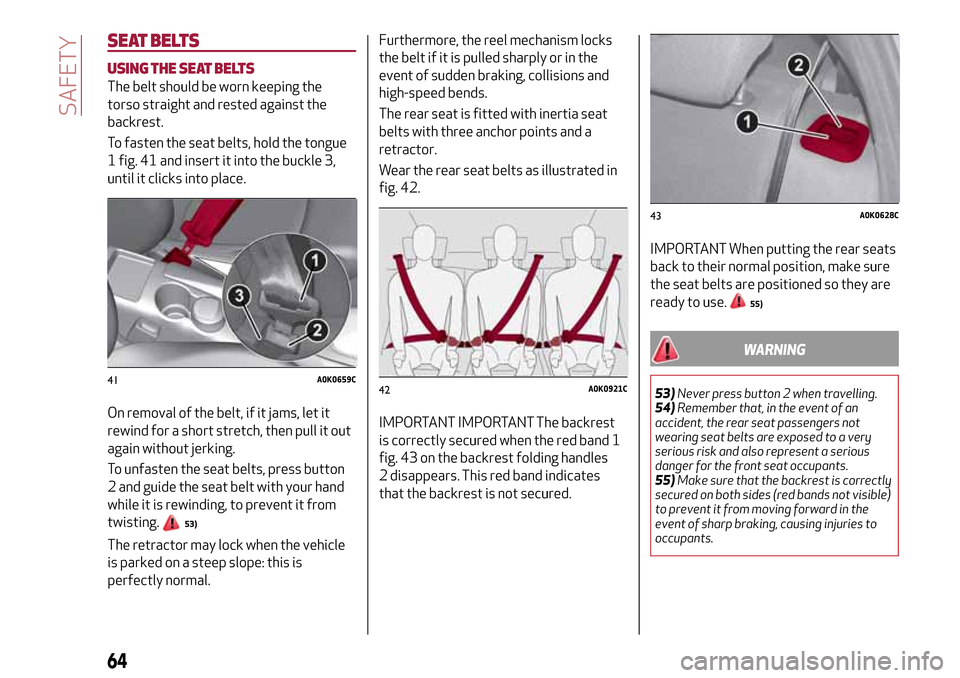
SEAT BELTS
USING THE SEAT BELTS
The belt should be worn keeping the
torso straight and rested against the
backrest.
To fasten the seat belts, hold the tongue
1 fig. 41 and insert it into the buckle 3,
until it clicks into place.
On removal of the belt, if it jams, let it
rewind for a short stretch, then pull it out
again without jerking.
To unfasten the seat belts, press button
2 and guide the seat belt with your hand
while it is rewinding, to prevent it from
twisting.
53)
The retractor may lock when the vehicle
is parked on a steep slope: this is
perfectly normal.Furthermore, the reel mechanism locks
the belt if it is pulled sharply or in the
event of sudden braking, collisions and
high-speed bends.
The rear seat is fitted with inertia seat
belts with three anchor points and a
retractor.
Wear the rear seat belts as illustrated in
fig. 42.
IMPORTANT IMPORTANT The backrest
is correctly secured when the red band 1
fig. 43 on the backrest folding handles
2 disappears. This red band indicates
that the backrest is not secured.IMPORTANT When putting the rear seats
back to their normal position, make sure
the seat belts are positioned so they are
ready to use.
55)
WARNING
53)Never press button 2 when travelling.
54)Remember that, in the event of an
accident, the rear seat passengers not
wearing seat belts are exposed to a very
serious risk and also represent a serious
danger for the front seat occupants.
55)Make sure that the backrest is correctly
secured on both sides (red bands not visible)
to prevent it from moving forward in the
event of sharp braking, causing injuries to
occupants.41A0K0659C42A0K0921C
43A0K0628C
64
SAFETY
Page 85 of 212

WHEN PARKED
Always remove the ignition key when
leaving the car.
When parking and leaving the car,
proceed as follows:
engage a gear (1st gear if facing uphill
or reverse if facing downhill) and leave
the wheels turned;
stop the engine and engage the
handbrake.
Block the wheels with a wedge or a stone
if the car is parked on a steep slope.
On versions equipped with Alfa TCT
transmission, before releasing the brake
pedal, wait for letter P to be displayed.
IMPORTANTNEVERleave the car with
the gearbox in neutral (or, on versions
equipped with Alfa TCT transmission,
before placing the gear lever at P).
HANDBRAKE
To engage the handbrake, pull lever 2
fig. 62 upwards until the car is secured.
When the handbrake is engaged and the
ignition key is on MAR-ON, the
instrument panel warning light
will
switch on.
To release it, raise lever 2 slightly, hold
down button 1 and lower the lever: the
warning light
on the instrument
panel switches off.
95) 96)
IMPORTANT Carry out these
manoeuvres with the brake pedal
pressed.
IMPORTANT For cars equipped with a
front armrest, lift it up to ensure that it
does not interfere with the action of the
handbrake.
WARNING
95)Never leave children unattended in the
car. Always remove the key from the ignition
when leaving the car and take it with you.
96)The car should be braked after a few
clicks of the parking brake: if this is not so,
contact an Alfa Romeo Dealership to have it
adjusted. Always park the car safely as
indicated by the Highway Code and as
described above.
TWIN CLUTCH TRANSMISSION
(for versions/markets, where provided)
SELECTOR LEVER
The lever has the following positions:
P= Park
R= Reverse
N= Neutral
D= Drive, (automatic forward speed)
+= Sequential upshifting
−= Sequential downshifting
If the lever is used in sequential mode,
moving the latter from D to the left, the
positions towards + or – are unstable.
The lever has a button A, which must be
pressed to move the lever to P or R.
Shifting from D to "Sequential mode" and
vice versa is free.
Shifting from D to N is free.
Shifting from N to R and from R to P is
possible only with button on gear lever
pressed.
STARTING THE ENGINE
Starting is only permitted with gear lever
in position P or N (with or without brake
pedal pressed).
On starting, the system is at N or P (the
latter means neutral, but with the car’s
wheels locked mechanically).
62A0K0615C
83
Page 95 of 212

TUTELA DIESEL ART additive in the
proportions shown on the container with
the fuel. Pour the additive into the tank
before the fuel.
When using or parking the car for a long
time in the mountains or cold areas, it is
advisable to refuel using locally available
fuel. In this case, it is also advisable to
keep the tank over 50% full.
LPG ENGINES
The gas filler is located next to the petrol
filler cap. It has a "non return", located in
the filler body itself.
To access the filler 1 fig. 68 open the
access flap 2.
Observe the following precautions during
the refuelling operation:
switch off the engine;
apply the handbrake;
turn the ignition key to the STOP
position;
do not smoke;
hand the special adapter 3 over to the
qualified LPG refuelling personnel.
The adapter 3 is located in a special case.
IMPORTANT Depending on the country,
there are different types of adapters for
refuelling pumps. The adapter that comes
with the car is specifically designed for
the country in which the car is sold. If you
are in a different country, find out what
type of adapter is used there.
IMPORTANT Only use the adapter
supplied with the vehicle as it is equipped
with a dedicated fuel pre-filter.
REFUELLING CAPACITY
To ensure that you fill the tank
completely, top up twice after the first
click of the fuel supply gun. Further
top-ups could cause faults in the fuel
feeding system.
FUEL TANK CAP
The fuel cap is unlocked when the central
locking system is released and
automatically clocked when the central
locking system is applied.
Opening
Press flap 2 fig. 69 to release it and
access fuel tank cap 1. Then press cap
1 and rotate it anticlockwise.
107)
The cap is provided with a retention
device 4 which attaches it to the flap and
prevents it from being lost. Attach the
cap to device 3 during refuelling.
How to open the flap in an emergency
In case of emergency, pull the cord
fig. 70 on the right-hand side of the
luggage compartment to open the fuel
flap.
68A0K0906C
69A0K0598C
70A0K0599C
93
Page 96 of 212

Pulling the cord releases the flap lock: the
flap can then can be opened by pressing
it.
Closing
Release cap 1 from device 3 and insert it
in its housing. Then tighten the cap
clockwise until one or more clicks are
heard. Finally, close flap A checking that
it is correctly locked.
The sealing may cause a slight pressure
increase in the tank. A little breathing off,
while slackening the cap is absolutely
normal.
Fuel - Vehicle compatibility
identification Graphic symbol for
informing consumers in accordance
with EN16942
The symbols shown below facilitated
recognising the correct fuel type to be
used on your car.
Before proceeding with refuelling, check
the symbols inside the fuel filler flap
(where provided) and compare them with
the symbols shown on the fuel pump
(where provided).Symbols for petrol powered cars
E5: Unleaded petrol containing up to
2.7% (m/m) oxygen and with maximum
5.0% (V/V) ethanol compliant with
EN228
E10: Unleaded petrol containing up to
3.7% (m/m) oxygen and with maximum
10.0% (V/V) ethanol compliant with
EN228
Symbols for diesel powered cars
B7: Diesel containing up to 7% (V/V) of
FAME (Fatty Acid Methyl Esters)
compliant with theEN590specification
B10: Diesel containing up to 10% (V/V)
of FAME (Fatty Acid Methyl Esters)
compliant with theEN16734
specificationSymbols for petrol/LPG bi-fuel cars
E5: Unleaded petrol containing up to
2.7% (m/m) oxygen and with maximum
5.0% (V/V) ethanol compliant with
EN228
E10: Unleaded petrol containing up to
3.7% (m/m) oxygen and with maximum
10.0% (V/V) ethanol compliant with
EN228
LPG: Automotive LPG compliant with
EN589WARNING
107)Do not bring naked flames or lit
cigarettes near to the fuel tank opening: fire
risk. Keep your face away from the fuel filler
to prevent breathing in harmful vapours.
94
STARTING AND DRIVING