Page 226 of 268
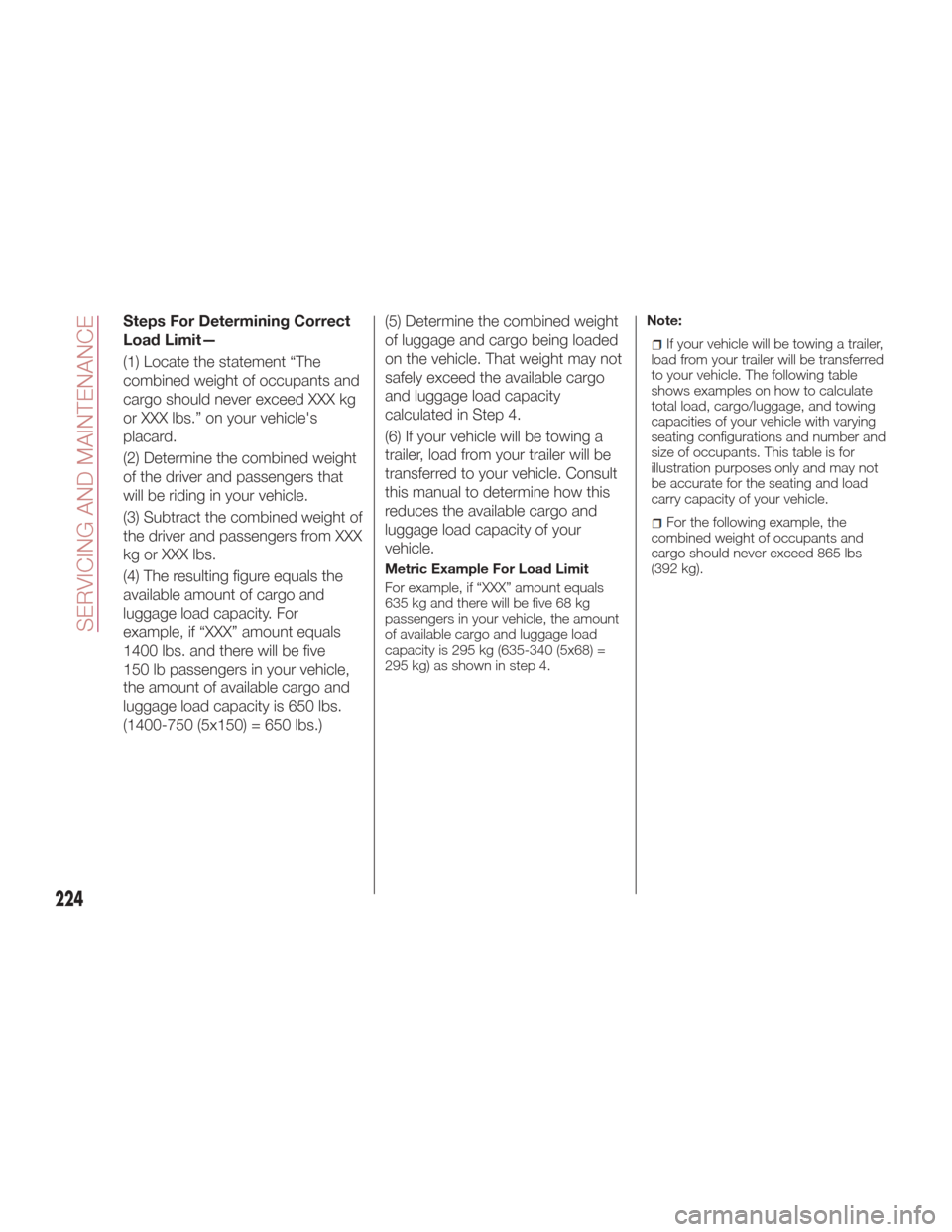
Steps For Determining Correct
Load Limit—
(1) Locate the statement “The
combined weight of occupants and
cargo should never exceed XXX kg
or XXX lbs.” on your vehicle's
placard.
(2) Determine the combined weight
of the driver and passengers that
will be riding in your vehicle.
(3) Subtract the combined weight of
the driver and passengers from XXX
kg or XXX lbs.
(4) The resulting figure equals the
available amount of cargo and
luggage load capacity. For
example, if “XXX” amount equals
1400 lbs. and there will be five
150 lb passengers in your vehicle,
the amount of available cargo and
luggage load capacity is 650 lbs.
(1400-750 (5x150) = 650 lbs.)(5) Determine the combined weight
of luggage and cargo being loaded
on the vehicle. That weight may not
safely exceed the available cargo
and luggage load capacity
calculated in Step 4.
(6) If your vehicle will be towing a
trailer, load from your trailer will be
transferred to your vehicle. Consult
this manual to determine how this
reduces the available cargo and
luggage load capacity of your
vehicle.
Metric Example For Load Limit
For example, if “XXX” amount equals
635 kg and there will be five 68 kg
passengers in your vehicle, the amount
of available cargo and luggage load
capacity is 295 kg (635-340 (5x68) =
295 kg) as shown in step 4.
Note:
If your vehicle will be towing a trailer,
load from your trailer will be transferred
to your vehicle. The following table
shows examples on how to calculate
total load, cargo/luggage, and towing
capacities of your vehicle with varying
seating configurations and number and
size of occupants. This table is for
illustration purposes only and may not
be accurate for the seating and load
carry capacity of your vehicle.
For the following example, the
combined weight of occupants and
cargo should never exceed 865 lbs
(392 kg).
224
SERVICING AND MAINTENANCE
Page 233 of 268

recommended safe operating speeds,
loading and cold tire inflation pressures.
Warning!
High speed driving with your vehicle under
maximum load is dangerous. The added
strain on your tires could cause them to
fail. You could have a serious collision. Do
not drive a vehicle loaded to the maximum
capacity at continuous speeds above
75 mph (120 km/h).
Radial Ply Tires
Warning!
Combining radial ply tires with other types
of tires on your vehicle will cause your
vehicle to handle poorly. The instability
could cause a collision. Always use radial
ply tires in sets of four. Never combine
them with other types of tires.
Tire Repair
If your tire becomes damaged, it may
be repaired if it meets the following
criteria:
The tire has not been driven on when
flat.
The damage is only on the tread
section of your tire (sidewall damage is
not repairable).
The puncture is no greater than a ¼
of an inch (6 mm).
Consult an authorized tire dealer for tire
repairs and additional information.
Damaged Run Flat tires, or Run Flat
tires that have experienced a loss of
pressure should be replaced
immediately with another Run Flat tire
of identical size and service description
(Load Index and Speed Symbol).
Run Flat Tires — If Equipped
Run Flat tires allow you the capability to
drive 50 miles (80 km) at 50 mph
(80 km/h) after a rapid loss of inflation
pressure. This rapid loss of inflation is
referred to as the Run Flat mode. A Run
Flat mode occurs when the tire inflation
pressure is of/or below 14 psi (96 kPa).
Once a Run Flat tire reaches the run flat
mode it has limited driving capabilities
and needs to be replaced immediately.
A Run Flat tire is not repairable.
It is not recommended driving a vehicle
loaded at full capacity or to tow a trailer
while a tire is in the run flat mode.
See the tire pressure monitoring section
for more information.
Tire Spinning
When stuck in mud, sand, snow, or ice
conditions, do not spin your vehicle's
wheels above 30 mph (48 km/h) or for
longer than 30 seconds continuously
without stopping.
Warning!
Fast spinning tires can be dangerous.
Forces generated by excessive wheel
speeds may cause tire damage or failure. A
tire could explode and injure someone. Do
not spin your vehicle's wheels faster than
30 mph (48 km/h) for more than
30 seconds continuously when you are
stuck, and do not let anyone near a
spinning wheel, no matter what the speed.
Tread Wear Indicators
Tread wear indicators are in the original
equipment tires to help you in
determining when your tires should be
replaced.
GUID-0806104865NATire Tread
1—WornTire
2—NewTire
231
Page 250 of 268
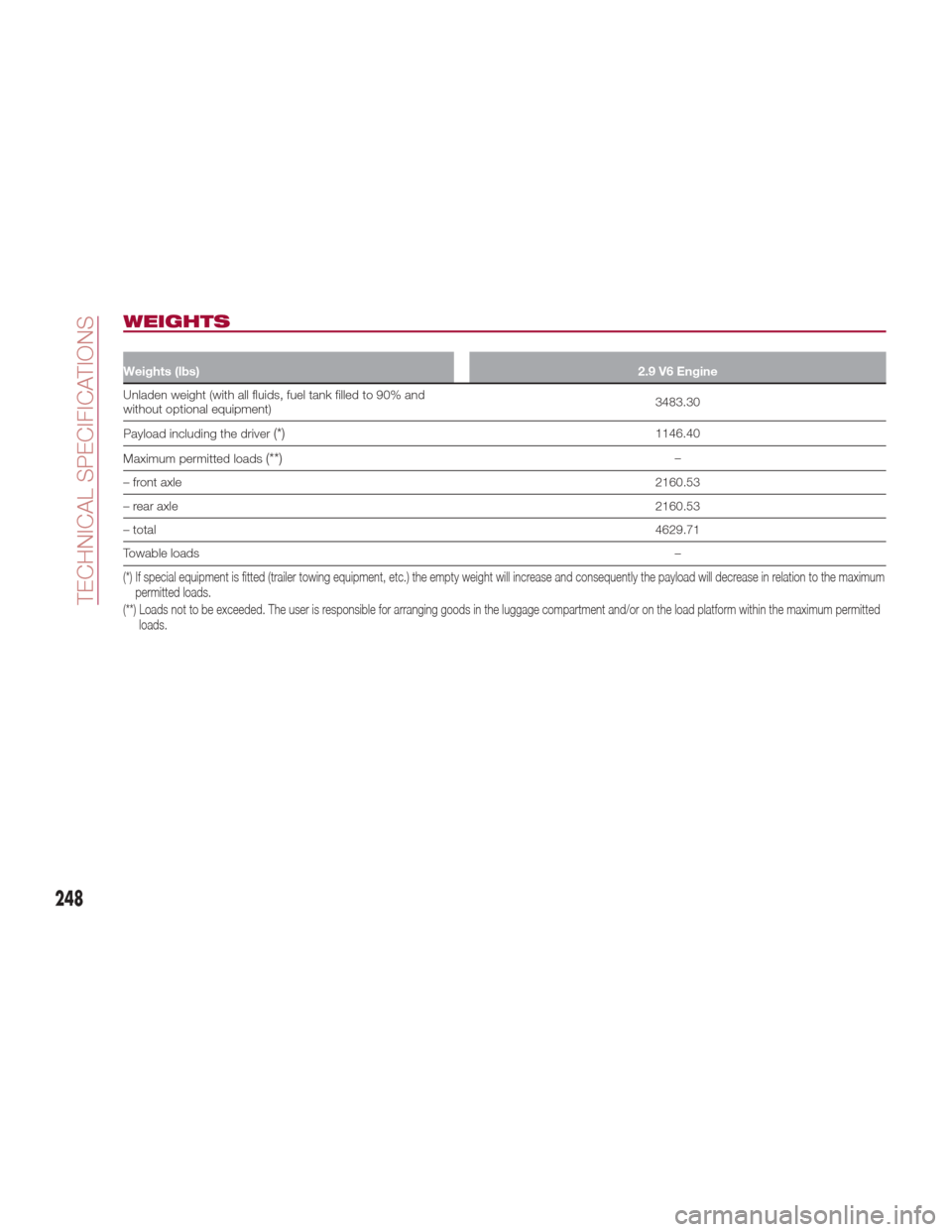
WEIGHTS
Weights (lbs)2.9 V6 Engine
Unladen weight (with all fluids, fuel tank filled to 90% and
without
optional equipment) 3483.30
Payload including the driver
(*)1146.40
Maximum permitted loads
(**)–
– front axle 2160.53
– rear axle 2160.53
– total 4629.71
Towable loads –
(*) If special equipment is fitted (trailer towing equipment, etc.) the empty weight will increase and consequently the payload will decrease in relation to the maximum
permitted loads.
(**) Loads not to be exceeded. The user is responsible for arranging goods in the luggage compartment and/or on the load platform within the maximum permitted loads.
248
TECHNICAL SPECIFICATIONS
Page 266 of 268

Supplemental Restraint System -AirBag ................ .116
Suspension ............... .244
Symbols ....................6
Telescoping Steering Column .....31
Tie Down Hooks, Cargo .........54
Tilt Steering Column ...........31
Tire And Loading Information Placard ................ .223
Tire Markings ...............221
Tire Safety Information .........221
Tire Service Kit ..............192
Tires...............226,229,233 Aging (Life Of Tires) .........232
Air Pressure .............229
Changing ...............220
Compact Spare ...........226
Flat Changing ............192
General Information ......226,229
High Speed .............230
Inflation Pressures .........230
Jacking ............... .220
Life Of Tires .............232 Load Capacity
............223
Quality Grading ...........233
Radial ................ .231
Replacement .............232
Safety ..............221,229
Snow Tires ..............228
Spare Tire ............226,227
Spinning ...............231
Tread Wear Indicators .......231
To Open Hood ...............52
Tow Hooks, Emergency ........201
Towing Disabled Vehicle ...........200
Towing trailers ..............175
TPMS (Tire Pressure Monitoring System) ................ .106
Traction Control System (TCS) .....97
Transmission ...............242
Transporting animals .........
.176
T
ransporting passengers ........176
Transporting Pets ............133
Tread Wear Indicators ..........231
Turn Signals .................36
Uniform Tire Quality Grades .....233
Untwisting Procedure, Seat Belt . . .112
Use of the Owner’s Manual ........5
Vehicle changes/alterations.......3
Vehicle identification number .....239
Vehicle Loading ...........173,223
Vent Operation ...............42
Warning Flasher, Hazard .......180
Warranty Information ..........258
Washer fluid for windshield/headlights ........211
Washers, Windshield ...........40
Weights ................. .248
Wheel And Wheel Trim .........227
Wheel And Wheel Trim Care ......227
Wheels and tires .............221
Windows (cleaning) ...........236
Windshield wiper .............40
replacing blades ...........216
Windshield wiper/washer Smart washing function .......40
Windshield Wipers ............40
Wrecker Towing .............200
INDEX