2017 Alfa Romeo Giulia tow
[x] Cancel search: towPage 57 of 268
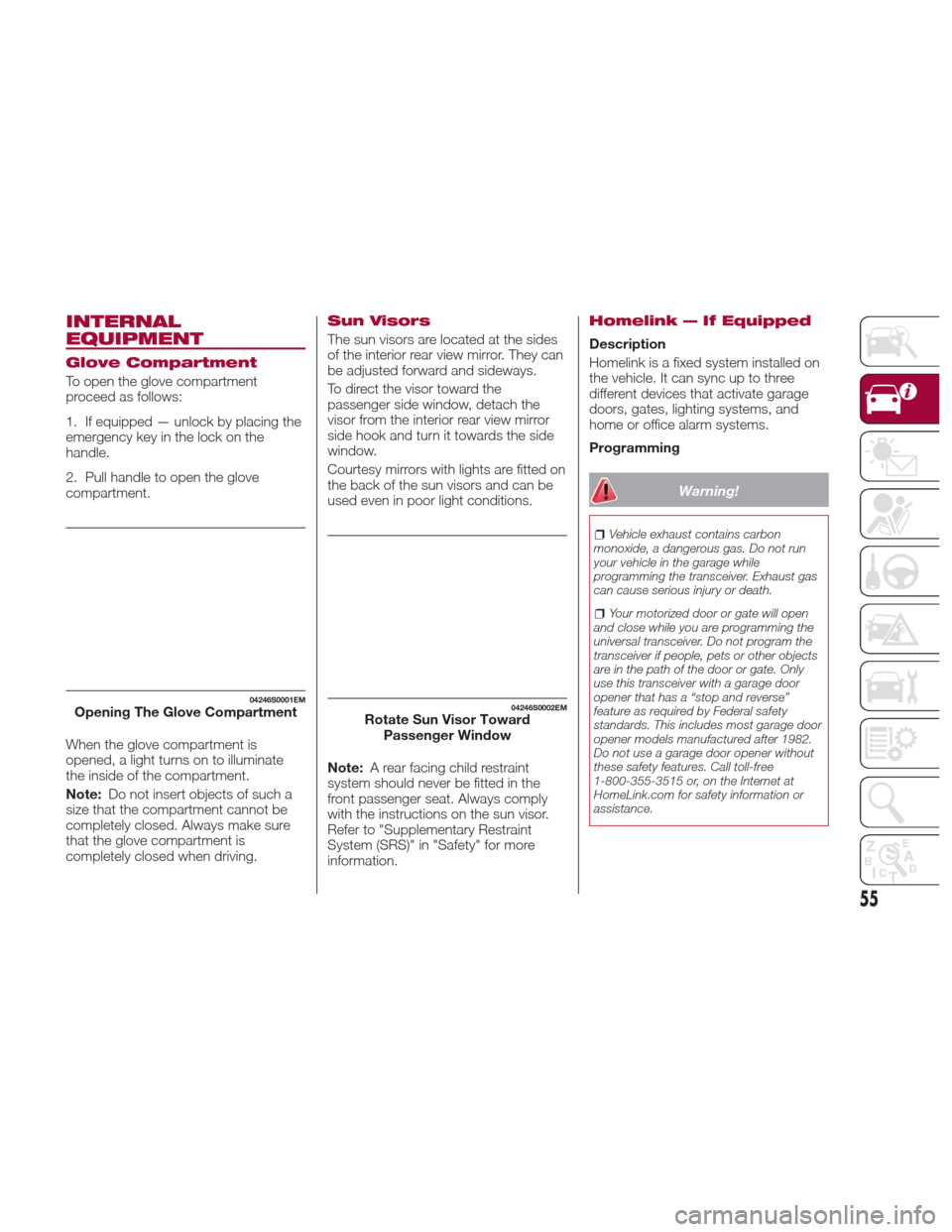
INTERNAL
EQUIPMENT
Glove Compartment
To open the glove compartment
proceed as follows:
1. If equipped — unlock by placing the
emergency key in the lock on the
handle.
2. Pull handle to open the glove
compartment.
When the glove compartment is
opened, a light turns on to illuminate
the inside of the compartment.
Note:Do not insert objects of such a
size that the compartment cannot be
completely closed. Always make sure
that the glove compartment is
completely closed when driving.
Sun Visors
The sun visors are located at the sides
of the interior rear view mirror. They can
be adjusted forward and sideways.
To direct the visor toward the
passenger side window, detach the
visor from the interior rear view mirror
sidehookandturnittowardstheside
window.
Courtesy mirrors with lights are fitted on
the back of the sun visors and can be
used even in poor light conditions.
Note: A rear facing child restraint
system should never be fitted in the
front passenger seat. Always comply
with the instructions on the sun visor.
Refer to "Supplementary Restraint
System (SRS)" in "Safety" for more
information.
Homelink — If Equipped
Description
Homelink is a fixed system installed on
the vehicle. It can sync up to three
different devices that activate garage
doors, gates, lighting systems, and
home or office alarm systems.
Programming
Warning!
Vehicle exhaust contains carbon
monoxide, a dangerous gas. Do not run
your vehicle in the garage while
programming the transceiver. Exhaust gas
can cause serious injury or death.
Your motorized door or gate will open
and close while you are programming the
universal transceiver. Do not program the
transceiver if people, pets or other objects
are in the path of the door or gate. Only
use this transceiver with a garage door
opener that has a “stop and reverse”
feature as required by Federal safety
standards. This includes most garage door
opener models manufactured after 1982.
Do not use a garage door opener without
these safety features. Call toll-free
1-800-355-3515 or, on the Internet at
HomeLink.com for safety information or
assistance.
04246S0001EMOpening The Glove Compartment04246S0002EMRotate Sun Visor Toward Passenger Window
55
Page 87 of 268

SymbolWhat It Means What To Do
ELECTRONIC THROTTLE CONTROL (ETC) WARNING
LIGHTS
This warning light, along with the related message, signals
a failure in the electronic throttle control system (ETC).Contact an authorized dealer as soon as possible.
If a failure is detected, the warning light switches on
while the engine is running.Place the ignition in the off position and the shift
selector in the park position: the warning light should
switch off. If the warning light stays on with engine
running the vehicle can still be driven.
Contact an authorized dealer as soon as possible to
have the failure eliminated.
If the warning light flashes with the engine running,
immediate intervention is required. A loss of
performance, irregular/high idling speed or engine
stopping might take place and the vehicle may need to
be towed.
Contact an authorized dealer as soon as possible to
have the failure eliminated.
LOW ENGINE OIL LEVEL
This warning light appears on the panel when the
engine oil level falls below the minimum recommended
value.
The level must also be checked using the dipstick in the
engine compartment (see chapter "Servicing and
Maintenance.")Contact an authorized dealer to have the system
checked.
ALFA STEERING TORQUE (AST) FAILURE
The switching on of the symbol signals a failure in the
automatic steering correction system.
Contact an authorized dealer to have the system
checked.
ALTERNATOR FAILURE
The switching on of the symbol with engine on
corresponds to an alternator failure.
Contact an authorized dealer as soon as possible.
85
Page 92 of 268
SymbolWhat It Means What To Do
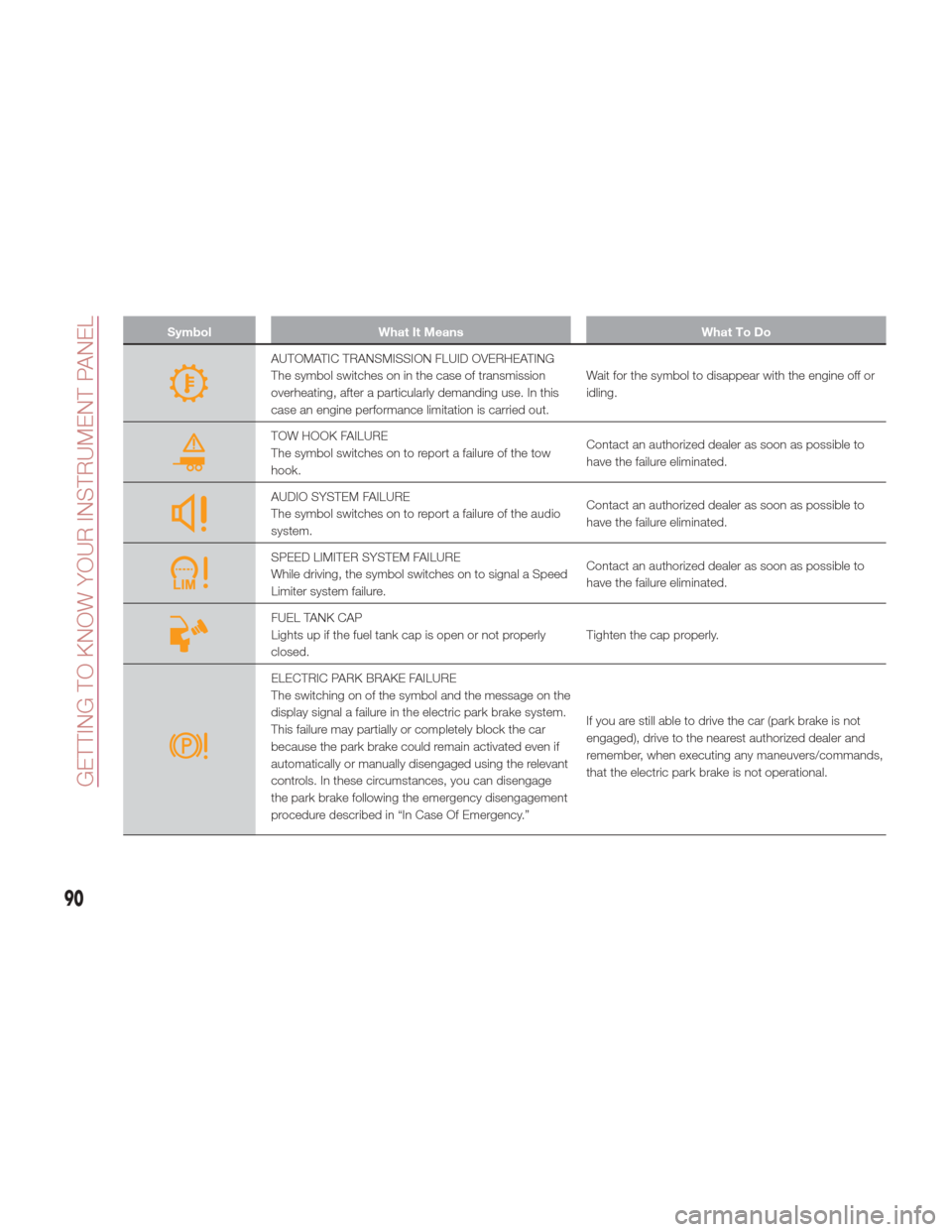
AUTOMATIC TRANSMISSION FLUID OVERHEATING
The symbol switches on in the case of transmission
overheating, after a particularly demanding use. In this
case an engine performance limitation is carried out.Wait for the symbol to disappear with the engine off or
idling.
TOW HOOK FAILURE
The symbol switches on to report a failure of the tow
hook.
Contact an authorized dealer as soon as possible to
have the failure eliminated.
AUDIO SYSTEM FAILURE
The symbol switches on to report a failure of the audio
system.Contact an authorized dealer as soon as possible to
have the failure eliminated.
SPEED LIMITER SYSTEM FAILURE
While driving, the symbol switches on to signal a Speed
Limiter system failure.Contact an authorized dealer as soon as possible to
have the failure eliminated.
FUEL TANK CAP
Lights up if the fuel tank cap is open or not properly
closed.
Tighten the cap properly.
ELECTRIC PARK BRAKE FAILURE
The switching on of the symbol and the message on the
display signal a failure in the electric park brake system.
This failure may partially or completely block the car
because the park brake could remain activated even if
automatically or manually disengaged using the relevant
controls. In these circumstances, you can disengage
the park brake following the emergency disengagement
procedure described in “In Case Of Emergency.”If you are still able to drive the car (park brake is not
engaged), drive to the nearest authorized dealer and
remember, when executing any maneuvers/commands,
that the electric park brake is not operational.
90
GETTING TO KNOW YOUR INSTRUMENT PANEL
Page 102 of 268

The system warns the driver about the
presence of vehicles in the detection
area by lighting up, on the relevant side,
the warning light located on the door
mirror.
When the engine is started the warning
light turns on to signal the driver that
the system is active.
Sensors
The sensors are activated when any
forward gear is engaged at a speed
higher than approximately 6 mph
(10 km/h) or when reverse is engaged.
The sensors are temporarily deactivated
when the vehicle is stationary and the
PARK (P) mode active.
The detection area of the system
covers approximately a lane on both
sides of the vehicle which is around 9 ft
(3 m).This area begins from the door mirror
and extends for approximately 19 ft
(6 m) towards the rear part of the
vehicle.
When the sensors are active, the
system monitors the detection areas on
both sides of the vehicle and warns the
driver about the possible presence of
vehicles in these areas.
While driving, the system monitors the
detection area from three different input
points (side, rear and front) to check
whether a alert needs to be sent to the
driver. The system can detect the
presence of a vehicle in one of these
three areas.
Note:
The system does not alert the driver
for the presence of fixed object (e.g.
safety barriers, poles, walls, etc.).
However, in some circumstances, the
system may activate in the presence of
these objects. This is normal and does
not indicate a system malfunction.
The system does not alert the driver
about the presence of vehicles coming
from the opposite direction, in the
adjacent lanes.
Warning!
The Blind Spot Monitoring system is only
an aid to help detect objects in the blind
spot zones. The BSM system is not
designed to detect pedestrians, bicyclists,
or animals. Even if your vehicle is equipped
with the BSM system, always check your
vehicle’s mirrors, glance over your
shoulder, and use your turn signal before
changing lanes. Failure to do so can result
in serious injury or death.
Important Notes
If a trailer is hitched to the vehicle, the
system automatically deactivates.
For the system to operate correctly, the
rear bumper area where the radar
sensors are located must stay free from
snow, ice and dirt gathered from the
road surface.
Do not cover the rear bumper area
where the radar sensors are located
with any object (e.g. adhesives, bike
rack, etc.).
If you wish to install the tow hook after
purchasing the vehicle, you need to
deactivate the system via the Connect
system. To access the function, select
the following items in sequence on the
main menu: "Settings", "Safety", and
"Blind Spot Alert".
06016S0002EMBSM Indicator Light
100
SAFETY
Page 103 of 268

Rear View
The system detects vehicles coming
from the rear part of your vehicle on
both sides and entering the rear
detection area with a difference in
speed of less than 31 mph (50 km/h)
with relation to your vehicle.
Overtaking Vehicles
If another vehicle is overtaken slowly,
with a difference in speed of less than
approximately 15 mph (25 km/h) and
the vehicle stays in the blind spot for
approximately 1.5 seconds, the
warning light on the door mirror of the
corresponding side lights up.
If the difference in speed between the
two vehicles is greater than
approximately 15 mph (25 km/h), the
warning light does not light up.
Rear Cross Path Detection (RCP)
System
This system helps the driver during
reverse maneuvers in the case of
reduced visibility.
The RCP system monitors the rear
detection areas on both sides of the
vehicle to detect objects moving
towards the sides of the vehicle, with a
minimum speed between approximately
1 mph (1 km/h) and 2 mph (3 km/h)
and objects moving at a maximum
speed of 21 mph (35 km/h), in areas
such as parking lots.
The system activation is signaled to the
driver by a visual and acoustic warning.Note:
If the sensors are covered by
objects or vehicles, the system will not
warn the driver.
Warning!
Rear Cross Path Detection (RCP) is not a
back up aid system. It is intended to be
used to help a driver detect an oncoming
vehicle in a parking lot situation. Drivers
must be careful when backing up, even
when using RCP. Always check carefully
behind your vehicle, look behind you, and
be sure to check for pedestrians, animals,
other vehicles, obstructions, and blind
spots before backing up. Failure to do so
can result in serious injury or death.
Operating Mode
The system may be activated/
deactivated via the Connect system. To
access the function, select the following
items on the main menu in sequence:
"Settings", "Safety" and "Blind Spot
Alert".
"Blind Spot Alert", "Visual" Mode
When the system is enabled, a visual
warning is sent to the door mirror on
the side of the detected object.
The visual warning on the mirror will
blink if the driver switches on the
direction indicators, thus indicating the
intention to change lane.
The warning will be fixed if the driver
stays in the same lane. "Blind Spot Alert" Function
Deactivation
When the system is deactivated ("Blind
Spot Alert" mode off), the BSM or RCP
systems will not emit either acoustic or
visual warnings.
The BSM system will store the
operating mode running when the
engine was stopped. Each time the
engine is started, the operating mode
stored previously will be recalled and
used.
General Information
This vehicle has systems that operate
on radio frequency that comply with
Part 15 of the Federal Communications
Commission (FCC) rules and with
Industry Canada Standards RSS-
GEN/210/220/310.
Operation is subject to the following
two conditions:
1. The device may not cause harmful
interference.
2. The device must accept any
interference received, including
interference that may cause undesired
operation of the device.
Changes or modifications to any of
these systems by other than an
authorized service facility could void
authorization to use this equipment.
101
Page 112 of 268
BeltAlert) (the outboard front passenger
seat BeltAlert is not active when the
outboard front passenger seat is
unoccupied). The BeltAlert warning
sequence starts by blinking the Seat
Belt Reminder Light and sounding an
intermittent chime. Once the BeltAlert
warning sequence has completed, the
Seat Belt Reminder Light will remain on
until the seat belts are buckled. The
BeltAlert warning sequence may repeat
based on vehicle speed until the driver
and occupied outboard front seat
passenger seat belts are buckled. The
driver should instruct all occupants to
buckle their seat belts.
Change Of Status
If the driver or outboard front seat
passenger (if equipped with outboard
front passenger seat BeltAlert)
unbuckles their seat belt while the
vehicle is traveling, the BeltAlert
warning sequence will begin until the
seat belts are buckled again.
The outboard front passenger seat
BeltAlert is not active when the
outboard front passenger seat is
unoccupied. BeltAlert may be triggered
when an animal or other items are
placed on the outboard front passenger
seat or when the seat is folded flat (if
equipped). It is recommended that pets
be restrained in the rear seat (if
equipped) in pet harnesses or pet
carriers that are secured by seat belts,
and cargo is properly stowed.BeltAlert can be activated or
deactivated by your authorized dealer.
FCA US LLC does not recommend
deactivating BeltAlert.
Note:
If BeltAlert has been deactivated
and the driver or outboard front seat
passenger (if equipped with outboard
front passenger seat BeltAlert) is
unbuckled the Seat Belt Reminder Light
will turn on and remain on until the
driver and outboard front seat
passenger seat belts are buckled.
Lap/Shoulder Belts
All seating positions in your vehicle are
equipped with lap/shoulder belts.
The seat belt webbing retractor will lock
only during very sudden stops or
collisions. This feature allows the
shoulder part of the seat belt to move
freely with you under normal conditions.
However, in a collision the seat belt will
lock and reduce your risk of striking the
inside of the vehicle or being thrown out
of the vehicle.
Warning!
Relying on the air bags alone could lead
to more severe injuries in a collision. The air
bags work with your seat belt to restrain
you properly. In some collisions, the air
bags won’t deploy at all. Always wear your
seat belt even though you have air bags.
In a collision, you and your passengers
can suffer much greater injuries if you are
not properly buckled up. You can strike the
interior of your vehicle or other passengers,
or you can be thrown out of the vehicle.
Always be sure you and others in your
vehicle are buckled up properly.
It is dangerous to ride in a cargo area,
inside or outside of a vehicle. In a collision,
people riding in these areas are more likely
to be seriously injured or killed.
Do not allow people to ride in any area
of your vehicle that is not equipped with
seats and seat belts.
Be sure everyone in your vehicle is in a
seat and using a seat belt properly.
Occupants, including the driver, should
always wear their seat belts whether or not
an air bag is also provided at their seating
position to minimize the risk of severe injury
or death in the event of a crash.
Wearing your seat belt incorrectly could
make your injuries in a collision much
worse. You might suffer internal injuries, or
you could even slide out of the seat belt.
Follow these instructions to wear your seat
belt safely and to keep your passengers
safe, too.
Two people should never be belted into
a single seat belt. People belted together
can crash into one another in a collision,
hurting one another badly. Never use a
lap/shoulder belt or a lap belt for more than
one person, no matter what their size.
110
SAFETY
Page 113 of 268
A lap belt worn too high can increase
the risk of injury in a collision. The seat belt
forces won’t be at the strong hip and pelvic
bones, but across your abdomen. Always
wear the lap part of your seat belt as low
as possible and keep it snug.
A twisted seat belt may not protect you
properly. In a collision, it could even cut into
you. Be sure the seat belt is flat against
your body, without twists. If you can’t
straighten a seat belt in your vehicle, take it
to your authorized dealer immediately and
have it fixed.
A seat belt that is buckled into the
wrong buckle will not protect you properly.
The lap portion could ride too high on your
body, possibly causing internal injuries.
Always buckle your seat belt into the
buckle nearest you.
A seat belt that is too loose will not
protect you properly. In a sudden stop, you
could move too far forward, increasing the
possibility of injury. Wear your seat belt
snugly.
A seat belt that is worn under your arm
is dangerous. Your body could strike the
inside surfaces of the vehicle in a collision,
increasing head and neck injury. A seat belt
worn under the arm can cause internal
injuries. Ribs aren’t as strong as shoulder
bones. Wear the seat belt over your
shoulder so that your strongest bones will
take the force in a collision.
A shoulder belt placed behind you will
not protect you from injury during a
collision. You are more likely to hit your
head in a collision if you do not wear your
shoulder belt. The lap and shoulder belt are
meant to be used together.
A frayed or torn seat belt could rip apart
in a collision and leave you with no
protection. Inspect the seat belt system
periodically, checking for cuts, frays, or
loose parts. Damaged parts must be
replaced immediately. Do not disassemble
or modify the seat belt system. Seat belt
assemblies must be replaced after a
collision.
Lap/Shoulder Belt Operating
Instructions
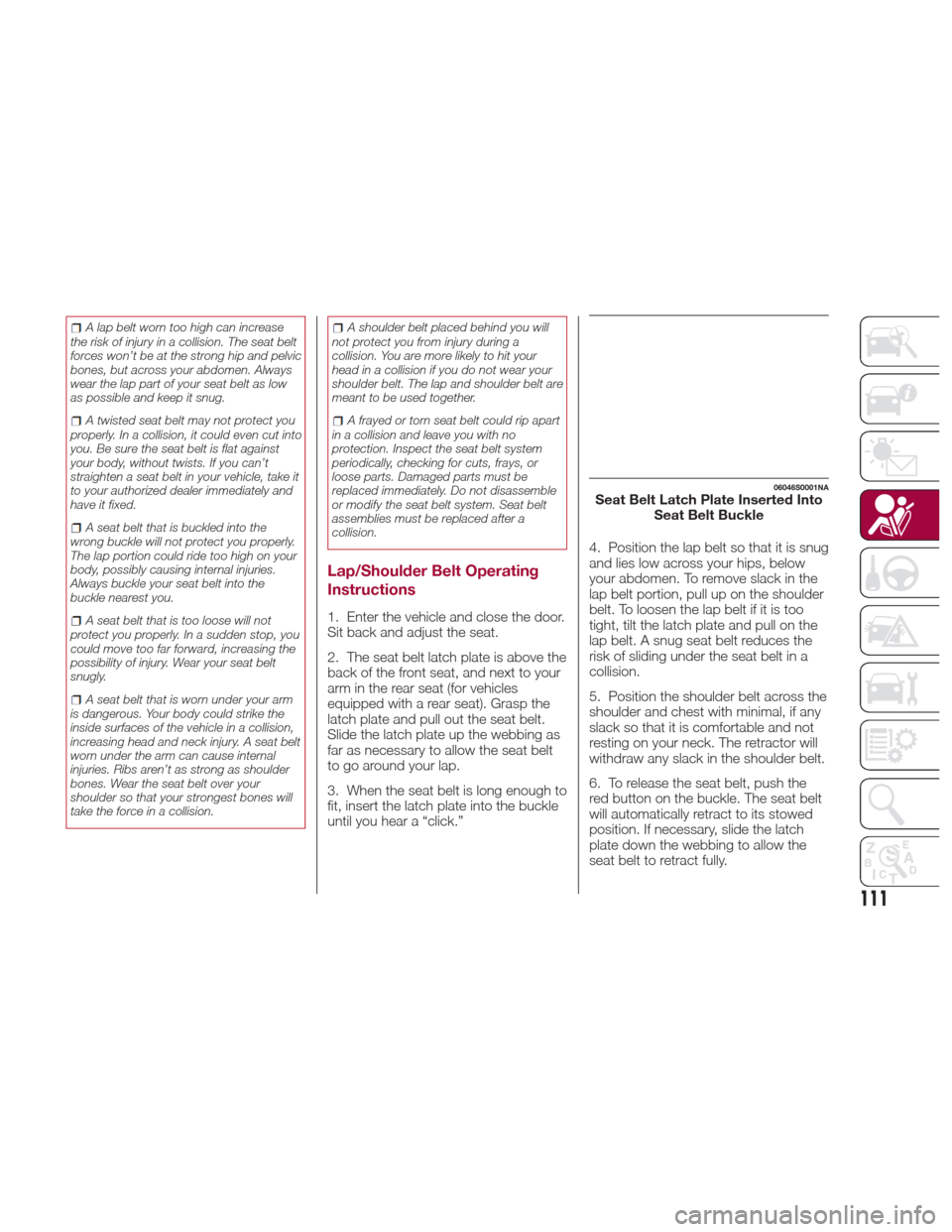
1. Enter the vehicle and close the door.
Sit back and adjust the seat.
2. The seat belt latch plate is above the
back of the front seat, and next to your
arm in the rear seat (for vehicles
equipped with a rear seat). Grasp the
latch plate and pull out the seat belt.
Slide the latch plate up the webbing as
far as necessary to allow the seat belt
to go around your lap.
3. When the seat belt is long enough to
fit, insert the latch plate into the buckle
until you hear a “click.” 4. Position the lap belt so that it is snug
and lies low across your hips, below
your abdomen. To remove slack in the
lap belt portion, pull up on the shoulder
belt. To loosen the lap belt if it is too
tight, tilt the latch plate and pull on the
lap belt. A snug seat belt reduces the
risk of sliding under the seat belt in a
collision.
5. Position the shoulder belt across the
shoulder and chest with minimal, if any
slack so that it is comfortable and not
resting on your neck. The retractor will
withdraw any slack in the shoulder belt.
6. To release the seat belt, push the
red button on the buckle. The seat belt
will automatically retract to its stowed
position. If necessary, slide the latch
plate down the webbing to allow the
seat belt to retract fully.
06046S0001NASeat Belt Latch Plate Inserted Into
Seat Belt Buckle
111
Page 114 of 268
Lap/Shoulder Belt Untwisting
Procedure
Use the following procedure to untwist
a twisted lap/shoulder belt.
1. Position the latch plate as close as
possible to the anchor point.
2. At about 6 to 12 inches (15 to
30 cm) above the latch plate, grasp and
twist the seat belt webbing
180 degrees to create a fold that begins
immediately above the latch plate.
3. Slide the latch plate upward over the
folded webbing. The folded webbing
must enter the slot at the top of the
latch plate.
4. Continue to slide the latch plate up
until it clears the folded webbing and
the seat belt is no longer twisted.
Second Row Center Seat Belt
Operating InstructionsThe second row center seat belt
features a seat belt with a mini-latch
plate and buckle, which allows the seat
belt to detach from the lower anchor
when the seat is folded. The mini-latch
plate and regular latch plate can then
be stored out of the way in the parcel
tray for added convenience to open up
utilization of the storage areas behind
the front seats when the seat is not
occupied.
1. Remove the mini-latch plate and
regular latch plate from its stowed
position in the right rear side trim panel.
2. Grasp the mini-latch plate and pull
the seat belt over the seat.
3. Route the shoulder belt to the inside
of the right head restraint.
4. When the seat belt is long enough to
fit, insert the mini-latch plate into the
mini-buckle until you hear a “click.”
5. Sit back in seat. Slide the regular
latch plate up the webbing as far as
necessary to allow the seat belt to go
around your lap.
6. When the seat belt is long enough to
fit, insert the latch plate into the buckle
until you hear a “click.”
06056S0002EMSecond Row Seat Belts
1 — Seat
Belt Buckle3 — Mini
Latch Plate5 — Mini
Buckle
Release
2 — Seat
Belt Latch
Plate 4 — Mini
Seat Belt
Buckle
112
SAFETY