Page 59 of 233
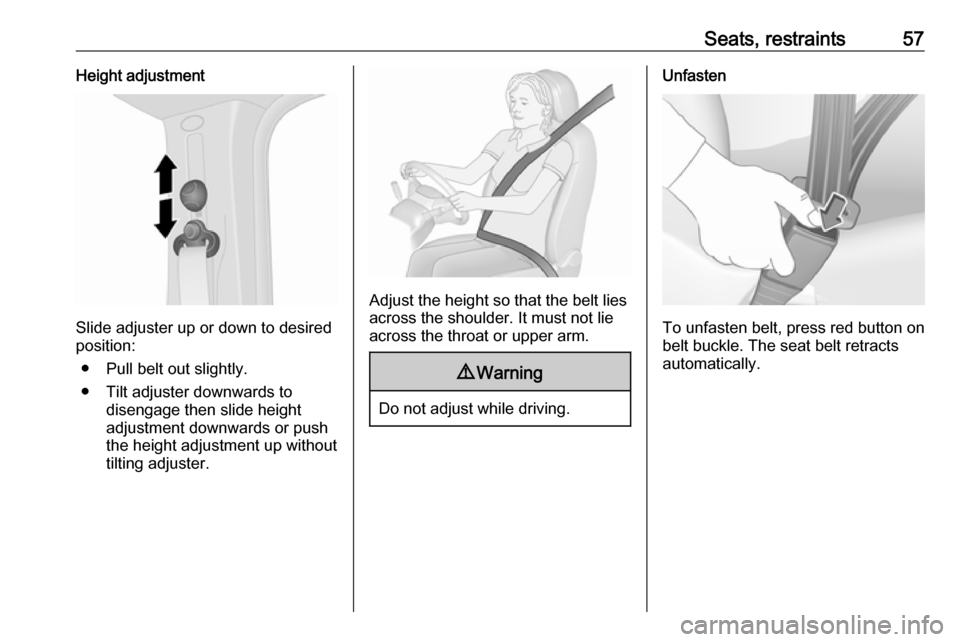
Seats, restraints57Height adjustment
Slide adjuster up or down to desired
position:
● Pull belt out slightly.
● Tilt adjuster downwards to disengage then slide height
adjustment downwards or push
the height adjustment up without
tilting adjuster.
Adjust the height so that the belt lies across the shoulder. It must not lie
across the throat or upper arm.
9 Warning
Do not adjust while driving.
Unfasten
To unfasten belt, press red button on
belt buckle. The seat belt retracts automatically.
Page 60 of 233

58Seats, restraintsSeat belts on the rear seats
For the second row seats, always use
frontmost seat belts 2 (located behind
the second row seats). When the
second row seat belts 2 are not in use,
place latch plate 3 in its housing 4 to
avoid damage to the vehicle.
For the third row seats (see
illustration), always use rearmost seat
belts 1 (located behind the third row
seats).
Before fastening the rear outer seat
belt, first ensure that the lower latch
plate 5 is fully engaged in its buckle 6.
Then guide the belt over the lap area
and the shoulder (do not twist) and
insert the upper latch plate into the
appropriate buckle.
Refer to "Seat belts on the front seats"
above for fastening and unfastening.
9 Warning
The seat belt will not be effective
in the event of an accident unless both the lower and upper latch
plates are correctly fitted.
When unfastening the seat belt,
always release the upper latch
plate from its buckle before the lower latch plate.
Remove latch plates from their
buckles before removing seats
from the vehicle or to facilitate
access to the rear seats.
For the rear centre seat, withdraw belt from the retractor, guide it untwisted
across the body and insert latch plate
into the buckle 7.
Page 61 of 233

Seats, restraints599Warning
Ensure that the rear seats and
backrests are fully engaged before occupying the rear seats.
Rear seats 3 51.
To avoid damage to the vehicle,
always store outboard rear seat belt
latch plates in their housing, if
available.
For the rear centre seat, insert the
latch plate into the appropriate buckle
when the seat is not occupied.
Using the seat belt while pregnant9 Warning
The lap belt must be positioned as
low as possible across the pelvis
to prevent pressure on the
abdomen.
Airbag system
The airbag system consists of a
number of individual systems
depending on the scope of
equipment.
When triggered, the airbags inflate
within milliseconds. They also deflate
so quickly that it is often unnoticeable
during the collision.9 Warning
If handled improperly the airbag
systems can be triggered in an
explosive manner.
Note
The airbag systems and belt
pretensioner control electronics are
located in the centre console area.
Do not put any magnetic objects in
this area.
Do not affix any objects onto the
airbag covers and do not cover them with other materials.
Each airbag is triggered only once.
Have deployed airbags replaced by
a workshop. Furthermore, it may be
Page 65 of 233

Seats, restraints639Warning
Optimum protection is only
provided when the seat is in the
proper position.
Seat position 3 47.
Keep the area in which the airbag
inflates clear of obstructions.
Fasten the seat belt correctly and
engage securely. Only then is the
airbag able to protect.
Side airbag system
The side airbag system consists of an
airbag in each front seat backrest.
This may be identified by the word
AIRBAG .
The side airbag system is triggered in the event of an accident of a certain
severity. The ignition must be
switched on.
The inflated airbags cushion the
impact, thereby reducing the risk of
injury to the upper body and pelvis in
the event of a side-on collision
considerably.
9 Warning
Keep the area in which the airbag
inflates clear of obstructions.
Note
Only use protective seat covers that have been approved for the vehicle.Be careful not to cover the airbags.
Curtain airbag system
The curtain airbag system consists of an airbag in the roof frame on each
side. This may be identified by the
word AIRBAG on the headlining trim.
Page 66 of 233

64Seats, restraintsThe curtain airbag system is triggeredin the event of a side-on impact of a
certain severity. The ignition must be
switched on.
The inflated airbags cushion the
impact, thereby reducing the risk of
injury to the head in the event of a
side-on impact considerably.9 Warning
Keep the area in which the airbag
inflates clear of obstructions.
The hooks on the handles in the
roof frame are only suitable for
hanging up light articles of
clothing, without coat hangers. Do not keep any items in these
clothes.
Airbag deactivation
The front passenger airbag system must be deactivated if a child restraint
is to be fitted on the front passenger
seat in accordance with the
instructions in the Child restraint
installation locations tables 3 68.
The belt tensioners and all other
airbag systems will remain active.
Depending on vehicle, there is a
warning on the airbag label located on the front passenger sun visor. Refer
to "Airbag system" for further
information 3 59.
Front passenger airbag system can
be deactivated via a switch located on the side of the instrument panel.
Open the front passenger door to
access the switch.
Press the switch in and rotate to
choose the position:* OFF:front passenger seat airbag
system is deactivated and
will not inflate in the event of
a collision. Control indicator
* OFF illuminates
continuously in the roof
console 3 94, 3 97 and
a corresponding message
appears in the Driver
Information Centre 3 102.Ó ON:front passenger airbag
system is active.9 Danger
Deactivate passenger airbag only
in combination with the use of a
child restraint system, subject to
the instructions and restrictions in
the table 3 68.
Otherwise, there is a risk of fatal
injury for a person occupying a
seat with a deactivated front
passenger airbag.
Page 67 of 233

Seats, restraints65If control indicator ÓON illuminates
after the ignition is switched on and
control indicator *OFF is not
illuminated, the front passenger
airbag system will inflate in the event
of a collision.
If both control indicators ÓON and
* OFF are illuminated
simultaneously, there is a system
failure. The status of the system is not
discernible, therefore no person is
permitted to occupy the front
passenger seat. Contact a workshop immediately.
If control indicator F 3 98
illuminates together with v 3 97,
this indicates a fault within the
system. The switch position may have been changed inadvertently with the
ignition on. Turn ignition off and on
again and reset the switch position. If
F and v still remain illuminated, seek
the assistance of a workshop.
Change status only when the vehicle
is stopped with the ignition off. Status remains until the next change.
Control indicator for airbag
deactivation 3 97.Child restraints
Child restraint systems9 Danger
If using a rear-facing child restraint
system on the front passenger
seat, the airbag system for the
front passenger seat must be
deactivated. This also applies to certain forward-facing child
restraint systems as indicated in
the table 3 68.
Airbag deactivation 3 64.
Airbag label 3 59.
We recommend a child restraint system which is tailored specifically to the vehicle. For further information,
contact your workshop.
When a child restraint system is being
used, pay attention to the following
usage and installation instructions
and also those supplied with the child
restraint system.
Always comply with local or national
regulations. In some countries, the
use of child restraint systems is
forbidden on certain seats.
Child restraint systems can be
fastened with:
● Three-point seat belt
● ISOFIX brackets
● Top-Tether
Three-point seat belt
Child restraint systems can be
fastened by using a three-point seat
belt 3 56.
Depending on the size of the used
child restraint systems and the model
variant, child restraint systems can be
attached to certain 2nd row and 3rd
row rear seats 3 68.
ISOFIX brackets ISOFIX mounting brackets are
indicated by the ISOFIX logo or
symbol on the seat cushion.
Page 68 of 233

66Seats, restraints
Fasten vehicle-approved ISOFIX
child restraint systems to the ISOFIX
mounting brackets.
When using ISOFIX mounting
brackets for seat mounting,
universally approved child restraint
systems for ISOFIX may be used.
A Top-Tether strap must be used in
addition to the ISOFIX mounting
brackets.
Permissible mounting location
positions for ISOFIX child restraint
systems are marked in the tables by
< , IL and IUF.
Top-Tether fastening eyes
Top-Tether fastening eyes are
located on the back of the seat.
In addition to the ISOFIX mounting
brackets, fasten the Top-Tether strap
to the Top-Tether fastening eyes. The
strap must run between the two guide
rods of the head restraint.
ISOFIX child restraint systems of
universal category positions are
marked in the table by IUF 3 68.
Selecting the right system
The rear seats are the most
convenient location to fasten a child
restraint system.
Children should travel facing
rearwards in the vehicle as long as
possible. This makes sure that the
child's backbone, which is still very
weak, is under less strain in the event of an accident.
Suitable are restraint systems that
comply with valid UN ECE
regulations. Check local laws and
regulations for mandatory use of child restraint systems.
Ensure that the child restraint system
to be installed is compatible with the
vehicle type.
Ensure that the mounting location of
the child restraint system within the
vehicle is correct, see following
tables.
Allow children to enter and exit the
vehicle only on the side facing away
from the traffic.
When the child restraint system is not in use, secure the seat with a seat beltor remove it from the vehicle.
Page 72 of 233
70Seats, restraintsRear seats - Combi, Double cabWeight and age class2nd row seats13rd row seatsGroup 0: up to 10 kg
Group 0+: up to 13 kgUUGroup I: 9 to 18 kgU 2U2Group II: 15 to 25 kg
Group III: 22 to 36 kgU 2U21:If necessary, slide adjustable front seat forwards to install a child restraint system on these seats. There may not be
enough clearance to install particular child restraint systems on vehicles fitted with fixed front seats.2:Forward-facing child restraints: Remove head restraint 3 46 before installing child restraint. The seat in front of this
installation position must not be more than halfway back on its runners. Maximum backrest rake is 25°. Seat adjustment
3 48.U:Suitable for universal category restraint systems for use in this weight and age class, in conjunction with three-point
seat belt.X:Seat position not suitable for children in this weight and age class.