Page 198 of 362
ENGINE REMOVAL
5-3
Removing the electronic parts
Order Part name Q’ty Remarks
Use a suitable stand to raise the front wheel
off the ground.
Seat Refer to “GENERAL CHASSIS” on page 4-1.
Side cover (left/right) Refer to “GENERAL CHASSIS” on page 4-1.
Air scoop (left / right) Refer to “GENERAL CHASSIS” on page 4-1.
Fuel tank Refer to “FUEL TANK” on page 7-1.
Air filter case cover
1 Rectifier/regulator 1
2ECU 1
3 Ignition coil 1
4 Condenser 1
5 Neutral switch 1
6 AC magneto coupler 1 Disconnect.
7 Crankshaft position sensor coupler 1 Disconnect.
8 Coolant temperature sensor coupler 1 Disconnect.
For installation, reverse the removal proce-
dure.
T.R.
T.R.
T.R.T.R.
8 3
7
6
154
2
LT
Page 284 of 362

FUEL TANK
7-3
TIP
• Take care not to damage the installation sur-
faces of the fuel tank.
• Always use a new fuel pump gasket.
• Install the lip on the fuel pump gasket upward.
• Install the fuel pump as shown in the figure.
• Align the projection “a” on the fuel pump with
the slot “b” in the fuel pump bracket.
• Tighten the fuel pump bolts in the proper tight-
ening sequence as shown.
EASB111309INSTALLING THE FUEL TANK
1. Install:
• Fuel tank
2. Connect:
• Fuel hose
ECA
NOTICE
• Connect the fuel hose securely, and check
that the orientation of the installed fuel
hose holder is correct.
• Take care not to kink or pinch the fuel
hose.
TIP
• Insert the fuel hose into the fuel pipe securely
until you hear a “click”.
• Slide the fuel hose connector cover “1” at the
hose end in the direction of the arrow.
• Install the fuel hose connector holder “a”.
• Check that the fuel hose and the fuel pump
lead are routed through the guide on the cov-
er.3. Connect:
• Fuel pump coupler
4. Install:
• Air scoop (left/right)
• Seat
• Side cover (left/right)
Refer to “GENERAL CHASSIS” on page 4-
1.
EASB111310CHECKING THE FUEL PRESSURE
1. Check:
• Fuel pressure
▼▼▼▼▼▼▼▼▼▼▼▼▼▼▼▼▼▼▼▼▼▼▼▼▼▼▼▼▼▼▼▼
a. Remove the side cover (left/right), the seat
and the air scoop (left/right).
Refer to “GENERAL CHASSIS” on page 4-
1.
b. Remove the fuel tank bolt and lift the fuel
tank.
c. Disconnect the fuel hose from the fuel
pump.
Refer to “REMOVING THE FUEL TANK” on
page 7-2.
EWA
WARNING
Cover the fuel hose connection with a cloth
when disconnecting it. This is because re-
sidual pressure in the fuel hose could cause
fuel to spurt out when the hose is removed.
ECA
a
b
4 1
2
6
53
1
a
Page 286 of 362
THROTTLE BODY
7-5
EASB111313
THROTTLE BODY
Removing the throttle body
Order Part name Q’ty Remarks
Seat Refer to “GENERAL CHASSIS” on page 4-1.
Side cover (left/right) Refer to “GENERAL CHASSIS” on page 4-1.
Air scoop (left/right) Refer to “GENERAL CHASSIS” on page 4-1.
Fuel tank Refer to “FUEL TANK” on page 7-1.
ECU Refer to “ENGINE REMOVAL” on page 5-1.
Ignition coil Refer to “ENGINE REMOVAL” on page 5-1.
1 Intake air temperature sensor coupler 1 Disconnect.
2 Air filter case 1
3 Fuel injector coupler 1 Disconnect.
4 Intake air pressure sensor coupler 1 Disconnect.
5 Throttle position sensor coupler 1 Disconnect.
6 Throttle cable cover 1
7 Throttle cable 2
8 Fuel hose 1
2
1
6
10
11
9
8
3
7
5
4
10 Nm (1.0 m kgf, 7.2 ft lbf)
7 Nm (0.7 m kgf, 5.1 ft lbf)
3.5 Nm (0.35 m kgf, 2.5 ft lbf)
3.0 Nm (0.30 m kgf, 2.2 ft lbf)
3.5 Nm (0.35 m kgf, 2.5 ft lbf)
Page 291 of 362

8
ELECTRICAL SYSTEM
IGNITION SYSTEM.......................................................................................... 8-2
CIRCUIT DIAGRAM ................................................................................... 8-2
TROUBLESHOOTING ............................................................................... 8-4
CHARGING SYSTEM....................................................................................... 8-6
CIRCUIT DIAGRAM ................................................................................... 8-6
TROUBLESHOOTING ............................................................................... 8-8
FUEL INJECTION SYSTEM........................................................................... 8-10
CIRCUIT DIAGRAM ................................................................................. 8-10
YAMAHA DIAGNOSTIC TOOL ................................................................ 8-12
TROUBLESHOOTING DETAILS ............................................................. 8-13
FUEL PUMP SYSTEM.................................................................................... 8-32
CIRCUIT DIAGRAM ................................................................................. 8-32
TROUBLESHOOTING ............................................................................. 8-34
ELECTRICAL COMPONENTS....................................................................... 8-36
CHECKING THE SWITCHES .................................................................. 8-38
CHECKING THE IGNITION SPARK GAP................................................ 8-41
CHECKING THE SPARK PLUG CAP ...................................................... 8-41
CHECKING THE IGNITION COIL ............................................................ 8-41
CHECKING THE CRANKSHAFT POSITION SENSOR........................... 8-42
CHECKING THE ECU .............................................................................. 8-42
CHECKING THE STATOR COIL ............................................................. 8-42
CHECKING THE RECTIFIER/REGULATOR ........................................... 8-43
CHECKING THE COOLANT TEMPERATURE SENSOR........................ 8-43
CHECKING THE THROTTLE POSITION SENSOR ................................ 8-44
CHECKING THE THROTTLE POSITION SENSOR INPUT VOLTAGE .. 8-45
CHECKING THE INTAKE AIR PRESSURE SENSOR ............................ 8-45
CHECKING THE INTAKE AIR TEMPERATURE SENSOR ..................... 8-45
CHECKING THE NEUTRAL SWITCH ..................................................... 8-46
CHECKING THE FUEL INJECTOR ......................................................... 8-46
Page 295 of 362
IGNITION SYSTEM
8-3
1. Crankshaft position sensor
2. AC magneto
3. Rectifier/regulator
4. Joint connector
5. Condenser
7. Engine stop switch
8. Neutral switch
9. Launch control switch
10.ECU
11.Ignition coil
12.Spark plug
19.Ignition coil sub-lead
Page 297 of 362
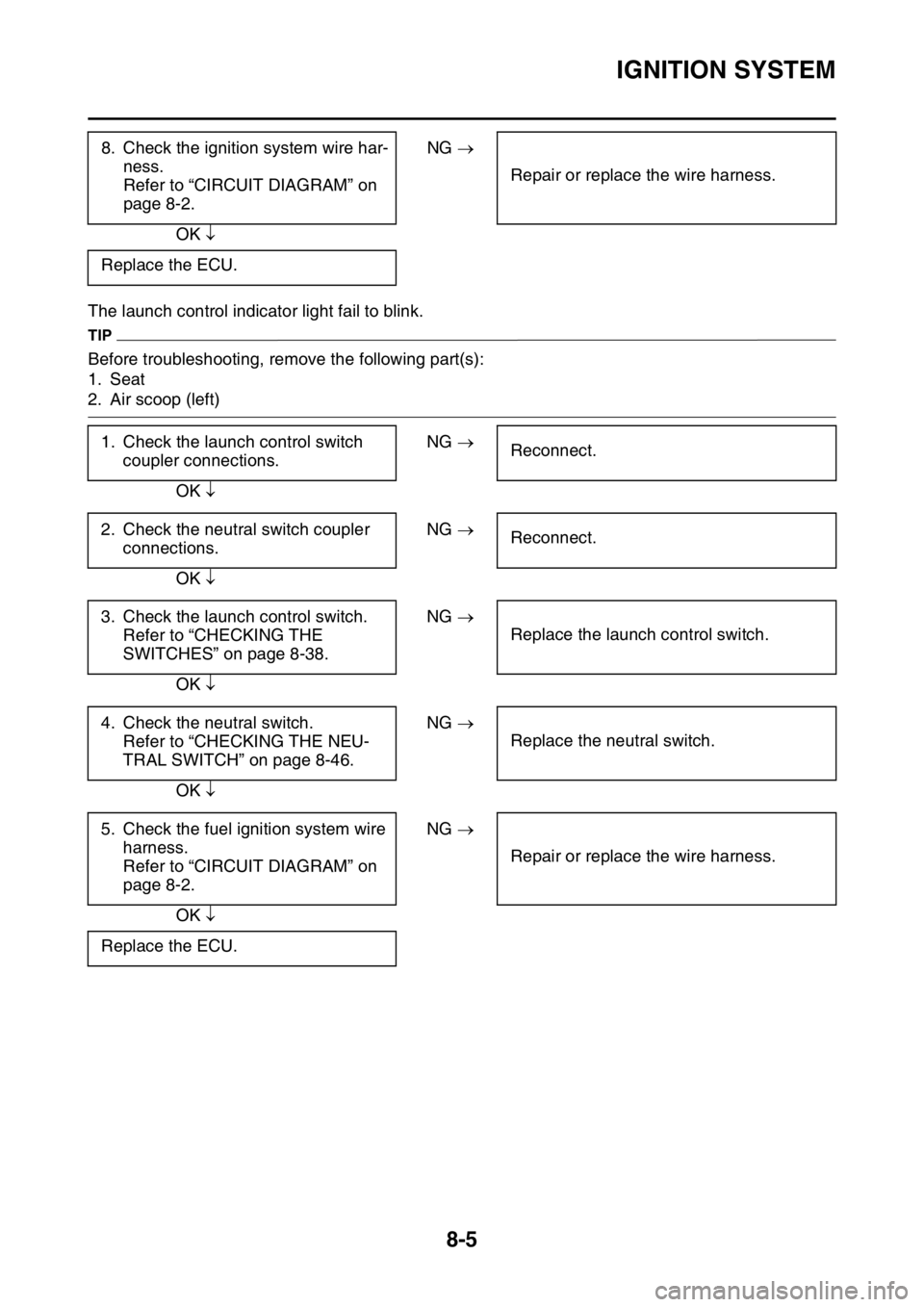
IGNITION SYSTEM
8-5
The launch control indicator light fail to blink.
TIP
Before troubleshooting, remove the following part(s):
1. Seat
2. Air scoop (left)8. Check the ignition system wire har-
ness.
Refer to “CIRCUIT DIAGRAM” on
page 8-2.NG
Repair or replace the wire harness.
OK
Replace the ECU.
1. Check the launch control switch
coupler connections.NG
Reconnect.
OK
2. Check the neutral switch coupler
connections.NG
Reconnect.
OK
3. Check the launch control switch.
Refer to “CHECKING THE
SWITCHES” on page 8-38.NG
Replace the launch control switch.
OK
4. Check the neutral switch.
Refer to “CHECKING THE NEU-
TRAL SWITCH” on page 8-46.NG
Replace the neutral switch.
OK
5. Check the fuel ignition system wire
harness.
Refer to “CIRCUIT DIAGRAM” on
page 8-2.NG
Repair or replace the wire harness.
OK
Replace the ECU.
Page 303 of 362
FUEL INJECTION SYSTEM
8-11
1. Crankshaft position sensor
2. AC magneto
3. Rectifier/regulator
4. Joint connector
5. Condenser
7. Engine stop switch
8. Neutral switch
10.ECU
13.Fuel injector
14.Fuel pump
15.Intake air temperature sensor
16.Coolant temperature sensor
17.Throttle position sensor
18.Intake air temperature sensor
Page 304 of 362

FUEL INJECTION SYSTEM
8-12
EASB111326YAMAHA DIAGNOSTIC TOOL
This model uses the Yamaha diagnostic tool to identify malfunctions.
For information about using the Yamaha diagnostic tool, refer to the operation manual that is included
with the tool.
FEATURES OF THE YAMAHA DIAGNOSTIC TOOL
A diagnosis can be made more quickly than traditional methods with the Yamaha diagnostic tool.
Using this software, ECU and sensor data, as well as fault diagnosis, vehicle maintenance, and any
necessary information can be recorded and displayed on your computer screen through a USB
adapter connected to the computer interface with a communication cable connected to the vehicle’s
ECU.
Data obtained in various functions can be saved as vehicle history, and can be accumulated.
FUNCTIONS OF THE YAMAHA DIAGNOSTIC TOOL
However, the diagnostic tool cannot be used to freely change the basic vehicle functions, such as
adjusting the ignition timing.Yamaha diagnostic tool
90890-03231
Yamaha diagnostic tool (US)
90890-03234
Fault diagnosis mode Fault codes recorded on the ECU are read, and the con-
tents are displayed.
Function diagnostic mode Check the operation of the output value of each sensor
and actuator.
Inspection mode Determine whether each sensor or actuator is functioning
properly.
CO adjustment mode Adjust the concentration of CO admissions during idling.
Monitoring mode Displays a graph of sensor output values for actual oper-
ating conditions.
Logging mode Records and saves the sensor output value in actual driv-
ing conditions.
View log Displays the logging data.
ECU rewrite If necessary, the ECU is rewritten using the ECU rewrite
data provided by Yamaha. Ignition timing adjustment, etc.
cannot be changed from the vehicle’s original state.