Page 278 of 356
FUEL TANK
7-3
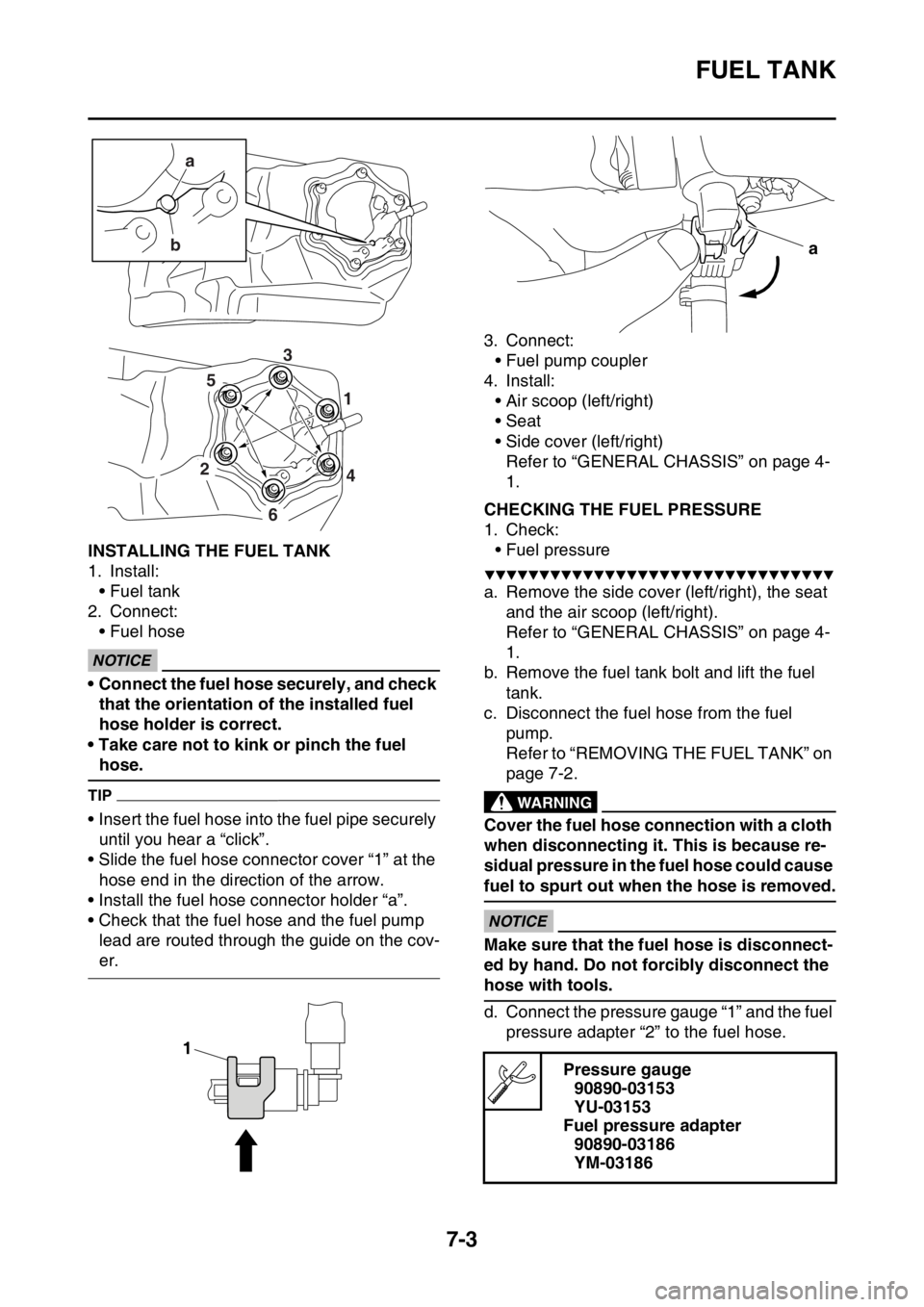
EAS1SM9309INSTALLING THE FUEL TANK
1. Install:
• Fuel tank
2. Connect:
• Fuel hose
ECA
NOTICE
• Connect the fuel hose securely, and check
that the orientation of the installed fuel
hose holder is correct.
• Take care not to kink or pinch the fuel
hose.
TIP
• Insert the fuel hose into the fuel pipe securely
until you hear a “click”.
• Slide the fuel hose connector cover “1” at the
hose end in the direction of the arrow.
• Install the fuel hose connector holder “a”.
• Check that the fuel hose and the fuel pump
lead are routed through the guide on the cov-
er.3. Connect:
• Fuel pump coupler
4. Install:
• Air scoop (left/right)
• Seat
• Side cover (left/right)
Refer to “GENERAL CHASSIS” on page 4-
1.
EAS1SM9310CHECKING THE FUEL PRESSURE
1. Check:
• Fuel pressure
▼▼▼▼▼▼▼▼▼▼▼▼▼▼▼▼▼▼▼▼▼▼▼▼▼▼▼▼▼▼▼▼
a. Remove the side cover (left/right), the seat
and the air scoop (left/right).
Refer to “GENERAL CHASSIS” on page 4-
1.
b. Remove the fuel tank bolt and lift the fuel
tank.
c. Disconnect the fuel hose from the fuel
pump.
Refer to “REMOVING THE FUEL TANK” on
page 7-2.
EWA
WARNING
Cover the fuel hose connection with a cloth
when disconnecting it. This is because re-
sidual pressure in the fuel hose could cause
fuel to spurt out when the hose is removed.
ECA
NOTICE
Make sure that the fuel hose is disconnect-
ed by hand. Do not forcibly disconnect the
hose with tools.
d. Connect the pressure gauge “1” and the fuel
pressure adapter “2” to the fuel hose.
a
b
4 1
2
6
53
1
Pressure gauge
90890-03153
YU-03153
Fuel pressure adapter
90890-03186
YM-03186
a
Page 280 of 356
THROTTLE BODY
7-5
EAS1SM9313
THROTTLE BODY
Removing the throttle body
Order Part name Q’ty Remarks
Seat Refer to “GENERAL CHASSIS” on page 4-1.
Side cover (left/right) Refer to “GENERAL CHASSIS” on page 4-1.
Air scoop (left/right) Refer to “GENERAL CHASSIS” on page 4-1.
Fuel tank Refer to “FUEL TANK” on page 7-1.
ECU Refer to “ENGINE REMOVAL” on page 5-1.
Ignition coil Refer to “ENGINE REMOVAL” on page 5-1.
1 Intake air temperature sensor coupler 1 Disconnect.
2 Air filter case 1
3 Fuel injector coupler 1 Disconnect.
4 Intake air pressure sensor coupler 1 Disconnect.
5 Throttle position sensor coupler 1 Disconnect.
6 Throttle cable cover 1
7 Throttle cable 2
8 Fuel hose 1
9 Exhaust pipe bracket 1
2
1
6
10
11
9
8
3
7
5
4
3.5 Nm (0.35 m�kgf, 2.5 ft�Ibf)T.R.
3.5 Nm (0.35 m�kgf, 2.5 ft�Ibf)T.R.
7 Nm (0.7 m�kgf, 5.1 ft�Ibf)T.R.
3.0 Nm (0.30 m�kgf, 2.2 ft�Ibf)T.R.
10 Nm (1.0 m�kgf, 7.2 ft�Ibf)T.R.
Page 285 of 356

8
ELECTRICAL SYSTEM
IGNITION SYSTEM.......................................................................................... 8-2
CIRCUIT DIAGRAM ................................................................................... 8-2
TROUBLESHOOTING ............................................................................... 8-4
CHARGING SYSTEM....................................................................................... 8-6
CIRCUIT DIAGRAM ................................................................................... 8-6
TROUBLESHOOTING ............................................................................... 8-8
FUEL INJECTION SYSTEM........................................................................... 8-10
CIRCUIT DIAGRAM ................................................................................. 8-10
YAMAHA DIAGNOSTIC TOOL ................................................................ 8-12
TROUBLESHOOTING DETAILS ............................................................. 8-13
FUEL PUMP SYSTEM.................................................................................... 8-32
CIRCUIT DIAGRAM ................................................................................. 8-32
TROUBLESHOOTING ............................................................................. 8-34
ELECTRICAL COMPONENTS....................................................................... 8-36
CHECKING THE SWITCHES .................................................................. 8-38
CHECKING THE IGNITION SPARK GAP................................................ 8-41
CHECKING THE SPARK PLUG CAP ...................................................... 8-41
CHECKING THE IGNITION COIL ............................................................ 8-41
CHECKING THE CRANKSHAFT POSITION SENSOR........................... 8-42
CHECKING THE ECU .............................................................................. 8-43
CHECKING THE STATOR COIL ............................................................. 8-43
CHECKING THE RECTIFIER/REGULATOR ........................................... 8-43
CHECKING THE COOLANT TEMPERATURE SENSOR........................ 8-44
CHECKING THE THROTTLE POSITION SENSOR ................................ 8-44
CHECKING THE THROTTLE POSITION SENSOR INPUT VOLTAGE .. 8-45
CHECKING THE INTAKE AIR PRESSURE SENSOR ............................ 8-46
CHECKING THE INTAKE AIR TEMPERATURE SENSOR ..................... 8-46
CHECKING THE NEUTRAL SWITCH ..................................................... 8-46
CHECKING THE FUEL INJECTOR ......................................................... 8-47
Page 289 of 356
IGNITION SYSTEM
8-3
1. Crankshaft position sensor
2. AC magneto
3. Rectifier/regulator
4. Joint connector
5. Condenser
7. Engine stop switch
9. ECU
10.Ignition coil
11.Spark plug
18.Ignition coil sub-lead
Page 291 of 356
IGNITION SYSTEM
8-5
8. Check the ignition system wire har-
ness.
Refer to “CIRCUIT DIAGRAM” on
page 8-2.NG
Repair or replace the wire harness.
OK
Replace the ECU.
Page 297 of 356
FUEL INJECTION SYSTEM
8-11
1. Crankshaft position sensor
2. AC magneto
3. Rectifier/regulator
4. Joint connector
5. Condenser
7. Engine stop switch
8. Neutral switch
9. ECU (electronic control unit)
12.Fuel injector
13.Fuel pump
14.Intake air temperature sensor
15.Coolant temperature sensor
16.Throttle position sensor
17.Intake air temperature sensor
Page 298 of 356

FUEL INJECTION SYSTEM
8-12
EAS1SM9326YAMAHA DIAGNOSTIC TOOL
This model uses the Yamaha diagnostic tool to identify malfunctions.
For information about using the Yamaha diagnostic tool, refer to the operation manual that is included
with the tool.
FEATURES OF THE YAMAHA DIAGNOSTIC TOOL
A diagnosis can be made more quickly than traditional methods with the Yamaha diagnostic tool.
Using this software, ECU and sensor data, as well as fault diagnosis, vehicle maintenance, and any
necessary information can be recorded and displayed on your computer screen through a USB
adapter connected to the computer interface with a communication cable connected to the vehicle’s
ECU.
Data obtained in various functions can be saved as vehicle history, and can be accumulated.
FUNCTIONS OF THE YAMAHA DIAGNOSTIC TOOL
However, the diagnostic tool cannot be used to freely change the basic vehicle functions, such as
adjusting the ignition timing.
CONNECTING THE YAMAHA DIAGNOSTIC TOOL
1. Remove the coupler for connecting setting tool.Yamaha diagnostic tool
90890-03231
Yamaha diagnostic tool (US)
90890-03234
Fault diagnosis mode Fault codes recorded on the ECU are read, and the con-
tents are displayed.
Function diagnostic mode Check the operation of the output value of each sensor
and actuator.
Inspection mode Determine whether each sensor or actuator is functioning
properly.
CO adjustment mode Adjust the concentration of CO admissions during idling.
Monitoring mode Displays a graph of sensor output values for actual oper-
ating conditions.
Logging mode Records and saves the sensor output value in actual driv-
ing conditions.
View log Displays the logging data.
ECU rewrite If necessary, the ECU is rewritten using the ECU rewrite
data provided by Yamaha. Ignition timing adjustment, etc.
cannot be changed from the vehicle’s original state.
Page 300 of 356

FUEL INJECTION SYSTEM
8-14
Fault code 12
SymptomCrankshaft position sensor: no normal signals are received
from the crankshaft position sensor.
Fail-safe systemUnable to start engine
Unable to drive vehicle
Diagnostic code No.—
Diagnostic tool display—
Procedure—
Or-
derProbable cause of malfunc-
tion and checkMaintenance job Reinstatement method
1 Connection of crankshaft po-
sition sensor coupler.
Check the locking condition
of the coupler.
Disconnect the coupler, and
check the pins (for bent or
broken terminals and locking
condition of the pins).Improperly connected
Connect the coupler secure-
ly, or repair/replace the wire
harness.Crank the engine.
Fault code No. is not dis-
played Repair is finished.
Fault code No. is displayed
Go to next order.
2 Connection of wire harness
ECU coupler.
Check the locking condition
of the coupler.
Disconnect the coupler, and
check the pins (for bent or
broken terminals and locking
condition of the pins).Improperly connected
Connect the coupler secure-
ly, or repair/replace the wire
harness.Crank the engine.
Fault code No. is not dis-
played Repair is finished.
Fault code No. is displayed
Go to next order.
3 Wire harness continuity. Open or short circuit Re-
place the wire harness.
Between the crankshaft posi-
tion sensor coupler and ECU
coupler.
gray–gray
black/blue–black/blueCrank the engine.
Fault code No. is not dis-
played Repair is finished.
Fault code No. is displayed
Go to next order.
4 Mounted condition of crank-
shaft position sensor.
Check for looseness or
pinching.
Check the gap between the
crankshaft position sensor
and the pickup rotor.Improperly mounted sensor
Remount or replace the
sensor. “AC MAGNETO” on
page 5-58.Crank the engine.
Fault code No. is not dis-
played Repair is finished.
Fault code No. is displayed
Go to next order.
5 Defective crankshaft position
sensor.Check the crankshaft position
sensor.
“CHECKING THE CRANK-
SHAFT POSITION SEN-
SOR” on page 8-42.Crank the engine.
Fault code No. is not dis-
played Repair is finished.
Fault code No. is displayed
Go to next order.
6 Faulty ECU Replace the ECU.