2016 YAMAHA YZ250F ECU
[x] Cancel search: ECUPage 106 of 356

CHASSIS
3-22
EAS1SM9087
CHASSIS
EAS1SM9088BLEEDING THE BRAKE SYSTEMEWA13100
WARNING
Bleed the brake system whenever:
• The system is disassembled.
• A brake hose is loosened, disconnected,
or replaced.
• The brake fluid level is very low.
• Brake operation is faulty.
1. Remove:
• Brake master cylinder cap
• Reservoir diaphragm
• Reservoir float (front brake)
• Protector (rear brake)
TIP
• Be careful not to spill any brake fluid or allow
the reservoir to overflow.
• Make sure that there is enough brake fluid be-
fore applying the brake. Ignoring this precau-
tion could allow air to enter the brake system,
considerably lengthening the bleeding proce-
dure.
• If bleeding is difficult, it may be necessary to
let the brake fluid settle for a few hours. Re-
peat the bleeding procedure when the tiny
bubbles in the hose have disappeared.
2. Bleed the brake system.
▼▼▼▼▼▼▼▼▼▼▼▼▼▼▼▼▼▼▼▼▼▼▼▼▼▼▼▼▼▼▼▼
a. Fill the reservoir to the proper level with the
recommended brake fluid.
b. Install the reservoir diaphragm.
c. Connect the plastic hose “1” to the bleed
screw “2” securely, and place a container
under the end of the plastic hose.d. Slowly apply the brake several times.
e. Fully pull the brake lever or fully press down
the brake pedal and hold it in position.
f. Loosen the bleed screw.
TIP
Loosening the bleed screw will release the
pressure in the brake caliper and cause the
brake lever to contact the throttle grip or the
brake pedal to fully extend.
g. Tighten the bleed screw and then release
the brake lever or brake pedal.
h. Repeat steps (d) to (g) until all of the air bub-
bles have disappeared from the brake fluid
in the plastic hose.
TIP
During the procedure, keep adding brake fluid
to the reservoir.
ECA
NOTICE
Brake fluid may erode painted surfaces or
plastic parts. Always clean up spilled fluid
immediately.
i. Tighten the bleed screw.
j. Pour brake fluid to the reservoir up to the
specified level.
Refer to “CHECKING THE BRAKE FLUID
LEVEL” on page 3-27.
EWA13110
WARNING
After bleeding the hydraulic brake system,
check the brake operation.
▲▲▲▲▲▲▲▲▲▲▲▲▲▲▲▲▲▲▲▲▲▲▲▲▲▲▲▲▲▲▲▲
1 2
A
A. Front
B. Rear
Bleed screw
6 Nm (0.6 m·kgf, 4.3 ft·lbf)
2
1B
T R..
Page 112 of 356
CHASSIS
3-28
WARNING
• Use only the designated brake fluid. Other
brake fluids may cause the rubber seals to
deteriorate, causing leakage and poor
brake performance.
• Refill with the same type of brake fluid that
is already in the system. Mixing brake flu-
ids may result in a harmful chemical reac-
tion, leading to poor brake performance.
• When refilling, be careful that water does
not enter the brake fluid reservoir. Water
will significantly lower the boiling point of
the brake fluid and could cause vapor
lock.
ECA
NOTICE
Brake fluid may damage painted surfaces
and plastic parts. Therefore, always clean
up any spilt brake fluid immediately.
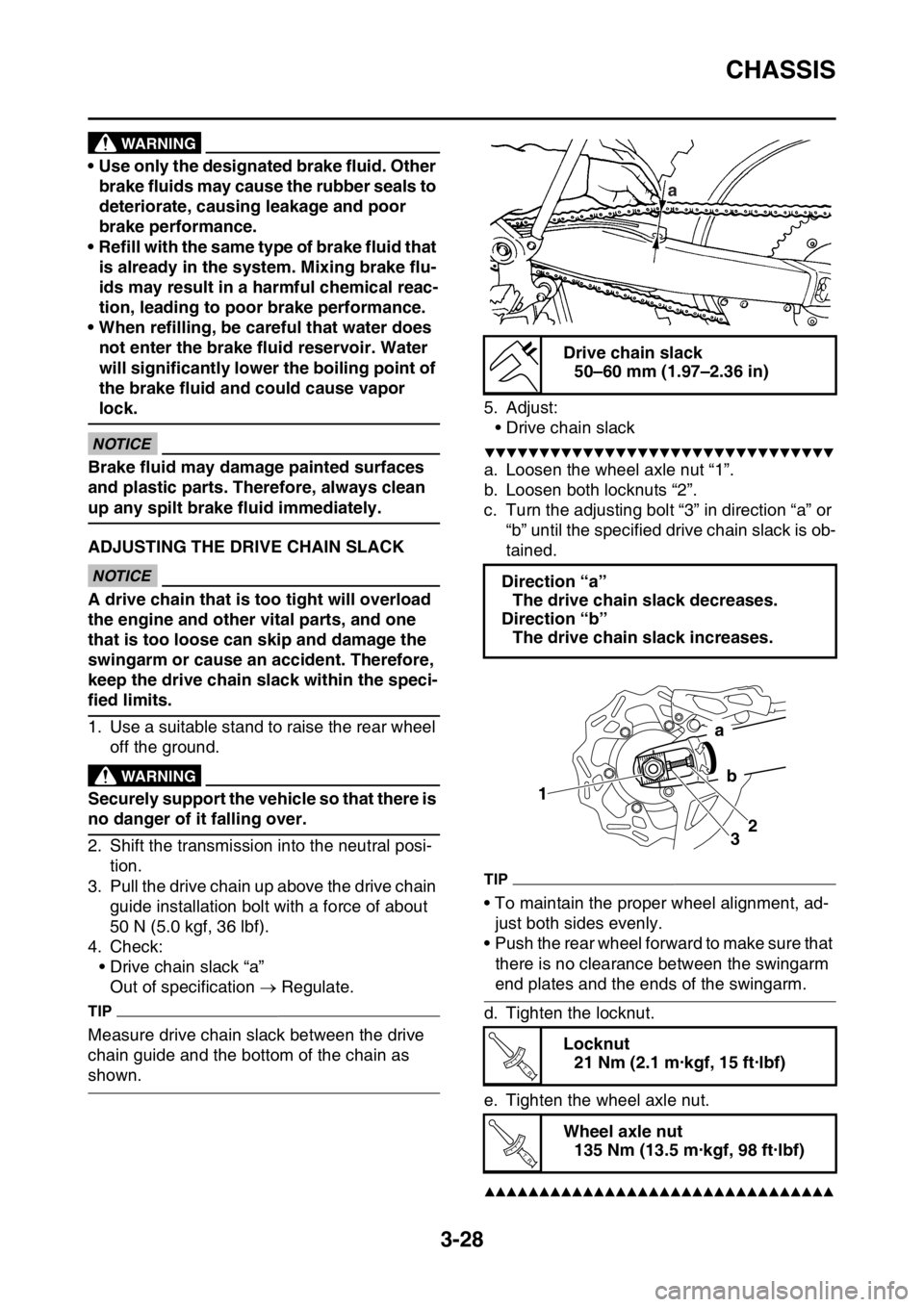
EAS1SM9096ADJUSTING THE DRIVE CHAIN SLACKECA13550
NOTICE
A drive chain that is too tight will overload
the engine and other vital parts, and one
that is too loose can skip and damage the
swingarm or cause an accident. Therefore,
keep the drive chain slack within the speci-
fied limits.
1. Use a suitable stand to raise the rear wheel
off the ground.
EWA13120
WARNING
Securely support the vehicle so that there is
no danger of it falling over.
2. Shift the transmission into the neutral posi-
tion.
3. Pull the drive chain up above the drive chain
guide installation bolt with a force of about
50 N (5.0 kgf, 36 lbf).
4. Check:
• Drive chain slack “a”
Out of specification Regulate.
TIP
Measure drive chain slack between the drive
chain guide and the bottom of the chain as
shown.5. Adjust:
• Drive chain slack
▼▼▼▼▼▼▼▼▼▼▼▼▼▼▼▼▼▼▼▼▼▼▼▼▼▼▼▼▼▼▼▼
a. Loosen the wheel axle nut “1”.
b. Loosen both locknuts “2”.
c. Turn the adjusting bolt “3” in direction “a” or
“b” until the specified drive chain slack is ob-
tained.
TIP
• To maintain the proper wheel alignment, ad-
just both sides evenly.
• Push the rear wheel forward to make sure that
there is no clearance between the swingarm
end plates and the ends of the swingarm.
d. Tighten the locknut.
e. Tighten the wheel axle nut.
▲▲▲▲▲▲▲▲▲▲▲▲▲▲▲▲▲▲▲▲▲▲▲▲▲▲▲▲▲▲▲▲
Drive chain slack
50–60 mm (1.97–2.36 in)
Direction “a”
The drive chain slack decreases.
Direction “b”
The drive chain slack increases.
Locknut
21 Nm (2.1 m·kgf, 15 ft·lbf)
Wheel axle nut
135 Nm (13.5 m·kgf, 98 ft·lbf)
a
1
32
a
b
T R..
T R..
Page 113 of 356
CHASSIS
3-29
EAS1SM9097CHECKING THE FRONT FORK LEGS
1. Stand the vehicle upright on a level surface.
EWA
WARNING
Securely support the vehicle so that there is
no danger of it falling over.
2. Check:
• Inner tube
Damage/scratches Replace.
• Front fork leg (s)
Oil leaks between inner tube and outer tube
Replace the oil seal.
3. Hold the vehicle upright and apply the front
brake.
4. Check:
• Front fork operation
Push down hard on the handlebar several
times and check if the front fork rebounds
smoothly.
Unsmooth operation Correct or replace.
Refer to “FRONT FORK” on page 4-37.
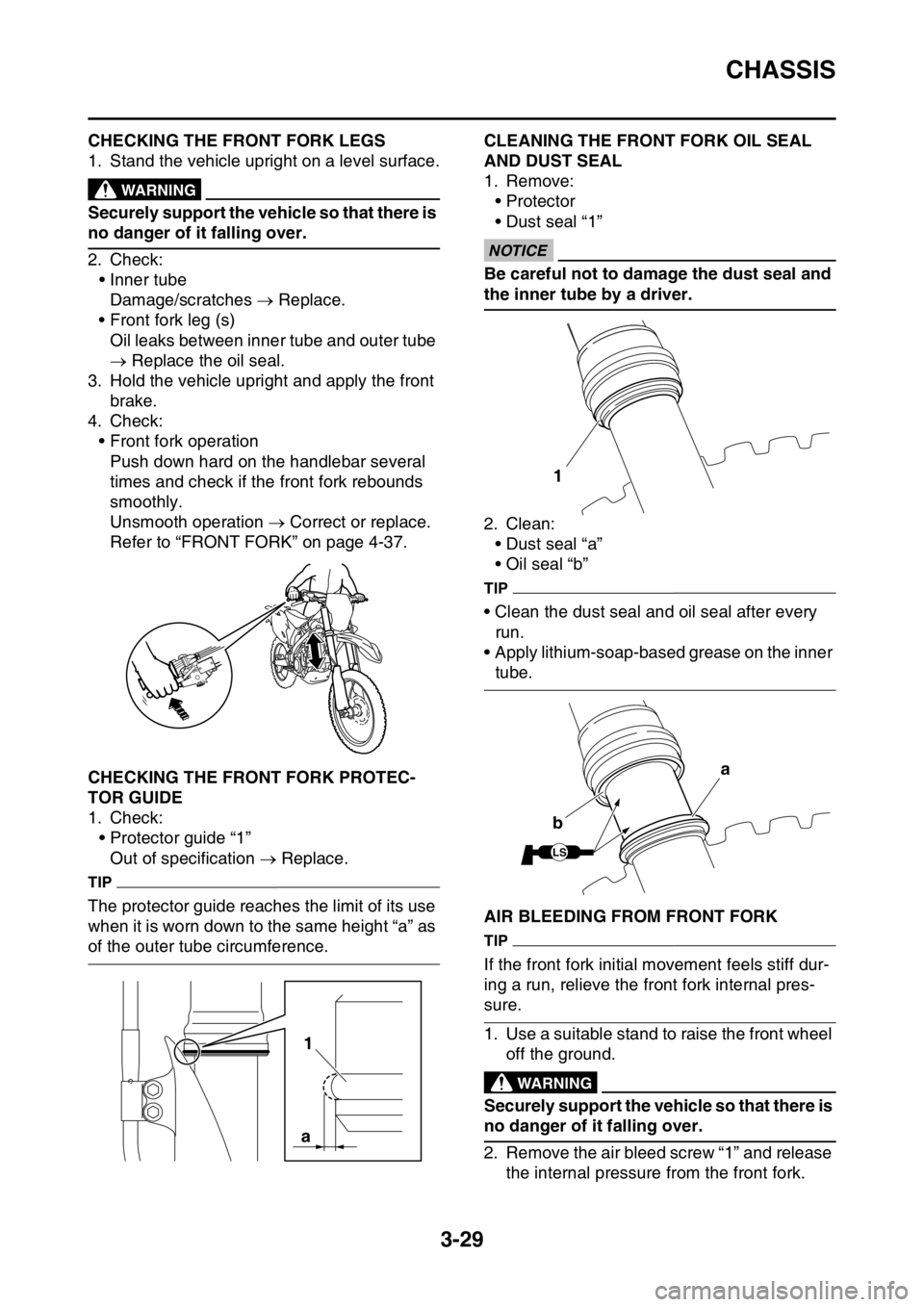
EAS1SM9098CHECKING THE FRONT FORK PROTEC-
TOR GUIDE
1. Check:
• Protector guide “1”
Out of specification Replace.
TIP
The protector guide reaches the limit of its use
when it is worn down to the same height “a” as
of the outer tube circumference.
EAS1SM9099CLEANING THE FRONT FORK OIL SEAL
AND DUST SEAL
1. Remove:
•Protector
• Dust seal “1”
ECA
NOTICE
Be careful not to damage the dust seal and
the inner tube by a driver.
2. Clean:
• Dust seal “a”
• Oil seal “b”
TIP
• Clean the dust seal and oil seal after every
run.
• Apply lithium-soap-based grease on the inner
tube.
EAS1SM9100AIR BLEEDING FROM FRONT FORK
TIP
If the front fork initial movement feels stiff dur-
ing a run, relieve the front fork internal pres-
sure.
1. Use a suitable stand to raise the front wheel
off the ground.
EWA
WARNING
Securely support the vehicle so that there is
no danger of it falling over.
2. Remove the air bleed screw “1” and release
the internal pressure from the front fork.
1
a
1
LS
a
b
Page 114 of 356

CHASSIS
3-30
3. Tighten:
• Air bleed screw
EAS1SM9101ADJUSTING THE FRONT FORK LEGSEWA32D1006
WARNING
• Always adjust the left and right front forks
evenly. If this is not done, the vehicle may
have poor stability.
• Securely support the vehicle so that there
is no danger of it falling over.
Rebound damping
ECA@
NOTICE
Do not turn the adjuster forcibly beyond its
adjusting range.
1. Adjust:
• Rebound damping
▼▼▼▼▼▼▼▼▼▼▼▼▼▼▼▼▼▼▼▼▼▼▼▼▼▼▼▼▼▼▼▼
a. Turn the adjuster “1” in the direction of “a” or
“b” to make an adjustment.
▲▲▲▲▲▲▲▲▲▲▲▲▲▲▲▲▲▲▲▲▲▲▲▲▲▲▲▲▲▲▲▲
Compression dampingECA@
NOTICE
Do not turn the adjuster forcibly beyond its
adjusting range.
1. Adjust:
• Compression damping
▼▼▼▼▼▼▼▼▼▼▼▼▼▼▼▼▼▼▼▼▼▼▼▼▼▼▼▼▼▼▼▼
a. Turn the adjuster “1” in the direction of “a” or
“b” to make an adjustment.
▲▲▲▲▲▲▲▲▲▲▲▲▲▲▲▲▲▲▲▲▲▲▲▲▲▲▲▲▲▲▲▲
Air bleed screw
1.3 Nm (0.13 m·kgf, 0.94 ft·lbf)
Direction “a”
Rebound damping is increased (sus-
pension is harder).
Direction “b”
Rebound damping is decreased (sus-
pension is softer).
Rebound damping adjusting posi-
tions
Maximum
Fully turned in
Standard
12 clicks out* (USA) (CAN)
8 clicks out* (EUR) (JPN) (AUS)
(NZL) (ZAF)
Minimum
20 clicks out*
* With the adjuster fully turned in
T R..
1
Direction “a”
Compression damping is increased
(suspension is harder).
Direction “b”
Compression damping is decreased
(suspension is softer).
Compression damping adjusting
positions
Maximum
Fully turned in
Standard
10 clicks out* (USA) (CAN)
6 clicks out* (EUR) (JPN) (AUS)
(NZL) (ZAF)
Minimum
20 clicks out*
* With the adjuster fully turned in
1
a
b
a b
1
Page 115 of 356

CHASSIS
3-31
EAS1SM9102CHECKING THE SWINGARM OPERATION
1. Check:
• Swingarm smooth action
• Swingarm free play
Refer to “SWINGARM” on page 4-60.
EAS1SM9103CHECKING THE REAR SUSPENSION
1. Stand the vehicle upright on a level surface.
EWA
WARNING
Securely support the vehicle so that there is
no danger of it falling over.
2. Check:
• Rear shock absorber assembly
Gas leaks/oil leaks Replace the rear
shock absorber assembly.
Refer to “REAR SHOCK ABSORBER AS-
SEMBLY” on page 4-53.
3. Check:
• Rear shock absorber assembly smooth ac-
tion
• Rear suspension link smooth action
Sit astride the seat and shake your body up
and down several times to check whether
the rear shock absorber assembly operates
smoothly.
Unsmooth operation Correct or replace.
Refer to “REAR SHOCK ABSORBER AS-
SEMBLY” on page 4-53.
EAS1SM9104ADJUSTING THE REAR SHOCK ABSORB-
ER ASSEMBLY
Use a suitable stand to raise the rear wheel off
the ground.
EWA13120
WARNING
Securely support the vehicle so that there is
no danger of it falling over.
Spring preload
ECA@
NOTICE
Do not turn the adjuster forcibly beyond its
adjusting range.1. Remove:
• Rear frame
Refer to “REAR SHOCK ABSORBER AS-
SEMBLY” on page 4-53.
2. Adjust:
• Spring preload
▼▼▼▼▼▼▼▼▼▼▼▼▼▼▼▼▼▼▼▼▼▼▼▼▼▼▼▼▼▼▼▼
a. Loosen the locknut “1”.
b. Loosen the adjuster “2” until there is some
clearance between the spring and the ad-
juster.
c. Measure the spring free length “a”.
d. Turn the adjuster in the direction of “b” or “c”
to make an adjustment.
TIP
• Be sure to remove all dirt and mud from
around the locknut and adjusting ring before
adjustment.
• The length of the spring (installed) changes
1.5 mm (0.06 in) per turn of the adjusting ring.
Direction “b”
Spring preload is increased (suspen-
sion is harder).
Direction “c”
Spring preload is decreased (suspen-
sion is softer).
Spring preload adjusting positions
Minimum
Position in which the spring is
turned in 1.5 mm (0.06 in) from
its free length.
Standard
Position in which the spring is
turned in 10 mm (0.39 in) from its
free length.
Maximum
Position in which the spring is
turned in 18 mm (0.71 in) from its
free length.
Page 118 of 356

CHASSIS
3-34
2. Tighten:
• Spokes
Use a spoke nipple wrench “1” for tighten-
ing.
TIP
• Do not give a half turn (180 °) or more for one
tightening.
• Make sure that tightening after a break-in is
done until the initial looseness in nipples dis-
appears.
• Make sure that tightening is done in stages,
not at a time.
EAS1SM9107CHECKING THE WHEELS
1. Check:
• Wheel(s)
Damage/out-of-round Replace.
EWA
WARNING
Never attempt to make any repairs to the
wheel.
TIP
After replacing a tire or a wheel, always bal-
ance the wheel.
EAS1SM9108CHECKING THE WHEEL BEARINGS
1. Check:
• Wheel bearings
Refer to “CHECKING THE FRONT WHEEL”
on page 4-4 and “CHECKING THE REAR
WHEEL” on page 4-8.
EAS1SM9109
CHECKING AND ADJUSTING THE STEER-
ING HEAD
1. Use a suitable stand to raise the front wheel
off the ground.
EWA
WARNING
Securely support the vehicle so that there is
no danger of it falling over.
2. Check:
• Steering head
Grasp the bottom of the front fork legs and
gently rock the front fork.
Blinding/looseness Adjust the steering
head.
3. Remove:
• Handlebar
Refer to “HANDLEBAR” on page 4-31.
• Upper bracket
Refer to “STEERING HEAD” on page 4-49.
4. Adjust:
• Steering head
▼▼▼▼▼▼▼▼▼▼▼▼▼▼▼▼▼▼▼▼▼▼▼▼▼▼▼▼▼▼▼▼
a. Remove the washer “1”.
b. After loosening the ring nut “2” with a steer-
ing nut wrench “3”, tighten it to the specified
torque.
TIP
• Set the torque wrench at a right angle to the
steering nut wrench.
• Move the steering to the left and right a couple
of times to check that it moves smoothly. Spoke nipple wrench (6–7)
90890-01521
YM-01521
Spokes
2.5 Nm (0.25 m·kgf, 1.8 ft·lbf)
1
T R..
1
3
2
Page 128 of 356
FRONT WHEEL
4-4
EAS1SM9121REMOVING THE FRONT WHEEL
1. Use a suitable stand to raise the front wheel
off the ground.
EWA
WARNING
Securely support the vehicle so that there is
no danger of it falling over.
2. Remove:
• Front wheel
EAS1SM9122CHECKING THE FRONT WHEEL
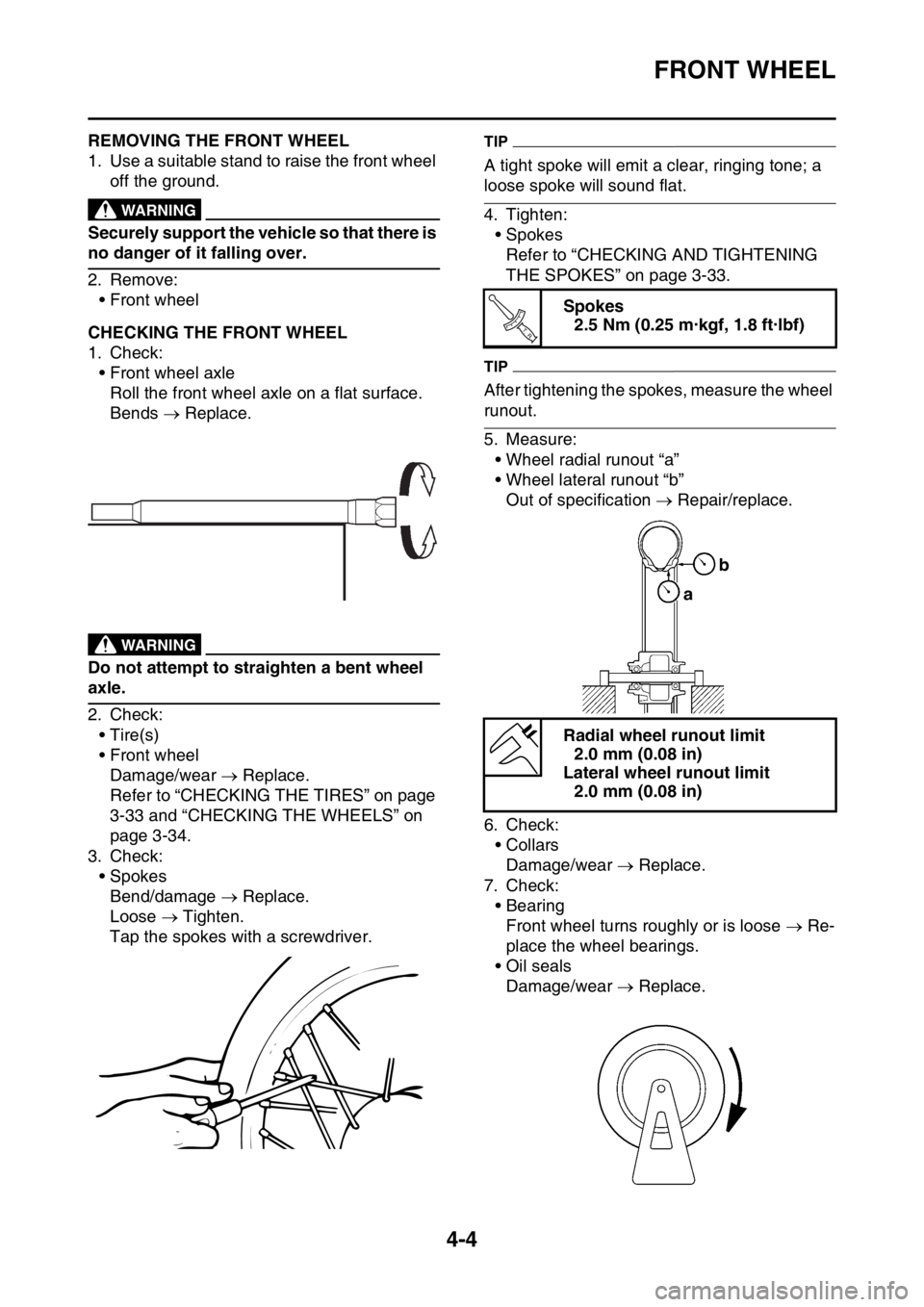
1. Check:
• Front wheel axle
Roll the front wheel axle on a flat surface.
Bends Replace.
EWA
WARNING
Do not attempt to straighten a bent wheel
axle.
2. Check:
•Tire(s)
• Front wheel
Damage/wear Replace.
Refer to “CHECKING THE TIRES” on page
3-33 and “CHECKING THE WHEELS” on
page 3-34.
3. Check:
• Spokes
Bend/damage Replace.
Loose Tighten.
Tap the spokes with a screwdriver.
TIP
A tight spoke will emit a clear, ringing tone; a
loose spoke will sound flat.
4. Tighten:
• Spokes
Refer to “CHECKING AND TIGHTENING
THE SPOKES” on page 3-33.
TIP
After tightening the spokes, measure the wheel
runout.
5. Measure:
• Wheel radial runout “a”
• Wheel lateral runout “b”
Out of specification Repair/replace.
6. Check:
•Collars
Damage/wear Replace.
7. Check:
• Bearing
Front wheel turns roughly or is loose Re-
place the wheel bearings.
• Oil seals
Damage/wear Replace.
Spokes
2.5 Nm (0.25 m·kgf, 1.8 ft·lbf)
Radial wheel runout limit
2.0 mm (0.08 in)
Lateral wheel runout limit
2.0 mm (0.08 in)
T R..
ab
Page 132 of 356

REAR WHEEL
4-8
EAS1SM9127REMOVING THE REAR WHEEL
1. Use a suitable stand to raise the rear wheel
off the ground.
EWA
WARNING
Securely support the vehicle so that there is
no danger of it falling over.
2. Remove:
• Rear wheel axle nut “1”
3. Loosen:
• Locknut “2”
4. Tighten:
• Adjusting bolt “3”
5. Remove:
• Rear wheel axle
• Rear wheel
TIP
• Push the rear wheel forward and remove the
drive chain from the rear wheel sprocket.
• Do not depress the brake pedal with the rear
wheel removed.
EAS1SM9128CHECKING THE REAR WHEEL
1. Check:
• Rear wheel axle
• Rear wheel
• Bearing
• Oil seals
Refer to “CHECKING THE FRONT WHEEL”
on page 4-4.
2. Check:
•Tire(s)
• Rear wheel
Damage/wear Replace.
Refer to “CHECKING THE TIRES” on page
3-33 and “CHECKING THE WHEELS” on
page 3-34.
3. Check:
• Spokes
Refer to “CHECKING THE FRONT WHEEL”
on page 4-4.4. Measure:
• Radial wheel runout
• Lateral wheel runout
Refer to “CHECKING THE FRONT WHEEL”
on page 4-4.
EAS1SM9129DISASSEMBLING THE REAR WHEEL
1. Remove:
• Oil seals
• Bearing
Refer to “DISASSEMBLING THE FRONT
WHEEL” on page 4-5.
EAS1SM9130CHECKING AND REPLACING THE REAR
WHEEL SPROCKET
1. Check:
• Rear wheel sprocket
More than 1/4 tooth wear “a” Replace the
rear wheel sprocket and the drive sprocket
as a set.
Bent tooth Replace the rear wheel
sprocket and the drive sprocket as a set.
2. Replace:
• Rear wheel sprocket
▼▼▼▼▼▼▼▼▼▼▼▼▼▼▼▼▼▼▼▼▼▼▼▼▼▼▼▼▼▼▼▼
a. Remove the self-locking nuts and the rear
wheel sprocket.
b. Clean the rear wheel drive hub with a clean
cloth, especially the surfaces that contact
the sprocket.
c. Install the new rear wheel sprocket.
3
12
Radial wheel runout limit
2.0 mm (0.08 in)
Lateral wheel runout limit
2.0 mm (0.08 in)
b. Correct
1. Drive chain roller
2. Rear wheel sprocket
Rear wheel sprocket self-locking
nut
42 Nm (4.2 m·kgf, 30 ft·lbf)
T R..