Page 73 of 172
6-3
6
Do not turn the key to the “ ” (start) position
with the engine running; otherwise, damage
to the electric starter may result.TIPFor maximum engine life, never accelerate
hard when the engine is cold! EBU31910Drive select lever operation and re-
verse drivingNOTICEECB02150Do not shift without coming to a complete
stop and waiting for the engine to return to
normal idle speed. Damage to the engine
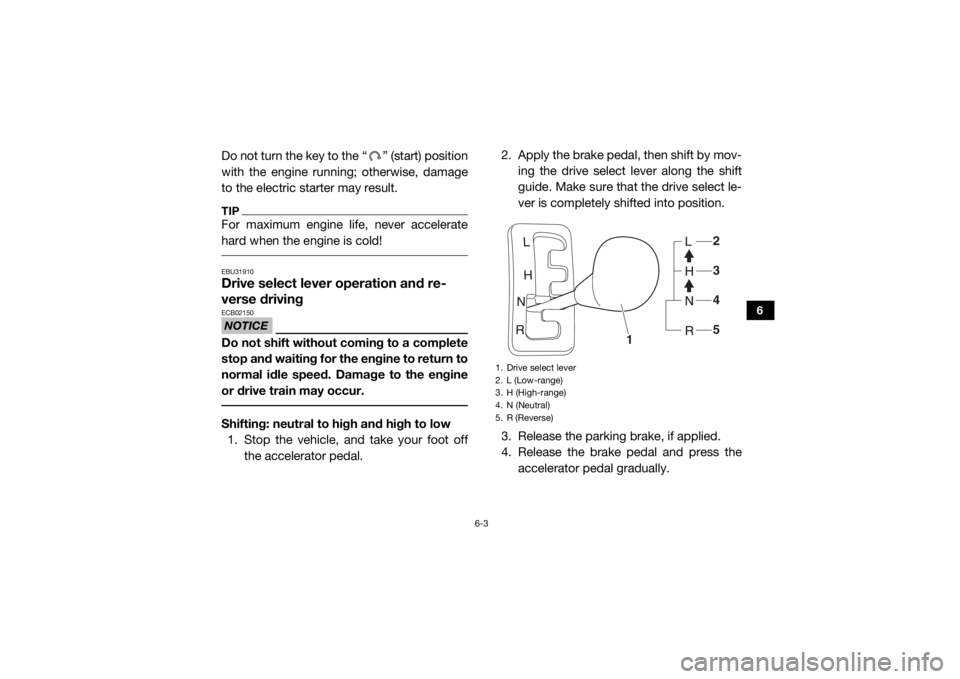
or drive train may occur. Shifting: neutral to high and high to low1. Stop the vehicle, and take your foot off the accelerator pedal. 2. Apply the brake pedal, then shift by mov-
ing the drive select lever along the shift
guide. Make sure that the drive select le-
ver is completely shifted into position.
3. Release the parking brake, if applied.
4. Release the brake pedal and press the accelerator pedal gradually.
1. Drive select lever
2. L (Low-range)
3. H (High-range)
4. N (Neutral)
5. R (Reverse)
1
2
5 4
3
UB427AE0.book Page 3 Monday, May 18, 2015 9:17 AM
Page 74 of 172
6-4
6
Shifting: neutral to reverse
WARNING
EWB03300Before you shift into reverse, make sure
there are no obstacles or people behind
you. When it is safe to proceed, go slowly.
Hitting an obstacle or person could result
in serious injury or death. 1. Stop the vehicle, take your foot off the ac- celerator pedal, and check behind you.
2. Apply the brake pedal.
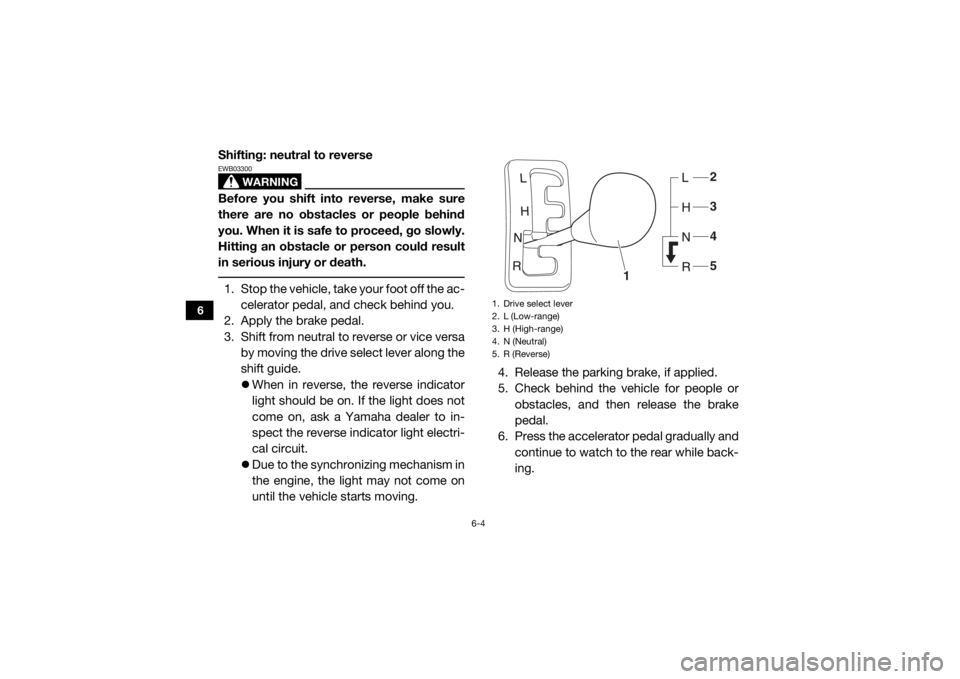
3. Shift from neutral to reverse or vice versa by moving the drive select lever along the
shift guide.
When in reverse, the reverse indicator
light should be on. If the light does not
come on, ask a Yamaha dealer to in-
spect the reverse indicator light electri-
cal circuit.
Due to the synchronizing mechanism in
the engine, the light may not come on
until the vehicle starts moving. 4. Release the parking brake, if applied.
5. Check behind the vehicle for people or
obstacles, and then release the brake
pedal.
6. Press the accelerator pedal gradually and
continue to watch to the rear while back-
ing.
1. Drive select lever
2. L (Low-range)
3. H (High-range)
4. N (Neutral)
5. R (Reverse)
1
2
5 4
3
UB427AE0.book Page 4 Monday, May 18, 2015 9:17 AM
Page 77 of 172

6-7
6
EBU31930ParkingWhen parking, stop the engine and shift the
drive select lever into the neutral position. Ap-
ply the parking brake to help prevent the ve-
hicle from rolling. See page 7-16 for more
information on parking and parking on a
slope.EBU31940LoadingTake extra precautions when driving with a
load or trailer. Follow these instructions and
always use common sense and good judg-
ment when carrying cargo or towing a trailer.
Prepare your load or trailer
WARNING
EWB03310Improper loading or towing can increase
the risk of loss of control, an overturn, or
other accident:
Do not exceed the Maximum Loading
Limits for the vehicle (see “MAXIMUM
LOADING LIMIT” in this section and ve-
hicle labeling).
Keep weight in the cargo bed centered
side to side, and as low and as far for-
ward as possible. Top-heavy loads in-
crease the risk of overturn. Be sure
cargo is secured – a loose load could
change handling unexpectedly or strike
occupants.
Do not exceed the maximum tongue
weight.
Make sure the load does not interfere
with your control or ability to see where
you are going.
Tie down cargo in the trailer securely.
Make sure cargo in the trailer cannot
move around. A shifting load can cause
an accident.
Use the hooks equipped on the cargo bed to
tie down loads.
UB427AE0.book Page 7 Monday, May 18, 2015 9:17 AM
Page 93 of 172

7-14
7
Getting ready to ride
Perform the Pre-Operation Checks on page
5-1. Follow the instructions starting on page
6-2 to start the engine.
Turning
Use care in turns – turning the steering wheel
too far or too fast can result in loss of control
or a rollover. Slow down before entering
turns. When making tight turns from a stand-
still or at slow speeds, avoid sudden or hard
acceleration. Driving aggressively or making
abrupt maneuvers even on flat, open areas
can cause side rollovers. Avoid sideways slid-
ing, skidding, or back-wheel sliding, and nev-
er do donuts. If you feel the Viking begin to
slide sideways or the back wheels slide dur-
ing a turn, steer into the direction of the slide,
if possible, and gradually let off the accelera-
tor pedal to regain directional control and
avoid rollover. For example, if you feel the
back of the vehicle start to slide to your right,
steer to the right.If you think or feel that the vehicle may tip or
roll, keep your body completely inside the
protective structure of the vehicle:
Brace yourself by pressing your feet firmly
on the floorboard and keep a firm grip on
the steering wheel or passenger handhold.
Do not put your hands or feet outside of the
vehicle for any reason. Do not try to stop a
tipover using your arm or leg.
Accelerating
With the engine idling in neutral and your foot
on the brake, shift the drive select lever into
low or high. NOTICE: Do not shift from low
to high or vice versa without coming to a
complete stop and waiting for the engine
to return to normal idle speed – damage to
the engine or drive train may occur. Then
release the parking brake.
[ECB02160]
Press the
accelerator pedal slowly and smoothly. The
centrifugal clutch will engage and the vehicle
will begin to accelerate.
UB427AE0.book Page 14 Monday, May 18, 2015 9:17 AM
Page 94 of 172

7-15
7
Avoid higher speeds and sudden or hard ac-
celeration until you are thoroughly familiar
with the operation of your vehicle. Avoid sud-
den or hard acceleration in any turn.
Braking
When slowing down or stopping, take your
foot off the accelerator pedal and press the
brake pedal smoothly. Improper use of the
brakes can cause the tires to lose traction, re-
ducing control of the vehicle and increasing
the possibility of an accident.
Braking ability is affected by type of terrain. In
most cases, gradual application of the brakes
is more effective than abrupt braking, partic-
ularly on loose surfaces, such as gravel. Al-
ways allow for greater braking distance on
rough, loose, or slippery surfaces.
Engine braking
Engine compression braking is designed to
assist you when operating your Viking off-
road. With this feature, the engine helps slow the vehicle down after you take your foot off
the accelerator. Engine braking is more no-
ticeable in four-wheel drive. Application of ve-
hicle brakes provides additional stopping
power.
Leaving the vehicle
Do not get out of the vehicle while the engine
is running and the drive select lever is in any
gear. There is a risk
of injury because:
Children or others may accidentally press
the accelerator pedal.
Objects tossed into the vehicle may strike
the accelerator pedal.
The parking brake may not keep the vehicle
from accelerating.
Unwanted vehicle movement can cause seri-
ous injury or death, and it may be dangerous
to try to stop the vehicle.UB427AE0.book Page 15 Monday, May 18, 2015 9:17 AM
Page 95 of 172

7-16
7
Parking on a flat area
When parking on a flat area, stop the engine
and shift the drive select lever into the neutral
position. Apply the parking brake to help pre-
vent the vehicle from rolling.
Parking on a slope
The parking brake acts only on the rear
wheels when in “2WD”. For the parking brake
to take effect on all four wheels, shift to “DIFF
LOCK” before stopping the engine.
If you park on a hill that is too steep the vehi-
cle may roll out of control. Never park on hills
that are so steep you cannot walk up them
easily. If you must park on an incline follow
these instructions:1. Bring the vehicle to a stop by applying the brake pedal.
2. Put the vehicle in “DIFF LOCK”.
3. Turn the key to “ ” (off).
4. With the brake pedal applied, set the parking brake. 5. Block the front and rear wheels with
rocks or other objects.
Loading
The total weight of operator, passengers, ac-
cessories, cargo, trailer tongue weight, and
the vehicle itself must not exceed 1080 kg
(2381 lb). Vehicle loading can affect handling.
See “Loading” on page 6-7.
EBU33360Operation on different surfaces and
terrainsGo slowly and proceed with caution when op-
erating on an unfamiliar surface or terrain.
This vehicle may handle differently in certain
types of terrains or on certain surfaces. You
may come upon hidden rocks, bumps, or
holes without enough time to react. To avoid
loss of control or rollover, always be alert to
changing surfaces or terrain when operating
the vehicle.
UB427AE0.book Page 16 Monday, May 18, 2015 9:17 AM
Page 100 of 172

7-21
7
muffler or exhaust pipe, or next to other hot
parts. Check under the vehicle after operating
in areas where combustible materials may
have collected. Do not idle or park the vehicle
in long dry grass or other dry ground cover.
Encountering obstacles
If you cannot go around an obstacle, such as
a fallen tree or a ditch, stop the vehicle where
it is safe to do so. Set the parking brake and
get out to inspect the area thoroughly. Look
from both your approach side and exit side. If
you believe you can continue safely, choose
the path that will allow you to get over the ob-
stacle and at as close to a right angle as pos-
sible to minimize vehicle tipping. Go only fast
enough to maintain your momentum but still
give yourself plenty of time to react to chang-
es in conditions. If there is any question about your ability to
maneuver safely over the obstacle, you
should turn around if the ground is flat and
you have the room or back up until you find a
less difficult path.UB427AE0.book Page 21 Monday, May 18, 2015 9:17 AM
Page 107 of 172

8-7
8
8*Parking brake • Check operation and free play/brake pad
wear.
• Correct if necessary. Replace pads if worn to the limit. √√√√√
9 *Brake fluid • Change. Every 2 years
10 *Accelerator pedal • Check operation and free play. √√√√√
11 *V-b e l t • Check operation.
• Check for wear, cracks, or damage. √√
√
12 *Wheels • Check balance/damage/runout.
• Repair if necessary. √√√√
13 *Wheel bearings • Check bearing assemblies for loose-
ness/damage.
• Replace if damaged. √√√√
14 *Front and rear
suspension • Check operation and for leakage.
• Correct if necessary.
√√
15 *Steering system • Check operation and for looseness/Replace
if damaged.
• Check toe-in/Adjust if necessary. √√√√√
16 *Stabilizer bushes • Check for cracks or other damage, and re-
place if necessary. √√√
NO. ITEM
ROUTINE INITIAL
EVERY
Whichev- er comes first month 1 3 6 6 12
km
(mi) 320
(200) 1200
(750) 2400
(1500) 2400
(1500) 4800
(3000)
hours 20 75 150 150 300
UB427AE0.book Page 7 Monday, May 18, 2015 9:17 AM