Page 52 of 114

Operation and important riding points
5-2
1
2
3
45
6
7
8
9
10
11
12
EAU58031
Starting the engineIn order for the ignition circuit cut-off
system to enable starting, one of the
following conditions must be met:
The transmission is in the neutral
position.
The transmission is in gear with
the clutch lever pulled and the sid-
estand up. (See page 3-30.)
1. Turn the key to “ON” and set the start/engine stop switch to “ ”.
The following warning lights and
indicator light should come on for a
few seconds, then go off.
Oil level warning light
Coolant temperature warning
light
Engine trouble warning light
Immobilizer system indicator
light
Traction control system indica-
tor light (for equipped models)
NOTICE
ECA17671
If the above warning lights or indica-
tor light do not come on initially
when the key is turned to “ON”, or if
a warning or indicator light remains on, see page 3-4 for the correspond-
ing warning and indicator light cir-
cuit check.
For ABS models:
The ABS warning light should
come on when the key is turned to
“ON”, and then go off after travel-
ing at a speed of 10 km/h (6 mi/h)
or higher.
NOTICE
ECA17682
If the ABS warning light does not
come on and then go off as ex-
plained above, see page 3-4 for thewarning light circuit check.2. Shift the transmission into the neu- tral position. The neutral indicator
light should come on. If not, ask a
Yamaha dealer to check the elec-
trical circuit.
3. Start the engine by pushing the “ ” side of the start/engine stop
switch.
If the engine fails to start, release
the start/engine stop switch, wait a
few seconds, and then try again.
Each starting attempt should be as
short as possible to preserve the battery. Do not crank the engine
more than 10 seconds on any one
attempt.
NOTICE
ECA11043
For maximum engine life, never ac-
celerate hard when the engine iscold!
B87-9-E0_1.book 2 ページ 2015年12月16日 水曜日 午前10時21分
Page 60 of 114

Periodic maintenance and adjustment
6-5
1
2
3
4
56
7
8
9
10
11
12
11 Drive chain Check chain slack, alignment and
condition.
Adjust and lubricate chain with a special O-ring chain lubricant
thoroughly. Every 800 km (500 mi) and after washing the motorcycle, riding in the rain or
riding in wet areas
12 *Steering bearings Check bearing play and steering
for roughness.
Lubricate with lithium-soap-based grease. Every 20000 km (12000 mi)
13 *Chassis fasteners Make sure that all nuts, bolts and
screws are properly tightened.
14 Brake lever pivot
shaft Lubricate with silicone grease.
15 Brake pedal pivot
shaft Lubricate with lithium-soap-based
grease.
16 Clutch lever pivot
shaft Lubricate with lithium-soap-based
grease.
17 Shift pedal pivot
shaft Lubricate with lithium-soap-based
grease.
18 Sidestand Check operation.
Lubricate with lithium-soap-based
grease.
19 *Sidestand switch Check operation.
20 *Front fork Check operation and for oil
leakage.
21 *Shock absorber
assembly Check operation and shock
absorber for oil leakage.
22 *Rear suspension
relay arm and
connecting arm
pivoting points Check operation.
NO. ITEM CHECK OR MAINTENANCE JOB
ODOMETER READING
ANNUAL
CHECK
1000 km
(600 mi) 10000 km
(6000 mi) 20000 km
(12000 mi) 30000 km
(18000 mi) 40000 km
(24000 mi)B87-9-E0_1.book 5 ページ 2015年12月16日 水曜日 午前10時21分
Page 75 of 114

Periodic maintenance and adjustment6-20
1
2
3
4
567
8
9
10
11
12
sult in loss of control and an acci-
dent.
EAU57070
Brake light switchesFor non-ABS models
The brake light, which is activated by
the brake pedal and brake lever, should
come on just before braking takes ef-
fect. If necessary, adjust the rear brake
light switch as follows, but the front
brake light switch should be adjusted
by a Yamaha dealer.
Turn the rear brake light switch adjust-
ing nut while holding the rear brake light
switch in place. To make the brake light
come on earlier, turn the adjusting nut
in direction (a). To make the brake light
come on later, turn the adjusting nut in direction (b).
For ABS models
The brake light, which is activated by
the brake pedal and brake lever, should
come on just before braking takes ef-
fect. If necessary, have a Yamaha deal-
er adjust the brake light switches.1. Rear brake light switch
2. Rear brake light switch adjusting nut
1
2
(b)
(a)
B87-9-E0_1.book 20 ページ 2015年12月16日 水曜日 午前10時21分
Page 77 of 114

Periodic maintenance and adjustment6-22
1
2
3
4
567
8
9
10
11
12
Rear brake
WARNING
EWA16011
Improper maintenance can result in
loss of braking ability. Observe
these precautions:
Insufficient brake fluid may al-
low air to enter the brake sys-
tem, reducing braking
performance.
Clean the filler cap before re-
moving. Use only DOT 4 brake
fluid from a sealed container.
Use only the specified brake flu-
id; otherwise, the rubber seals may deteriorate, causing leak-
age.
Refill with the same type of
brake fluid. Adding a brake fluid
other than DOT 4 may result in a
harmful chemical reaction.
Be careful that water or dust
does not enter the brake fluid
reservoir when refilling. Water
will significantly lower the boil-
ing point of the fluid and may re-
sult in vapor lock, and dirt may
clog the ABS hydraulic unitvalves.
NOTICE
ECA17641
Brake fluid may damage painted sur-
faces or plastic parts. Always cleanup spilled fluid immediately.
As the brake pads wear, it is normal for
the brake fluid level to gradually go
down. A low brake fluid level may indi-
cate worn brake pads and/or brake sys-
tem leakage; therefore, be sure to
check the brake pads for wear and the
brake system for leakage. If the brake
fluid level goes down suddenly, have a
Yamaha dealer check the cause before
further riding.
1. Minimum level markSpecified brake fluid:
DOT 4
1
B87-9-E0_1.book 22 ページ 2015年12月16日 水曜日 午前10時21分
Page 87 of 114
Periodic maintenance and adjustment6-32
1
2
3
4
567
8
9
10
11
12
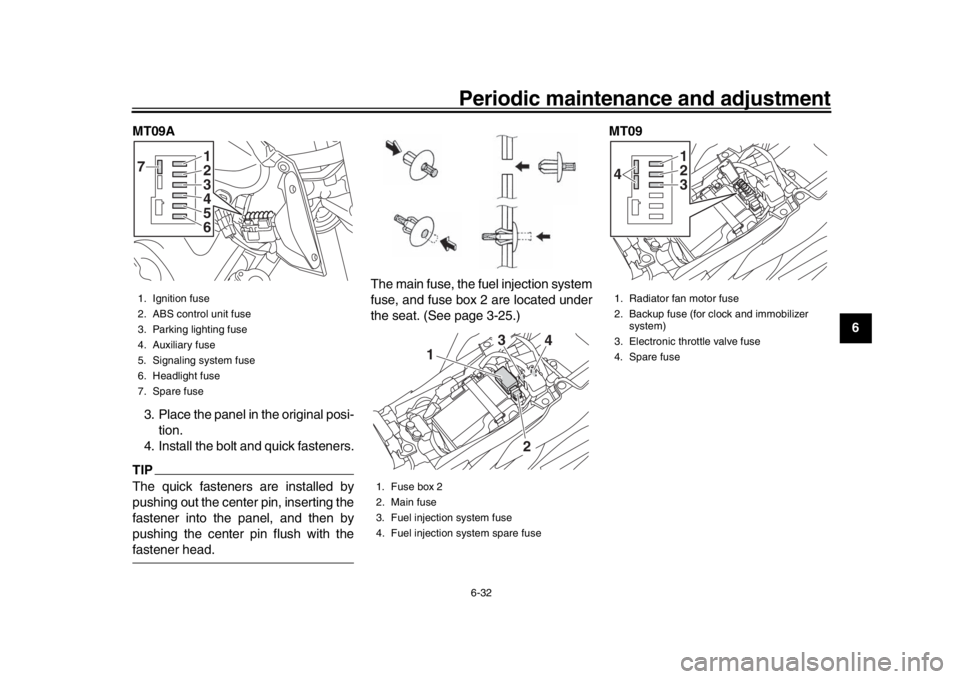
MT09A
3. Place the panel in the original posi- tion.
4. Install the bolt and quick fasteners.
TIPThe quick fasteners are installed by
pushing out the center pin, inserting the
fastener into the panel, and then by
pushing the center pin flush with thefastener head. The main fuse, the fuel injection system
fuse, and fuse box 2 are located under
the seat. (See page 3-25.)
MT091. Ignition fuse
2. ABS control unit fuse
3. Parking lighting fuse
4. Auxiliary fuse
5. Signaling system fuse
6. Headlight fuse
7. Spare fuse
123
7
456
1. Fuse box 2
2. Main fuse
3. Fuel injection system fuse
4. Fuel injection system spare fuse
2
3
4
1
1. Radiator fan motor fuse
2. Backup fuse (for clock and immobilizer
system)
3. Electronic throttle valve fuse
4. Spare fuse
123
4
B87-9-E0_1.book 32 ページ 2015年12月16日 水曜日 午前10時21分
Page 88 of 114

Periodic maintenance and adjustment
6-33
1
2
3
4
56
7
8
9
10
11
12 MT09A
TIPTo access the fuel injection system
fuse, remove the starter relay cover bypulling it upward.
If a fuse is blown, replace it as follows.
1. Turn the key to “OFF” and turn off the electrical circuit in question.
2. Remove the blown fuse, and then install a new fuse of the specified
amperage. WARNING! Do not
use a fuse of a higher amperage
rating than recommended to
avoid causing extensive dam-
age to the electrical system and
possibly a fire.
[EWA15132]
3. Turn the key to “ON” and turn on the electrical circuit in question to
check if the device operates.
4. If the fuse immediately blows again, have a Yamaha dealer
1. Radiator fan motor fuse
2. Backup fuse (for clock and immobilizer system)
3. Electronic throttle valve fuse
4. ABS solenoid fuse
5. ABS motor fuse
6. Spare fuse
123
6
45
1. Starter relay cover
2. Fuel injection system fuse
3. Fuel injection system spare fuse
1
2
3
Specified fuses: Main fuse:50.0 A
Auxiliary fuse:
2.0 A
Headlight fuse: 15.0 A
Signaling system fuse: 7.5 A
Ignition fuse:
15.0 A
Parking lighting fuse: 7.5 A
Radiator fan motor fuse: 15.0 A
ABS motor fuse:
30.0 A (MT09A)
ABS solenoid fuse: 15.0 A (MT09A)
Fuel injection system fuse: 10.0 A
ABS control unit fuse:
7.5 A (MT09A)
Backup fuse: 7.5 A
Electronic throttle valve fuse: 7.5 A
B87-9-E0_1.book 33 ページ 2015年12月16日 水曜日 午前10時21分
Page 94 of 114

Periodic maintenance and adjustment
6-39
1
2
3
4
56
7
8
9
10
11
12 3. Insert a new bulb into the socket.
4. Install the socket (together with the
bulb) by pushing it in, and then in-
stall the license plate light unit by
installing the collars and nuts.
EAU67131
Supporting the motorcycleSince this model is not equipped with a
centerstand, use maintenance stands
when removing the front or rear wheel
or when performing other maintenance
that requires the motorcycle to stand up
right.
Check that the motorcycle is in a stable
and level position before starting any
maintenance.
EAU44792
Front wheel (for non-ABS
models)
WARNING
EWA14841
For the ABS model, have a Yamahadealer remove and install the wheel.
EAU56270
To remove the front wheel
WARNING
EWA10822
To avoid injury, securely support the
vehicle so there is no danger of itfalling over.
1. Loosen the front wheel axle pinch bolt, then the wheel axle and the
brake caliper bolts.
1. License plate light bulb
1
1. Maintenance stand (example)
1
B87-9-E0_1.book 39 ページ 2015年12月16日 水曜日 午前10時21分
Page 96 of 114

Periodic maintenance and adjustment
6-41
1
2
3
4
56
7
8
9
10
11
12
EAU44802
Rear wheel (for non-ABS
models)
WARNING
EWA14841
For the ABS model, have a Yamahadealer remove and install the wheel.
EAU56701
To remove the rear wheel
WARNING
EWA10822
To avoid injury, securely support the
vehicle so there is no danger of itfalling over. 1. Loosen the axle nut. 2. Lift the rear wheel off the ground
according to the procedure on
page 6-39.
3. Remove the axle nut.
4. Fully loosen the locknut on each side of the swingarm.
5. Turn the drive chain slack adjust- ing bolts fully in direction (a) and
push the wheel forward. 6. Remove the drive chain from the
rear sprocket.
TIP
If the drive chain is difficult to re-
move, remove the wheel axle first,
and then lift the wheel upward
enough to remove the drive chain
from the rear sprocket.
The drive chain cannot be disas-sembled.
7. While supporting the brake caliper bracket, pull the wheel axle out,
and then remove the wheel.
NOTICE: Do not apply the brake
after the wheel and brake disc
1. Axle nut
1
1. Drive chain slack adjusting bolt
2. Locknut
(a)1
2
B87-9-E0_1.book 41 ページ 2015年12月16日 水曜日 午前10時21分