Page 44 of 120
Instrument and control functions
3-30
3 95 or higher. If knocking (or pinging)
occurs, use a gasoline of a different
brand or premium unleaded fuel. Use
of unleaded fuel will extend spark plug
life and reduce maintenance costs.
Gasohol
There are two types of gasohol: gaso-
hol containing ethanol and that con-
taining methanol. Gasohol containing
ethanol can be used if the ethanol con-
tent does not exceed 10% (E10). Gas-
ohol containing methanol is not
recommended by Yamaha because it
can cause damage to the fuel system
or vehicle performance problems.
EAU72970
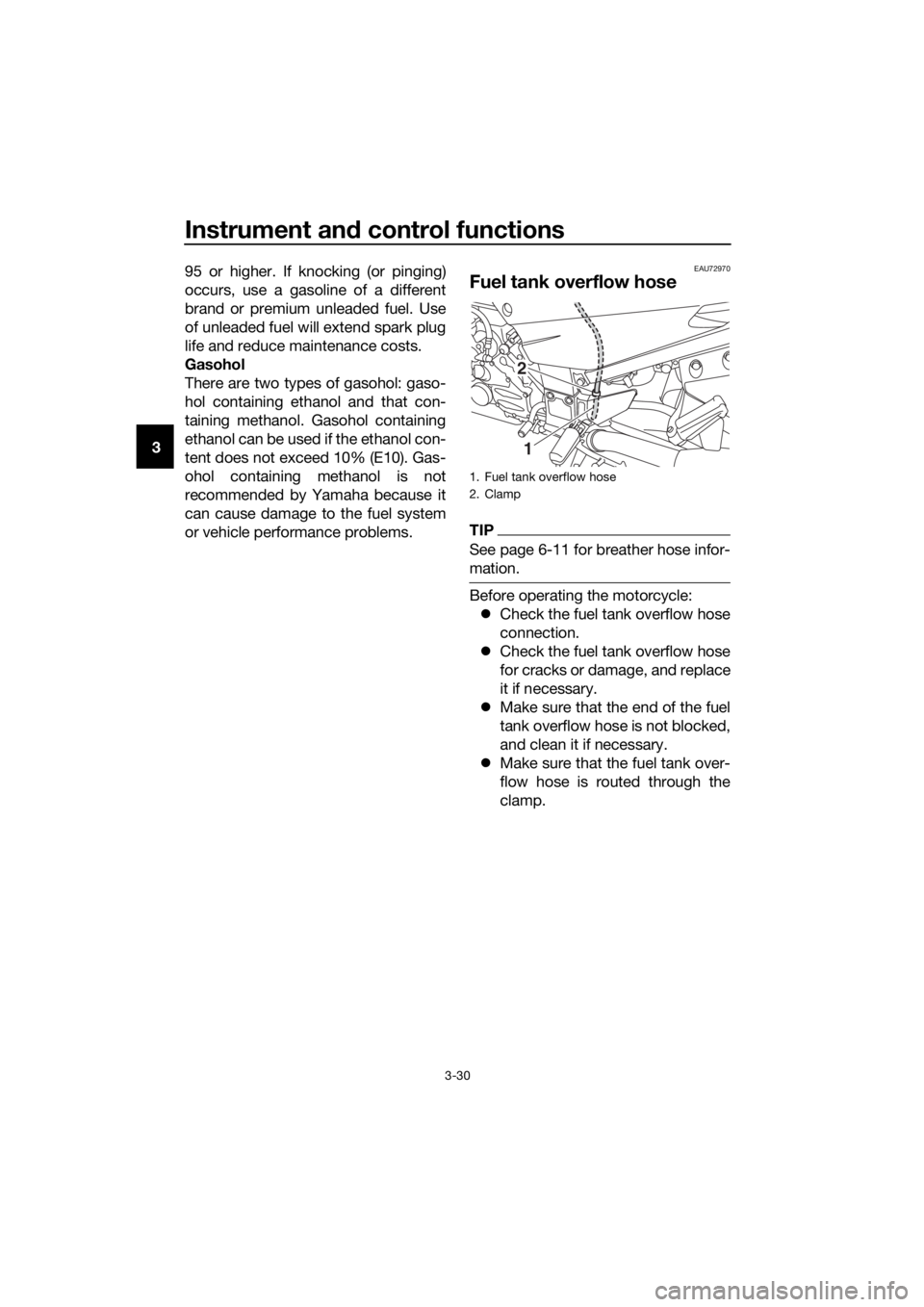
Fuel tank overflow hose
TIP
See page 6-11 for breather hose infor-
mation.
Before operating the motorcycle:
Check the fuel tank overflow hose
connection.
Check the fuel tank overflow hose
for cracks or damage, and replace
it if necessary.
Make sure that the end of the fuel
tank overflow hose is not blocked,
and clean it if necessary.
Make sure that the fuel tank over-
flow hose is routed through the
clamp.
1. Fuel tank overflow hose
2. Clamp
2
1
UB88E0E0.book Page 30 Friday, October 16, 2015 11:59 AM
Page 45 of 120
Instrument and control functions
3-31
3
EAU13447
Catalytic converters
This vehicle is equipped with catalytic
converters in the exhaust system.
WARNING
EWA10863
The exhaust system is hot after op-
eration. To prevent a fire hazar d or
b urns:
Do not park the vehicle near
possi ble fire hazar ds such as
g rass or other materials that
easily burn.
Park the vehicle in a place
where ped estrians or child ren
are not likely to touch the hot
exhaust system.
Make sure that the exhaust sys-
tem has coole d down before
d oin g any maintenance work.
Do not allow the eng ine to idle
more than a few minutes. Lon g
i d lin g can cause a b uild-up of
heat.
NOTICE
ECA10702
Use only unlea ded g asoline. The use
of lead ed g asoline will cause unre-
paira ble damag e to the catalytic
converter.
EAU39496
Seats
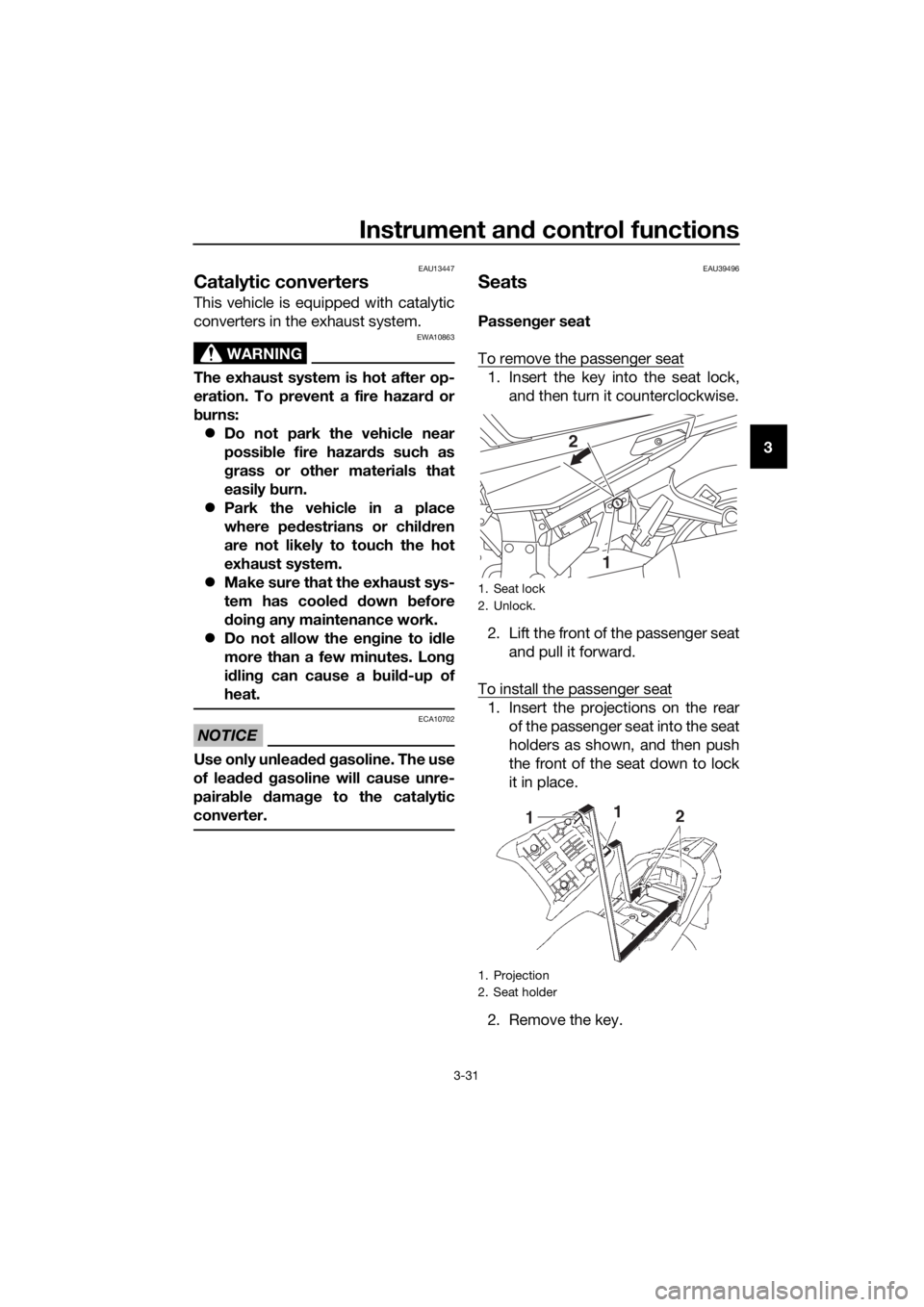
Passen ger seat
To remove the passenger seat
1. Insert the key into the seat lock, and then turn it counterclockwise.
2. Lift the front of the passenger seat and pull it forward.
To install the passenger seat
1. Insert the projections on the rear of the passenger seat into the seat
holders as shown, and then push
the front of the seat down to lock
it in place.
2. Remove the key.
1. Seat lock
2. Unlock.
1. Projection
2. Seat holder
1
2
UB88E0E0.book Page 31 Friday, October 16, 2015 11:59 AM
Page 46 of 120
Instrument and control functions
3-32
3 Ri
der seat
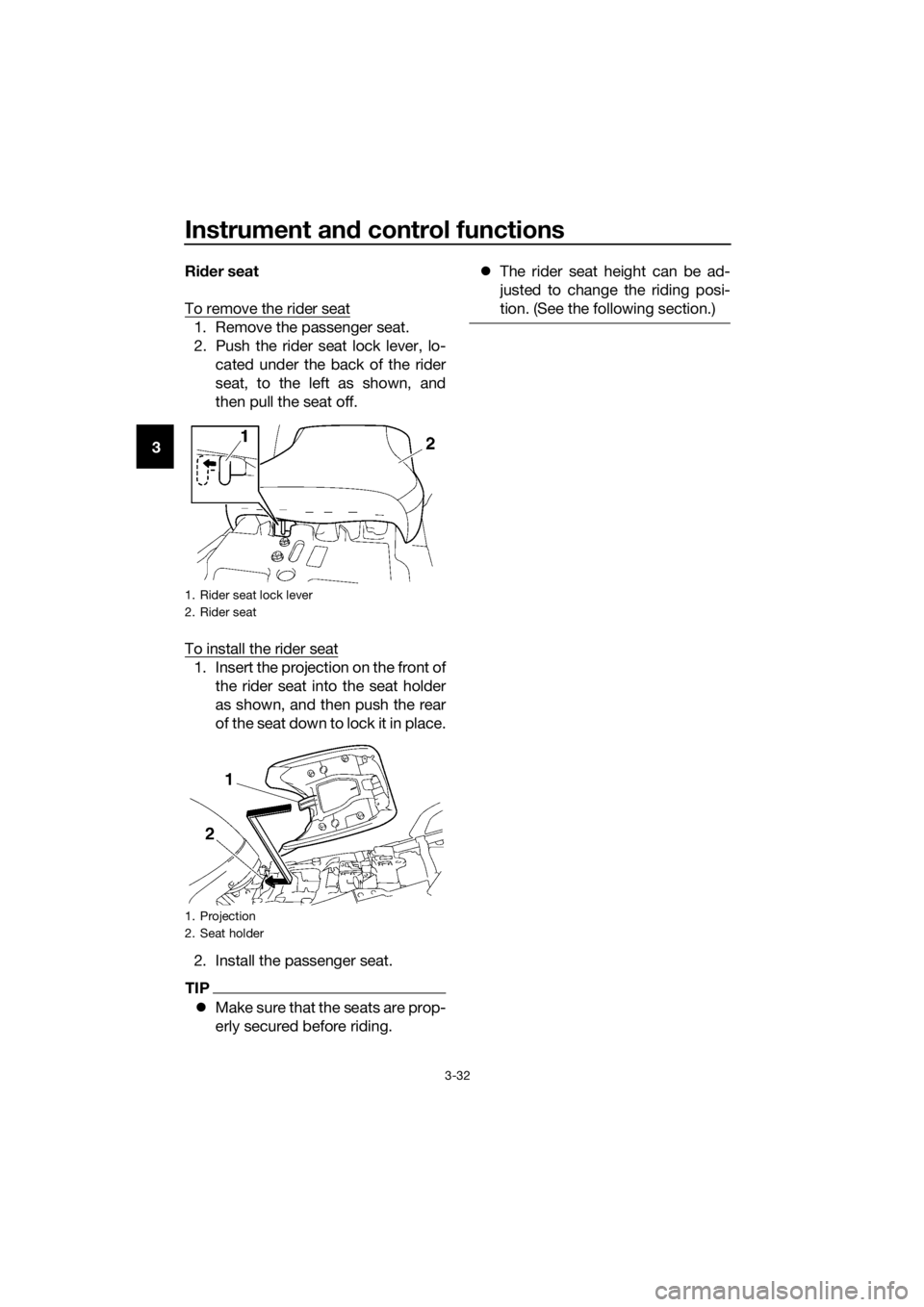
To remove the rider seat
1. Remove the passenger seat.
2. Push the rider seat lock lever, lo- cated under the back of the rider
seat, to the left as shown, and
then pull the seat off.
To install the rider seat
1. Insert the projection on the front of the rider seat into the seat holder
as shown, and then push the rear
of the seat down to lock it in place.
2. Install the passenger seat.
TIP
Make sure that the seats are prop-
erly secured before riding.
The rider seat height can be ad-
justed to change the riding posi-
tion. (See the following section.)
1. Rider seat lock lever
2. Rider seat
1. Projection
2. Seat holder
UB88E0E0.book Page 32 Friday, October 16, 2015 11:59 AM
Page 48 of 120
Instrument and control functions
3-34
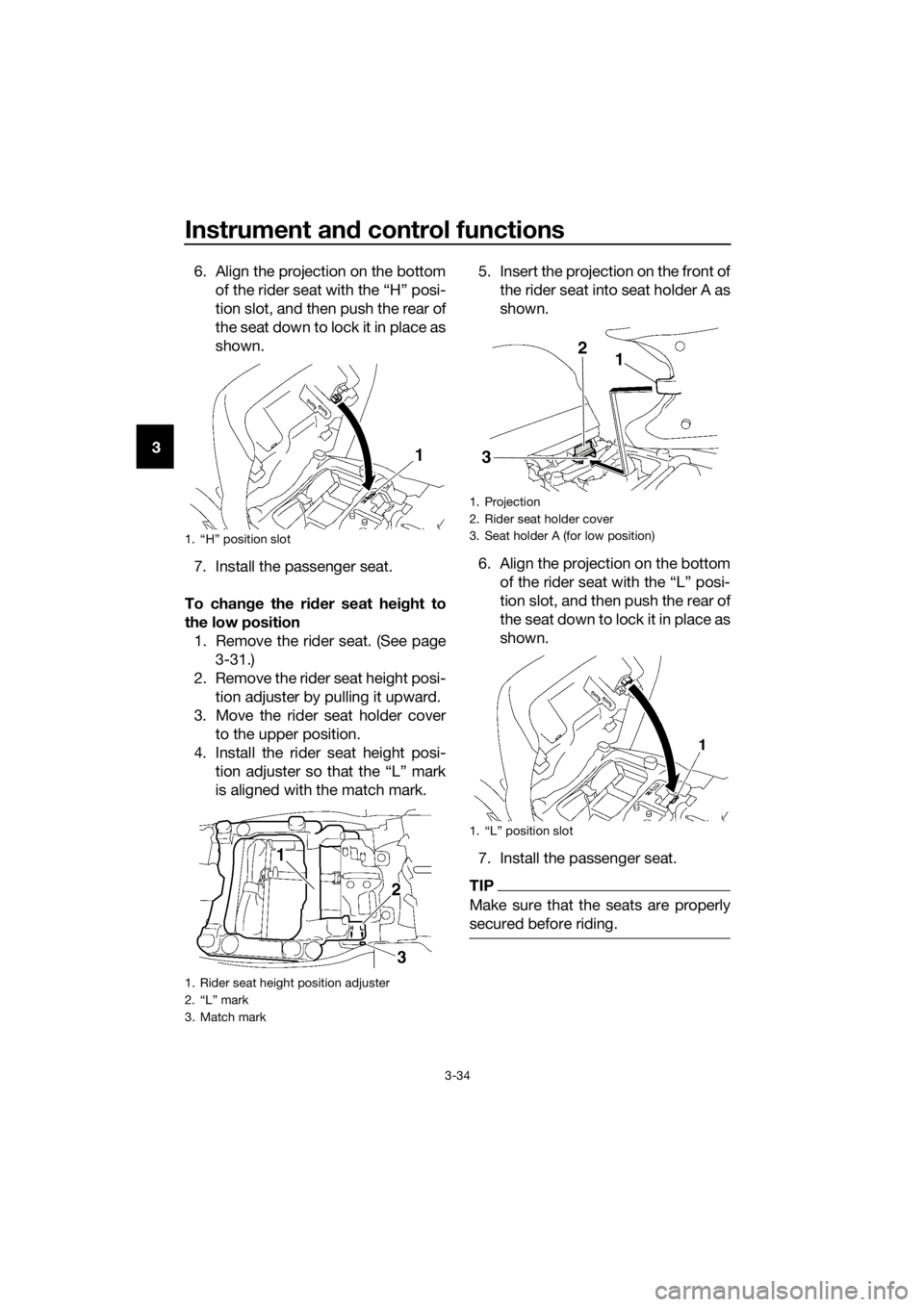
3 6. Align the projection on the bottom
of the rider seat with the “H” posi-
tion slot, and then push the rear of
the seat down to lock it in place as
shown.
7. Install the passenger seat.
To chan ge the ri der seat hei ght to
the low position 1. Remove the rider seat. (See page 3-31.)
2. Remove the rider seat height posi- tion adjuster by pulling it upward.
3. Move the rider seat holder cover to the upper position.
4. Install the rider seat height posi- tion adjuster so that the “L” mark
is aligned with the match mark. 5. Insert the projection on the front of
the rider seat into seat holder A as
shown.
6. Align the projection on the bottom of the rider seat with the “L” posi-
tion slot, and then push the rear of
the seat down to lock it in place as
shown.
7. Install the passenger seat.
TIP
Make sure that the seats are properly
secured before riding.
1. “H” position slot
1. Rider seat height position adjuster
2. “L” mark
3. Match mark
1. Projection
2. Rider seat holder cover
3. Seat holder A (for low position)
1. “L” position slot
12
3
UB88E0E0.book Page 34 Friday, October 16, 2015 11:59 AM
Page 79 of 120

Periodic maintenance an d a djustment
6-11
6
EAU36111
Canister
This model is equipped with a canister
to prevent the discharging of fuel vapor
into the atmosphere. Before operating
this vehicle, make sure to check the
following:
Check each hose connection.
Check each hose and canister for
cracks or damage. Replace if
damaged.
Make sure that the canister
breather is not blocked, and if
necessary, clean it.
EAU19888
Engine oil an d oil filter car-
tri dge
The engine oil level should be checked
before each ride. In addition, the oil
must be changed and the oil filter car-
tridge replaced at the intervals speci-
fied in the periodic maintenance and
lubrication chart.
To check the en gine oil level
1. Place the vehicle on the center- stand. A slight tilt to the side can
result in a false reading.
2. Start the engine, warm it up for several minutes, and then turn it
off.
3. Wait a few minutes until the oil set- tles, and then check the oil level
through the check window locat-
ed at the bottom-left side of the
crankcase.
TIP
The engine oil should be between the
minimum and maximum level marks.
1. Canister
2. Canister breather
1
2
1. Engine oil level check window
2. Engine oil filler cap
3. Maximum level mark
4. Minimum level mark
31
4
2
UB88E0E0.book Page 11 Friday, October 16, 2015 11:59 AM
Page 94 of 120
Periodic maintenance an d a djustment
6-26
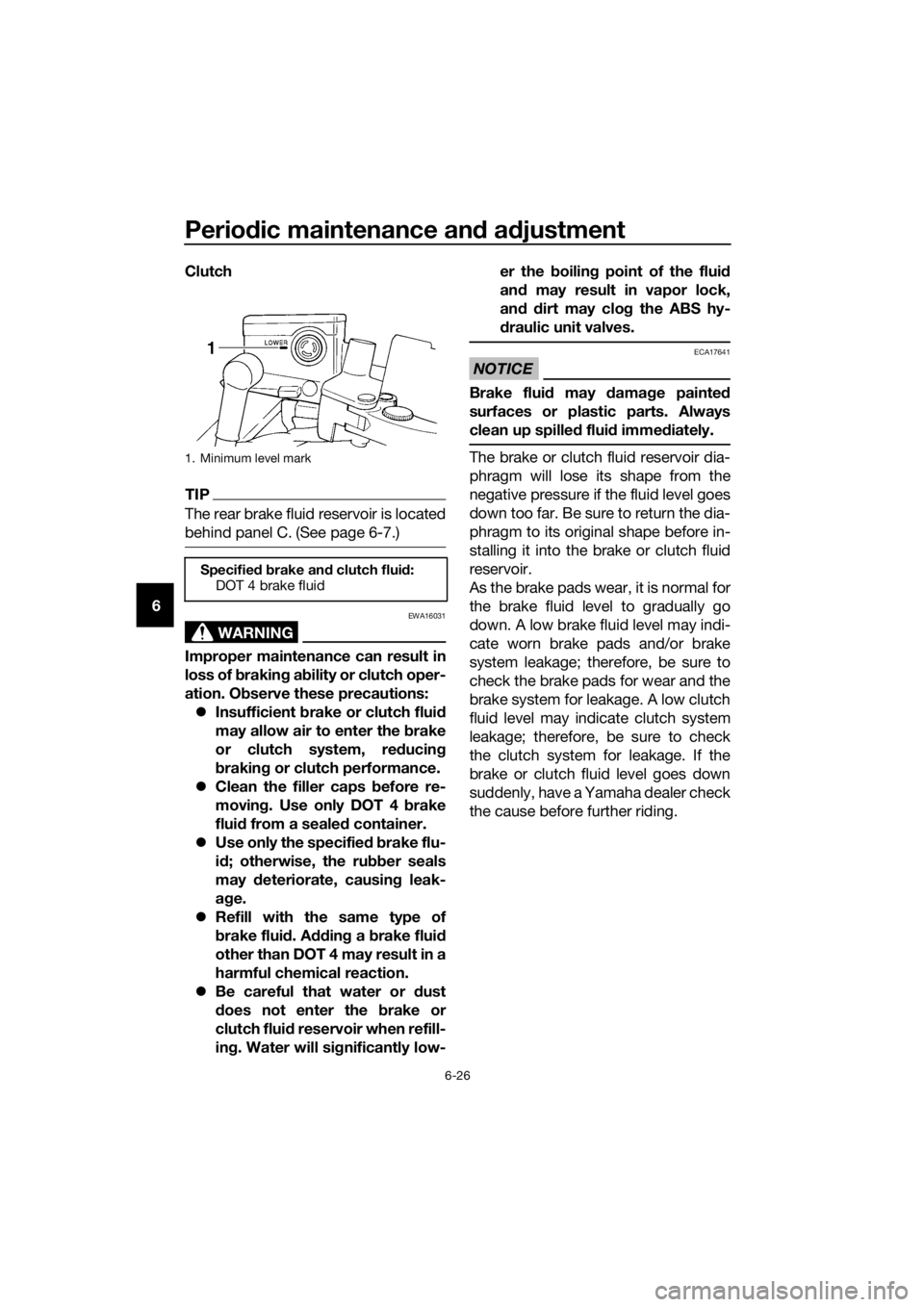
6 Clutch
TIP
The rear brake fluid reservoir is located
behind panel C. (See page 6-7.)
WARNING
EWA16031
Improper maintenance can result in
loss of b
raking a bility or clutch oper-
ation. O bserve these precautions:
Insufficient brake or clutch flui d
may allow air to enter the brake
or clutch system, re ducin g
b rakin g or clutch performance.
Clean the filler caps before re-
movin g. Use only DOT 4 b rake
flui d from a seale d container.
Use only the specifie d b rake flu-
i d ; otherwise, the ru bber seals
may deteriorate, causin g leak-
a g e.
Refill with the same type of
brake flui d. A ddin g a b rake flui d
other than DOT 4 may result in a
harmful chemical reaction.
Be careful that water or dust
d oes not enter the brake or
clutch flui d reservoir when refill-
in g. Water will si gnificantly low- er the
boilin g point of the flui d
an d may result in vapor lock,
an d d irt may clo
g
the ABS hy-
d raulic unit valves.
NOTICE
ECA17641
Brake flui d may damag e painte d
surfaces or plastic parts. Always
clean up spille d flui d imme diately.
The brake or clutch fluid reservoir dia-
phragm will lose its shape from the
negative pressure if the fluid level goes
down too far. Be sure to return the dia-
phragm to its original shape before in-
stalling it into the brake or clutch fluid
reservoir.
As the brake pads wear, it is normal for
the brake fluid level to gradually go
down. A low brake fluid level may indi-
cate worn brake pads and/or brake
system leakage; therefore, be sure to
check the brake pads for wear and the
brake system for leakage. A low clutch
fluid level may indicate clutch system
leakage; therefore, be sure to check
the clutch system for leakage. If the
brake or clutch fluid level goes down
suddenly, have a Yamaha dealer check
the cause before further riding.1. Minimum level mark
Specifie d b rake an d clutch flui d:
DOT 4 brake fluid
UB88E0E0.book Page 26 Friday, October 16, 2015 11:59 AM
Page 102 of 120

Periodic maintenance an d a djustment
6-34
6
EAU54515
Replacin g the fuses
The fuse boxes and individual fuses
are located under panel A. (See page
6-7.)
If a fuse is blown, replace it as follows.1. Turn the key to “OFF” and turn off the electrical circuit in question.
2. Remove the blown fuse, and then install a new fuse of the specified
amperage. WARNING! Do not
use a fuse of a hi gher ampera ge
ratin g than recommen ded to
avoi d causin g extensive dam-
a g e to the electrical system an d
possi bly a fire.
[EWA15132]
1. Main fuse
2. Spare fuse
3. Cruise control fuse
4. Brake light fuse
5. Fuse box
6. Main fuse 2
5
1
3
4
2
5 26
1. ABS motor fuse
2. ABS solenoid fuse
3. Fuel injection system fuse
4. Backup fuse (for clock and immobilizer sys-
tem)
5. Electronic throttle valve fuse
6. Headlight fuse
7. Spare fuse
8. Hazard fuse
9. Signaling system fuse
10.Terminal fuse 1 (for auxiliary DC jack)
11.ABS control unit fuse
12.Ignition fuse
13.Right radiator fan motor fuse
14.Left radiator fan motor fuse
15.Windshield motor fuse
14
7
9
10
11
1213
7
158
1
7
23
4
5
6
7
UB88E0E0.book Page 34 Friday, October 16, 2015 11:59 AM
Page 106 of 120

Periodic maintenance an d a djustment
6-38
6 En
gine overheatin g
WARNING
EWAT1041
Do not remove the ra diator cap when the en gine an d ra diator are hot.
Scal din g hot flui d an d steam may b e blown out un der pressure, which
coul d cause serious injury. Be sure to wait until the eng ine has cooled.
Place a thick ra g, like a towel, over the ra diator cap, an d then slowly ro-
tate the cap counterclockwise to the detent to allow any resi dual pres-
sure to escape. When the hissin g soun d has stopped , press down on the
cap while turnin g it counterclockwise, an d then remove the cap.
TIP
If coolant is not available, tap water can be temporarily used instead, provided
that it is changed to the recommended coolant as soon as possible.
Wait until the engine
has cooled.
Check the coolant
level in the reservoir
and radiator.Add coolant.
(See TIP.)
The coolant level is
OK.
There is no leakage.
There is leakage.
The coolant level is
low.
Check the cooling
system for leakage.
Have a Yamaha
dealer check and
repair the cooling
system.
Start the engine. If the engine overheats again,
have a Yamaha dealer check and repair the cooling
system.
UB88E0E0.book Page 38 Friday, October 16, 2015 11:59 AM