2016 TOYOTA RAV4 HYBRID ESP
[x] Cancel search: ESPPage 464 of 660
464
RAV4-HV_OM_OM42A56U_(U)
7-2. Maintenance
Maintenance requirements
General maintenance should be performed on a daily basis. This can
be done by yourself or by a Toyota dealer.
Scheduled maintenance should be performed at specified intervals
according to the maintenance schedule.
For details about maintenance items and schedules, refer to the “Sched-
uled Maintenance Guide” or “Owner’s Manual Supplement”.
You can perform some maintenance procedures by yourself.
Please be aware that do-it-yourself maintenance may affect warranty
coverage.
The use of Toyota Repair Manuals is recommended.
For details about warranty coverage, see the separate “Owner’s Warranty
Information Booklet” or “Owner’s Manual Supplement”.
To ensure safe and economical driv ing, day-to-day care and reg-
ular maintenance are essential. It is the owner’s responsibility to
perform regular checks. Toyota recommends the following main-
tenance:
General maintenance
Scheduled maintenance
Do-it-yourself maintenance
Page 495 of 660

RAV4-HV_OM_OM42A56U_(U)
4957-3. Do-it-yourself maintenance
7
Maintenance and care
■The initialization operation (vehicles with the tire pressure warning
system)
●Make sure to carry out in itialization after adjusting the tire inflation pres-
sure.
Also, make sure the tires are cold be fore carrying out initialization or tire
inflation pressure adjustment.
●If you have accidentally turned the power switch off during initialization,
it is not necessary to press the reset switch again as initialization will
restart automatically when the power switch has been turned to ON
mode for the next time.
●If you accidentally press the reset s witch when initialization is not neces-
sary, adjust the tire inflation pressu re to the specified level when the
tires are cold, and conduct initialization again.
■When initialization of the tire pressure warning system has failed (if
equipped)
Initialization can be completed in a few minutes. However, in the following
cases, the settings have not been recorded and the system will not oper-
ate properly. If repeated attempts to record tire inflation pressure settings
are unsuccessful, have the vehicle inspected by your Toyota dealer.
●When operating the tire pressure wa rning reset switch, the tire pressure
warning light does not blink 3 times.
●After driving for a certain period of time since the initialization has been
completed, the warning light comes on after blinking for 1 minute.
■Tire pressure warning system certification
For vehicles sold in the U.S.A.
FCC ID: PAXPMVC010
NOTE
This device complies with Part 15 of th e FCC Rules. Operation is subject
to the following two conditions: (1) This device may not cause harmful
interference, and (2) this device must accept any interference received,
including interference that may cause undesired operation.
FCC WARNING
Changes or modifications not ex pressly approved by the party
responsible for compliance could void the user’s authority to operate the
equipment.
Page 542 of 660

5428-2. Steps to take in an emergency
RAV4-HV_OM_OM42A56U_(U)
WARNING
■Maintenance of the tires (vehicles with the tire pressure warning
system)
Each tire, including the spare (if provided), should be checked monthly
when cold and inflated to the inflation pressure recommended by the
vehicle manufacturer on the vehicle placard or tire inflation pressure
label (tire and load information label). (If your vehicle has tires of a dif-
ferent size than the size indicated on the vehicle placard or tire inflation
pressure label [tire and load information label], you should determine
the proper tire inflation pressure for those tires.)
As an added safety feature, your vehicle has been equipped with a tire
pressure monitoring system (TPMS-ti re pressure warning system) that
illuminates a low tire pre ssure telltale (tire pressure warning light) when
one or more of your tires is significantly under-inflated. Accordingly,
when the low tire pressure telltale (tire pressure warning light) illumi-
nates, you should stop and check your tires as soon as possible, and
inflate them to the proper pressure. Driving on a significantly under-
inflated tire causes the tire to overheat and can lead to tire failure.
Under-inflation also reduces fuel effi ciency and tire tread life, and may
affect the vehicle’s hand ling and stopping ability.
Please note that the TPMS (tire pres sure warning system) is not a sub-
stitute for proper ti re maintenance, and it is the driver’s responsibility to
maintain correct tire pressure, even if under-inflation has not reached
the level to trigger illumina tion of the TPMS low tire pressure telltale (tire
pressure warning light).
Your vehicle has also been equipped with a TPMS (tire pressure warn-
ing system) malfunction indicator to indicate when the system is not
operating properly. The TPMS (tire pressure warning system) malfunc-
tion indicator is combined with the lo w tire pressure telltale (tire pressure
warning light). When the system dete cts a malfunction, the telltale will
flash for approximately one minute and then remain continuously illumi-
nated. This sequence will continue up on subsequent vehicle start-ups
as long as the malfunction exists. When the malfunction indicator is illu-
minated, the system may not be able to detect or signal low tire pres-
sure as intended.
TPMS (tire pressure warning system) malfunctions may occur for a vari-
ety of reasons, including the installati on of replacement or alternate tires
or wheels on the vehicle that prevent the TPMS (tire pressure warning
system) from functioning properly. Always check the TPMS (tire pres-
sure warning system) malfunction te lltale after replacing one or more
tires or wheels on your vehicle to ensure that the replacement or alter-
nate tires and wheels allow the TPMS (tire pressure warning system) to
continue to function properly.
Page 556 of 660

5568-2. Steps to take in an emergency
RAV4-HV_OM_OM42A56U_(U)
(If equipped)
Indicates that all maintenance according to the
driven distance on the maintenance schedule
*2
should be performed soon.Comes on approximately 4500 miles (7200 km)
after the message has been reset.
If necessary, perform maintenance.
(If equipped)
Indicates that all maintenance is required to cor-
respond to the driven distance on the mainte-
nance schedule
*2.
Comes on approximately 5000 miles (8000 km)
after the message has been reset. (The mes-
sage will not display properly unless the mes-
sage has been reset.)
Perform the necessary maintenance.
Please reset the message after the mainte-
nance is performed. ( P. 465)
(If equipped)
Indicates that, since the VSC (Vehicle Stability
Control) system was turned off, the pre-collision
brake system operation is stopped
Turn the VSC on. ( P. 298)
(If equipped)
Indicates that the pre-collision system is tempo-
rarily unavailable
Please wait until the system returns.
If the warning message does not disappear,
the system may be malfunctioning. Have
the vehicle inspected by your Toyota dealer
immediately.
Air conditioning, heater and other operations are
temporarily limited due to high power consump-
tion
Turn off unnecessary electronic equipment
to reduce power consumption.
Please wait until the power supply returns
to normal.
If this item is frequently displayed, have the
vehicle inspected at your Toyota dealer
immediately.
Warning messageDetails/Actions
(Flashes)
Page 583 of 660

5838-2. Steps to take in an emergency
RAV4-HV_OM_OM42A56U_(U)
8
When trouble arises
Make sure the “READY” indicator comes on. If the indicator light
does not come on, contact your Toyota dealer.
Once the hybrid system has started, remove the jumper cables in
the exact reverse order from which they were connected.
Close the exclusive jump starting terminal cover, and reinstall the
fuse box cover to its original position.
When installing, first hook the fuse box cover onto the two rear tabs.
Once the hybrid system starts, have the vehicle inspected at your
Toyota dealer as soon as possible.
■ Starting the hybrid system when th e 12-volt battery is discharged
The hybrid system cannot be started by push-starting.
■ To prevent 12-volt battery discharge
●Turn off the headlights and the audio system while the hybrid system is off.
● Turn off any unnecessary electrical components when the vehicle is running
at a low speed for an extended period, such as in heavy traffic.
■ Charging the 12-volt battery
The electricity stored in the 12-volt battery will discharge gradually even when
the vehicle is not in use, due to natural discharge and the draining effects of
certain electrical appliances. If the vehicle is left for a long time, the 12-volt
battery may discharge, and the hybrid system may be unable to start. (The
12-volt battery recharges automatically while the hybrid system is operating.)
■ When recharging or repl acing the 12-volt battery
● In some cases, it may not be possible to unlock the doors using the smart
key system when the 12-volt battery is discharged. Use the wireless remote
control or the mechanical key to lock or unlock the doors.
● The hybrid system may not start on the first attempt after the 12-volt battery
has recharged but will start normally after the second attempt. This is not a
malfunction.
● The power switch mode is memorized by the vehicle. When the 12-volt bat-
tery is reconnected, the system will return to the mode it was in before the
12-volt battery was discharged. Before disconnecting the 12-volt battery,
turn the power switch off.
If you are unsure what mode the power switch was in before the 12-volt bat-
tery discharged, be especially careful when reconnecting the 12-volt battery.
● Some systems may require initialization. ( P. 628)
7
8
9
Page 589 of 660

5898-2. Steps to take in an emergency
RAV4-HV_OM_OM42A56U_(U)
8
When trouble arises
Start the hybrid system and check for the multi-information dis-
play.
If the message does not disappear:
Stop the hybrid system and contact your Toyota dealer.
If the message is not displayed:
Have the vehicle ins pected at the nearest your Toyota dealer.
WARNING
■When inspecting under the hood of your vehicle
Observe the following precautions.
Failure to do so may result in serious injury such as burns.
●If steam is seen coming from under the hood, do not open the hood until
the steam has subsided. The engine compartment may be very hot.
● After the hybrid system has been turned off, check that the “READY” indi-
cator is off.
When the hybrid system is operating, the gasoline engine may automati-
cally start, or the cooling fan may suddenly operate even if the gasoline
engine stops. Do not touch or approach rotating parts such as the fan,
which may lead to fingers or clothing (especially a tie, a scarf or a muffler)
getting caught, resulting in serious injury.
● Do not loosen the coolant reservoir cap while the hybrid system and radia-
tor are hot.
High temperature steam or coolant could spray out.
6
Page 612 of 660

612
RAV4-HV_OM_OM42A56U_(U)
9-1. Specifications
■Temperature A, B, C
The temperature grades are A (the highest), B, and C, representing
the tire’s resistance to the generation of heat and its ability to dissi-
pate heat when tested under cont rolled conditions on a specified
indoor laboratory test wheel.
Sustained high temperature can cause the material of the tire to
degenerate and reduce tire life, and excessive temperature can lead
to sudden tire failure.
Grade C corresponds to a level of performance which all passenger
car tires must meet under the Federal Motor Vehicle Safety Stan-
dard No. 109.
Grades B and A represent higher le vels of performance on the labo-
ratory test wheel than the minimum required by law.
Warning: The temperature grades of a tire assume that it is properly
inflated and not overloaded.
Excessive speed, underinflation, or excessive loading, either sepa-
rately or in combination, can cause heat buildup and possible tire
failure.
Page 640 of 660
640
RAV4-HV_OM_OM42A56U_(U)
AVERTISSEMENT
■Précautions relatives aux coussins gonflables SRS
●N’accrochez pas de cintres ni d’objets rigides sur les crochets porte-vête-
ments. Tous ces objets pourraient se transformer en projectiles et vous
occasionner des blessures graves, voire mortelles, en cas de déploiement
des coussins gonflables SRS en rideau.
● Si un recouvrement de vinyle est placé sur la zone de déploiement du
coussin gonflable SRS de protection des genoux, veillez à le retirer.
● N’utilisez pas d’accessoires recouvrant les parties du siège où les cous-
sins gonflables SRS latéraux et le coussin gonflable SRS du coussin de
siège se déploient, car ces accessoires pourraient entraver le déploiement
des coussins SRS. De tels accessoires peuvent empêcher les coussins
gonflables latéraux et le coussin gonflable du coussin de siège de se
déployer correctement, rendre le système inopérant ou provoquer acci-
dentellement le déploiement des coussins gonflables latéraux et du cous-
sin gonflable du coussin de siège, occasionnant des blessures graves,
voire mortelles.
● Ne frappez pas et n’appliquez pas une pression importante à l’emplace-
ment des composants des coussins gonflables SRS.
Ces actions peuvent entraîner un mauvais fonctionnement des coussins
gonflables SRS.
● Ne touchez à aucun composant des coussins gonflables SRS immédiate-
ment après leur déploiement (gonflage), car ils pourraient être chauds.
● Si vous avez de la difficulté à respirer après le déploiement des coussins
gonflables SRS, ouvrez une portière ou une glace pour laisser entrer l’air,
ou quittez le véhicule si vous pouvez le faire en toute sécurité. Dès que
possible, nettoyez tous les résidus afin d’éviter les irritations cutanées.
● Si les emplacements de stockage des coussins gonflables SRS, tels que
le tampon de volant et les garnitures des montants avant et arrière, sont
endommagés ou fissurés, faites-les remplacer par votre concessionnaire
Toyota.
● Ne placez aucun objet, par exemple un coussin, sur le siège du passager
avant. Cela disperserait le poids du passager, ce qui empêcherait le cap-
teur de le détecter correctement. Cela pourrait empêcher le déploiement
des coussins gonflables SRS du passager avant en cas de collision.
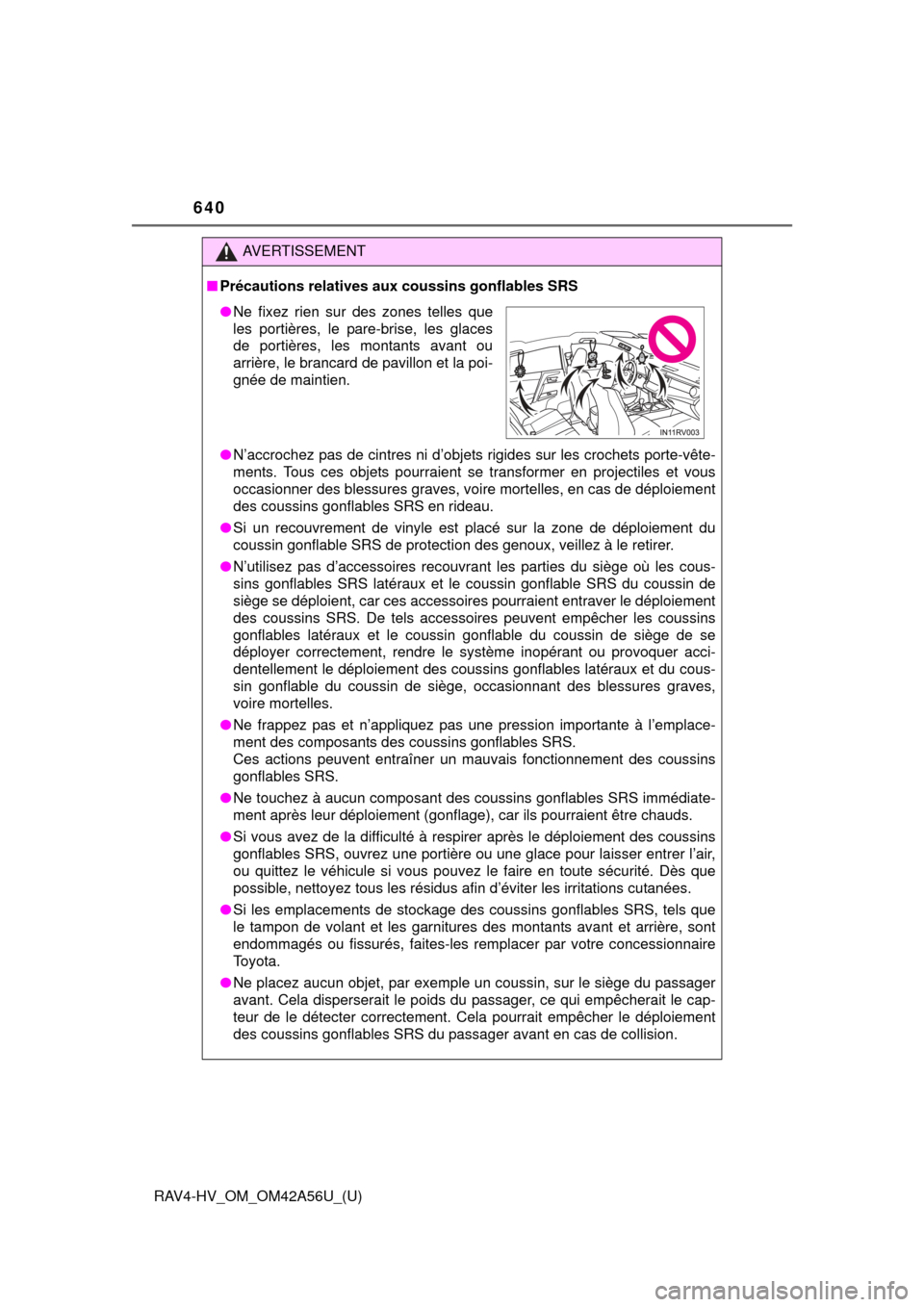
●Ne fixez rien sur des zones telles que
les portières, le pare-brise, les glaces
de portières, les montants avant ou
arrière, le brancard de pavillon et la poi-
gnée de maintien.