2016 TOYOTA PRIUS V park assist
[x] Cancel search: park assistPage 3 of 620

3
1
9 8
7
6 4 3
2
PRIUS v_OM_OM47B12U_(U)
10
5
3-4. Adjusting the steering
wheel and mirrors
Steering wheel .................. 147
Inside rear view mirror....... 149
Outside rear view
mirrors ............................. 151
3-5. Opening and closing the
windows
Power windows ................. 153
4-1. Before driving
Driving the vehicle ............. 158
Cargo and luggage............ 167
Vehicle load limits ............. 171
Trailer towing..................... 172
Dinghy towing.................... 173
4-2. Driving procedures
Power (ignition) switch ...... 174
EV drive mode................... 179
Hybrid transmission........... 181
Turn signal lever................ 187
Parking brake .................... 1884-3. Operating the lights
and wipers
Headlight switch ................ 189
Automatic High Beam ........ 194
Fog light switch .................. 200
Windshield wipers and
washer ............................. 202
Rear window wiper and
washer ............................. 205
4-4. Refueling
Opening the fuel tank
cap................................... 207
4-5. Using the driving support
systems
Cruise control .................... 210
Dynamic radar cruise
control.............................. 214
LDA (Lane Departure
Alert) ................................ 227
Rear view monitor
system ............................. 235
Driving mode select
switch .............................. 245
Driving assist systems ....... 246
PCS (Pre-Collision
System) ........................... 253
4-6. Driving tips
Hybrid vehicle driving
tips ................................... 260
Winter driving tips .............. 263
4Driving
Page 17 of 620

17Pictorial index
PRIUS v_OM_OM47B12U_(U)Windshield wipers . . . . . . . . . . . . . . . . . . . . . . . . . . . . . . . . . P. 202
Precautions against winter season . . . . . . . . . . . . . . . . . . . . . P. 263
Fuel filler door . . . . . . . . . . . . . . . . . . . . . . . . . . . . . . . . . . . . P. 207
Refueling method . . . . . . . . . . . . . . . . . . . . . . . . . . . . . . . . . . . P. 207
Fuel type/fuel tank capacity . . . . . . . . . . . . . . . . . . . . . . . . . . . P. 554
Tires . . . . . . . . . . . . . . . . . . . . . . . . . . . . . . . . . . . . . . . . . . P. 443
Tire size/inflation pressure . . . . . . . . . . . . . . . . . . . . . . . . . P. 559
Winter tires/tire chain . . . . . . . . . . . . . . . . . . . . . . . . . . . . . P. 263
Checking/rotation/tire pressure warning system . . . . . . . . . P. 443
Coping with flat tires . . . . . . . . . . . . . . . . . . . . . . . . . . . . . . P. 521
Hood . . . . . . . . . . . . . . . . . . . . . . . . . . . . . . . . . . . . . . . . . . . . P. 421
Opening . . . . . . . . . . . . . . . . . . . . . . . . . . . . . . . . . . . . . . . . . . P. 421
Engine compartment cover . . . . . . . . . . . . . . . . . . . . . . . . . . . P. 426
Engine oil . . . . . . . . . . . . . . . . . . . . . . . . . . . . . . . . . . . . . . . . . P. 555
Coping with overheat . . . . . . . . . . . . . . . . . . . . . . . . . . . . . . . . P. 543
Headlights/parking lights/daytime running lights
*/
side marker lights . . . . . . . . . . . . . . . . . . . . . . . . . . . . . . . . . P. 189
Fog lights
* . . . . . . . . . . . . . . . . . . . . . . . . . . . . . . . . . . . . . . . P. 200
Turn signal lights . . . . . . . . . . . . . . . . . . . . . . . . . . . . . . . . . . P. 187
Stop/tail lights
Hill-start assist control . . . . . . . . . . . . . . . . . . . . . . . . . . . . . . . P. 247
License plate lights . . . . . . . . . . . . . . . . . . . . . . . . . . . . . . . . P. 189
Back-up lights
Shifting the shift lever to R . . . . . . . . . . . . . . . . . . . . . . . . . . . . P. 181
4
5
6
7
Light bulbs of the exterior lights for driving
(Replacing method: P. 466, Watts: P. 560)
*: If equipped
8
9
10
11
12
13
Page 48 of 620

481-1. For safe use
PRIUS v_OM_OM47B12U_(U)
■If the SRS airbags deploy (inflate)
●Bruising and slight abrasions may result from contact with a deploying
(inflating) SRS airbag.
●A loud noise and white powder will be emitted.
●Parts of the airbag module (steering wheel hub, airbag cover and inflator) as
well as the front seats, parts of the front and rear pillars, and roof side rails,
may be hot for several minutes. The airbag itself may also be hot.
●The windshield may crack.
●For Safety Connect subscribers, if the SRS airbags deploy or in the event of
a severe rear-end collision, the system is designed to send an emergency
call to the response center, notifying them of the vehicle’s location (without
needing to push the “SOS” button) and an agent will attempt to speak with
the occupants to ascertain the level of emergency and assistance required.
If the occupants are unable to communicate, the agent automatically treats
the call as an emergency and helps to dispatch the necessary emergency
services. (P. 398)
■SRS airbag deployment conditions (SRS front airbags)
●The SRS front airbags will deploy in the event of an impact that exceeds the
set threshold level (the level of force corresponding to an approximately 12 -
18 mph [20 - 30 km/h] frontal collision with a fixed wall that does not move or
deform).
However, this threshold velocity will be considerably higher in the following
situations:
• If the vehicle strikes an object, such as a parked vehicle or sign pole,
which can move or deform on impact
• If the vehicle is involved in an underride collision, such as a collision in
which the front of the vehicle “underrides”, or goes under, the bed of a
truck
●Depending on the type of collision, it is possible that only the seat belt pre-
tensioners will activate.
●The SRS front airbags for the front passenger will not activate if there is no
passenger sitting in the front passenger seat. However, the SRS front air-
bags for the front passenger may deploy if luggage is put in the seat, even if
the seat is unoccupied. (P. 52)
■SRS airbag deployment conditions (SRS side and curtain shield airbags)
●The SRS side and curtain shield airbags will deploy in the event of an
impact that exceeds the set threshold level (the level of force corresponding
to the impact force produced by an approximately 3300 lb. [1500 kg] vehicle
colliding with the vehicle cabin from a direction perpendicular to the vehicle
orientation at an approximate speed of 12 - 18 mph [20 - 30 km/h]).
●The SRS side and curtain shield airbags may also deploy in the event of a
severe frontal collision.
Page 157 of 620

157
PRIUS v_OM_OM47B12U_(U)
4Driving
4-1. Before driving
Driving the vehicle ............. 158
Cargo and luggage ........... 167
Vehicle load limits ............. 171
Trailer towing..................... 172
Dinghy towing ................... 173
4-2. Driving procedures
Power (ignition) switch ...... 174
EV drive mode .................. 179
Hybrid transmission........... 181
Turn signal lever................ 187
Parking brake .................... 188
4-3. Operating the lights
and wipers
Headlight switch ................ 189
Automatic High Beam ....... 194
Fog light switch ................. 200
Windshield wipers and
washer ............................ 202
Rear window wiper and
washer ............................ 2054-4. Refueling
Opening the fuel tank
cap .................................. 207
4-5. Using the driving support
systems
Cruise control .................... 210
Dynamic radar cruise
control ............................. 214
LDA (Lane Departure
Alert) ............................... 227
Rear view monitor
system ............................ 235
Driving mode select
switch .............................. 245
Driving assist systems ...... 246
PCS (Pre-Collision
System)........................... 253
4-6. Driving tips
Hybrid vehicle driving
tips .................................. 260
Winter driving tips ............. 263
Page 159 of 620

PRIUS v_OM_OM47B12U_(U)
1594-1. Before driving
4
Driving
Firmly set the parking brake with the brake pedal depressed, and
then shift the shift position to D.
Release the brake pedal and gently depress the accelerator pedal.
Release the parking brake.
■When starting off on a uphill
The hill-start assist control will activate. (P. 247)
■For fuel-efficient driving
Keep in mind that hybrid vehicles are similar to conventional vehicles, and it
is necessary to refrain from activities such as sudden acceleration. (P. 260)
■Driving in the rain
●Drive carefully when it is raining, because visibility will be reduced, the win-
dows may become fogged-up, and the road will be slippery.
●Drive carefully when it starts to rain, because the road surface will be espe-
cially slippery.
●Refrain from high speeds when driving on an expressway in the rain,
because there may be a layer of water between the tires and the road sur-
face, preventing the steering and brakes from operating properly.
■Breaking in your new Toyota
To extend the life of the vehicle, observing the following precautions is recom-
mended:
●For the first 200 miles (300 km):
Avoid sudden stops.
●For the first 1000 miles (1600 km):
• Do not drive at extremely high speeds.
• Avoid sudden acceleration.
• Do not drive at a constant speed for extended periods.
■Drum-in-disc type parking brake system
Your vehicle has a drum-in-disc type parking brake system. This type of brake
system needs bedding-down of the brake shoes periodically or whenever the
parking brake shoes and/or drum are replaced. Have your Toyota dealer per-
form the bedding down operation.
■Operating your vehicle in a foreign country
Comply with the relevant vehicle registration laws and confirm the availability
of the correct fuel. (P. 554)
Starting off on a uphill
1
2
3
Page 164 of 620

164
PRIUS v_OM_OM47B12U_(U)
4-1. Before driving
WARNING
Observe the following precautions.
Failure to do so may result in death or serious injury.
■When taking a nap in the vehicle
Always turn the hybrid system off. Otherwise, if you accidentally move the
shift lever or depress the accelerator pedal, this could cause an accident or
fire due to hybrid system overheating. Additionally, if the vehicle is parked in
a poorly ventilated area, exhaust gases may collect and enter the vehicle,
leading to death or a serious health hazard.
■When braking
●When the brakes are wet, drive more cautiously.
Braking distance increases when the brakes are wet, and this may cause
one side of the vehicle to brake differently than the other side. Also, the
parking brake may not securely hold the vehicle.
●If the electronically controlled assist function does not operate, do not fol-
low other vehicles closely and avoid downhill or sharp turns that require
braking.
In this case, braking is still possible, but the brake pedal should be
depressed more firmly than usual. Also, the braking distance will increase.
Have your brakes fixed immediately.
●The brake system consists of 2 or more individual hydraulic systems; if
one of the systems fails, the other(s) will still operate. In this case, the
brake pedal should be depressed more firmly than usual and the braking
distance will increase. Have your brakes fixed immediately.
Page 235 of 620
235
PRIUS v_OM_OM47B12U_(U)
4-5. Using the driving support systems
4
Driving
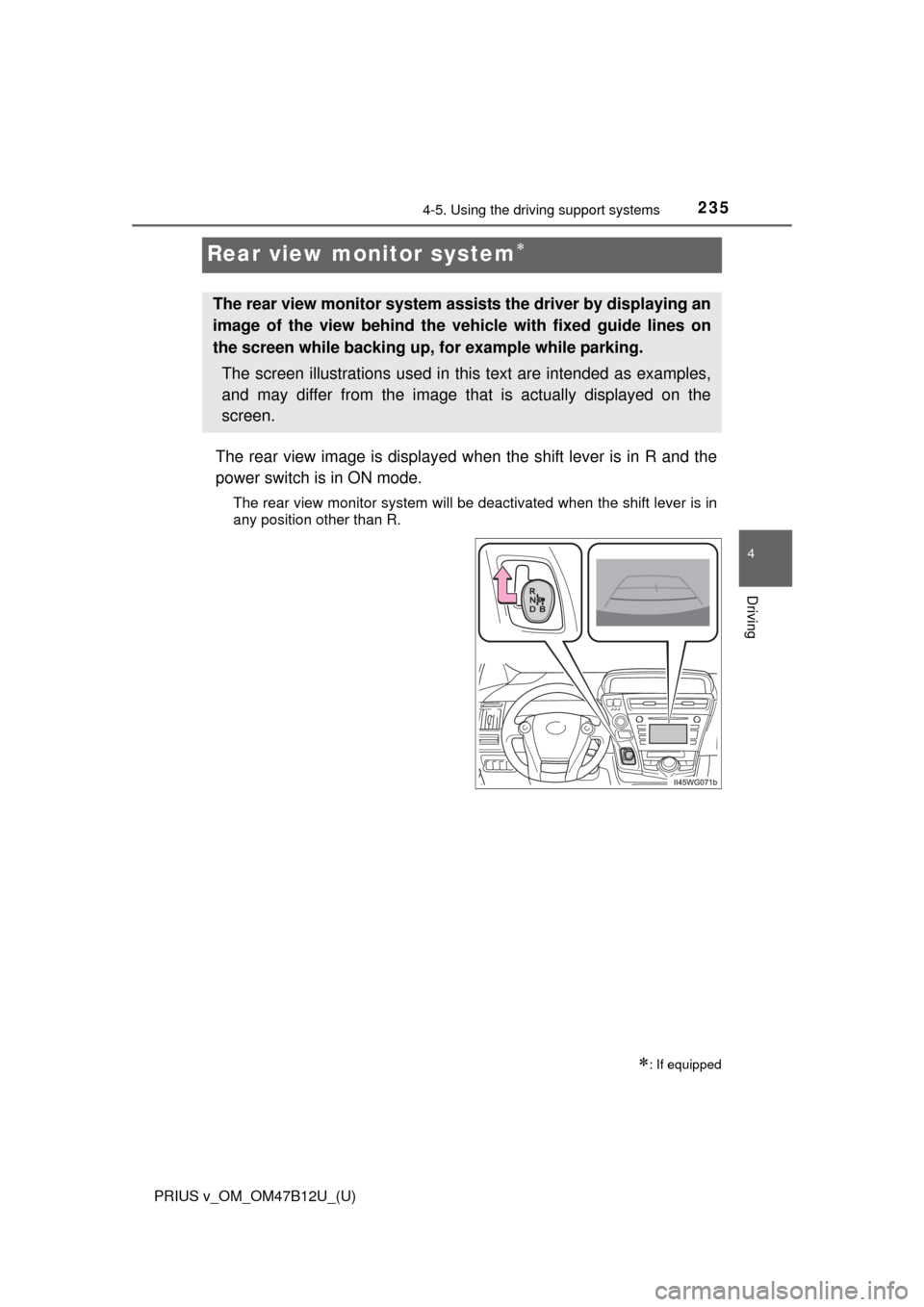
Rear view monitor system
The rear view image is displayed when the shift lever is in R and the
power switch is in ON mode.
The rear view monitor system will be deactivated when the shift lever is in
any position other than R.
: If equipped
The rear view monitor system assists the driver by displaying an
image of the view behind the vehicle with fixed guide lines on
the screen while backing up, for example while parking.
The screen illustrations used in this text are intended as examples,
and may differ from the image that is actually displayed on the
screen.
Page 243 of 620

PRIUS v_OM_OM47B12U_(U)
2434-5. Using the driving support systems
4
Driving
WARNING
■When using the rear view monitor system
The rear view monitor system is a supplemental device intended to assist
the driver when backing up. When backing up, be sure to visually check all
around the vehicle both directly and using the mirrors before proceeding.
Observe the following precautions to avoid an accident that could result in
death or serious injuries.
●Never depend on the rear view monitor system entirely when backing up.
The image and the position of the guide lines displayed on the screen may
differ from the actual state.
Use caution, just as you would when backing up any vehicle.
●Be sure to back up slowly, depressing the brake pedal to control vehicle
speed.
●The instructions given are only guide lines.
When and how much to turn the steering wheel will vary according to traf-
fic conditions, road surface conditions, vehicle condition, etc. when park-
ing. It is necessary to be fully aware of this before using the rear view
monitor system.
●When parking, be sure to check that the parking space will accommodate
your vehicle before maneuvering into it.
●Do not use the rear view monitor system in the following cases:
• On icy or slick road surfaces, or in snow
• When using tire chains or emergency tires
• When the back door is not closed completely
• On roads that are not flat or straight, such as curves or slopes
●In low temperatures, the screen may darken or the image may become
faint. The image could distort when the vehicle is moving, or you may
become unable to see the image on the screen. Be sure to visually check
all around the vehicle both directly and using the mirrors before proceed-
ing.
●If the tire sizes are changed, the position of the fixed guide lines displayed
on the screen may change.
●The camera uses a special lens. The distances between objects and
pedestrians that appear in the image displayed on the screen will differ
from the actual distances. (P. 238)